
How Solid-State Batteries Are Finally Moving From the Lab to the Road in 2026
After a decade of research, solid-state batteries are entering pilot production, promising electric vehicles with double the range, 15-minute charge times, and unprecedented safety.
By Factlen Editorial Team
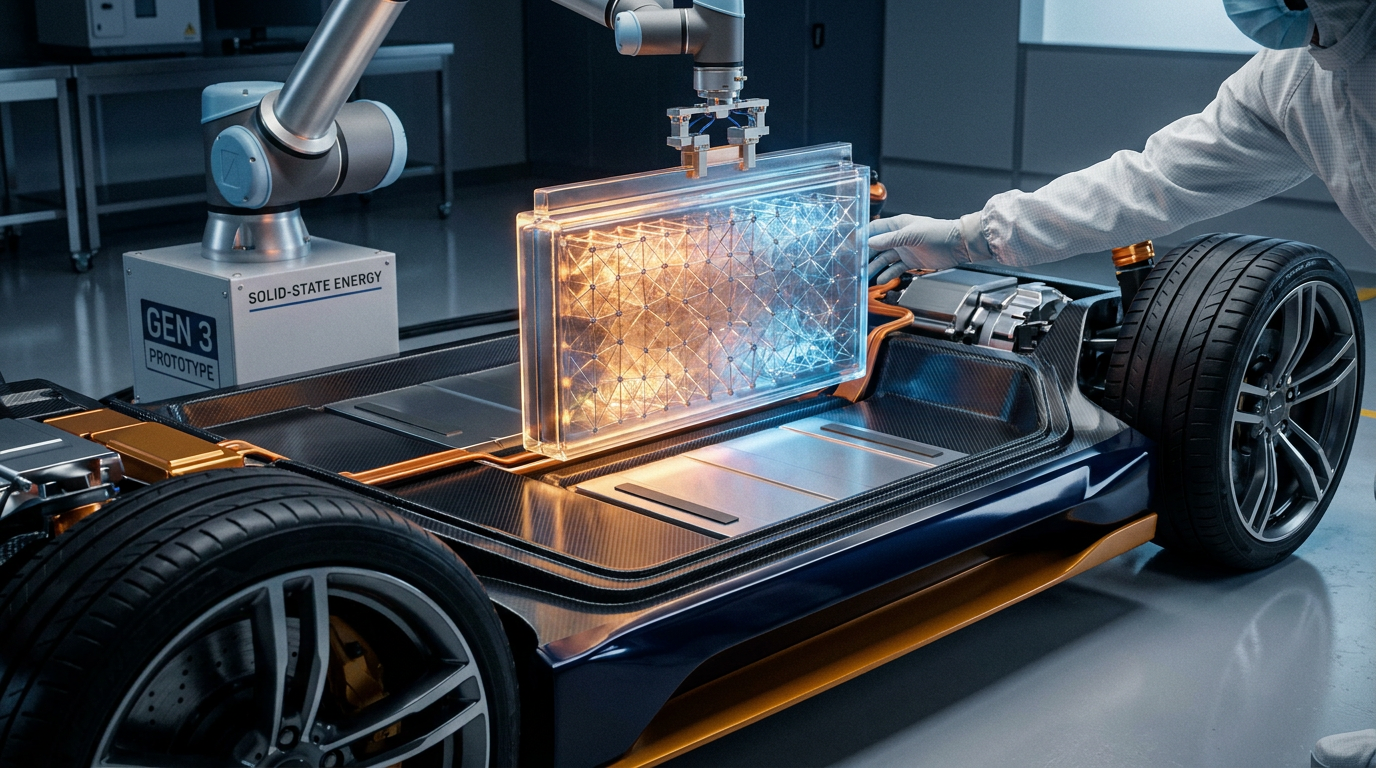
- Legacy Automakers
- Established car manufacturers prioritizing safety, scale, and supply chain control.
- Battery Innovators & Startups
- Agile tech companies pushing for rapid commercialization and licensing models.
- Industry Analysts
- Market observers focused on cost parity and the threat of existing technologies.
What's not represented
- · Raw material suppliers (lithium/sulfide mining)
Why this matters
Solid-state batteries represent the biggest leap in energy storage since the invention of the lithium-ion cell. By doubling energy density and eliminating fire risks, this technology will make electric vehicles lighter, safer, and capable of charging as quickly as filling a gas tank.
Key points
- Solid-state batteries replace flammable liquid electrolytes with stable solid materials, eliminating the risk of thermal runaway.
- The use of solid electrolytes allows for lithium-metal anodes, which can nearly double the energy density of current EV batteries.
- Major automakers like Toyota and Nissan are building pilot manufacturing plants, targeting mass-market vehicle launches between 2027 and 2029.
- Startups like QuantumScape and Factorial Energy are already producing test cells that demonstrate 15-minute fast charging and 700-plus mile ranges.
The "holy grail" of electric vehicles is finally descending from the ivory tower of laboratory research. For a decade, solid-state batteries have been the automotive industry's perpetual "five years away" technology. But in 2026, the narrative has definitively shifted from theoretical chemistry to industrial manufacturing.
The shift is visible on the roads and in the factories. In a landmark real-world test, a Mercedes-Benz EQS equipped with solid-state cells from US-based Factorial Energy recently drove 1,205 kilometers (about 748 miles) from Stuttgart, Germany, to Malmö, Sweden, on a single charge.[2][7]
Meanwhile, in Silicon Valley, battery developer QuantumScape inaugurated its "Eagle Line" pilot facility, moving its proprietary solid-state technology out of the research and development phase and into scalable production for automotive partners like Volkswagen.[3]
To understand why the industry is pouring billions into this transition, one must look inside the cell. Traditional lithium-ion batteries rely on a liquid electrolyte—a chemical soup that shuttles lithium ions back and forth between the cathode and the graphite anode during charging and discharging.

While effective, this liquid architecture has fundamental limits. The liquid electrolyte is highly flammable. If the battery is damaged, overcharged, or subjected to extreme heat, it can ignite, causing a chain reaction known as thermal runaway.
Furthermore, liquid batteries struggle to safely utilize lithium-metal anodes. When pure lithium metal is used in a liquid cell, it tends to form dendrites—microscopic, needle-like metallic whiskers that grow across the liquid gap, eventually piercing the separator and causing a catastrophic short circuit.
Solid-state batteries solve both problems by replacing the liquid soup with a solid, non-flammable material—typically a ceramic, sulfide, or polymer. This solid electrolyte acts as an impenetrable physical barrier that suppresses dendrite growth while still allowing lithium ions to pass through.
By unlocking the safe use of lithium-metal anodes, solid-state chemistry dramatically increases a battery's energy density. Today's best lithium-ion cells max out around 250 to 300 watt-hours per kilogram (Wh/kg). The first wave of commercial solid-state cells is hitting 400 to 500 Wh/kg.[1][6]
By unlocking the safe use of lithium-metal anodes, solid-state chemistry dramatically increases a battery's energy density.
For the consumer, this translates to a paradigm shift in the electric vehicle experience. A battery with double the energy density means automakers can either double a vehicle's range without adding weight, or cut the battery's size and weight in half while maintaining the current range.

Charging speeds are also poised for a revolution. Because solid electrolytes are vastly more stable under high electrical loads and extreme temperatures, they can accept electrons much faster. Companies like QuantumScape and China's Greater Bay Technology (GBT) are demonstrating cells that can charge from 10% to 80% in just 10 to 15 minutes, mimicking the cadence of a traditional gas station visit.[1][3]
The race to commercialize this technology has split the industry into distinct camps. On one side are the agile battery innovators and startups. GBT recently announced that its first "A-sample" all-solid-state cells have rolled off the production line, targeting mass production by the end of 2026.[1]
On the other side are the legacy automotive giants, who are taking a more measured, infrastructure-heavy approach. Toyota, which holds over a thousand patents in solid-state technology, has partnered with Japanese oil refiner Idemitsu Kosan to build a massive facility dedicated to manufacturing solid electrolytes.[4]
Toyota's roadmap targets 2027 or 2028 for its first solid-state passenger vehicles, promising ranges exceeding 620 miles. Nissan is following a similar timeline, currently constructing a pilot plant in Yokohama with the explicit goal of launching its first solid-state electric vehicle by fiscal year 2028.[4][5]
Despite the undeniable momentum, significant uncertainties remain. The primary hurdle is no longer basic chemistry, but the brutal economics of mass manufacturing. Building a solid-state battery requires entirely new production techniques, such as applying immense pressure during cell assembly to ensure perfect contact between the solid layers.

The success of these early pilot lines will depend entirely on whether manufacturing partners can successfully scale production yields while maintaining the pristine quality required for automotive safety.[7]
Cost parity is another major question mark. Current lithium-ion batteries, particularly Lithium Iron Phosphate (LFP) chemistries, have plummeted in price due to massive global scale. Early solid-state batteries will carry a hefty premium, restricting them to luxury sedans and high-end performance vehicles for the first few years.
Nevertheless, the long-term trajectory is clear. Market analysts at IDTechEx project the global solid-state battery market will reach $10 billion by 2036, driven by the electrification of transportation and the demand for safer energy storage.[6]
As 2026 unfolds, the industry is entering a critical transitional phase. We are moving from the era of press releases and laboratory breakthroughs into the era of pilot plants, B-samples, and real-world road tests.

The internal combustion engine dominated the 20th century because gasoline was an incredibly energy-dense, convenient fuel. Solid-state batteries represent the moment electricity finally matches—and in terms of efficiency, surpasses—that legacy, fundamentally rewriting the rules of global transportation.
How we got here
1970s–2010s
Foundational laboratory research establishes the theoretical viability of solid electrolytes.
April 2022
Nissan opens its first solid-state battery prototype production line.
Late 2023
Toyota publishes its roadmap targeting 1,000 km range solid-state EVs.
January 2025
Nissan opens an all-solid-state EV battery production line at its Yokohama plant.
August 2025
A Mercedes-Benz EQS drives 1,205 km on a single charge using Factorial solid-state cells.
February 2026
QuantumScape inaugurates its 'Eagle Line' pilot production facility in San Jose.
April 2026
Greater Bay Technology announces its first A-sample mass-producible cells have rolled off the line.
Viewpoints in depth
Battery Innovators & Startups
Agile tech companies pushing for rapid commercialization and licensing models.
Companies like QuantumScape, Factorial Energy, and Greater Bay Technology view solid-state batteries as an immediate software-like disruption to a hardware industry. Rather than building massive gigafactories themselves, many of these startups are adopting an 'ecosystem approach'—developing the core intellectual property, such as proprietary solid separators or dry-electrode manufacturing processes, and licensing them to existing automakers. They argue that the technology is ready now, pointing to successful A-sample and B-sample testing, and believe rapid iteration will solve remaining manufacturing bottlenecks faster than legacy automakers predict.
Legacy Automakers
Established car manufacturers prioritizing safety, scale, and supply chain control.
Giants like Toyota and Nissan are treating the solid-state transition as an infrastructure megaproject rather than a quick tech pivot. While they acknowledge the massive performance benefits, they emphasize the brutal realities of automotive-grade reliability and mass-manufacturing economics. Toyota's strategy involves deep vertical integration, partnering with oil and chemical companies like Idemitsu Kosan to build dedicated supply chains for solid electrolytes from scratch. They argue that launching a solid-state vehicle before the supply chain can support millions of units is a gimmick, which is why they are targeting 2027 to 2029 for true mass-market deployment.
Industry Analysts
Market observers focused on cost parity and the threat of existing technologies.
Financial and market analysts caution against irrational exuberance. While acknowledging the technical superiority of solid-state cells, groups like IDTechEx and BloombergNEF point out that traditional lithium-ion batteries—particularly cheap, durable Lithium Iron Phosphate (LFP) chemistries—are a rapidly moving target. As LFP prices continue to plummet, analysts argue that solid-state batteries will initially be confined to a high-margin luxury niche. They warn that the ultimate success of solid-state technology depends entirely on achieving manufacturing yields high enough to compete on price, not just on performance.
What we don't know
- Whether the complex, high-pressure manufacturing techniques required for solid-state cells can be scaled up to produce millions of units without high defect rates.
- Exactly how much of a price premium early solid-state vehicles will carry compared to traditional lithium-ion models.
- How long it will take for the specialized supply chain—particularly for solid electrolytes like sulfides—to meet global automotive demand.
Key terms
- Solid Electrolyte
- A non-flammable solid material (like ceramics, sulfides, or polymers) that conducts ions between the battery's anode and cathode, replacing flammable liquid solvents.
- Lithium-Metal Anode
- A battery anode made of pure lithium metal rather than graphite, which drastically increases energy density but requires a solid electrolyte to work safely.
- Dendrites
- Microscopic, needle-like metallic structures that can grow inside liquid batteries during charging, potentially causing short circuits and fires.
- Energy Density
- The amount of energy a battery can store relative to its weight, typically measured in watt-hours per kilogram (Wh/kg).
- Thermal Runaway
- A dangerous chain reaction inside a battery where excessive heat causes further heat generation, often leading to fires or explosions in liquid-based cells.
Frequently asked
Can I buy an EV with a solid-state battery today?
Not yet in mass-market passenger cars. While some pilot vehicles and electric motorcycles are using them in 2026, broad consumer availability from major automakers is targeted for 2027 to 2029.
Why are solid-state batteries considered safer?
They replace the flammable liquid electrolyte found in traditional lithium-ion batteries with a stable, non-flammable solid material, practically eliminating the risk of thermal runaway and battery fires.
Will solid-state batteries make electric vehicles cheaper?
Initially, no. Early solid-state batteries will be expensive and reserved for premium vehicles. However, as manufacturing scales up, their simplified design and reduced cooling requirements could eventually lower overall vehicle costs.
How fast can a solid-state battery charge?
Because solid electrolytes are highly stable under heavy electrical loads, early commercial cells are demonstrating the ability to charge from 10% to 80% in just 10 to 15 minutes.
Sources
Source coverage
7 outlets
3 viewpoints surfaced







[1]ElectrekBattery Innovators & Startups
Solid-state EV batteries are coming sooner than expected after another breakthrough
Read on Electrek →[2]EleportIndustry Analysts
New Battery Technologies 2026 Are Changing The Industry. Here's How
Read on Eleport →[3]InsideEVsBattery Innovators & Startups
QuantumScape Inaugurates Eagle Line for Solid-State Battery Pilot Production
Read on InsideEVs →[4]CarscoopsLegacy Automakers
Toyota's 620-Mile Solid-State EV Plan Just Got A Major Boost From Big Oil
Read on Carscoops →[5]Battery TechnologyLegacy Automakers
Nissan's Solid-State Plans Revealed: SSB-Powered EVs by 2029
Read on Battery Technology →[6]IDTechExIndustry Analysts
Solid-State Batteries 2026-2036: Technology, Forecasts, Players
Read on IDTechEx →[7]Intelligent LivingIndustry Analysts
Solid-State Battery Scoreboard 2025–2026: Who Shipped, Who Tested, and Who is Scaling Next
Read on Intelligent Living →
Every angle. Every day.
Get automotive stories with full source coverage and perspective breakdowns delivered to your inbox.