
The Cosmic Chicken-or-Egg Problem: JWST Reveals Black Holes Predate Galaxies
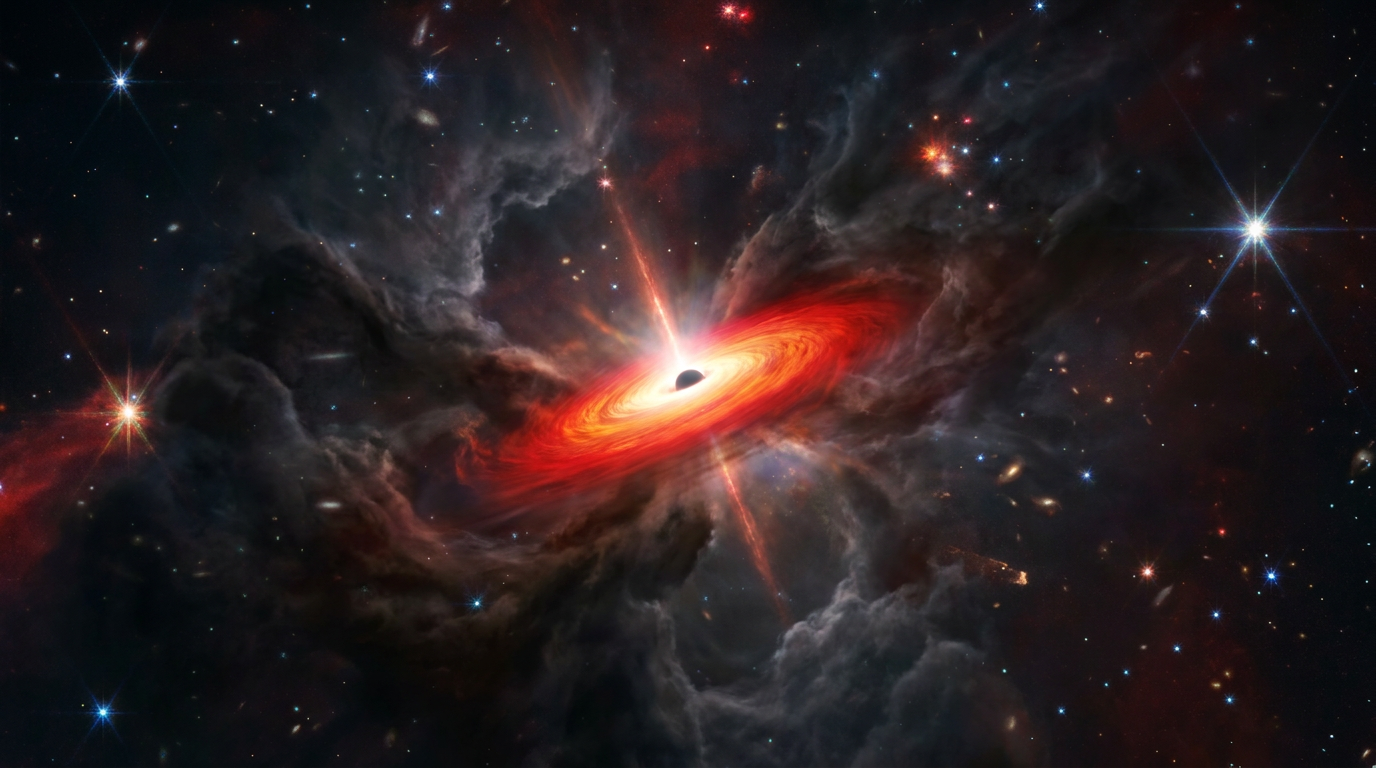
New observations from the James Webb Space Telescope are upending classical cosmology, revealing that supermassive black holes likely formed before the stars and galaxies that surround them.
By Factlen Editorial Team
- Direct Collapse Theorists
- Argue that giant clouds of pristine gas collapsed directly into massive black holes, bypassing the star phase.
- Primordial Black Hole Advocates
- Suggest that supermassive black hole seeds were forged in the extreme density of the universe's first fractions of a second.
- Stellar-Seed Traditionalists
- Maintain that while early black holes grew faster than expected, they still originated from the collapse of the first generation of massive stars.
What's not represented
- · Observational Astronomers studying local universe dynamics
- · Dark Matter Particle Physicists
Why this matters
Understanding the sequence of cosmic dawn rewrites our fundamental knowledge of how the universe evolved from a dark, formless soup of gas into the structured, star-filled cosmos we inhabit today. It proves that black holes are not just cosmic destroyers, but the foundational architects of the universe.
Key points
- The classical model assumed galaxies formed first, with black holes slowly growing from the remnants of dead stars.
- JWST observations reveal supermassive black holes existed in the first 50 million years of the universe.
- Early black holes acted as amplifiers, using powerful outflows to crush gas clouds and trigger rapid star formation.
- A newly discovered black hole from 700 million years post-Big Bang makes up two-thirds of its host object's mass.
- The pristine chemical environment around early black holes suggests they formed directly from collapsing gas clouds.
- The findings resolve a major cosmological debate, indicating that black holes formed before the galaxies that surround them.
For decades, astrophysicists have wrestled with a cosmic riddle that perfectly mirrors the oldest paradox in biology: What came first, the supermassive black hole or the galaxy that surrounds it? In the modern universe, these two distinct astronomical entities are inextricably linked. Nearly every large galaxy, including our own Milky Way, harbors a supermassive black hole at its gravitational core. Furthermore, the sizes of the two are tightly correlated; a larger galaxy almost always hosts a proportionally larger central black hole. This consistent relationship suggested a shared evolutionary history, but telescopes lacked the power to look far enough back in time to see how the partnership began, leaving scientists to debate whether the galaxy birthed the black hole, or the black hole anchored the galaxy.[6]
The classical "bottom-up" model of cosmology offered a straightforward, intuitive sequence of events that dominated astronomical textbooks for years. After the Big Bang, vast, diffuse clouds of primordial hydrogen and helium slowly cooled and condensed over millions of years. Eventually, these dense pockets of gas ignited, giving birth to the universe's very first generation of stars. These colossal early stars, unpolluted by heavier elements, burned through their nuclear fuel at a ferocious pace and died in spectacular supernova explosions, leaving behind dense, stellar-mass black holes. Over billions of years, these relatively small black holes sank to the gravitational centers of their nascent galaxies, merging with one another and gorging on surrounding gas to slowly balloon into the supermassive behemoths we observe today.[1][5][6]

But this classical narrative eventually faced a severe mathematical crisis. As ground-based observatories and the Hubble Space Telescope peered deeper into space—and thus further back in time—they began spotting fully formed supermassive black holes that existed less than a billion years after the Big Bang. There simply had not been enough time in the universe's short lifespan for stellar-mass black holes to feed and grow to such gargantuan proportions without violating the known laws of physics. The timeline was fundamentally broken, suggesting that either black holes could consume matter at impossible speeds, or they were somehow born massive from the very beginning.[1][2][5]
Enter the James Webb Space Telescope (JWST). Launched in late 2021, this ten-billion-dollar observatory was designed specifically to solve this exact mystery. With its unprecedented infrared sensitivity, JWST is capable of peering through the thick cosmic dust that obscures the "cosmic dawn"—the critical, fleeting epoch when the universe's first stars and galaxies flickered to life. By capturing light that has been traveling across the cosmos for over thirteen billion years, JWST allows astronomers to observe the early universe exactly as it was, providing the direct observational evidence needed to finally test the competing theories of black hole formation.[1][6]

In early 2024, an exhaustive analysis of JWST data led by researchers at Johns Hopkins University and Sorbonne University provided the first major shock to the classical model. The research team discovered that supermassive black holes were not only present during the first 50 million years of the universe, but they were actively driving the formation of stars. Rather than acting as mere cosmic vacuum cleaners that passively consumed matter after a galaxy had formed, these early black holes were acting as gigantic amplifiers, fundamentally shaping the architecture of the cosmos around them before the galaxies had fully matured.[3][6]
The mechanism behind this creative power lies in the violent, extreme physics of a feeding black hole. As immense volumes of gas spiral inward toward the event horizon, intense magnetic fields and friction heat the material to millions of degrees. This process blasts powerful, luminous outflows of radiation and high-energy particles back into deep space. Rather than simply dispersing the surrounding gas, these ferocious outflows acted like a cosmic snowplow. They violently crushed adjacent clouds of cold, diffuse hydrogen, triggering the rapid gravitational collapse necessary to ignite new baby stars at a dramatically accelerated rate.[3][5]
The mechanism behind this creative power lies in the violent, extreme physics of a feeding black hole.
Then, in May 2026, a landmark observation definitively cemented the paradigm shift. Astronomers using JWST focused their instruments on a "Little Red Dot" known as Abell2744-QSO1, a highly compact, luminous object existing just 700 million years after the Big Bang. Because the object is gravitationally lensed—magnified by a massive foreground cluster of galaxies—researchers were able to study its internal structure with unprecedented clarity. By analyzing the Keplerian motion of the gas swirling around the object, the team confirmed that QSO1 housed a supermassive black hole weighing roughly 50 million times the mass of our Sun.[1][2][4]

Crucially, the researchers discovered that this central black hole accounted for roughly two-thirds of the entire object's mass. This was a staggering revelation. In the modern universe, a central black hole typically makes up only about 0.1 percent of its host galaxy's total mass—a ratio of roughly one to one thousand. Finding an early-universe object where the black hole outweighed the surrounding stellar material by a factor of two to one completely inverted the expected relationship, proving that the black hole had grown to enormous proportions long before a substantial galaxy of stars could coalesce around it.[2][6]
Furthermore, the environment surrounding the QSO1 black hole was remarkably pristine. Spectroscopic analysis revealed that the swirling gas consisted almost entirely of primordial hydrogen and helium, with a metallicity less than 0.5 percent of our Sun. It completely lacked the heavier elements—like oxygen, carbon, and iron—that are forged in the nuclear furnaces of stars and scattered across space by supernovae. This pristine chemical signature, combined with the inverted mass ratio, provided the ultimate smoking gun: the supermassive black hole had formed in a stellar vacuum, predating the life and death of the stars that classical models assumed were necessary for its birth.[1][4]

If these early behemoths did not grow from the collapsed corpses of the first stars, how did they get so big so fast? Astrophysicists are now rapidly coalescing around the "heavy seed" theory, also known in cosmological circles as direct collapse. In the classical model, gas clouds fragment as they cool, forming hundreds of smaller individual stars. But in the unique, pristine conditions of the early universe, certain massive clouds of hydrogen may have been prevented from cooling and fragmenting by intense ultraviolet radiation from neighboring regions.[1][5]
Unable to fragment into smaller stars, these immense, pristine clouds of gas bypassed the star-formation phase entirely. Driven by the relentless gravitational pull of dense dark matter halos, the entire colossal cloud collapsed directly under its own immense weight. This violent, instantaneous collapse would form a massive black hole seed weighing anywhere from ten thousand to one hundred thousand solar masses, skipping the stellar lifecycle completely and providing a massive evolutionary head start.[5][6]

By beginning their lives already massive, these heavy seeds did not need to violate the physical limits of matter consumption to reach supermassive status within the first billion years of the universe. Instead, they quickly grew into the supermassive monsters observed by JWST, and their powerful outflows subsequently crushed surrounding gas to sculpt the galaxies that eventually formed around them. After decades of debate, the cosmic chicken-or-egg problem appears to finally have an answer: the black hole came first, serving as the foundational anchor upon which the modern universe was built.[1][2][6]
How we got here
13.8 billion years ago
The Big Bang occurs, initiating the rapid expansion and cooling of the universe.
First 50 million years
Early supermassive black holes begin driving powerful outflows, crushing gas clouds to accelerate star formation.
700 million years post-Big Bang
The supermassive black hole in Abell2744-QSO1 reaches 50 million solar masses, predating its host galaxy.
1990s–2010s
Astronomers establish that nearly all modern galaxies host supermassive black holes, sparking the chicken-or-egg debate.
2024–2026
JWST observations confirm that early black holes were 'born big' and actively shaped the formation of the first galaxies.
Viewpoints in depth
Direct Collapse Theorists
Argue that giant clouds of pristine gas collapsed directly into massive black holes, bypassing the star phase.
This camp points to the pristine, metal-poor gas surrounding early quasars like QSO1 as definitive proof that supermassive black holes formed before stars had a chance to live, die, and enrich the universe with heavier elements. They argue that intense ultraviolet radiation in the early universe prevented massive gas clouds from cooling and fragmenting into individual stars. Instead, these clouds collapsed entirely under their own gravity, creating "heavy seeds" of up to 100,000 solar masses that provided the necessary head start to explain the giant black holes observed by JWST.
Stellar-Seed Traditionalists
Maintain that while early black holes grew faster than expected, they still originated from the collapse of the first generation of massive stars.
While acknowledging the challenge posed by JWST's discoveries, this perspective argues that the first generation of stars (Population III stars) were vastly more massive than stars today. When these colossal stars died, they could have left behind black holes large enough to merge rapidly in the dense environment of the early universe. They suggest that periods of "super-Eddington accretion"—where a black hole temporarily consumes matter much faster than standard physical limits usually allow—could bridge the gap, explaining the rapid growth without needing to invoke the unproven physics of direct gas cloud collapse.
Primordial Black Hole Advocates
Suggest that supermassive black hole seeds were forged in the extreme density of the universe's first fractions of a second.
This camp looks beyond standard astrophysics and into the realm of quantum cosmology. They argue that neither stellar collapse nor direct gas collapse can fully explain the sheer scale of early supermassive black holes. Instead, they propose that microscopic density fluctuations in the immediate aftermath of the Big Bang caused pockets of spacetime to collapse into black holes before atoms even existed. These primordial black holes would have served as the ultimate foundational seeds, gathering dark matter and gas around them as the universe expanded, eventually blossoming into the galactic centers we see today.
What we don't know
- Whether the 'heavy seeds' formed from the direct collapse of gas clouds or from primordial quantum fluctuations immediately after the Big Bang.
- Exactly how the intense ultraviolet radiation required to prevent early gas clouds from fragmenting into stars was generated and sustained.
- If the inverted mass ratio seen in QSO1 is a universal rule for all early galaxies, or if it represents a unique evolutionary pathway.
Key terms
- Supermassive Black Hole
- A black hole millions to billions of times the mass of our Sun, typically found at the gravitational center of a large galaxy.
- Cosmic Dawn
- The period spanning roughly 50 million to 1 billion years after the Big Bang when the first stars, black holes, and galaxies formed.
- Keplerian Motion
- The predictable way gas or planets orbit a central massive object, which astronomers use to calculate the exact mass of the central body.
- Direct Collapse
- A theoretical mechanism where a massive cloud of gas collapses straight into a black hole without first fragmenting to form a star.
- Metallicity
- The proportion of an astronomical object's matter that is made up of chemical elements heavier than hydrogen and helium.
Frequently asked
What is the cosmic chicken-or-egg problem?
It is the long-standing astronomical debate over whether galaxies formed first and birthed supermassive black holes at their centers, or if black holes formed first and built galaxies around them.
How did the James Webb Space Telescope change our understanding?
JWST's infrared instruments allowed astronomers to see black holes in the very early universe that were already massive before their host galaxies had fully formed, flipping the classical timeline.
What is a 'Little Red Dot'?
It is a class of highly compact, distant objects discovered by JWST in the early universe, which astronomers now believe are powered by actively feeding supermassive black holes.
How can a black hole create stars?
As a black hole consumes gas, it ejects powerful magnetic and radiation outflows. These outflows act like a snowplow, crushing nearby cold gas clouds and triggering the gravitational collapse needed to form new stars.
Sources
Source coverage
6 outlets
3 viewpoints surfaced






[1]NASAPrimordial Black Hole Advocates
James Webb Space Telescope detects clear evidence that some supermassive black holes were enormous from the beginning
Read on NASA →[2]NatureDirect Collapse Theorists
A supermassive black hole in the early universe predating its host galaxy
Read on Nature →[3]The Astrophysical Journal LettersPrimordial Black Hole Advocates
Black holes as amplifiers of star formation in the early universe
Read on The Astrophysical Journal Letters →[4]Monthly Notices of the Royal Astronomical SocietyDirect Collapse Theorists
Kinematics of pristine gas around early supermassive black holes
Read on Monthly Notices of the Royal Astronomical Society →[5]arXivStellar-Seed Traditionalists
Direct collapse models for supermassive black hole seeds in the JWST era
Read on arXiv →[6]Factlen Editorial TeamDirect Collapse Theorists
Synthesis by Factlen editorial team
Read on Factlen Editorial Team →

Every angle. Every day.
Get science stories with full source coverage and perspective breakdowns delivered to your inbox.