
How Scientists Are Using Underwater Soundscapes to Bring Dead Coral Reefs Back to Life
Marine biologists have discovered that playing the recorded sounds of healthy, bustling coral reefs through underwater speakers can attract drifting coral larvae to settle on degraded reefs at significantly higher rates.
By Factlen Editorial Team
- Marine Bioacousticians
- Scientists focused on how marine life uses sound, advocating for acoustic enrichment as a primary tool to trigger ecosystem recovery.
- Restoration Technologists
- Engineers and ecologists prioritizing scalable, low-cost interventions like underwater speakers and AI monitoring to rebuild reefs.
- Holistic Conservationists
- Environmental advocates who caution that acoustic tools must be paired with global climate action and local water quality improvements to ensure long-term survival.
What's not represented
- · Local coastal communities whose fishing livelihoods depend on the success of these restoration efforts.
- · Policy makers who must decide how to allocate limited conservation funding between high-tech interventions and basic emissions reductions.
Why this matters
Coral reefs support a quarter of all marine species and the livelihoods of a billion people, but traditional restoration methods are slow and labor-intensive. By tapping into the natural sensory behaviors of marine life, acoustic enrichment provides a low-cost, rapidly deployable method to accelerate ecosystem recovery on a global scale.
Key points
- Marine biologists are using 'acoustic enrichment' to broadcast the sounds of healthy reefs into degraded underwater habitats.
- Free-swimming coral larvae use microscopic hairs called cilia to detect these vibrations and navigate toward the source.
- Field studies show that playing healthy reef sounds can increase coral larval settlement rates by up to seven times.
- The technique also attracts juvenile herbivorous fish, which clean the reef and create a positive feedback loop for ecosystem recovery.
- While highly scalable, scientists warn that acoustic enrichment must be paired with climate action to ensure the long-term survival of the corals.
The ocean is rarely quiet. A thriving coral reef is a bustling, noisy metropolis, echoing with the rhythmic crackling of snapping shrimp, the low grunts of territorial damselfish, and the scraping of parrotfish beaks against rock. This underwater symphony is more than just background noise; it is the vital pulse of a healthy ecosystem.[1][2]
But when a reef is devastated by bleaching, disease, or destructive fishing, it falls silent. The vibrant community of soniferous—or sound-producing—animals abandons the skeletal remains of the coral. For decades, scientists noted this eerie quiet as a symptom of ecological collapse. Now, they are realizing that the silence itself is a barrier to the reef's recovery.[4][5]
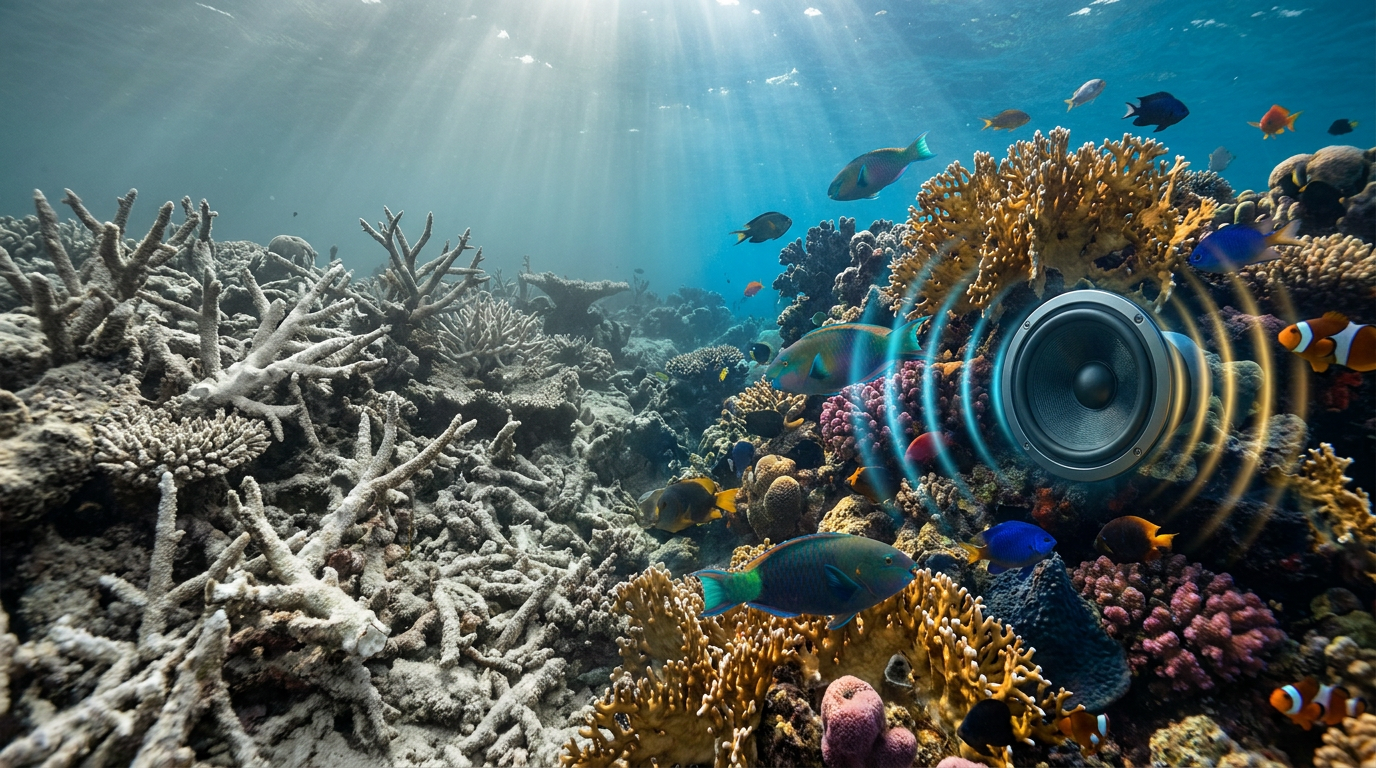
Enter "acoustic enrichment," an emerging conservation technique that flips the script on reef degradation. By lowering waterproof speakers into the ocean and broadcasting the pre-recorded soundscapes of healthy reefs, marine biologists have discovered they can trick the ocean's youngest inhabitants into returning to barren areas.[3][7]
To understand why this works, one must look at the life cycle of a coral. While adult corals are famously stationary, anchoring themselves to the seabed for centuries, they begin their lives as tiny, free-swimming larvae. These microscopic organisms drift in the open ocean currents, searching for a suitable place to settle, attach, and begin building their calcium carbonate skeletons.[1][6]

For a long time, scientists believed these larvae relied entirely on chemical cues or light gradients to find a home. Corals, after all, do not have ears. However, recent discoveries have revealed that coral larvae are covered in microscopic, hair-like structures called cilia. These cilia act as highly sensitive biological antennas, capable of detecting the subtle acoustic vibrations traveling through the water column.[2][3]
A landmark series of experiments conducted by the Woods Hole Oceanographic Institution (WHOI) in the U.S. Virgin Islands put this sensory ability to the test. Researchers set up underwater speaker systems on heavily degraded reef patches and played the bustling audio of a thriving marine environment. They then monitored the settlement rates of local coral species, including the mustard hill coral and the golfball coral.[1][5]
The results were staggering. In areas where the healthy reef sounds were broadcast, coral larvae settled at an average rate 1.7 times higher than in silent control areas. In some optimal patches, the settlement rate spiked to seven times the normal baseline. The larvae were actively swimming toward the acoustic illusion of a healthy neighborhood.[2][7]

The researchers also discovered that timing is everything. For species like the golfball coral, the larvae were highly responsive to the acoustic cues during their first 36 hours in the water column. After that critical window closed, the sound had little to no effect on their settlement behavior, highlighting the precise evolutionary tuning of their sensory systems.[1][3]
For species like the golfball coral, the larvae were highly responsive to the acoustic cues during their first 36 hours in the water column.
The benefits of acoustic enrichment extend beyond the corals themselves. Studies off the coast of Australia's Great Barrier Reef have shown that playing healthy reef sounds also attracts juvenile fish. Within a 40-day acoustic treatment period, researchers observed a 50 percent increase in juvenile damselfish and a surge in diverse trophic guilds.[2][5]
This influx of fish creates a powerful positive feedback loop. Herbivorous fish graze on the macroalgae that would otherwise smother the newly settled coral polyps. Their presence cleans the substrate, making it even more inviting for the next wave of drifting larvae. Slowly, the acoustic illusion becomes a biological reality.[2][6]
What makes acoustic enrichment particularly exciting for conservationists is its scalability. Traditional coral restoration—which involves manually growing fragments in underwater nurseries and outplanting them by hand—is incredibly labor-intensive and expensive. Replicating the chemical or microbial signature of a healthy reef across acres of ocean is practically impossible.[3][4]

In contrast, deploying an acoustic playback system is relatively straightforward. Initiatives like the Reef Acoustic Playback System (RAPS), funded by the Coral Research & Development Accelerator Platform (CORDAP), are developing low-cost, solar-powered buoys and submerged speakers that can operate autonomously for months.[8]
The technology is also becoming a two-way street. Conservationists are increasingly pairing underwater speakers with passive acoustic monitoring (PAM) devices. By using machine learning algorithms to analyze the audio recorded at restoration sites, scientists can measure the return of specific fish calls and shrimp snaps, providing a real-time, automated metric of ecosystem recovery.[8][9]
Despite the immense promise of bioacoustics, researchers are quick to emphasize that sound alone cannot save the world's reefs. Acoustic enrichment is a powerful lure, but it does not alter the physical chemistry of the water. If larvae are coaxed into settling on a reef where the water remains dangerously hot or heavily polluted, they will simply die after attaching.[5][7]
"You don't want to encourage them to settle where they will die," notes Nadège Aoki, a WHOI researcher who led the Virgin Islands study. Acoustic enrichment must be integrated into a holistic restoration strategy that includes strict protections against overfishing, the mitigation of agricultural runoff, and, most importantly, global reductions in greenhouse gas emissions.[1][5]

There are also physical limitations to the technique. The strong, unpredictable currents of the open ocean can easily overpower the swimming capabilities of microscopic coral larvae. In some highly turbulent environments, the larvae may be swept past the acoustic beacons before they have a chance to navigate toward the source.[5]
Nevertheless, in a world that has lost roughly 50 percent of its coral cover since the 1950s, any scalable tool that accelerates natural recovery is a vital asset. Acoustic enrichment is moving rapidly from experimental trials to standard operational practice in marine nurseries and protected areas across the Caribbean and the Indo-Pacific.[2][5]
How we got here
Pre-2010s
Scientists document the complex 'soundscapes' of healthy coral reefs, noting that degraded reefs are eerily silent.
2019
Researchers in Australia demonstrate that playing healthy reef sounds can increase the population of juvenile fish on degraded coral rubble by 50 percent.
2022
The Woods Hole Oceanographic Institution conducts field experiments in the U.S. Virgin Islands, broadcasting sounds to drifting coral larvae.
March 2024
WHOI publishes landmark findings showing that acoustic enrichment increases coral larval settlement rates by up to seven times.
October 2024
Further studies confirm that multiple species of coral respond to acoustic cues, proving the technique is widely applicable.
2025–2026
Conservation groups begin integrating AI-driven bioacoustic monitoring with acoustic playback systems for large-scale reef restoration.
Viewpoints in depth
Marine Bioacousticians
Scientists focused on the sensory ecology of marine life and the evolutionary role of sound.
Researchers in this camp emphasize that the ocean is fundamentally an acoustic environment. Because light attenuates quickly in seawater and chemical cues are easily scattered by currents, sound is the most reliable long-distance navigational beacon for marine life. Bioacousticians argue that understanding how larvae use their cilia to 'hear' vibrations is not just a neat biological trick, but a critical evolutionary mechanism that must be leveraged if we are to successfully guide ecosystem recovery at scale.
Restoration Technologists
Engineers and ecologists prioritizing scalable, low-cost interventions to rebuild reefs.
For technologists, the appeal of acoustic enrichment lies in its scalability. Traditional outplanting requires armies of scuba divers and years of nursery growth, making it prohibitively expensive for vast stretches of degraded ocean. By contrast, solar-powered acoustic buoys and machine-learning-driven monitoring systems can be deployed rapidly and left to operate autonomously. This camp views bioacoustics as a force multiplier that can automate the hardest parts of habitat restoration.
Holistic Conservationists
Advocates who caution that acoustic tools must be paired with global climate action.
While celebrating the ingenuity of acoustic enrichment, holistic conservationists warn against viewing it as a silver bullet. They point out that luring coral larvae to a reef is only half the battle; if the local water temperatures continue to break historical records or if agricultural runoff remains unchecked, the newly settled corals will simply bleach and die. This perspective insists that technological interventions must remain secondary to the primary goal of rapidly decarbonizing the global economy.
What we don't know
- It remains unclear exactly how many different coral species possess the ability to navigate using sound.
- Scientists are still studying whether corals that settle in response to artificial acoustic cues have the same long-term survival rates as those that settle naturally.
- The maximum effective range of underwater speakers in different ocean current conditions is still being mapped.
Key terms
- Acoustic Enrichment
- A conservation technique that involves playing the recorded sounds of a healthy ecosystem to attract wildlife and encourage settlement in a degraded area.
- Bioacoustics
- The scientific study of sound production, dispersion, and reception in animals, increasingly used to monitor ecosystem health.
- Larval Settlement
- The process by which free-swimming coral larvae drop out of the water column, attach themselves to a hard surface, and begin to grow into adult corals.
- Cilia
- Microscopic, hair-like structures on the outside of coral larvae that vibrate in response to underwater sound waves, allowing them to navigate.
- Trophic Guilds
- Groups of species that exploit the same kinds of resources in a similar way, such as herbivorous fish that all graze on reef algae.
Frequently asked
How do coral larvae hear without ears?
Coral larvae are covered in microscopic, hair-like structures called cilia. These cilia act as biological antennas that can detect subtle acoustic vibrations and pressure changes in the water, allowing the larvae to sense the direction of a noisy, healthy reef.
What does a healthy coral reef sound like?
A thriving reef sounds like a bustling underwater city. It is characterized by the continuous crackling of snapping shrimp, combined with the low grunts, croaks, and purrs of various fish species communicating, feeding, and defending territory.
Can acoustic enrichment replace traditional coral planting?
No. Scientists view acoustic enrichment as a complementary tool. While it helps attract natural larvae to a site, traditional outplanting is still necessary to introduce mature, climate-resilient coral fragments to areas that have been completely wiped out.
Does playing reef sounds attract predators?
While it can attract a wide variety of marine life, studies have shown that acoustic enrichment primarily brings in juvenile fish and herbivores. These herbivores actually help the reef by eating algae that would otherwise smother young corals.
Sources
Source coverage
9 outlets
3 viewpoints surfaced









[1]Woods Hole Oceanographic InstitutionMarine Bioacousticians
WHOI researchers reinforce acoustic enhancement as a reef restoration method
Read on Woods Hole Oceanographic Institution →[2]Earth.OrgHolistic Conservationists
Can Soundscapes Save Coral Reefs?
Read on Earth.Org →[3]Popular ScienceRestoration Technologists
Healthy reef soundscapes can help degraded coral reefs grow
Read on Popular Science →[4]EcoWatchRestoration Technologists
Playing Healthy Reef Sounds Underwater Could Help Save Corals, Study Finds
Read on EcoWatch →[5]Atmos MagazineHolistic Conservationists
Can Nature's Own Sounds Help Heal the Earth?
Read on Atmos Magazine →[6]ScienceDailyMarine Bioacousticians
Sonic youth: Healthy reef sounds increase coral settlement
Read on ScienceDaily →[7]Royal Society Open ScienceMarine Bioacousticians
Soundscape enrichment increases larval settlement rates for a brooding coral
Read on Royal Society Open Science →[8]CORDAPRestoration Technologists
Sound on: using acoustic enrichment to boost coral larval settlement
Read on CORDAP →[9]AIP PublishingRestoration Technologists
Bioacoustics and machine learning as key tools in coral reef restoration
Read on AIP Publishing →
Every angle. Every day.
Get environment stories with full source coverage and perspective breakdowns delivered to your inbox.