
How Logical Qubits Are Solving Quantum Computing's Biggest Problem
Recent breakthroughs in quantum error correction have successfully suppressed hardware noise, shifting quantum computing from a theoretical physics challenge to a scalable engineering discipline.
By Factlen Editorial Team
- Hardware Manufacturers
- Companies building the physical machines view error correction as the final engineering hurdle before massive scale.
- Quantum Theorists
- Academic and independent researchers emphasize the mathematical milestones of fault tolerance.
- Commercial Adopters
- Industries and security agencies are preparing for the practical impacts of reliable quantum machines.
What's not represented
- · Classical supercomputing manufacturers
- · Cryptographers managing the post-quantum transition
Why this matters
For decades, quantum computers were fragile laboratory experiments that crashed before finishing complex calculations. The successful creation of 'logical qubits' proves that these machines can correct their own errors in real time, clearing the final scientific hurdle to building supercomputers that will revolutionize drug discovery, battery design, and global cybersecurity.
Key points
- Quantum computing has historically been limited by the extreme fragility of physical qubits, which lose data to environmental noise.
- Engineers have successfully created 'logical qubits' by grouping dozens of physical qubits together to detect and correct errors in real time.
- A landmark demonstration by Microsoft and Quantinuum achieved an 800-fold reduction in error rates, running 14,000 consecutive circuits flawlessly.
- Multiple hardware architectures have now crossed the 'below-threshold' milestone, proving that adding more qubits exponentially suppresses errors.
- The industry is now focused on scaling these systems to the hundreds of logical qubits required for breakthroughs in chemistry and materials science.
For decades, the fundamental promise of quantum computing has been bottlenecked by a single, infuriating physics problem: noise. Quantum bits, or qubits, are extraordinarily fragile, losing their information at the slightest fluctuation in temperature or electromagnetic interference.[7]
This fragility meant that as engineers added more physical qubits to a processor to solve harder problems, the error rate multiplied until the calculation dissolved into static. The industry was trapped in what researchers call the noisy intermediate-scale quantum, or NISQ, era, where machines were too error-prone to run deep algorithms.[3][7]
But a series of recent milestones has fundamentally shifted the trajectory of the field, moving quantum computing from a theoretical physics experiment into a scalable engineering discipline. The key to this transition is a concept known as quantum error correction, and specifically the creation of "logical qubits."[5][7]
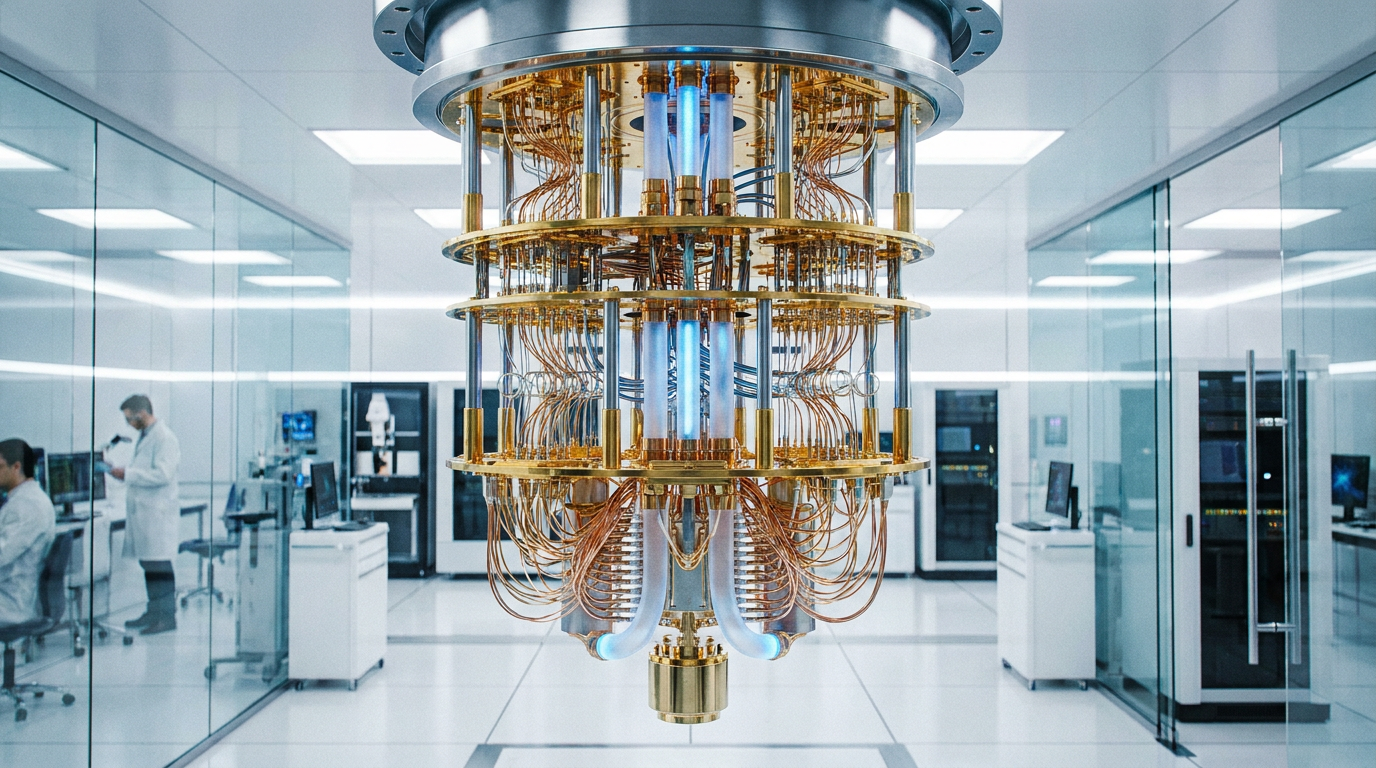
A physical qubit is the actual hardware component—a superconducting circuit, a trapped ion, or a neutral atom—that holds a quantum state. A logical qubit, by contrast, is a virtual construct. It is created by grouping dozens or hundreds of physical qubits together using specialized software to act as a single, highly reliable data point.[4]

In a landmark demonstration, Microsoft and hardware manufacturer Quantinuum successfully applied an innovative qubit-virtualization system to an ion-trap quantum processor. By orchestrating 30 physical qubits, they created four highly reliable logical qubits.[1][2]
The results of that collaboration were unprecedented. The joint team ran 14,000 independent instances of a quantum circuit without a single uncorrected error, proving that software could actively manage hardware imperfections.[1][2]
This represented an 800-fold improvement in the logical error rate compared to the underlying physical error rate of the hardware. When entangled, these logical qubits exhibited a circuit error rate of just 0.00001, meaning they would fail only once in every 100,000 runs.[1][2]

The mechanism behind this reliability relies on a technique called active syndrome extraction. During a computation, the control system continuously measures a subset of the physical qubits to detect errors—without observing, and thereby destroying, the actual quantum information being processed.[2][3]
The mechanism behind this reliability relies on a technique called active syndrome extraction.
If the system detects an anomaly, it applies a real-time correction, such as a bit-flip or a phase-flip, to the affected qubit. This allows the logical qubit to remain coherent and accurate over much deeper and more complex circuits than the raw hardware could ever support on its own.[3]
The Microsoft and Quantinuum achievement is not an isolated victory. Across the industry, different hardware architectures are converging on the same critical threshold. Google’s Willow processor, utilizing superconducting chips, recently demonstrated that logical error rates decrease exponentially as the surface-code lattice size increases.[4][5]
This phenomenon—where adding more physical qubits actually suppresses errors rather than amplifying them—is known as operating "below the threshold." Crossing this mathematical line is the holy grail of fault-tolerant quantum computing, proving that large-scale machines are theoretically and practically possible.[5]
Meanwhile, companies like QuEra and Atom Computing are proving that neutral-atom systems can also achieve fault-tolerant operations at practical scales. Neutral atoms, which are trapped and manipulated by lasers, offer different trade-offs in speed and connectivity compared to trapped ions or superconducting circuits.[4][5]

The architectural debate is now less about whether error correction works, and more about which hardware path offers the shortest route to commercial utility. Superconducting gates operate hundreds of times faster than trapped-ion gates, but trapped ions currently boast higher baseline fidelities, meaning they require fewer physical qubits to create a single logical one.[7]
For commercial developers, these breakthroughs mean that hybrid quantum-classical cloud services can begin tackling mid-size optimization and simulation problems that were previously out of reach. By extending the lifetime of logical qubits, researchers can run deeper algorithms for materials chemistry, logistics, and financial modeling.[6]
However, the timeline for true "quantum advantage"—the point where a quantum computer solves a commercially valuable problem that a classical supercomputer cannot—remains tethered to scale. Current systems boast a handful of logical qubits, but simulating complex molecules for battery design or pharmaceutical catalysts will require hundreds.[6][7]
According to published roadmaps from multiple hardware groups, reaching the hundreds-of-logical-qubits milestone is targeted for the 2028 to 2030 window. Until then, the focus remains on refining the control layers, improving physical fidelities, and proving that the exponential error suppression holds as systems grow larger.[7]

The pressure to scale is also coming from the cybersecurity sector. Government agencies, including the National Institute of Standards and Technology, are pushing for a transition to post-quantum cryptography, anticipating the day when fault-tolerant machines might break current encryption standards.[4]
Ultimately, the recent breakthroughs in logical qubits mark the end of the beginning for quantum computing. The field has proven that the blur of quantum noise can be systematically corrected, leaving behind the sharp, reliable calculations needed to power the next generation of computational science.[7]
How we got here
2019
Google's Sycamore processor demonstrates early quantum supremacy, though still limited by high error rates.
2021–2023
Researchers begin demonstrating the first instances where a logical qubit outperforms a single physical qubit.
April 2024
Microsoft and Quantinuum announce the creation of four highly reliable logical qubits with an 800-fold error reduction.
Late 2024–2025
Multiple hardware architectures, including superconducting and neutral-atom systems, prove exponential error suppression at scale.
2026
The industry shifts focus from proving the physics of error correction to engineering systems with hundreds of logical qubits.
Viewpoints in depth
Hardware Manufacturers
Companies building the physical machines view error correction as the final engineering hurdle before massive scale.
For groups like Microsoft and Quantinuum, the focus is entirely on fidelity and architecture. By proving that 30 physical qubits can reliably form four logical qubits, they argue that the fundamental physics risks have been retired. Their roadmaps now prioritize scaling the number of physical qubits while maintaining these low error rates, believing that raw engineering and manufacturing prowess will deliver hundreds of logical qubits by the end of the decade.
Quantum Theorists
Academic and independent researchers emphasize the mathematical milestones of fault tolerance.
Theorists are less concerned with near-term commercial applications and more focused on the validation of "below-threshold" scaling. For decades, it was theoretically possible that adding more qubits would simply introduce too much noise to ever correct. The recent demonstrations that error rates decrease exponentially as surface-code lattices grow is viewed as the most profound scientific achievement in the field's history, proving that the universe allows for fault-tolerant quantum computation.
Commercial Adopters
Industries and security agencies are preparing for the practical impacts of reliable quantum machines.
For finance, logistics, and cybersecurity sectors, the timeline is everything. They view these breakthroughs as a starting gun. While true quantum advantage for materials science may be years away, the ability to run deeper circuits on cloud platforms allows developers to test optimization algorithms today. Simultaneously, security agencies view the accelerated hardware timelines as a mandate to finalize and deploy post-quantum encryption before these machines scale enough to break current cryptographic standards.
What we don't know
- Which hardware architecture—superconducting, trapped-ion, or neutral-atom—will ultimately scale most cost-effectively to thousands of logical qubits.
- Whether the exponential error suppression observed in 100-qubit systems will hold perfectly as processors scale to millions of physical qubits.
- The exact year when a fault-tolerant quantum computer will achieve a definitive, commercially valuable 'quantum advantage' over classical supercomputers.
Key terms
- Qubit
- The basic unit of quantum information, capable of existing in multiple states simultaneously, unlike classical bits which are strictly 0 or 1.
- Fault Tolerance
- The ability of a computer system to continue operating accurately even when individual components fail or produce errors.
- Active Syndrome Extraction
- A technique where a quantum system continuously measures specific qubits to detect and correct errors without destroying the underlying calculation.
- NISQ Era
- Noisy Intermediate-Scale Quantum era; the period of quantum computing characterized by processors that are too noisy to run complex, deep algorithms without errors.
Frequently asked
What is a logical qubit?
A logical qubit is a highly reliable, virtual quantum bit created by grouping many fragile physical qubits together using error-correction software.
Why is quantum noise a problem?
Quantum states are extremely delicate and can be disrupted by tiny changes in temperature or electromagnetic fields, causing calculations to fail before they finish.
What does 'below the threshold' mean?
It is a mathematical tipping point where adding more physical qubits to a system actually decreases the overall error rate exponentially, rather than increasing it.
When will quantum computers be commercially useful?
While small-scale hybrid systems are available now, experts project that machines with enough logical qubits to solve major chemistry and materials problems will arrive between 2028 and 2030.
Sources
Source coverage
7 outlets
3 viewpoints surfaced







[1]MicrosoftHardware Manufacturers
Advancing science: Microsoft and Quantinuum demonstrate the most reliable logical qubits on record
Read on Microsoft →[2]QuantinuumHardware Manufacturers
Quantinuum and Microsoft achieve breakthrough in making fault tolerant quantum computing a reality
Read on Quantinuum →[3]Post-QuantumCommercial Adopters
Microsoft and Quantinuum announce major quantum computing breakthrough
Read on Post-Quantum →[4]Red Stag LabsQuantum Theorists
The Emergence of Logical Qubits and Quantum Breakthroughs
Read on Red Stag Labs →[5]BQP SimQuantum Theorists
What is the biggest quantum computing breakthrough in 2026?
Read on BQP Sim →[6]Quantum AI InsidersCommercial Adopters
Practical advance in quantum error correction meaningfully extends logical qubit lifetimes
Read on Quantum AI Insiders →[7]Factlen Editorial TeamQuantum Theorists
Synthesis by Factlen editorial team
Read on Factlen Editorial Team →

Every angle. Every day.
Get technology stories with full source coverage and perspective breakdowns delivered to your inbox.