
2026 Rivian R2 vs. Tesla Model Y: The Ultimate Mid-Size EV Comparison
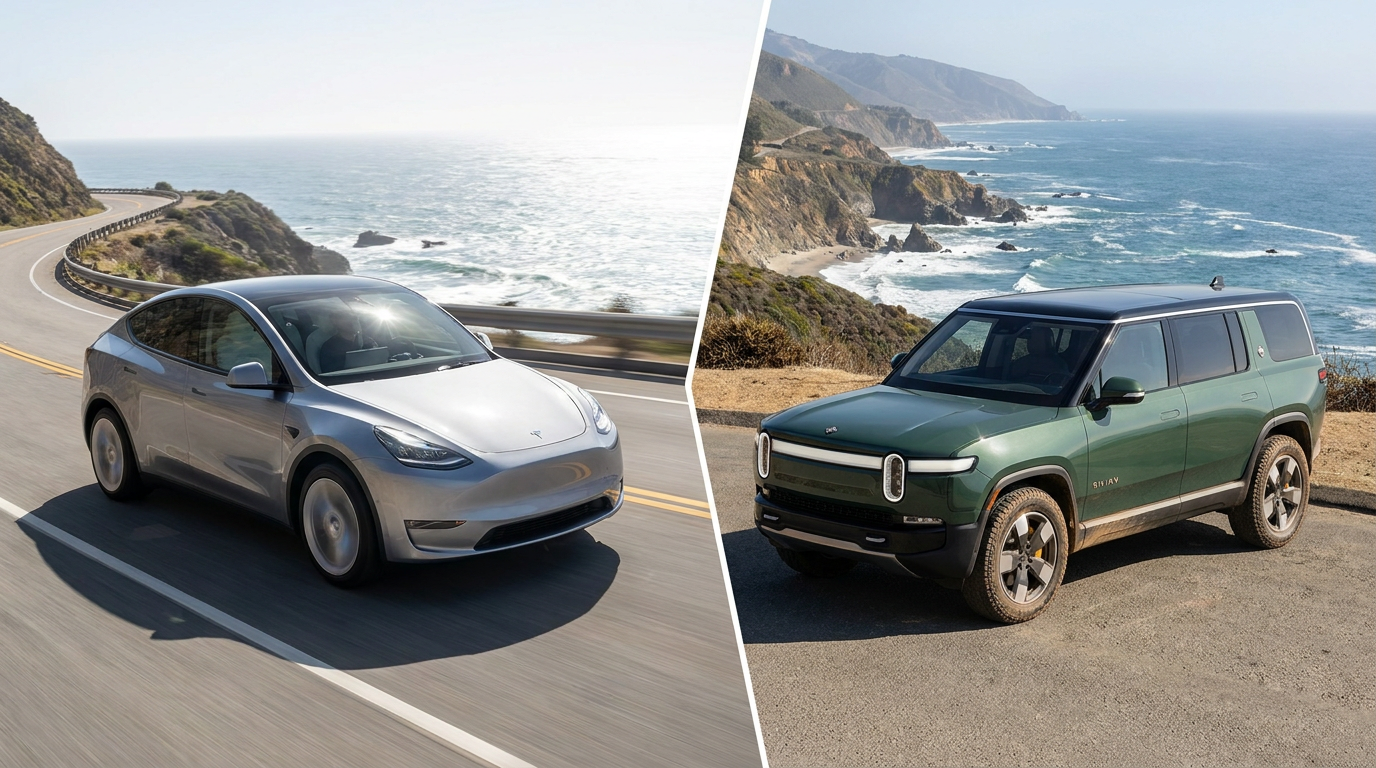
The refreshed 2026 Tesla Model Y and the all-new Rivian R2 offer buyers two distinct paths: aerodynamic street efficiency or rugged off-road utility.
By Factlen Editorial Team
- Efficiency & Value Prioritizers
- Focuses on the Model Y's immediate affordability, aerodynamic range, and street performance.
- Utility & Adventure Seekers
- Values the Rivian R2's ground clearance, massive cargo volume, and off-road capability.
- Industry & Market Analysts
- Tracks delivery timelines, pricing strategies, and the broader EV market landscape.
What's not represented
- · Traditional legacy automakers losing market share to these EV-only brands
- · Buyers requiring a third row, which the Model Y offers as an option but the R2 lacks
Why this matters
For the first time, mid-size electric SUV buyers don't have to compromise. Choosing between the Model Y and the R2 dictates whether your daily driver is optimized for maximum highway range and value, or built to double as a rugged basecamp for outdoor adventures.
Key points
- The 2026 Tesla Model Y starts at $39,990, while the Rivian R2 launches with a $57,990 Performance trim.
- Tesla's 'Juniper' update brings ventilated seats, rear screens, and a quieter cabin to the Model Y.
- The Rivian R2 offers superior utility with 90.1 cubic feet of cargo space and 9.6 inches of ground clearance.
- Model Y wins on maximum efficiency, offering up to 357 miles of range compared to the R2's 345 miles.
- Both vehicles feature native NACS ports for seamless access to the Tesla Supercharger network.
The electric vehicle market has officially entered its era of refinement. For years, buyers seeking a mid-size electric crossover had a default answer, but the landscape in 2026 offers a genuine divergence in philosophy. The arrival of the Rivian R2 and the heavily updated "Juniper" iteration of the Tesla Model Y means consumers no longer have to compromise on their specific lifestyle needs.[1][3]
These two vehicles represent the pinnacle of the $40,000 to $60,000 EV segment, yet they approach the assignment from opposite directions. Tesla has doubled down on aerodynamic efficiency, street performance, and minimalist tech. Rivian, meanwhile, has distilled the rugged, off-road DNA of its larger R1 series into a more accessible, boxy footprint.[1][5]
Pricing and availability are the most immediate differentiators for buyers shopping in 2026. The Tesla Model Y holds a distinct advantage at the entry level, with its Standard rear-wheel-drive trim starting at $39,990 and available immediately.[1][2]
Rivian is taking a top-down approach to its rollout. The R2 is launching in Spring 2026 exclusively in its $57,990 Performance trim. While Rivian recently announced a price cut for its base model—bringing the future entry point down to $46,485—those more affordable Standard trims will not reach customers until 2027.[4][6]

At the top of the pricing spectrum, however, the two vehicles are locked in a dead heat. A fully loaded Model Y Performance and the launch-edition R2 Performance both sit in the $57,000 to $59,000 range. At this tier, the decision shifts entirely from budget to capability.[1][6]
In terms of straight-line speed, both crossovers deliver supercar-level acceleration. The R2 Performance boasts a staggering 656 horsepower and 609 pound-feet of torque, launching it from zero to 60 mph in 3.6 seconds.[6]
Despite the Rivian's raw power advantage, the Tesla Model Y Performance is lighter and more aerodynamic, allowing it to edge out the R2 with a zero to 60 mph sprint of just 3.3 seconds.[1][2]
That aerodynamic advantage also translates to overall efficiency. The Model Y Premium rear-wheel-drive variant is the range champion, offering an EPA-estimated 357 miles per charge. The most efficient Rivian R2 tops out at an estimated 345 miles, while the launch-edition Performance trim yields 330 miles.[1][2]

That aerodynamic advantage also translates to overall efficiency.
Where the Model Y rules the pavement, the Rivian R2 claims the dirt. The R2 is built with genuine off-road geometry, featuring 9.6 inches of ground clearance, a 25-degree approach angle, and a 26-degree departure angle. It achieves this trail readiness without relying on complex air suspension systems.[1][5]
The R2's boxy silhouette also pays massive dividends for interior utility. It offers a class-leading 90.1 cubic feet of total cargo space, aided by a 5.2-cubic-foot front trunk and seats that fold completely flat. Rivian even included a fully retractable rear window to accommodate oversized gear like surfboards or lumber.[3][5]
The Model Y, by contrast, offers a respectable but smaller 76 cubic feet of maximum cargo space and a 4.1-cubic-foot front trunk. Its sloping roofline cuts into vertical storage, making it less ideal for hauling bulky, square items.[3][5]

Inside the cabin, the two automakers offer vastly different user experiences. Tesla's 2026 "Juniper" update addressed long-standing criticisms by adding ventilated seats, ambient LED lighting, a quieter ride through improved acoustic glass, and an 8-inch rear touchscreen for passengers. However, it remains fiercely minimalist, relying entirely on a central 15.4-inch screen with no dedicated driver display.[2][5]
Rivian's interior feels more like a traditional premium SUV. The R2 features a 15.6-inch main display but pairs it with a 12.3-inch digital gauge cluster directly in front of the driver. It also prioritizes physical storage with dual gloveboxes and extensive open-pore wood trim that lends the cabin a warm, nature-inspired aesthetic.[3][5]
When weighing the trade-offs, the case for the Model Y centers on efficiency and value. The primary evidence is its 357-mile maximum range, superior aerodynamics, and a starting price under $40,000 in 2026. The argument against it is its limited utility on rough terrain and a minimalist cabin that lacks a dedicated driver display.[1][2]

Conversely, the case for the Rivian R2 is built on versatility and ruggedness. The evidence lies in its 9.6 inches of ground clearance, 90.1 cubic feet of total storage, and fold-flat seating. The argument against the R2 is its higher immediate entry price—launching only in its $57,990 Performance trim in 2026—and slightly lower aerodynamic efficiency compared to the Tesla.[1][5]
Ultimately, the Tesla Model Y fits well when a buyer prioritizes maximum highway range, immediate access to lower-priced trims, and a sleek, street-oriented driving dynamic. It does not fit well when the driver regularly tackles unpaved trails or needs to haul oversized, boxy cargo.[1][2]
The Rivian R2 fits well when a driver wants genuine off-road geometry, a traditional SUV aesthetic, and a cabin designed to double as a campsite. It does not fit well when the budget is strictly capped under $45,000 for a 2026 purchase, as those more affordable variants will not arrive until 2027.[1][4][6]
How we got here
Early 2020
Tesla launches the original Model Y, quickly establishing it as the world's best-selling electric vehicle.
March 2024
Rivian officially unveils the R2 mid-size SUV, promising a more accessible entry point to its rugged lineup.
Late 2025
Tesla rolls out the 'Juniper' refresh for the Model Y, upgrading the interior, suspension, and exterior styling.
Spring 2026
Rivian begins initial customer deliveries of the top-tier R2 Performance launch editions.
Summer 2027
The more affordable Rivian R2 Standard trims are slated to arrive, completing the lineup.
Viewpoints in depth
The Efficiency & Commuter View
Prioritizing aerodynamic range, charging speed, and on-road driving dynamics.
For buyers focused on daily commuting and long highway road trips, the Tesla Model Y remains the benchmark. Its teardrop shape and lighter weight allow it to extract more miles per kilowatt-hour, peaking at 357 miles of range. Proponents of this view argue that the Model Y's car-like handling and immediate availability at a sub-$40,000 price point make it the most logical choice for 90% of driving scenarios, which rarely involve unpaved roads.
The Outdoor & Utility View
Valuing ground clearance, cargo volume, and rugged versatility over pure aerodynamics.
For outdoor enthusiasts and heavy packers, the Rivian R2 is a revelation. This camp points to the R2's 9.6 inches of ground clearance and 90.1 cubic feet of storage as essential tools, not just aesthetic choices. The ability to fold all seats completely flat and roll down the rear window transforms the vehicle into a functional campsite or gear hauler. To these buyers, sacrificing a few miles of aerodynamic range is a worthwhile trade for genuine off-road geometry and a traditional SUV form factor.
What we don't know
- How the Rivian R2's real-world highway range will hold up against its EPA estimates when loaded with gear.
- Whether Tesla will introduce further price cuts to the Model Y to undercut the Rivian R2's cheaper trims arriving in 2027.
Key terms
- NACS
- North American Charging Standard, the charging plug design originally developed by Tesla that is now the industry standard for most new EVs.
- Frunk
- A front trunk, utilizing the space under the hood where a traditional gas engine would normally sit.
- Approach Angle
- The maximum angle of a ramp or obstacle a vehicle can climb from a flat surface without the front bumper hitting the ground.
- Open-Pore Wood
- A type of wood trim used in car interiors that is left unsealed or lightly finished, preserving its natural texture and matte appearance.
Frequently asked
Which vehicle is cheaper in 2026?
The Tesla Model Y is significantly cheaper in 2026, starting at $39,990. The Rivian R2 is only available in its $57,990 Performance trim this year, with cheaper versions arriving in 2027.
Do both vehicles use the same charging network?
Yes. Both the Tesla Model Y and the Rivian R2 feature native NACS (North American Charging Standard) ports, granting them seamless access to Tesla's extensive Supercharger network.
Which SUV has more cargo space?
The Rivian R2 offers considerably more cargo space, with 90.1 cubic feet of total storage compared to the Model Y's approximately 76 cubic feet. The R2 also features seats that fold completely flat.
Is the Tesla Model Y faster than the Rivian R2?
Yes, slightly. While the R2 Performance boasts more horsepower, the Model Y Performance is lighter and more aerodynamic, reaching 60 mph in 3.3 seconds compared to the R2's 3.6 seconds.
Sources
Source coverage
6 outlets
3 viewpoints surfaced






[1]Road EthosEfficiency & Value Prioritizers
Rivian R2 Vs. Tesla Model Y: An Honest Comparison For 2026 Buyers
Read on Road Ethos →[2]Car and DriverEfficiency & Value Prioritizers
2026 Tesla Model Y Review, Pricing, and Specs
Read on Car and Driver →[3]AutoblogUtility & Adventure Seekers
2026 Rivian R2 Performance vs. 2026 Tesla Model Y: Which Crossover EV Should You Choose?
Read on Autoblog →[4]EdmundsIndustry & Market Analysts
The Cheapest Rivian R2 Just Got a Price Cut and Is Coming Sooner
Read on Edmunds →[5]Car ConfectionsUtility & Adventure Seekers
2027 Rivian R2 vs. 2026 Tesla Model Y: Trouble for Tesla?
Read on Car Confections →[6]CleanTechnicaIndustry & Market Analysts
The Rivian R2 Is Here!
Read on CleanTechnica →
Every angle. Every day.
Get automotive stories with full source coverage and perspective breakdowns delivered to your inbox.