
Evidence Pack: Does Ranked-Choice Voting Actually Reduce Political Polarization?
As more municipalities and states adopt ranked-choice voting, empirical data is finally catching up to the theory. Here is what the evidence says about civility, extremism, and voter confusion.
By Factlen Editorial Team
- Empirical Researchers
- Political scientists and economists who analyze election data to measure the actual impact of voting systems.
- Electoral Reform Advocates
- Organizations actively pushing for the adoption of RCV to improve representation and reduce polarization.
- Election Administrators
- Pragmatic officials and policy centers focused on the logistical realities, costs, and voter education required to run elections.
What's not represented
- · Incumbent politicians who benefit from plurality rules
- · Third-party candidates who gain ballot access through RCV
Why this matters
Structural democratic reforms are often debated using hypotheticals and partisan talking points. By looking strictly at the peer-reviewed evidence, voters can understand exactly what changes—and what doesn't—when a city or state alters how it counts ballots.
Key points
- Ranked-Choice Voting (RCV) requires candidates to secure a 50% majority, eliminating the 'spoiler effect' of third-party runs.
- Empirical data shows RCV measurably reduces negative campaigning, as candidates need second-choice votes from rivals' supporters.
- The system favors consensus candidates over polarizing figures, though it cannot manufacture moderates if the electorate is deeply skewed.
- Initial voter confusion is real but drops significantly after the first election cycle with proper education.
- RCV adoption correlates with increased electoral success for women and minority candidates in local races.
For decades, American political discourse has been trapped in a cycle of escalating polarization, driven in part by electoral systems that reward base-pleasing extremes over broad consensus. In response, a structural reform known as Ranked-Choice Voting (RCV) has moved from academic theory to widespread implementation. As of 2026, dozens of municipalities and several states have abandoned traditional plurality voting in favor of the ranked model. With this critical mass of real-world adoption, political scientists finally have the longitudinal data needed to separate advocacy from empirical reality.[1][4]
The traditional American election uses a plurality system: voters pick one candidate, and the person with the most votes wins, even if they secure less than a majority. This system is highly susceptible to the 'spoiler effect,' where two ideologically similar candidates split the majority vote, allowing a candidate opposed by most of the electorate to win. It also creates a strategic dilemma for voters, who often feel compelled to vote for the 'lesser of two evils' rather than their genuine preference, simply to prevent their least favorite candidate from taking office.[2][6]
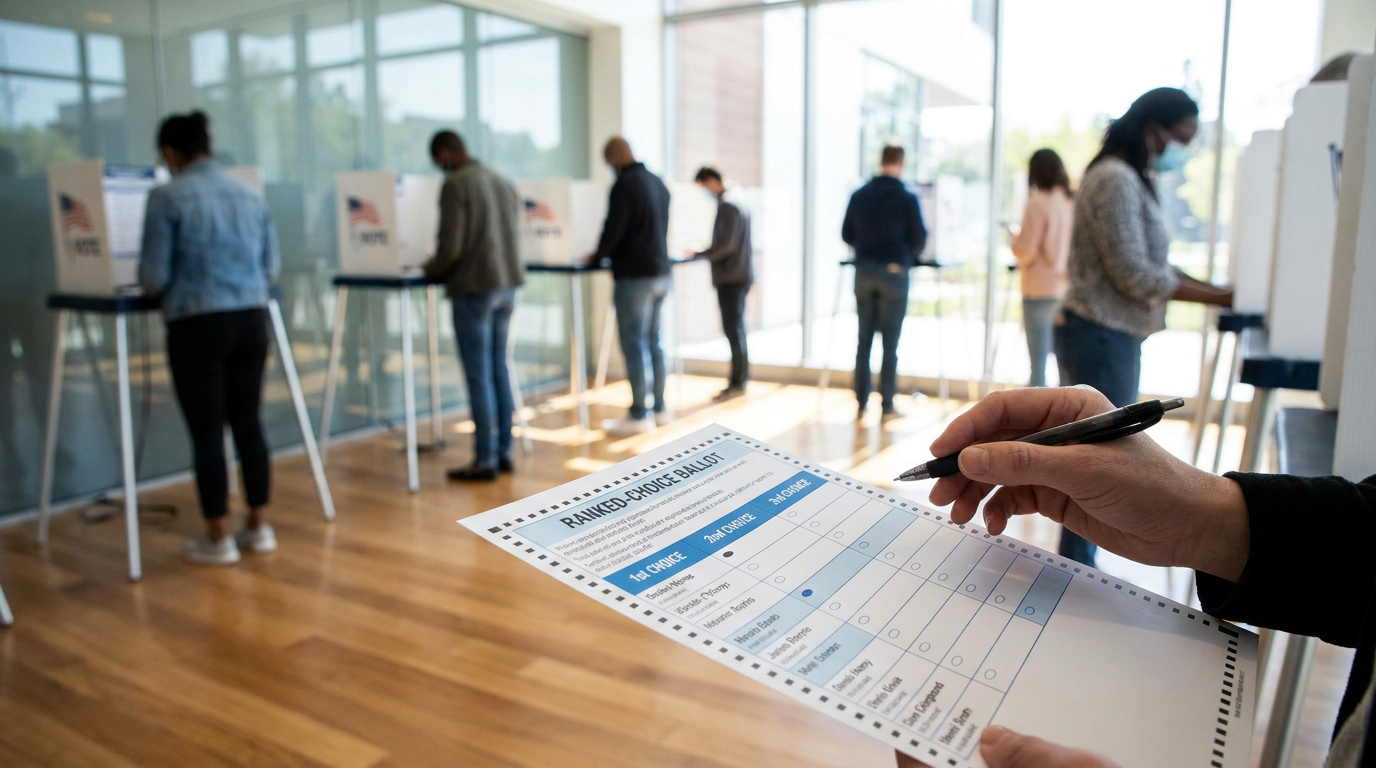
Ranked-Choice Voting fundamentally alters this arithmetic. Instead of choosing a single name, voters rank candidates in order of preference: first choice, second choice, third choice, and so on. If a candidate wins an outright majority of first-preference votes, the election is over. However, if no one clears the 50 percent threshold, an instant runoff is triggered. The candidate with the fewest first-choice votes is eliminated, and their supporters' ballots are instantly reallocated to their second choices. This process repeats until one candidate secures a majority.[2][4]
The most prominent claim made by RCV advocates is that it reduces negative campaigning and fosters civility. The theoretical mechanism is straightforward: in a plurality system, a candidate only needs to tear down their opponent to win. In an RCV system, a candidate needs to appeal to their opponent's supporters to secure crucial second- or third-choice votes. Alienating a rival's base through vicious attack ads becomes a mathematically losing strategy.[3][4]

Empirical evidence largely supports this claim, though the effects are nuanced. Studies analyzing mayoral races in cities that adopted RCV found a measurable decrease in negative campaign messaging compared to matched cities using plurality rules. Candidates in RCV jurisdictions were more likely to engage in positive self-promotion and, occasionally, cross-endorsements. Researchers noted that campaigns shifted their resources away from opposition research and toward broader voter outreach, fundamentally altering the tone of the final weeks of the election.[3][5]
However, the data also reveals that civility has its limits. While candidates are less likely to attack rivals who share a similar ideological space—hoping to inherit their voters—they will still aggressively contrast themselves with candidates on the opposite end of the spectrum. The system does not eliminate political disagreement, but it does heavily penalize the specific tactic of scorched-earth campaigning against adjacent allies.[3][6]
The second major claim is that RCV reduces political extremism by favoring consensus candidates over polarizing figures. Because winning requires broad acceptability across the electorate, candidates who appeal only to a narrow, fervent base struggle to survive the instant runoff rounds. They may lead in the first round of voting, but they fail to accumulate the transfer votes necessary to cross the 50 percent threshold.[5][6]
Data from statewide implementations, particularly in Alaska, provides strong evidence for this moderating effect. In highly publicized races, candidates who campaigned on bipartisan cooperation and broad appeal consistently defeated candidates who relied on highly partisan, base-mobilization strategies. Post-election analyses demonstrated that the winning candidates were often the 'Condorcet winner'—the candidate who would have beaten every other candidate in a series of head-to-head matchups, reflecting the true center of gravity of the electorate.[4][6]
Data from statewide implementations, particularly in Alaska, provides strong evidence for this moderating effect.
Yet, political scientists caution against viewing RCV as a magic bullet for moderation. If an entire electorate is deeply skewed toward one ideological extreme, RCV will accurately reflect that preference. The system's primary virtue is not that it artificially manufactures moderates, but that it prevents a fractured majority from accidentally electing a candidate representing a fringe minority. It ensures the winner is genuinely acceptable to the broadest possible swath of the voting public.[1][5]
The most persistent criticism of RCV centers on voter confusion and the phenomenon of 'exhausted ballots.' Critics argue that ranking multiple candidates is cognitively demanding, particularly in crowded fields. If a voter only ranks one or two candidates, and those candidates are eliminated early in the instant runoff, that voter's ballot becomes 'exhausted' and does not factor into the final round of counting. This, skeptics argue, can inadvertently disenfranchise less-informed voters.[2][7]

Election data confirms that exhausted ballots are a real phenomenon, particularly in the first cycle after a jurisdiction adopts RCV. In some early races, up to 10 percent of ballots did not transfer to the final round because voters chose not to rank the ultimate finalists. This has led to instances where the final winner secured a majority of the *remaining* votes, but not a majority of the *total* ballots originally cast.[2][7]
However, longitudinal studies by election administration experts show that this confusion is largely a transitional friction. Voter education campaigns and intuitive ballot design significantly reduce error rates. By the second or third election cycle under RCV rules, the vast majority of voters—often exceeding 85 percent—report that they understand the system and find it easy to use. Furthermore, voters consistently report higher satisfaction with their choices, as they no longer feel forced to vote strategically against their own preferences.[2][4]
Another measurable impact of RCV is its effect on diverse representation. Advocacy groups have long argued that plurality voting penalizes women and minority candidates, who are often pressured to drop out of races to avoid splitting the vote with similar candidates. RCV removes this pressure, allowing multiple candidates from the same demographic or ideological background to run simultaneously without acting as spoilers.[4][7]
The empirical record here is robust. Across dozens of municipal elections, the implementation of RCV has correlated with a significant increase in the election of women and candidates of color. Because candidates do not have to wait their turn or clear the field, more diverse voices enter the race. The ability of voters to rank these candidates ensures that their collective support is consolidated rather than fractured, leading to city councils and mayoral offices that more closely demographically mirror their populations.[4][5]
Administratively, the transition to RCV is not without cost. Election officials must procure compatible voting machines, redesign ballots, and implement new auditing procedures. The instant runoff process also means that final results are rarely known on election night, as officials must wait for all mail-in and provisional ballots to arrive before they can accurately run the elimination rounds. This delay has occasionally fueled conspiracy theories among voters accustomed to immediate results.[2][7]

To mitigate this, best practices in election administration now emphasize extreme transparency during the tabulation process. Jurisdictions are increasingly releasing 'cast vote records'—anonymized data sets of all ranked ballots—allowing independent researchers and the public to verify the instant runoff math themselves. When administered with this level of openness, public trust in the outcome remains high, even when the final tabulation takes several days.[1][7]
Ultimately, the evidence pack on Ranked-Choice Voting reveals a system that successfully addresses several specific structural flaws in American elections. It definitively eliminates the spoiler effect, measurably reduces the incentive for negative campaigning, and reliably produces winners with broader mandates than plurality systems. It does not erase deep-seated political divisions, but it changes the incentive structure for how politicians navigate them.[1][3][6]
As the data continues to accumulate, the consensus among political scientists is solidifying: RCV is a substantial, evidence-backed improvement over the status quo. While it requires an upfront investment in voter education and administrative upgrades, the long-term dividends—more representative outcomes, less toxic campaigns, and the freedom for voters to express their true preferences—make it one of the most effective democratic reforms currently available.[1][2][5]
How we got here
2004
San Francisco becomes the first major modern US city to implement Ranked-Choice Voting for municipal elections.
2018
Maine becomes the first state to use RCV for federal congressional elections.
2020
Alaska voters approve a ballot measure establishing open primaries and RCV for general elections.
2022
Alaska holds its first statewide RCV elections, drawing national attention to the system's moderating effects.
2026
Over 50 US jurisdictions now utilize RCV, providing a robust dataset for political scientists to evaluate its impact.
Viewpoints in depth
Empirical Researchers
Political scientists who measure the actual impact of voting systems.
Academic researchers approach RCV not as a utopian fix, but as a structural variable. Their data confirms that RCV successfully eliminates the spoiler effect and marginally reduces campaign toxicity. However, they frequently caution that RCV's ability to elect moderates is entirely dependent on the underlying electorate. If a district is deeply partisan, RCV will still elect a partisan; it simply ensures that the elected official truly represents the majority faction rather than a plurality sliver.
Electoral Reform Advocates
Organizations actively pushing for the adoption of RCV to improve representation.
Advocacy groups like FairVote view RCV as the most viable mechanism to break the two-party duopoly and improve democratic representation. They point to data showing that RCV lowers the barrier to entry for women and minority candidates, who no longer face pressure to drop out to avoid splitting the vote. For these advocates, the freedom for voters to express their true first choice without fear of wasting their vote is a fundamental democratic right that plurality voting suppresses.
Election Administrators
Officials focused on the logistical realities and costs of running elections.
For the officials tasked with running elections, RCV presents a complex logistical challenge. The Bipartisan Policy Center and similar groups highlight the friction of transition: upgrading voting machines, redesigning ballots, and retraining poll workers. They are particularly concerned with the delay in tabulation, noting that waiting days for final instant-runoff results can breed public suspicion in a highly polarized environment. Their focus is on ensuring that jurisdictions do not adopt RCV until they have the funding and transparency protocols in place to administer it flawlessly.
What we don't know
- Whether the moderating effects seen in statewide races like Alaska will replicate in highly polarized, closed-primary states.
- The long-term impact of RCV on the viability of a permanent third major political party in the United States.
Key terms
- Plurality Voting
- The traditional system where voters choose one candidate, and the person with the most votes wins, even if they do not secure a majority.
- Spoiler Effect
- A scenario where two similar candidates split the vote of a shared demographic, allowing a candidate with minority support to win the election.
- Exhausted Ballot
- A ballot that can no longer be counted in an instant runoff because all the candidates ranked by the voter have been eliminated.
- Condorcet Winner
- A candidate who would win a head-to-head election against every other candidate in the race, representing the true consensus of the electorate.
Frequently asked
Does my vote still count if my first choice is eliminated?
Yes. If your first choice is eliminated, your vote instantly transfers to the candidate you marked as your second choice, ensuring your voice still influences the final outcome.
What happens if I only vote for one person?
Your vote will count for that person in the first round. If they are eliminated and you haven't ranked anyone else, your ballot becomes 'exhausted' and does not participate in subsequent tie-breaking rounds.
Does Ranked-Choice Voting favor one political party?
Empirical data shows RCV does not inherently favor Democrats or Republicans. It tends to favor candidates with broad, consensus appeal over those who rely strictly on highly polarized bases, regardless of party.
Why do RCV results sometimes take longer to announce?
Because the instant runoff requires knowing the exact total of all first-choice votes before eliminating the lowest candidate, officials must wait for all mail-in and provisional ballots to arrive before running the final mathematical rounds.
Sources
Source coverage
7 outlets
3 viewpoints surfaced







[1]Factlen Editorial Team
Synthesis by Factlen editorial team
Read on Factlen Editorial Team →[2]MIT Election Data and Science LabEmpirical Researchers
Evaluating the Administration and Impact of Ranked-Choice Voting
Read on MIT Election Data and Science Lab →[3]National Bureau of Economic ResearchEmpirical Researchers
The Effects of Ranked Choice Voting on Campaign Civility and Polarization
Read on National Bureau of Economic Research →[4]FairVoteElectoral Reform Advocates
Data and Research on Ranked Choice Voting Outcomes
Read on FairVote →[5]American Political Science ReviewEmpirical Researchers
Does Ranked Choice Voting Alter Electoral Outcomes and Candidate Strategy?
Read on American Political Science Review →[6]Stanford Center on Democracy, Development and the Rule of LawEmpirical Researchers
Electoral Systems, Moderation, and Democratic Stability
Read on Stanford Center on Democracy, Development and the Rule of Law →[7]Bipartisan Policy CenterElection Administrators
The Administrative Realities of Ranked Choice Voting
Read on Bipartisan Policy Center →

More in news politics
See all 5 stories →Information Ecosystem
The Evidence Behind Crowdsourced Fact-Checking: Why Community Notes Actually Work
0 sources

US-Iran Relations
US and Iran to Sign Peace Deal Ending War, Reopening Strait of Hormuz
0 sources

US-Iran Relations
US and Iran Reach Peace Deal to End Conflict and Reopen Strait of Hormuz
0 sources

Every angle. Every day.
Get news politics stories with full source coverage and perspective breakdowns delivered to your inbox.