
Intermittent Fasting vs. Caloric Restriction: Which Weight-Loss Method Actually Works Better?
Recent clinical trials reveal the distinct trade-offs between watching the clock and counting calories, proving that the best diet depends entirely on your behavioral psychology.
By Factlen Editorial Team
- Time-Restricted Advocates
- Focus on hormonal optimization, circadian rhythms, and behavioral simplicity.
- Energy Balance Traditionalists
- Emphasize that all weight loss ultimately comes down to calories in versus calories out.
- Lifestyle Pragmatists
- Argue that adherence is the only metric that matters, advocating for whichever method fits the individual.
What's not represented
- · Fitness Coaches
- · Eating Disorder Recovery Specialists
Why this matters
Choosing the right weight-loss method can mean the difference between years of frustrating yo-yo dieting and sustainable, long-term health. Understanding the distinct trade-offs between fasting and calorie counting empowers you to pick the tool that actually fits your psychology and daily routine.
Key points
- Intermittent fasting and daily caloric restriction both rely on an energy deficit to drive weight loss.
- A major study found 4:3 fasting produced slightly more weight loss over a year than daily calorie counting.
- Fasting simplifies daily decisions by restricting eating times, but can cause evening hunger and social friction.
- Caloric restriction offers total flexibility in meal timing but requires meticulous tracking that can lead to diet fatigue.
- Both methods reliably improve blood pressure, cholesterol, and overall cardiometabolic health.
- The most effective diet is the one that best aligns with an individual's psychology and daily schedule.
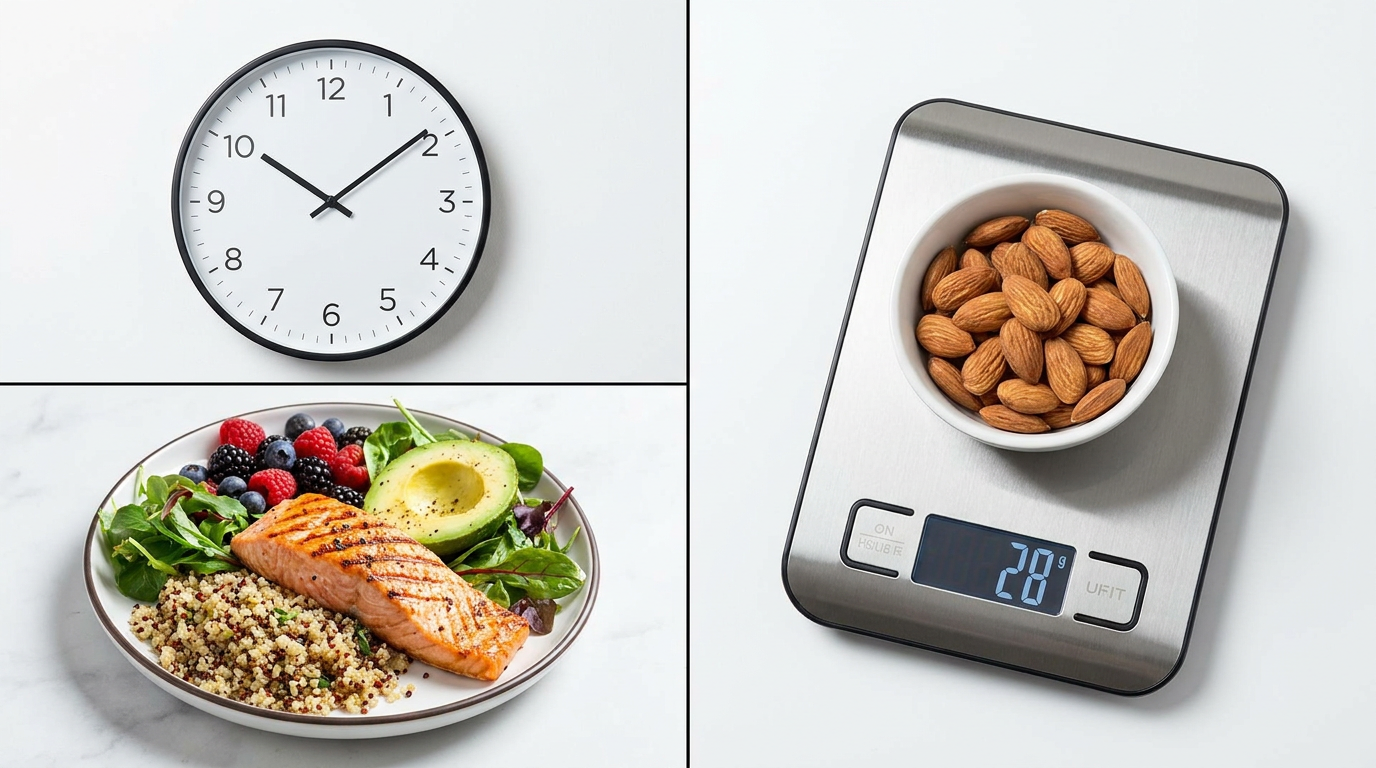
For decades, the undisputed king of weight loss was the pocket calculator. If you wanted to shed pounds, you logged every almond, weighed every chicken breast, and maintained a continuous daily caloric deficit. But in recent years, a challenger has emerged that asks you to put away the scale and simply watch the clock. Intermittent fasting has surged from a niche biohacking trend to a mainstream medical recommendation. Now, a wave of high-quality clinical trials is finally providing definitive answers on how these two heavyweights truly compare.[1][2]
At their core, both intermittent fasting and continuous caloric restriction rely on the exact same biological mechanism: an energy deficit. To lose weight, your body must expend more energy than it takes in. However, they approach this mathematical reality from entirely different behavioral angles. One method restricts how much you eat at any given moment, while the other restricts when you are allowed to eat at all. Understanding the trade-offs between these two approaches is the key to finding a sustainable path to metabolic health.[4][6]
The argument for intermittent fasting centers on behavioral simplicity and hormonal optimization. Proponents argue that modern humans suffer from decision fatigue. By compressing the eating window—whether through a daily 16:8 schedule or a weekly 4:3 protocol—fasting eliminates the need for constant dietary math. Furthermore, extending the fasting window lowers insulin levels for longer periods, which theoretically allows the body to access and burn stored fat more efficiently.[3][5]
The evidence supporting intermittent fasting has grown remarkably robust. A landmark study published in the Annals of Internal Medicine followed 165 adults over a full year. The researchers found that participants utilizing a 4:3 fasting protocol lost an average of 7.6 percent of their body weight. In contrast, those following traditional daily calorie restriction lost only 5.0 percent. Crucially, 58 percent of the fasting group achieved clinically significant weight loss, compared to just 47 percent in the calorie-counting group.[3][7]

However, the case against intermittent fasting highlights its potential for social friction and physical discomfort. Fasting can induce significant hunger pangs, particularly in the hours just before bedtime, which can disrupt sleep for some individuals. Critics also point out that a restricted eating window can lead to compensatory bingeing; if a person feels deprived all morning, they may consume highly processed, calorie-dense foods the moment their window opens. Additionally, skipping meals can complicate social gatherings and family dinners.[5]
Conversely, the argument for continuous caloric restriction is rooted in flexibility and steady energy. Traditional calorie counting does not dictate meal timing, allowing individuals to spread their intake evenly throughout the day. This steady stream of nutrients can prevent the severe dips in blood sugar that trigger irritability and fatigue. For people who enjoy grazing or need to fuel intense morning workouts, continuous restriction offers the freedom to eat whenever hunger strikes, provided the daily energy budget is respected.[1][6]
Conversely, the argument for continuous caloric restriction is rooted in flexibility and steady energy.
The evidence for daily caloric restriction is foundational to modern nutritional science. Decades of metabolic ward studies have proven its efficacy. Recent systematic reviews, including a comprehensive analysis in The BMJ, confirm that when the total caloric deficit is strictly matched, continuous restriction and intermittent fasting yield nearly identical reductions in body fat. For researchers focused purely on thermodynamics, daily restriction remains the gold standard because it directly addresses the root cause of weight gain: overconsumption.[4][6]
Yet, the case against daily caloric restriction centers on psychological burnout. Logging every meal requires a relentless level of vigilance that many find exhausting. Diet fatigue is the primary reason traditional weight-loss attempts fail; the mental burden of calculating the caloric value of a restaurant meal or a home-cooked stew can drain the joy from eating. Over time, this constant tracking can lead to an unhealthy fixation on numbers rather than the nutritional quality of the food itself.[1][7]
When analyzing the trade-offs in cardiometabolic health, both diets perform admirably. Whether you fast or count calories, shedding excess weight reliably lowers blood pressure, reduces chronic inflammation, and improves cholesterol profiles. However, intermittent fasting appears to offer a slight edge in glycemic control. Short-term data indicates that fasting protocols can reduce fasting insulin by an average of 7.5 pmol/L, providing a unique benefit for individuals managing insulin resistance or prediabetes.[4][6]

Ultimately, choosing between these two methods requires an honest assessment of your lifestyle. Intermittent fasting fits well when you have a busy morning routine, naturally lack an appetite for breakfast, or experience severe burnout from tracking food. It is highly effective for people who prefer clear, binary rules—you are either eating or you are not—over the gray area of portion control.[1][2]
Conversely, intermittent fasting does not fit well when you are pregnant, have a history of eating disorders, or take medications that must be consumed with food. It is also a poor choice for elite athletes who require precise nutrient timing to optimize recovery and performance.[5]
Continuous caloric restriction fits well when you are highly data-driven and enjoy the gamification of tracking macros. It is ideal for individuals who experience severe mood swings when hungry, or those who want the ultimate flexibility to eat a small treat at any hour of the day. If you view food as steady fuel, this traditional method provides predictable stability.[4][6]

However, continuous restriction does not fit well when you are prone to obsessive behaviors around food or lack the time to weigh and measure ingredients. If the thought of opening a tracking app before every meal fills you with dread, the daily restriction model is likely to end in frustration and rebound weight gain.[3][7]
The scientific consensus is overwhelmingly positive: we now have multiple, evidence-backed tools for improving metabolic health. There is no single winner in the battle between the clock and the calculator. The most effective diet is not the one that burns an extra fraction of a percent of fat in a laboratory setting; it is the one that seamlessly integrates into your life, allowing you to sustain healthy habits for years to come.[1][5][8]
How we got here
Early 2000s
Continuous caloric restriction remains the undisputed gold standard for weight loss in clinical guidelines.
2012
The 5:2 diet popularizes intermittent fasting for the general public, sparking a wave of new nutritional research.
2018
Landmark studies demonstrate that time-restricted eating improves blood sugar control even without weight loss.
March 2025
A major trial in the Annals of Internal Medicine shows 4:3 fasting outperforming daily calorie counting over a one-year period.
June 2025
Systematic reviews confirm both methods offer similar cardiometabolic benefits, shifting the medical consensus toward lifestyle preference.
Viewpoints in depth
Time-Restricted Advocates
Fasting optimizes hormones and simplifies eating.
This camp points to evolutionary biology, arguing that human bodies are designed to endure periods of scarcity. By extending the fasting window, insulin levels drop, allowing the body to access stored fat more easily. They argue that counting calories is a modern, unnatural chore that leads to burnout, whereas setting a clock is a sustainable behavioral shift.
Energy Balance Traditionalists
Weight loss is strictly a matter of thermodynamics.
Researchers in this camp emphasize that intermittent fasting only works because it inadvertently creates a caloric deficit. They cite metabolic ward studies showing that when calories and protein are strictly equated, the timing of meals has no magical effect on fat loss. For them, teaching people portion control and macronutrient balance is more empowering than arbitrary time rules.
Lifestyle Pragmatists
The best diet is the one you don't quit.
Medical professionals in this group view the debate as a distraction. They focus on adherence data, noting that different psychological profiles respond to different rules. If a patient finds peace of mind in skipping breakfast, they prescribe fasting; if a patient prefers grazing and data tracking, they prescribe continuous restriction. Their goal is removing the moral weight from diet choices.
What we don't know
- Whether the long-term (5+ years) muscle preservation rates differ significantly between the two methods.
- Exactly how different fasting windows (e.g., 16:8 versus 14:10) compare to each other in head-to-head clinical trials.
- How genetic variations influence an individual's hormonal response to prolonged fasting periods.
Key terms
- Intermittent Fasting (IF)
- An eating pattern that cycles between periods of fasting and eating, focusing on when to eat rather than what to eat.
- Continuous Caloric Restriction (CCR)
- The traditional weight-loss method of reducing daily energy intake by a set percentage, typically requiring calorie counting.
- Time-Restricted Eating (TRE)
- A specific form of intermittent fasting where all daily meals are consumed within a set window, such as eight hours.
- Ketosis
- A metabolic state where the body, lacking sufficient glucose from food, begins burning stored fat for energy.
- Ghrelin
- A hormone produced in the stomach that signals hunger to the brain.
Frequently asked
Does intermittent fasting slow down your metabolism?
No, short-term fasting does not significantly slow metabolism. Both fasting and caloric restriction cause slight metabolic adaptations due to weight loss, but neither damages the metabolism.
Can I drink coffee during the fasting window?
Yes, black coffee, plain tea, and water are allowed and will not break your fast or disrupt the metabolic benefits.
Do I still need to count calories if I fast?
Not necessarily. Many people naturally eat fewer calories when their eating window is restricted, which is why fasting works without strict counting.
Which method is better for preserving muscle?
Both methods preserve muscle equally well provided you consume adequate protein and engage in resistance training during your weight loss phase.
Sources
Source coverage
8 outlets
3 viewpoints surfaced








[1]Harvard HealthLifestyle Pragmatists
Fasting vs. calorie restriction for weight loss: Which one wins?
Read on Harvard Health →[2]HealthlineLifestyle Pragmatists
Weight Loss: Intermittent Fasting As Effective As Calorie Restriction
Read on Healthline →[3]University of Colorado Anschutz Medical CampusTime-Restricted Advocates
4:3 Intermittent Fasting Outperforms Daily Calorie Restriction in Weight-Loss Study
Read on University of Colorado Anschutz Medical Campus →[4]The BMJEnergy Balance Traditionalists
Efficiency of time-restricted eating and energy restriction on anthropometrics and body composition in adults
Read on The BMJ →[5]Mayo ClinicLifestyle Pragmatists
Intermittent fasting: What are the benefits?
Read on Mayo Clinic →[6]ExamineEnergy Balance Traditionalists
Intermittent fasting vs. continuous calorie restriction for improving outcomes in obesity
Read on Examine →[7]Annals of Internal MedicineTime-Restricted Advocates
4:3 Intermittent Fasting Shows Modestly Greater Weight Loss Than Daily Caloric Restriction
Read on Annals of Internal Medicine →[8]Factlen Editorial TeamLifestyle Pragmatists
Synthesis by Factlen editorial team
Read on Factlen Editorial Team →

Every angle. Every day.
Get fitness stories with full source coverage and perspective breakdowns delivered to your inbox.