
The Renaissance of European Sleeper Trains: Inside the 2026 Route Expansion
Driven by climate pragmatism and citizen cooperatives, Europe's night train network is undergoing a massive revival in 2026 with next-generation cabins and ambitious cross-border routes.
By Factlen Editorial Team
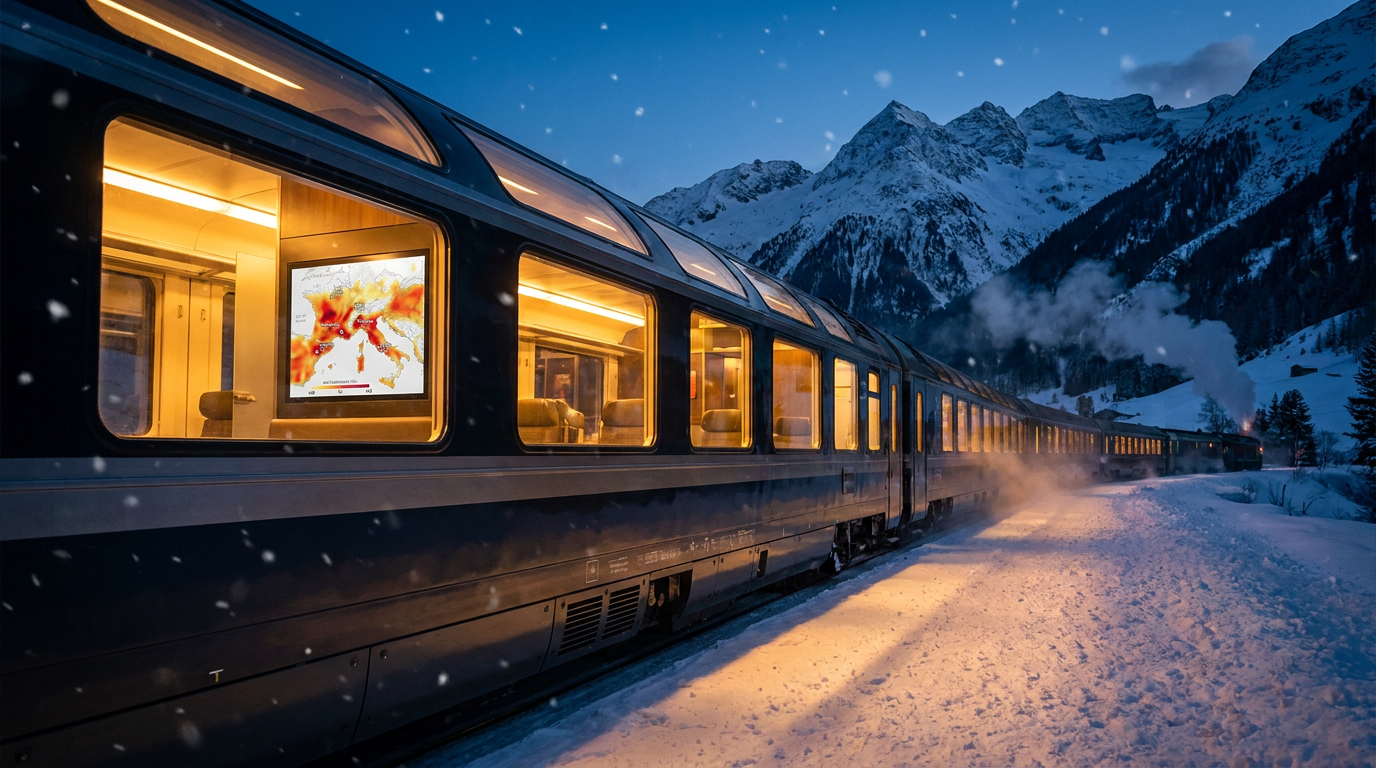
- Citizen Rail Cooperatives
- Grassroots organizations arguing that agile, crowdfunded operators are essential to fill the gaps left by state monopolies.
- State Railway Operators
- National carriers emphasizing the massive capital and logistical scale required to modernize the rail network.
- Sustainable Travel Advocates
- Environmental groups and conscious travelers championing rail as the primary solution to aviation emissions.
- Industry Analysts
- Observers tracking the logistical, financial, and infrastructure challenges of cross-border rail.
What's not represented
- · Budget Airlines
- · National Infrastructure Managers
Why this matters
As travelers increasingly seek low-carbon alternatives to short-haul flights, the expansion of sleeper trains offers a practical, comfortable way to cross Europe without the hassle of airport security or the cost of an extra hotel night. This shift is reshaping international tourism, making the journey itself a seamless part of the vacation.
Key points
- European sleeper trains are experiencing a major revival in 2026, driven by climate goals and new investments.
- Next-generation Nightjet trains now feature solo 'Mini Cabins' and private en-suite bathrooms.
- Citizen cooperative European Sleeper has successfully taken over the abandoned Paris-Berlin route.
- New cross-border routes are launching, including an Amsterdam-to-Milan Alpine crossing.
- Despite the momentum, the industry still faces hurdles with fragmented ticketing and track engineering works.
The romanticized image of the European sleeper train—clinking glasses in the dining car, waking up to Alpine vistas—is no longer just a nostalgic memory. In 2026, overnight rail travel is experiencing a massive, pragmatic renaissance. Driven by a collective desire for low-carbon transit and frustration with airport bottlenecks, travelers are trading short-haul flights for a bed on the rails.[6][7]
This year marks a definitive turning point for the continent's night train network. After years of relying on aging 1980s rolling stock, operators are deploying next-generation trains, while citizen-backed cooperatives are launching ambitious new routes that cross multiple borders. The shift is transforming how Europeans and international visitors navigate the continent.[2][7]
The most visible symbol of this revival is the rollout of the Austrian Federal Railways' (ÖBB) new generation of Nightjet trains. Built by Siemens between 2023 and 2025, these state-of-the-art carriages are systematically replacing outdated fleets on key corridors like Vienna-Hamburg and Munich-Venice.[4]
The new Nightjets address the primary historical complaint about sleeper trains: a lack of privacy and modern amenities. The updated trains feature electronic cabin access, significantly improved soundproofing, and high-speed Wi-Fi. For solo travelers, ÖBB has introduced "Mini Cabins"—compact, private sleeping pods that offer an affordable alternative to booking a full sleeper or sharing a couchette.[2][4]

For those willing to pay a premium, the new sleeper cabins now include private bathrooms with integrated showers and toilets, a luxury previously reserved for high-end tourist trains. This modernization is crucial for attracting business travelers and tourists who expect hotel-level comfort while moving between European capitals at 120 miles per hour.[2][4]
But state-backed monopolies like ÖBB aren't the only ones driving the renaissance. Enter European Sleeper, a Belgian-Dutch cooperative founded in 2021 by two rail enthusiasts and funded by more than 6,000 citizen investors. The cooperative has become a disruptive force in a notoriously rigid industry.[2][5]
European Sleeper's defining moment arrived in March 2026, when it took over the iconic Paris-to-Berlin route. After ÖBB and SNCF controversially discontinued their joint Nightjet service on the corridor in late 2025, the citizen cooperative stepped in to fill the gap, proving that demand existed where state operators saw only risk.[1][2][5]
European Sleeper's defining moment arrived in March 2026, when it took over the iconic Paris-to-Berlin route.
The new Paris-Berlin service, which runs three times a week, strategically routes through Brussels-Midi. This routing is a game-changer for UK travelers, as it allows for seamless connections with the Eurostar from London, effectively linking the British capital to Berlin with just one easy transfer. By July 2026, the route will expand to include a stop in Hamburg.[2][5]

The cooperative's ambitions extend far beyond Germany. In September 2026, European Sleeper is scheduled to launch a highly anticipated route connecting Amsterdam and Brussels to Milan. The train will travel south through the Rhine Valley, cross the Alps via the Gotthard line, and glide into northern Italy, allowing passengers to swap Dutch canals for Italian espresso overnight.[3][5]
Eastern Europe is also seeing unprecedented connectivity. The upcoming Adriatic Express, operated by PKP Intercity, will connect Warsaw to Rijeka on the Croatian coast. Traveling through Poland, the Czech Republic, Austria, Slovenia, and Croatia, it will be the first service to link five countries in a single overnight journey, replacing what previously required three separate trains.[2][3]

The environmental math underpinning this rail boom is undeniable. As the travel industry grapples with its carbon footprint, trains offer a drastically lower-emission alternative to short-haul aviation. The Rail Industry Association projects that rail demand could increase by 97% by 2050, fueled by travelers actively seeking to shrink their environmental impact.[6]
Yet, the sleeper train renaissance is not without its friction points. The European rail network remains a patchwork of national grids with varying track gauges, signaling systems, and voltage standards. Navigating these technical hurdles requires complex engineering and significant capital.[3][7]
Furthermore, night trains are highly vulnerable to daytime infrastructure projects. Mass engineering works frequently disrupt overnight schedules, and high track access charges levied by national rail authorities make it difficult for new, independent operators to maintain profitability.[3]

Ticketing also remains stubbornly fragmented. Unlike the airline industry, which relies on global distribution systems to seamlessly combine flights from different carriers, booking a multi-leg European train journey often requires navigating several different national websites.[7]
Despite these structural challenges, the momentum in 2026 is entirely in rail's favor. The combination of cutting-edge carriage design, grassroots citizen investment, and a cultural shift toward sustainable travel has rescued the European sleeper train from obsolescence. For the modern traveler, the journey itself has once again become a destination.[1][6][7]
How we got here
2021
European Sleeper is founded as a cooperative by two rail enthusiasts and funded by citizen investors.
2023–2025
Siemens builds the next-generation Nightjet fleet for the Austrian Federal Railways (ÖBB).
Dec 2025
ÖBB and SNCF controversially discontinue their joint Nightjet service on the Paris-Berlin corridor.
Mar 2026
European Sleeper steps in to revive the Paris-Berlin route, connecting it through Brussels.
Sep 2026
European Sleeper launches a new Alpine crossing route connecting Amsterdam and Brussels to Milan.
Viewpoints in depth
Citizen Rail Cooperatives
Grassroots organizations arguing that agile, crowdfunded operators are essential to fill the gaps left by state monopolies.
Cooperatives like European Sleeper view themselves as disruptors in a stagnant industry. They argue that legacy state operators are too risk-averse and bureaucratic to quickly establish cross-border routes. By crowdfunding capital directly from passengers, these cooperatives claim they are democratizing rail travel and proving that demand exists for routes that national carriers have abandoned, such as the Paris-Berlin corridor.
State Railway Operators
National carriers emphasizing the massive capital and logistical scale required to modernize the rail network.
Legacy operators like Austria's ÖBB point out that true modernization requires billions in capital expenditure—scale that only state-backed entities can achieve. They emphasize that deploying next-generation rolling stock, like the Siemens-built Nightjets, involves years of safety testing and complex negotiations with multiple national infrastructure managers. From their perspective, cooperatives are a welcome addition but cannot replace the heavy lifting of national rail grids.
Sustainable Travel Advocates
Environmental groups and conscious travelers championing rail as the primary solution to aviation emissions.
For environmental advocates, the sleeper train revival is less about romance and more about urgent climate math. They view short-haul European flights as an indefensible luxury in the face of climate change. This camp pushes for policy interventions—such as banning ultra-short flights and subsidizing track access charges—to make night trains the default, most affordable option for intra-European travel.
What we don't know
- Whether independent cooperatives can maintain long-term profitability against high track access charges.
- How quickly national rail grids will resolve the fragmented ticketing systems that complicate cross-border bookings.
- The exact completion dates for several proposed routes that are currently delayed by mass engineering works.
Key terms
- Couchette
- A basic sleeping compartment on a train with up to four or six fold-out berths and shared corridor bathrooms.
- Mini Cabin
- A compact, single-occupancy sleeping pod introduced on the new generation of Nightjet trains for solo travelers.
- Track Access Charges
- Fees paid by train operators to national infrastructure managers for the right to run trains on their rail networks.
- Rolling Stock
- The locomotives, carriages, and other vehicles used on a railway system.
Frequently asked
Are the new sleeper trains more expensive than flying?
While budget airlines can sometimes offer cheaper base fares, sleeper trains save the cost of a night in a hotel and avoid expensive airport transfers, making them highly competitive for the total trip cost.
Do the new trains have Wi-Fi and power outlets?
Yes, the next-generation Nightjets and most refurbished cooperative trains feature modern amenities including Wi-Fi, wireless charging, and electronic cabin access.
Can I travel from London on these new routes?
Yes, routes like the European Sleeper from Brussels are specifically timed to connect seamlessly with the Eurostar from London, allowing a one-transfer journey to Berlin or Milan.
What is a Mini Cabin?
A Mini Cabin is a compact, single-occupancy sleeping pod introduced on the new generation of Nightjet trains, offering privacy for solo travelers without the cost of a full sleeper compartment.
Sources
Source coverage
7 outlets
4 viewpoints surfaced







[1]Time OutSustainable Travel Advocates
The best European sleeper trains to ride in 2026
Read on Time Out →[2]PixidiaCitizen Rail Cooperatives
European Night Trains 2026: 10 New Routes You Need to Try
Read on Pixidia →[3]Byway TravelSustainable Travel Advocates
New train routes for 2026
Read on Byway Travel →[4]LunaTrainState Railway Operators
The new generation Nightjets: a complete guide
Read on LunaTrain →[5]Night RideCitizen Rail Cooperatives
European Sleeper: Routes, Cabins, Prices
Read on Night Ride →[6]Green UnionSustainable Travel Advocates
4 New Sustainable Travel Trends Making Opening the World to Greener Trips
Read on Green Union →[7]Factlen Editorial TeamIndustry Analysts
Synthesis by Factlen editorial team
Read on Factlen Editorial Team →
Every angle. Every day.
Get lifestyle stories with full source coverage and perspective breakdowns delivered to your inbox.