
Why Pediatricians Are Prescribing 'Risky Play' to Combat Childhood Anxiety
Major medical bodies are urging parents to step back and allow unstructured, thrilling outdoor play. Evidence shows that manageable physical risks build emotional resilience and actively reduce clinical anxiety.
By Factlen Editorial Team
- Medical & Psychological Consensus
- Pediatricians and psychologists who view the lack of unstructured play as a public health issue contributing to anxiety and obesity.
- Early Childhood Educators
- Teachers who emphasize the social and cognitive benefits of unstructured environments and loose parts play.
- Factlen Analysis
- Editorial synthesis highlighting the cultural shift required to move from absolute safety to calculated empowerment.
What's not represented
- · Safety-Conscious Parents
- · Municipal Risk Managers
Why this matters
As childhood anxiety rates climb, understanding the difference between a 'hazard' and a 'risk' empowers parents to foster independence. Stepping back during playtime is a proven, cost-free intervention that builds lifelong physical and emotional resilience.
Key points
- Pediatricians are urging a shift from keeping children 'as safe as possible' to 'as safe as necessary.'
- Risky play acts as self-directed exposure therapy, helping children habituate to fear and reduce clinical anxiety.
- A 'risk' is a challenge a child can assess, while a 'hazard' is a hidden danger adults must remove.
- Children who engage in risky play develop superior real-world safety skills, such as navigating busy intersections.
Modern parenting is often defined by a profound, almost biological desire to eliminate danger from a child's environment. From rubberized, low-height playground surfaces to smartphone GPS trackers and highly structured extracurricular schedules, the prevailing cultural instinct over the last few decades has been to keep children "as safe as possible." The modern childhood is heavily supervised, meticulously planned, and largely sanitized of physical uncertainty. Yet, a growing consensus among pediatricians, psychologists, and child development experts suggests this well-intentioned hyper-vigilance is actively backfiring. By removing all physical friction from early development, society has inadvertently removed the very mechanisms through which children learn to navigate fear, assess their own capabilities, and build self-trust.[8]
The unintended consequence of this risk-free childhood is a measurable, systemic rise in clinical anxiety and a corresponding decline in physical and emotional resilience among adolescents. In response to this crisis, major medical bodies, including the Canadian Paediatric Society and the American Academy of Pediatrics, are issuing a counterintuitive prescription to modern families: children need significantly more "risky play." Rather than viewing minor physical risks as a failure of parenting, these organizations are reframing them as a fundamental biological necessity. The medical consensus is shifting away from absolute injury prevention toward a holistic view of health, where the developmental benefits of taking physical chances far outweigh the threat of a scraped knee or a bruised ego.[1][3]
The concept of risky play does not mean reckless endangerment, ignoring evidence-based safety measures like bicycle helmets, or abandoning children in genuinely dangerous environments. Rather, it refers to thrilling, unstructured free play that involves a degree of uncertainty and a manageable possibility of physical injury. It is the kind of play that naturally makes observing adults slightly nervous—climbing high into trees, moving at rapid speeds on bicycles or scooters, engaging in rough-and-tumble wrestling, using real tools, or exploring a neighborhood out of direct adult sight. This type of play is entirely child-led, driven by intrinsic curiosity rather than adult direction or structured rules.[1][8]
To understand and implement this shift, it is crucial for caregivers to distinguish between a "risk" and a "hazard." Dr. Suzanne Beno, Medical Co-Director of the Trauma Program at SickKids and co-author of the Canadian Paediatric Society's position statement, emphasizes that a risk is a challenge a child can clearly see, assess, and navigate based on their own perceived skills. For example, a child deciding how high to climb on a complex structure is managing a risk. A hazard, conversely, is a hidden or unmanageable danger that is entirely beyond a child's capacity to recognize or mitigate, such as an improperly anchored slide that could collapse, a busy roadway, or toxic materials.[1]

Adults remain entirely responsible for eliminating hazards from the environment. However, by aggressively mitigating hazards while simultaneously supporting appropriate risk-taking, caregivers allow children to develop essential, lifelong risk-management strategies. The overarching goal of this developmental framework is to shift the environmental standard from keeping children "as safe as possible" to keeping them "as safe as necessary." This subtle linguistic shift represents a massive change in parenting philosophy, moving from a posture of constant protection to one of calculated empowerment, where minor injuries are accepted as the cost of profound developmental education.[1][8]
The psychological mechanics underpinning risky play are profound and deeply rooted in evolutionary biology. Researchers, including evolutionary psychologist Ellen Sandseter, have extensively documented the "anti-phobic effect" of this behavior. When children engage in thrilling, slightly frightening play, they are essentially conducting self-directed exposure therapy. By voluntarily exposing themselves to typical anxiety-eliciting stimuli—such as heights, speed, or separation from caregivers—in combination with intensely positive emotions like joy and excitement, they naturally habituate to fear. They learn that the physiological sensation of a racing heart does not always signal a catastrophic threat.[6]
This natural habituation process is critical because it prevents the development of harmful avoidance habits later in life. Avoidance is a primary driver of clinical anxiety disorders; when a child is allowed to avoid anything that feels scary or difficult, the world increasingly feels insurmountable and hostile. Risky play allows them to experience and process fear in a safe, self-guided setting. When they attempt something frightening—like jumping from a high rock—and emerge unscathed, they rewrite their internal narrative. They transition from a mindset of "I cannot handle this" to a deeply internalized belief of "I am capable of surviving difficult things."[5][6]
Beyond the psychological resilience, the physical benefits of unstructured outdoor play are equally vital to long-term health. The American Academy of Pediatrics explicitly recommends that children spend at least 60 minutes every single day engaging their large muscles in vigorous outdoor activity. Yet, the reality of modern childhood falls drastically short of this medical baseline. According to a comprehensive Sanford Health study, the average American child currently spends a mere four to seven minutes a day engaged in unstructured outdoor play, a statistic that underscores a massive deficit in basic physical movement and environmental exploration.[3]

Beyond the psychological resilience, the physical benefits of unstructured outdoor play are equally vital to long-term health.
When children are allowed to test their physical limits without adult intervention, they build what pediatricians call "physical literacy." This encompasses the fundamental balance, coordination, spatial awareness, and muscular strength required to navigate the physical world efficiently. Furthermore, exposure to diverse outdoor environments, including dirt and natural loose materials, during unstructured play has been shown to expose children to vital soil microbes. This exposure plays a crucial role in modulating and strengthening the developing immune system, providing a natural defense against autoimmune issues and allergies that overly sanitized indoor environments cannot replicate.[1][5]
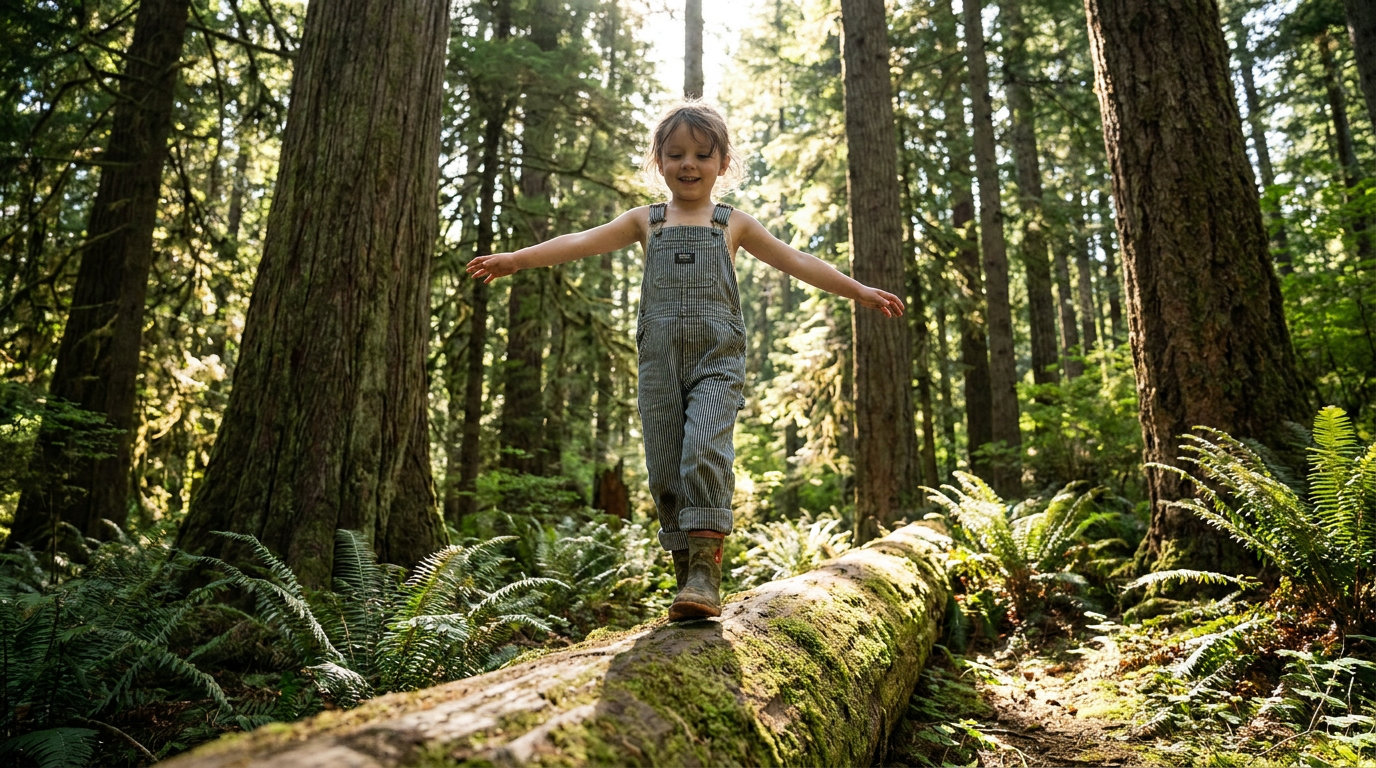
These physical challenges directly translate to cognitive growth through a mechanism that environmental psychologists refer to as the "perception-action loop." Through repeated cycles of trial and error on the playground, children learn to interpret environmental clues—known in the literature as "affordances"—and adjust their physical movements accordingly. A fallen log affords balancing; a low branch affords hanging. By continuously testing these affordances, children build a highly accurate mental map of their own physical dimensions and capabilities, learning exactly how much force, speed, or grip is required to achieve a specific outcome.[2]
Crucially, the cognitive and physical skills forged during risky play do not remain confined to the playground; they transfer directly to real-world survival and safety. A compelling 2026 study published in the Journal of Environmental Psychology found that children who frequently engage in risky play develop superior risk management skills for much higher-consequence scenarios. In controlled simulations, researchers discovered that children who took more physical chances during free play made significantly safer, faster, and more accurate decisions when tasked with navigating a busy pedestrian intersection, proving that playground risks build practical life-saving competence.[2]

Unstructured outdoor play is also a powerful, organic social catalyst that structured sports cannot easily replicate. When adults step back and remove themselves as the ultimate arbiters of fairness, children are forced to negotiate rules, share limited space, and respect each other's physical boundaries. Activities like rough-and-tumble play, or collaborating to build a complex fort from heavy natural materials, require intense cooperation, communication, and real-time conflict resolution. Children learn to read subtle facial expressions and body language to ensure that play remains consensual and fun for everyone involved.[5][7]
The American Psychological Association notes that this specific type of peer-directed play is foundational for teaching empathy, reciprocity, and perspective-taking. Interestingly, studies examining school environments have shown that allowing rough-and-tumble play during recess actually leads to fewer overall reports of malicious bullying. Because children are actively practicing how to modulate their physical strength and read the comfort levels of their peers, they develop a deeper mutual respect and a more sophisticated understanding of consent than children who are strictly forbidden from physical contact.[1][4]
Despite the overwhelming medical and psychological evidence supporting risky play, stepping back remains incredibly difficult for modern parents who have been culturally conditioned to hover. The instinct to immediately yell "Be careful!" or "Get down from there!" the moment a child leaves the ground is deeply ingrained and often driven by a fear of judgment from other adults. However, experts warn that constantly interrupting a child's deep focus to project adult anxiety can actually shatter their concentration, startle them, and significantly increase the likelihood of a physical fall or mistake.[8]
For parents and caregivers who genuinely struggle to resist the urge to intervene, child development researchers offer a highly effective, simple behavioral trick: the 17-second rule. When a child engages in a mildly risky but non-hazardous activity, caregivers are advised to silently count to 17 before stepping in or speaking up. In the vast majority of cases, within that brief window, the child will either successfully solve the physical problem, realize they are stuck and calmly ask for help, or safely abandon the attempt on their own terms.[2][8]

If intervention or communication is absolutely necessary, experts strongly recommend changing the language used. Instead of a panicked, unhelpful command like "Be careful," caregivers can ask guiding, open-ended questions: "Do you feel stable on that branch?" or "What is your plan for getting down from there?" This subtle shift in phrasing prompts the child to pause and actively engage their own internal risk-assessment skills, rather than blindly relying on an adult's external alarm system to dictate their physical boundaries.[7][8]
The ultimate objective of encouraging risky play is not to cultivate reckless daredevils or to dismiss the importance of safety. Rather, it is to foster deep-seated, unshakable emotional resilience. When children learn to trust their own bodies, take initiative, and recover from minor failures, they develop a profoundly positive self-concept. They build an internal sense of worth and capability that does not rely on external validation, perfectly controlled circumstances, or the constant reassurance of hovering adults.[5]
In an era increasingly defined by rising childhood anxiety, digital immersion, and sedentary lifestyles, the messy, unpredictable playground is a vital training ground for adulthood. By actively granting children the time, space, and freedom to encounter manageable risks, society equips them with the internal assurance needed to navigate an inherently complex world. Stepping back and allowing a child to climb a little higher might feel terrifying in the moment, but it is one of the most effective, evidence-based investments a parent can make in their child's long-term mental health.[8]
Viewpoints in depth
Medical & Psychological Consensus
Pediatricians and psychologists argue that eliminating risk harms development.
Major medical bodies, including the American Academy of Pediatrics and the Canadian Paediatric Society, view the lack of unstructured play as a growing public health issue. They argue that overly sanitized environments contribute directly to rising rates of childhood anxiety and obesity. By advocating for a return to 'as safe as necessary' environments, these experts emphasize that minor physical injuries are an acceptable and necessary cost for building lifelong emotional resilience and physical literacy.
Early Childhood Educators
Teachers emphasize the social and cognitive benefits of unstructured environments.
Educators who implement 'loose parts' play and natural playgrounds observe that when adult direction is removed, children are forced to develop critical social skills. Without an adult to arbitrate fairness, children must negotiate rules, cooperate to move heavy objects, and read peer comfort levels during rough-and-tumble play. This environment fosters empathy and conflict resolution far more effectively than highly structured, adult-led activities.
Risk-Averse Culture
The prevailing societal norm that prioritizes absolute safety and liability reduction.
Despite clinical recommendations, many parents and institutions continue to hover, driven by a complex mix of fear, social judgment, and legal liability. Municipalities often design playgrounds to minimize lawsuit potential rather than maximize developmental value, resulting in low-height, rubberized structures that quickly bore older children. For parents, the cultural pressure to be constantly vigilant makes stepping back feel like a dereliction of duty, even when evidence suggests it is beneficial.
What we don't know
- The exact threshold of risk required to trigger the anti-phobic effect in different age groups.
- How to perfectly balance municipal liability concerns with the need for challenging public playgrounds.
Key terms
- Risky Play
- Thrilling, unstructured free play that involves uncertainty and a manageable possibility of physical injury.
- Hazard
- A danger in the environment that is beyond a child's capacity to recognize or manage.
- Anti-phobic Effect
- The psychological process where voluntary exposure to scary situations during play helps a child habituate to fear and reduce anxiety.
- Physical Literacy
- The development of fundamental movement skills, balance, and coordination that allow a child to navigate their environment confidently.
- Perception-Action Loop
- The continuous learning cycle where a child interprets environmental clues and adjusts their physical movements through trial and error.
- Affordances
- The physical opportunities for action that a specific environment provides relative to a child's unique abilities.
Frequently asked
Does risky play mean letting my child do whatever they want?
No. Risky play is child-led but adult-supported. Adults are responsible for removing genuine hazards, like broken equipment or traffic, while allowing children to navigate manageable challenges.
How do I tell the difference between a risk and a hazard?
A risk is a challenge a child can see and assess based on their own skills, like how high to climb a tree. A hazard is a hidden or unmanageable danger a child cannot recognize, like an improperly anchored slide.
What if my child gets hurt?
Minor scrapes and bruises are considered a normal, educational part of risky play. The goal is to prevent serious or fatal injuries while accepting that minor bumps help children learn their physical limits.
How can I suppress my urge to intervene?
Experts recommend the '17-second rule': count to 17 before stepping in. If you must speak, ask guiding questions like 'What is your plan?' rather than yelling 'Be careful!'
Sources
Source coverage
8 outlets
3 viewpoints surfaced








[1]Canadian Paediatric SocietyMedical & Psychological Consensus
Healthy childhood development through outdoor risky play: Navigating the balance with injury prevention
Read on Canadian Paediatric Society →[2]PsyPostMedical & Psychological Consensus
Childhood risky play linked to better real-world safety skills
Read on PsyPost →[3]American Academy of PediatricsMedical & Psychological Consensus
The Role of Play in Promoting Healthy Child Development and Maintaining Strong Parent-Child Bonds
Read on American Academy of Pediatrics →[4]American Psychological AssociationMedical & Psychological Consensus
The importance of unstructured play
Read on American Psychological Association →[5]Rasmussen UniversityEarly Childhood Educators
8 Benefits of Risky Play in Child Development
Read on Rasmussen University →[6]ResearchGateMedical & Psychological Consensus
Children's Risky Play from an Evolutionary Perspective
Read on ResearchGate →[7]National Association for the Education of Young ChildrenEarly Childhood Educators
Fostering Risk Taking in Outdoor Play
Read on National Association for the Education of Young Children →[8]Factlen Editorial TeamFactlen Analysis
Synthesis by Factlen editorial team
Read on Factlen Editorial Team →
Every angle. Every day.
Get lifestyle stories with full source coverage and perspective breakdowns delivered to your inbox.