
Down vs. Synthetic Insulation: The Definitive Trade-Off Analysis
A comprehensive breakdown of the warmth, weight, and environmental trade-offs between natural down and synthetic outdoor gear.
By Factlen Editorial Team
- Ultralight Backpackers
- Advocates for minimizing pack weight at all costs, heavily favoring premium down.
- All-Weather Adventurers
- Prioritizes reliability and safety in unpredictable or wet conditions, favoring synthetic fill.
- Eco-Conscious Consumers
- Focuses on the lifecycle and environmental footprint of outdoor gear.
What's not represented
- · Casual Car Campers
- · Vegan Advocates
Why this matters
Choosing the wrong insulation can lead to a miserable, freezing experience or a dangerously heavy pack. Understanding these specific trade-offs ensures you invest in the right gear for your climate, keeping you safe and comfortable in the backcountry.
Key points
- Premium down offers an unmatched warmth-to-weight ratio, making it up to 50% lighter than synthetic equivalents.
- Synthetic insulation retains up to 80% of its thermal efficiency when wet, whereas untreated down collapses completely.
- Down gear can last 15 to 20 years with proper care, while synthetic fibers typically degrade after 5 to 10 years of compression.
- Natural down has an 18 times lower impact on climate change than virgin polyester, though recycled synthetics are closing the sustainability gap.
For outdoor enthusiasts facing freezing temperatures, the choice of insulation is not merely a matter of comfort—it is a critical decision that dictates warmth, pack weight, and survival in unpredictable weather. The perennial debate between natural down and synthetic insulation remains the most important crossroad when purchasing a winter jacket or sleeping bag. As materials science advances, both technologies have evolved significantly, making the decision more nuanced than ever. We analyzed the performance data, environmental impact reports, and field testing results to build a definitive comparison. Understanding the specific trade-offs between these two dominant insulators is essential for matching your gear to your specific climate, activity level, and budget.[8]
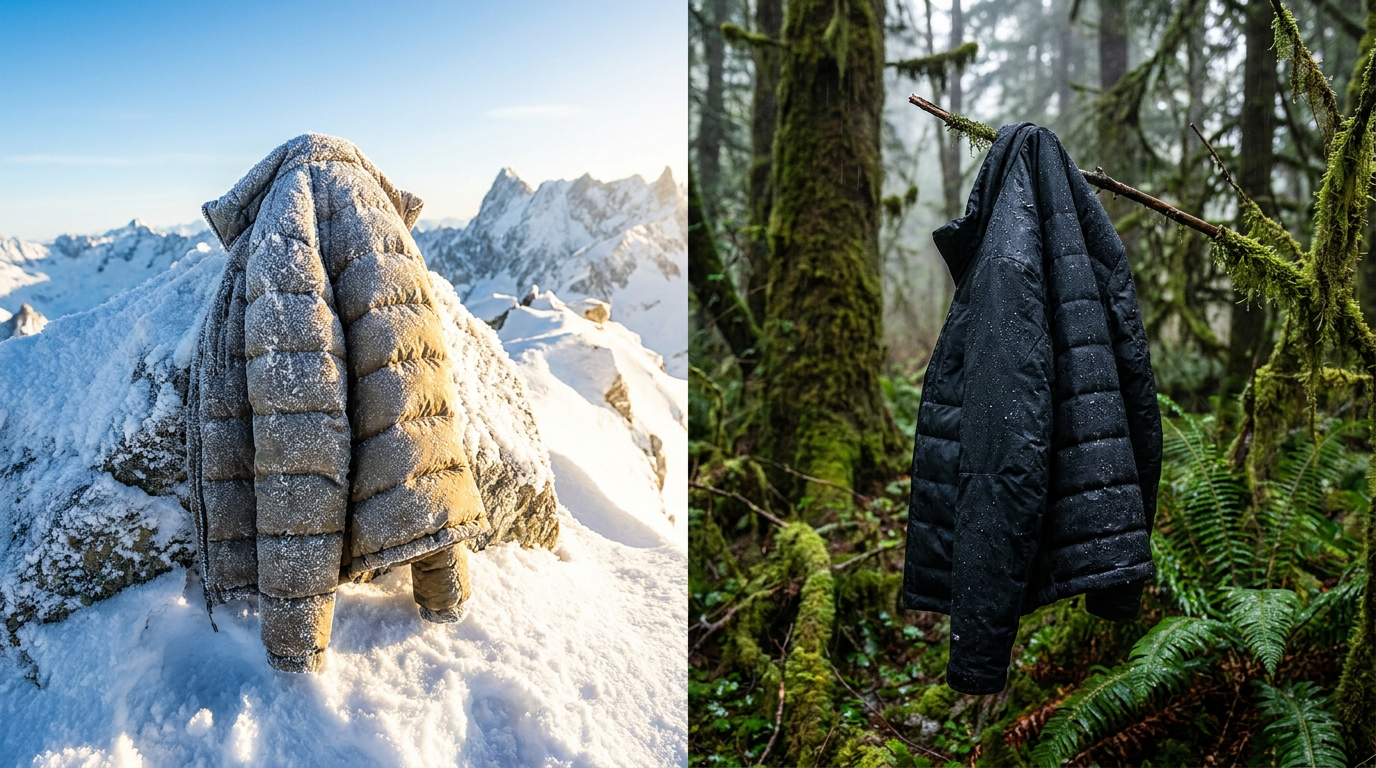
The case for down insulation rests entirely on its unparalleled warmth-to-weight ratio and its remarkable compressibility. Derived from the soft, fuzzy undercoat plumage of ducks and geese, down clusters are nature’s most efficient insulators. These complex, three-dimensional structures trap body heat within countless tiny air pockets while remaining incredibly lightweight. When you pull on a premium down jacket, the immediate sensation is one of intense, sleeping-bag-like coziness without the burden of heavy fabric. Because the clusters are so resilient, down can be crushed into the bottom of a backpack and will rapidly regain its original loft the moment it is unpacked, making it the gold standard for packability.[5][6]
The evidence for down’s superiority is quantified in its fill power, a metric that measures the volume in cubic inches that one ounce of down occupies. Premium goose down can achieve fill power ratings of 900 or more. At this elite level, the insulation is approximately fifty percent lighter than a 600-fill-power equivalent while delivering the exact same thermal output. This exponential efficiency allows winter-rated sleeping bags to weigh as little as two or three pounds. For high-altitude mountaineers and ultralight backpackers, this mathematical advantage is impossible to ignore, as it directly translates to less physical exertion on the trail.[2][8]

The case against down centers on its catastrophic vulnerability to moisture and its steep upfront cost. When untreated down feathers get wet, the delicate clusters clump together and collapse, completely losing their ability to trap air and retain heat. A saturated down jacket is effectively useless in a survival situation and takes a notoriously long time to dry. While modern hydrophobic treatments—which coat the feathers in a durable water repellent—have improved down’s resistance to light rain, a heavy downpour will still overwhelm the material. Furthermore, the complex sourcing and cleaning processes required to produce high-fill-power down make these garments significantly more expensive than their synthetic counterparts.[6][7]
The case for synthetic insulation is built on absolute reliability in adverse conditions and broader accessibility. Engineered from fine polyester fibers designed to mimic the heat-trapping structure of natural plumage, synthetic fill provides a robust thermal barrier that does not fail when the skies open up. Because the moisture is trapped between the solid polyester filaments rather than absorbed into them, the insulation maintains its structural integrity. This makes synthetic gear the workhorse of the outdoor industry, favored by those who need their equipment to perform consistently regardless of the forecast or their own heavy perspiration.[3][5]
The case for synthetic insulation is built on absolute reliability in adverse conditions and broader accessibility.
The evidence for synthetic performance is most visible in wet-weather testing and price tags. High-quality synthetic insulation retains up to eighty percent of its thermal efficiency even when fully saturated, a stark contrast to down’s near-total collapse. It also dries significantly faster, often relying solely on body heat to evaporate trapped moisture while on the move. From a financial perspective, the manufacturing efficiency of spun polyester means that synthetic jackets and sleeping bags typically cost thirty to fifty percent less than comparable down models, making them highly attractive for budget-conscious buyers or those outfitting an entire family.[7][8]

The case against synthetic insulation highlights its inherent bulk, heavier weight, and shorter functional lifespan. To achieve the same warmth as a premium down garment, synthetic gear must utilize denser, heavier sheets of polyester. A synthetic winter sleeping bag might weigh four to five pounds and demand twice the pack space of a down equivalent, forcing hikers to carry larger backpacks. Additionally, synthetic fibers are prone to mechanical breakdown. Repeated stuffing and compression gradually flatten the polyester filaments, meaning a synthetic bag will typically lose its loft after five to ten years, whereas a well-maintained down bag can last up to two decades.[5][7]
The environmental evidence presents a highly complex trade-off for eco-conscious consumers. A comprehensive Life Cycle Assessment commissioned by the International Down and Feather Bureau found that natural down has an eighteen times lower impact on climate change than virgin polyester fill, and it is fully biodegradable at the end of its life. However, down production raises significant animal welfare concerns, making third-party certifications like the Responsible Down Standard critical to ensure ethical sourcing. Conversely, while synthetic insulation avoids animal use, it relies heavily on petroleum extraction. To mitigate this, leading outdoor brands are aggressively shifting toward synthetic fills made entirely from post-consumer recycled plastic bottles.[1][4]

Ultimately, down insulation fits well when minimizing weight and maximizing pack space are the absolute highest priorities, and the environment is reliably dry or consistently below freezing. It is the definitive, uncompromising choice for high-altitude mountaineering, ultralight long-distance backpacking, and static cold-weather camping where every single gram matters. In these scenarios, the unmatched warmth-to-weight ratio of premium goose down provides a critical performance edge that synthetic materials simply cannot replicate. For those carrying their entire shelter and survival system across hundreds of miles of rugged terrain, the ability to compress a sub-zero sleeping bag to the size of a melon is worth the premium price tag and the meticulous care required to keep it dry.[6][7]
Conversely, down does not fit well when venturing into humid, rainy climates like the Pacific Northwest, or for high-output aerobic activities like backcountry skiing where heavy sweating is inevitable. In these damp scenarios, the risk of the insulation collapsing and leaving the wearer exposed to hypothermia far outweighs the initial weight savings. Down is also a poor choice for everyday outdoor workwear or environments where the lightweight, fragile nylon shell of a typical puffy jacket might be easily torn by branches, rocks, or tools, instantly exposing the expensive feathers to the elements and ruining the garment.[6]
Synthetic insulation fits well when consistent performance in wet conditions is an absolute non-negotiable requirement. It is the optimal choice for damp coastal hiking, winter sports where snow might melt directly into the fabric, and multi-day river trips where gear is constantly exposed to moisture. It also serves as the best option for budget-conscious buyers who need reliable warmth without the premium price tag, and for those who prefer low-maintenance gear that can be easily washed in a standard machine without specialized detergents or tennis balls.[5][6]
However, synthetic insulation does not fit well when pack space is severely restricted or when carrying the absolute minimum weight is essential for the success of a multi-day expedition. For those pushing the limits of fast-and-light alpine travel, the extra bulk of synthetic gear remains a significant handicap that slows progress and increases fatigue. It is also less ideal for long-term investments; users who spend hundreds of days a year in the backcountry will find that synthetic insulation packs out and loses its warmth far quicker than a quality down alternative, ultimately requiring more frequent replacement.[5][7]

How we got here
1960s
Lightweight down and feather gear becomes mainstream, revolutionizing outdoor recreation by replacing heavy wool and canvas.
1980s
PrimaLoft and other synthetic insulations are developed initially for the military to provide a water-resistant alternative to down.
2010s
Hydrophobic down treatments are introduced to the consumer market, bridging the gap between down's weight and synthetic's water resistance.
2020s
Major outdoor brands shift aggressively toward 100% recycled synthetic insulations and strictly certified ethical down to address environmental concerns.
Viewpoints in depth
Ultralight Backpackers
Advocates for minimizing pack weight at all costs, heavily favoring premium down.
For those carrying their shelter and survival gear across hundreds of miles, every ounce translates to physical toll. This camp argues that the unmatched warmth-to-weight ratio of 900-fill down makes it the only viable option for serious alpine pursuits. They mitigate the moisture risk through meticulous gear management, using waterproof stuff sacks and specialized tent designs rather than compromising on their insulation's baseline weight.
All-Weather Adventurers
Prioritizes reliability and safety in unpredictable or wet conditions, favoring synthetic fill.
This perspective emphasizes that the best gear is the gear that works when everything goes wrong. In environments like the Pacific Northwest or Scottish Highlands, staying perfectly dry is often impossible. This camp points to the fact that synthetic insulation retains up to 80% of its warmth when saturated as a critical safety feature, arguing that the extra pound of weight is a necessary insurance policy against hypothermia.
Eco-Conscious Consumers
Focuses on the lifecycle and environmental footprint of outdoor gear.
The environmental camp faces a difficult choice between two imperfect options. On one hand, natural down boasts an 18 times lower impact on climate change than virgin polyester and is fully biodegradable, but it carries inherent animal welfare concerns that require strict third-party certifications like the Responsible Down Standard. On the other hand, synthetic materials avoid animal use but rely on petroleum extraction and shed microplastics, leading this camp to increasingly demand 100% post-consumer recycled synthetic options.
What we don't know
- How quickly fully bio-based synthetic insulations will be able to match the exact warmth-to-weight ratio of 900-fill goose down.
- Whether emerging aerogel-infused synthetic fibers will eventually eliminate the bulk and weight penalty currently associated with wet-weather gear.
Key terms
- Fill Power
- A measurement of down quality indicating how many cubic inches one ounce of down occupies; higher numbers mean greater warmth for less weight.
- Loft
- The thickness or fluffiness of an insulating material, which determines how much warm air it can trap.
- Hydrophobic Down
- Natural down feathers that have been treated with a durable water repellent (DWR) coating to resist moisture and dry faster.
- Responsible Down Standard (RDS)
- A global certification ensuring that down and feathers come from animals that have not been subjected to unnecessary harm, such as live-plucking.
- Life Cycle Assessment (LCA)
- A scientific methodology used to evaluate the environmental impacts associated with all stages of a product's life, from raw material extraction to disposal.
Frequently asked
Can I wash a down jacket at home?
Yes, but it requires care. Use a specialized down wash and a front-loading machine on a gentle cycle. Crucially, tumble dry on low heat with clean tennis balls to break up clumps and restore the loft.
What does fill power actually mean?
Fill power measures the volume in cubic inches that one ounce of down occupies. A higher number, like 800 or 900, means the down is loftier, trapping more air and providing greater warmth for less weight.
Is hydrophobic down as good as synthetic insulation in the rain?
Hydrophobic down is treated with a water-repellent coating that helps it resist moisture up to 13 times longer than untreated down. However, if it becomes fully saturated, it will still lose its loft and insulating properties, unlike synthetic fill.
How long should a synthetic sleeping bag last?
With regular use, synthetic insulation typically begins to pack out and lose its loft after 5 to 10 years. In contrast, a well-maintained down sleeping bag can retain its performance for 15 to 20 years.
Sources
Source coverage
8 outlets
3 viewpoints surfaced







[1]International Down and Feather BureauEco-Conscious Consumers
Life Cycle Assessment Shows Down and Feather Products are More Sustainable than Alternatives
Read on International Down and Feather Bureau →[2]Outdoor Gear LabUltralight Backpackers
The Best Winter Jackets for Men | Tested & Ranked
Read on Outdoor Gear Lab →[3]Popular MechanicsAll-Weather Adventurers
Down vs. Synthetic Insulation: Which Keeps You Warmer This Winter?
Read on Popular Mechanics →[4]Better TrailEco-Conscious Consumers
Understanding Responsible Materials in Outdoor Gear
Read on Better Trail →[5]Taunton LeisureAll-Weather Adventurers
Down vs Synthetic Insulation: Which is best for you?
Read on Taunton Leisure →[6]Black DiamondAll-Weather Adventurers
How to Choose an Insulated Jacket
Read on Black Diamond →[7]CampSaverUltralight Backpackers
Down vs Synthetic Insulation: What You Need to Know
Read on CampSaver →[8]Factlen Editorial TeamEco-Conscious Consumers
Synthesis by Factlen editorial team
Read on Factlen Editorial Team →


Every angle. Every day.
Get shopping stories with full source coverage and perspective breakdowns delivered to your inbox.