
The Rise of the AI Automation Agency: How Fractional Consulting Became 2026's Most Profitable Side Hustle
Professionals are abandoning traditional hourly freelancing to build custom AI agents and automated workflows for small businesses, creating a booming market for 'fractional' tech talent.
By Factlen Editorial Team
- AI Automation Operators
- Freelancers and solo entrepreneurs who view AI as a tool to decouple their income from their time, prioritizing scalable systems over hourly billing.
- Small & Mid-Market Businesses
- Companies seeking the operational benefits of enterprise AI without the crushing overhead of full-time technical hires.
- Traditional Tech Sector
- Established developers and agencies who caution that no-code AI wrappers can be fragile and lack long-term defensibility.
What's not represented
- · Enterprise SaaS Providers
- · Full-time Machine Learning Engineers
Why this matters
As artificial intelligence reshapes the economy, the ability to implement AI systems for others has emerged as one of the most accessible and high-leverage paths to financial independence, requiring process-mapping skills rather than traditional coding.
Key points
- Freelancers are shifting from hourly work to building AI automation agencies.
- Operators use no-code tools to build custom AI agents for small businesses.
- The model relies on productized services, yielding 70% to 85% profit margins.
- Experienced operators are evolving into part-time 'Fractional AI Officers' for mid-market companies.
The traditional side hustle is undergoing a structural rewrite. For the past decade, the gig economy was defined by trading hours for dollars—driving, designing, or writing on a per-project basis. But in 2026, a new class of digital workers is abandoning the hourly model entirely. They are building "AI Automation Agencies" (AIAAs), a rapidly growing micro-business model where solo operators construct custom artificial intelligence systems for local and mid-market businesses.[6][8]
The premise is simple but lucrative: small and medium-sized businesses know they need to adopt AI to remain competitive, but they lack the technical expertise or the budget to hire a dedicated machine learning engineer. Instead of hiring full-time staff, these businesses are turning to freelance AI operators who can build bespoke solutions—like autonomous customer service bots, automated lead-qualification pipelines, or custom data-analysis agents—for a fraction of the cost.[1][2][5][6]
"The gap between AI activity and AI leadership is exactly what a fractional AI operator fills," notes industry analysis from Crescent AI. By stepping into this void, side-hustlers are transforming themselves from task-doers into high-leverage systems architects.[5][9]
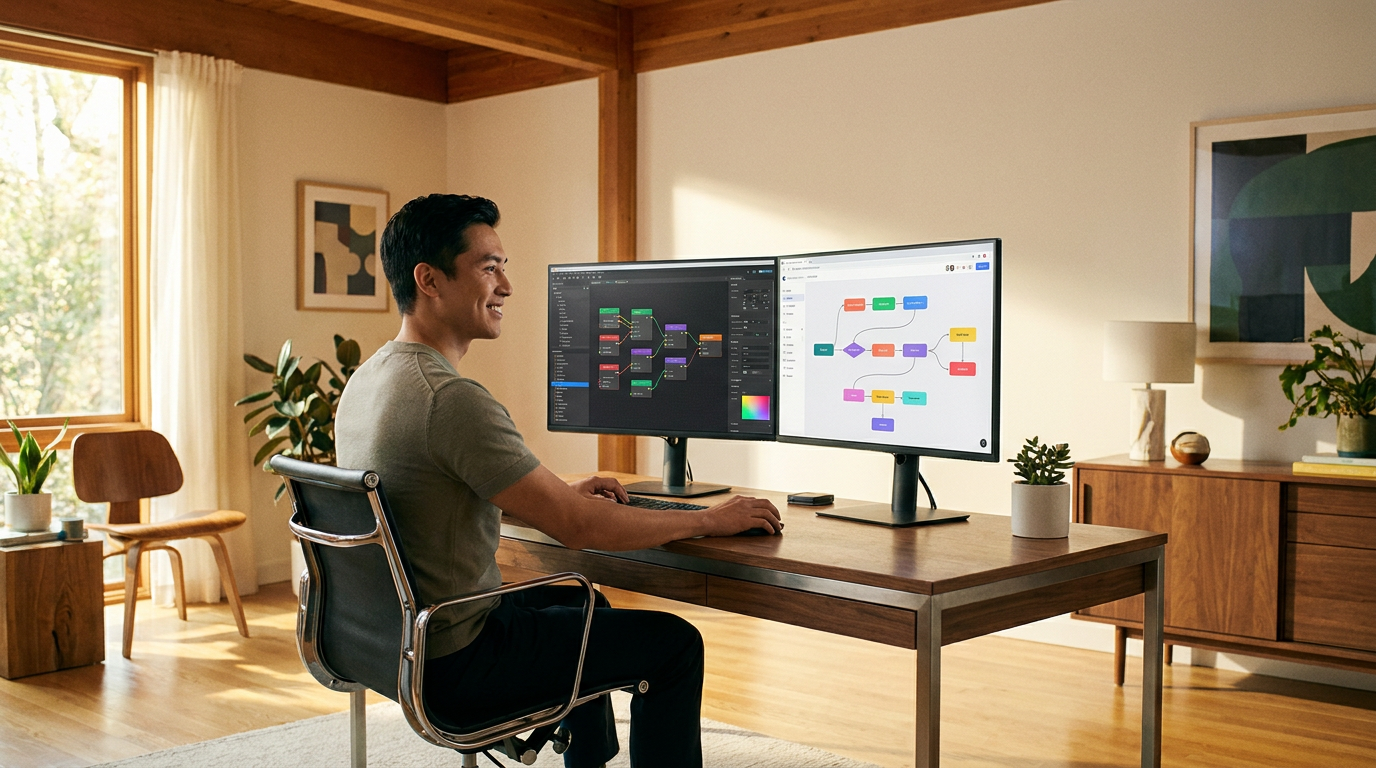
At the core of this boom is the "no-code" revolution. Just a few years ago, building a functional AI agent required deep programming knowledge and expensive cloud infrastructure. Today, the barrier to entry has evaporated. Operators are using visual, drag-and-drop platforms to connect powerful Large Language Models directly to a business's existing software.[3][6]

A typical tech stack for a 2026 AI side hustle rarely involves writing raw Python. Instead, operators use platforms like Voiceflow to design conversational agents, Lovable to spin up web applications from natural language prompts, and automation hubs like Make.com or n8n to wire everything together. For example, an operator might connect a real estate agency's inbound leads to an AI-powered voice agent that instantly calls the prospect, qualifies their budget, and books an appointment directly onto the broker's calendar.[3][6][7]
Because these tools handle the heavy technical lifting, the operator's true value lies in process mapping. The most successful AI automation agencies do not sell the concept of artificial intelligence; they sell specific, measurable business outcomes. They audit a company's workflow, identify bottlenecks where employees spend hours on repetitive tasks, and deploy an agent to handle the friction.[1][6][8]
This shift fundamentally changes the economics of freelance work. In a traditional service business, scaling revenue requires hiring more employees, which increases overhead and management complexity. The AIAA model, however, relies heavily on productized services. Once an operator builds a successful lead-generation workflow for one dental clinic, they can replicate that exact architecture for dozens of other clinics with minimal additional effort.[3][8]
This shift fundamentally changes the economics of freelance work.
This scalability allows solo operators to achieve profit margins that traditional agencies can only dream of. Industry data from 2026 shows that successful AI automation side hustles routinely hit 70% to 85% profit margins. Operators typically charge a setup fee ranging from $2,000 to $5,000, followed by a monthly retainer of $500 to $1,500 for maintenance, prompt optimization, and API costs.[3][8]

As these side-hustlers gain experience and prove their value, many are evolving into a more embedded, strategic role: the Fractional Chief AI Officer. While an automation agency focuses on building specific tools, a fractional AI officer owns the company's broader AI strategy on an ongoing, part-time retainer.[4][5]
"Fractional AI talent refers to senior AI engineers, automation specialists, and technical operators who work with a business on a part-time or project basis," explains Rafiki Works, a managed talent platform. For 10 to 15 hours a month, these specialists audit the company's existing software stack, govern data privacy protocols, and decide which AI tools the internal team should adopt.[4][5]
This model is particularly attractive to mid-market companies. A full-time, senior AI executive in the US currently commands an all-in compensation package exceeding $240,000 annually. By hiring a fractional officer for $2,000 to $5,000 a month, the business gets executive-level guidance without the crushing overhead, while the operator can service three to five clients simultaneously, pushing their side-hustle income well into the six figures.[4][5]

Despite the explosive growth and high margins, the AI automation space carries inherent risks. The most pressing uncertainty is the blistering pace of AI development itself. As foundation models become increasingly capable and user-friendly, the "wrapper" solutions built by today's agencies risk rapid commoditization.[8][9]
If a major tech provider releases a native, one-click feature that perfectly handles appointment booking or inventory management, the custom workflows built by freelance operators could become obsolete overnight. Traditional software developers also caution that no-code AI systems can be fragile; when an underlying API changes or a model updates its behavior, interconnected workflows can break silently, causing chaos for the end client.[8][9]
To survive this rapid evolution, the most resilient operators are moving beyond simple API connections. They are focusing on Retrieval-Augmented Generation systems that integrate deeply with a client's proprietary, unstructured data—something off-the-shelf AI cannot easily replicate without custom configuration.[4][6]
Ultimately, the rise of the AI Automation Agency represents a democratization of enterprise-grade technology. By bridging the gap between cutting-edge AI models and the everyday operational struggles of small businesses, a new generation of digital workers is proving that the most valuable skill in 2026 is not necessarily writing code—it is knowing exactly how to apply it to solve real-world problems.[1][9]
How we got here
Pre-2023
The gig economy is dominated by hourly freelance work on platforms like Upwork and Fiverr.
Late 2023
The release of advanced LLMs sparks initial interest in AI consulting, mostly focused on prompt engineering.
2024–2025
No-code tools mature, allowing non-programmers to build complex, autonomous AI agents.
2026
The 'Fractional AI' and AIAA models become mainstream, offering high-margin, scalable income for solo operators.
Viewpoints in depth
The Solo Operator's View
Prioritizing leverage and scalable income over traditional employment.
For AI automation operators, the appeal of this model is the decoupling of time and money. Traditional freelancing caps income based on the number of hours a person can work in a week. By building productized AI systems, operators create assets that run autonomously. They argue that mastering no-code tools and process mapping provides a faster, more reliable path to financial independence than climbing a corporate ladder or learning traditional full-stack software development.
The Mid-Market Business View
Seeking enterprise-grade AI capabilities without enterprise-grade overhead.
Small and medium-sized business owners view fractional AI talent as a critical bridge. They recognize that failing to adopt AI will leave them at a competitive disadvantage, but the economics of hiring a dedicated, full-time machine learning engineer simply do not make sense for a 50-person company. They value operators who speak in terms of business outcomes—like reducing customer service response times or increasing lead conversion rates—rather than technical jargon.
The Traditional Developer's View
Cautioning against the fragility of 'wrapper' solutions.
Traditional software engineers and enterprise IT professionals often view the AIAA boom with skepticism. They point out that many of these side hustles are essentially 'wrappers'—thin layers of automation built on top of third-party APIs like OpenAI. If those APIs change their pricing, alter their models, or experience downtime, the entire automated workflow can collapse. They argue that true, defensible value requires proprietary data integration and custom engineering, not just drag-and-drop connections.
What we don't know
- How quickly major SaaS platforms will release native AI features that render custom automation wrappers obsolete.
- Whether the high profit margins of AI automation agencies will compress as more operators enter the market.
Key terms
- AI Automation Agency (AIAA)
- A micro-business model where an operator builds and maintains custom artificial intelligence workflows for other companies.
- Fractional AI Officer
- A senior strategist who manages a company's AI adoption and governance on a part-time, retainer basis.
- No-Code Platforms
- Software tools that allow users to build applications and automated workflows using visual, drag-and-drop interfaces instead of writing traditional code.
- Productized Service
- A standardized service sold like a product, allowing the provider to replicate the same solution for multiple clients with minimal extra work.
- RAG (Retrieval-Augmented Generation)
- An AI framework that connects a language model to a specific, private database so it can answer questions based on proprietary company information.
Frequently asked
Do I need to know how to code to start an AI automation agency?
No. Most operators use visual 'no-code' platforms like Make.com, Zapier, and Voiceflow to connect AI models to business software.
What kind of businesses hire fractional AI talent?
Mid-market companies and local businesses (like real estate firms, dental clinics, and e-commerce brands) that need AI implementation but cannot afford a $240,000 full-time engineer.
What is the biggest risk to this business model?
Commoditization. As major software providers build native AI features into their platforms, custom 'wrapper' solutions built by freelancers may become obsolete.
Sources
Source coverage
9 outlets
3 viewpoints surfaced








[1]MediumAI Automation Operators
How People Are Actually Making Money With AI Agents in 2026
Read on Medium →[2]ForbesTraditional Tech Sector
3 AI Side Hustles That Pay Over $100K
Read on Forbes →[3]SyncSkillsAI Automation Operators
AI Side Hustle Ideas 2026: How to Make $500-$5,000/Month with AI Skills
Read on SyncSkills →[4]Rafiki WorksSmall & Mid-Market Businesses
What is fractional AI talent?
Read on Rafiki Works →[5]Crescent AISmall & Mid-Market Businesses
What Is a Fractional AI Officer? When Does Your Business Need One? (2026)
Read on Crescent AI →[6]VoiceflowSmall & Mid-Market Businesses
How To Start An AI Automation Agency In 7 Days
Read on Voiceflow →[7]IdeaProofTraditional Tech Sector
52 Side Hustle Ideas Ranked by Hourly Pay (2026 Data)
Read on IdeaProof →The $30K/Month AI Automation Agency Blueprint
Read on The AI Agency Blueprint →[9]Factlen Editorial TeamTraditional Tech Sector
Synthesis by Factlen editorial team
Read on Factlen Editorial Team →


Every angle. Every day.
Get finance stories with full source coverage and perspective breakdowns delivered to your inbox.