
At-Home Brain Implant Restores Voice and Autonomy for ALS Patient in Historic Milestone
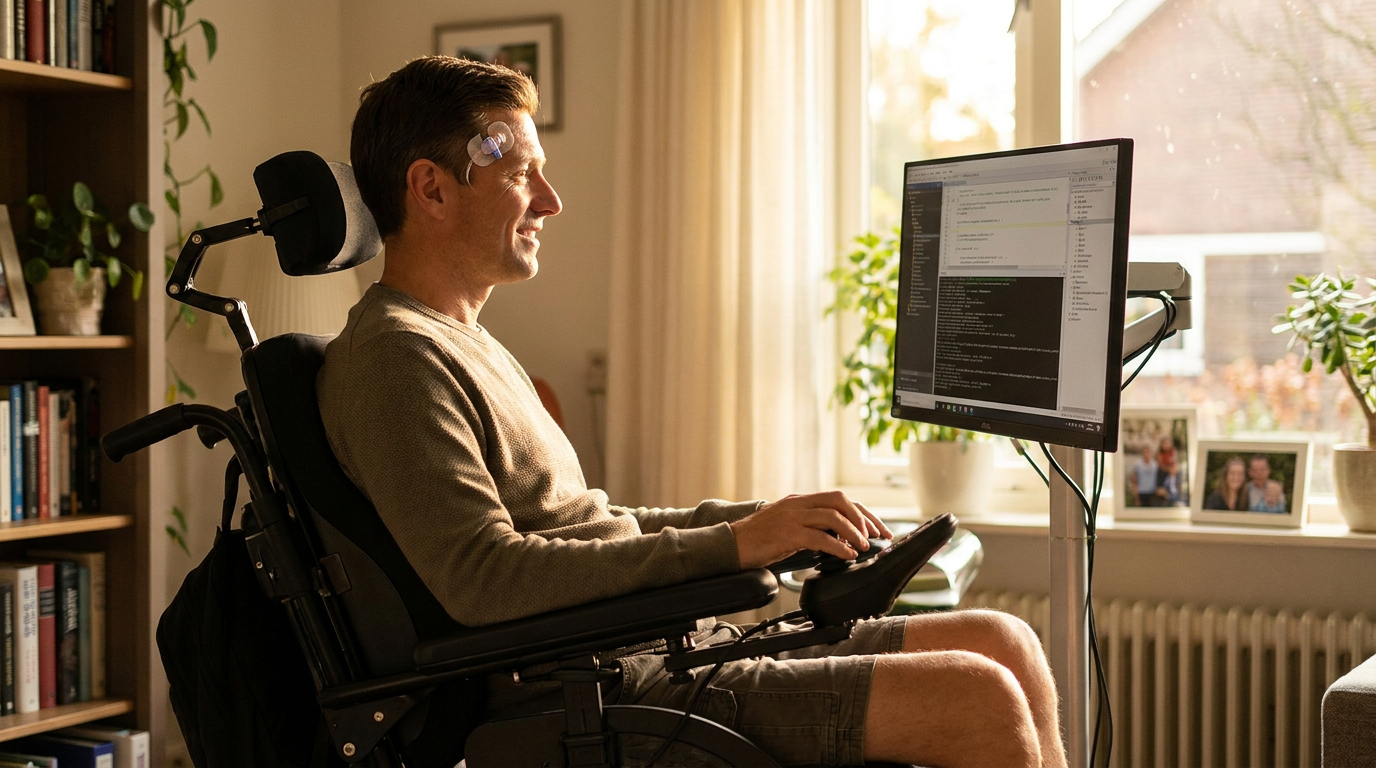
A 47-year-old man with ALS has successfully used a brain-computer interface independently at home for nearly two years, communicating at 56 words per minute with 99 percent accuracy.
By Factlen Editorial Team
- Neuroengineering Researchers
- View the breakthrough as a critical technical threshold crossed, proving that high-density intracortical BCIs can function reliably outside the lab without constant expert supervision.
- Patient Advocates & Users
- Emphasize the profound psychological and practical impacts of restoring a patient's voice, autonomy, and ability to participate in family and professional life.
- Technology Analysts
- Focus on the commercial and ethical future of the technology, noting that privacy controls and long-term stability are prerequisites for scaling BCIs to the broader public.
What's not represented
- · Regulatory Agencies (FDA)
- · Health Insurance Providers
Why this matters
For decades, brain-computer interfaces have been confined to highly controlled laboratories, offering theoretical hope but little practical utility. This breakthrough proves that severe paralysis and conditions like ALS no longer have to mean total isolation, paving the way for commercial implants that can restore a patient's voice, autonomy, and career from the comfort of their own home.
Key points
- A 47-year-old man with ALS has successfully used a brain-computer interface at home for nearly two years.
- The system translates his attempted speech into text and a synthesized voice at 56 words per minute.
- Operating with 99% accuracy, the BCI allows him to communicate independently without researchers present.
- The implant features 256 microelectrodes that record single-neuron activity in the speech motor cortex.
- The patient also uses the system to control a computer cursor, enabling him to navigate the web and work.
- The 3,800 hours of recorded use represents the largest single-neuron dataset ever compiled.
Casey Harrell spent years as a passionate climate activist, speaking out at public events and lobbying policymakers. But in 2020, he was diagnosed with amyotrophic lateral sclerosis (ALS), a devastating neurodegenerative disease that systematically destroys the body's motor neurons. Over the next few years, the disease stripped Harrell of his ability to walk, to type on a keyboard, and eventually, to speak. His mind remained entirely sharp, but his body had become a prison, severing his ability to communicate his thoughts, needs, and humor to the outside world.[2][5]
Today, however, Harrell is once again holding conversations, sending emails, and continuing his environmental advocacy from the comfort of his home. He does this without moving a single muscle. Instead, he relies on a cutting-edge brain-computer interface (BCI) that intercepts the electrical signals in his brain and translates them directly into text and a synthesized voice. The technology has not only given him his voice back, but it has also allowed him to reclaim his role as a father, a husband, and a professional.[2][3]
The details of this historic medical milestone were published on June 15, 2026, in the journal Nature Medicine. Researchers from UC Davis Health, Brown University, and the Mass General Brigham Neuroscience Institute documented Harrell's experience using the BCI over the course of nearly two years. While brain implants have successfully decoded speech in the past, this study marks a monumental threshold: it is the first time a patient has used a high-density intracortical BCI independently, at home, without a team of scientists hovering over them.[1][2]
For decades, brain-computer interfaces were strictly confined to highly controlled laboratory environments. They were viewed as brilliant proof-of-concept devices, but they required constant recalibration, complex software adjustments, and the physical presence of neuroengineers to function. Harrell's system shatters that paradigm. Today, his caregiver simply connects the external wire to a port on his head, and Harrell operates the system entirely on his own, sometimes for up to 12 hours a day.[2][6]

The mechanics of the system begin with a surgical procedure performed in July 2023. UC Davis neurosurgeon David Brandman implanted four microelectrode arrays into Harrell's left precentral gyrus, the specific region of the cerebral cortex responsible for coordinating the complex muscle movements required for speech. These arrays, manufactured by Blackrock Neurotech, feature 256 microscopic metallic spikes that penetrate 1.5 millimeters into the brain tissue to record the electrical firing of individual neurons.[2][4]
It is a common misconception that these devices read minds or intercept abstract inner monologues. They do not. The BCI only activates when Harrell makes a conscious attempt to move his jaw, lips, and tongue to articulate a word. Because his brain still generates the exact electrical commands required for speech—even though the spinal pathways to his muscles are broken—the microelectrodes can capture those specific neural blueprints as they are being drafted.[2][6]
Once the electrical signals are captured, advanced artificial intelligence takes over. A deep-learning neural network analyzes the brain's firing patterns every 80 milliseconds, predicting the specific phonemes—the fundamental acoustic building blocks of language—that Harrell is attempting to produce. An open-source language model then rapidly assembles these phonemes into coherent words and sentences, displaying them on a computer screen in real time.[4][6]
Once the electrical signals are captured, advanced artificial intelligence takes over.
The speed and accuracy of this decoding process are unprecedented in the field of neuroprosthetics. Harrell is able to communicate at an average speed of 56 words per minute. Furthermore, the system supports a massive vocabulary of 125,000 words while maintaining a staggering 99 percent word accuracy rate. In subjective feedback surveys, Harrell rated 92 percent of the generated sentences as perfectly capturing his intended meaning, allowing for fluid, naturalistic conversations.[1][2]

To make the experience as authentic as possible, the text output is routed through a sophisticated text-to-speech synthesizer. Before he completely lost his ability to speak, researchers trained the audio software on recordings of Harrell's actual voice. When he attempts to speak today, the computer does not output a generic robotic drone; it speaks in Harrell's own natural cadence and tone, allowing his young daughter and his wife to hear the voice they thought was lost forever.[3][6]
The UC Davis engineering team also discovered that the neural signals generated in the speech motor cortex could be repurposed for dual functionality. By attempting specific movements, Harrell can use the exact same BCI to control a computer cursor. This allows him to seamlessly transition from speaking aloud to navigating web browsers, clicking links, and drafting emails, granting him total digital autonomy and the ability to continue his professional lobbying work.[1][2]
The sheer volume of data generated by Harrell's daily use is historic. Over the course of 23 months, he has operated the system for more than 3,800 hours, communicating over 183,000 sentences and nearly two million words. According to neuroscientist Sergey Stavisky, co-director of the UC Davis Neuroprosthetics Lab, this represents by far the largest individual brain recording dataset with single-neuron resolution ever compiled in human history.[1][2]
This massive dataset is a goldmine for the broader scientific community. By analyzing thousands of hours of neural activity, researchers are gaining unprecedented insights into how the human brain orchestrates the incredibly complex mechanics of language. This foundational knowledge will accelerate the development of next-generation therapies, not just for ALS, but for stroke survivors and individuals with severe spinal cord injuries.[2][6]

Recognizing the deeply intimate nature of recording direct brain activity, the engineering team prioritized patient sovereignty by building a privacy mode into the software. Harrell can easily toggle a setting that completely blocks his BCI data from being transmitted back to the university's servers. Postdoctoral scholar Nicholas Card noted that this feature was intentionally designed to set an ethical standard for future commercial BCIs, ensuring that users retain absolute control over their neural data.[1][6]
The BrainGate2 clinical trial, which facilitated Harrell's implant, continues to actively enroll new participants across the United States. While the current system requires a physical wire connecting the skull to a computer, the ultimate goal of the consortium is to develop a fully implantable, wireless system that operates invisibly, much like a cardiac pacemaker. Several neurotechnology companies are already using the trial's success to design their own commercial roadmaps.[2][4]
For patients living with severe paralysis, the psychological toll of being locked in is often as devastating as the physical decline. The inability to express basic needs, share a joke, or comfort a loved one frequently leads to profound isolation and depression. By restoring a patient's ability to effortlessly project their thoughts into the world, this technology fundamentally alters the emotional trajectory of neurodegenerative diseases.[5][6]
The success of this trial proves that the era of practical, daily-use neuroprosthetics has officially arrived. The technology has matured from a fragile scientific demonstration into a reliable, life-sustaining tool. As researcher Nicholas Card reflected on the project, the true purpose of this monumental engineering feat is not simply to decode neurons or train algorithms, but to quietly give a person back to the people who love them.[3][6]

How we got here
2020
Casey Harrell is diagnosed with ALS, eventually losing his ability to walk, use his hands, and speak.
July 2023
Surgeons at UC Davis implant four microelectrode arrays into Harrell's speech motor cortex as part of the BrainGate2 trial.
Late 2023
Harrell begins using the BCI in a lab setting, achieving unprecedented speech decoding accuracy.
2024
The system is adapted for home use, and Harrell begins operating it independently without researchers present.
June 2026
Nature Medicine publishes the results of Harrell's 3,800 hours of independent at-home use, marking a historic milestone for neuroprosthetics.
Viewpoints in depth
Neuroengineering Researchers
Focus on the technical milestone of moving BCIs from the lab to independent home use.
For neuroscientists and engineers, the true victory of this trial is not just the decoding accuracy, but the system's stability. Historically, intracortical implants suffered from signal degradation and required constant, tedious recalibration by a team of experts. By demonstrating that a patient can operate a 256-electrode array independently for nearly two years—maintaining 99% accuracy while communicating over 183,000 sentences—researchers have proven that the hardware and AI algorithms are finally robust enough for real-world, unsupervised deployment.
Patient Advocates & Users
Emphasize the profound psychological impact of restoring a patient's voice and autonomy.
ALS and similar neurodegenerative diseases often leave patients 'locked in'—cognitively sharp but entirely cut off from the outside world. Patient advocates stress that the inability to communicate leads to severe isolation, depression, and a loss of identity. For users like Casey Harrell, the BCI is not just a medical device; it is a lifeline that allows them to express humor, make medical decisions, continue their careers, and speak to their children in their own natural, pre-disease voice.
Technology Analysts
Focus on the commercial roadmap and the ethical necessity of privacy controls in neural data.
As BCIs transition from clinical trials to commercial products, industry analysts are closely watching how companies handle neural data. The inclusion of a 'privacy mode' in the UC Davis system—allowing the user to cut off data transmission to researchers—is viewed as a vital precedent. Analysts argue that for BCIs to achieve widespread public acceptance, manufacturers must guarantee that intimate neural recordings are protected from commercial exploitation and that patients retain absolute sovereignty over their digital outputs.
What we don't know
- When fully wireless, invisible brain-computer interfaces will become available for the general public.
- How long the microelectrode arrays can remain implanted in the brain before signal degradation occurs.
- Whether the exact same AI decoding algorithms will work as seamlessly for patients with different neurological conditions, such as stroke.
Key terms
- Amyotrophic Lateral Sclerosis (ALS)
- A progressive neurodegenerative disease that destroys motor neurons, eventually stripping a person of their ability to walk, use their hands, speak, and breathe.
- Brain-Computer Interface (BCI)
- A system that connects the brain to an external device, allowing neural signals to control computers, prosthetics, or speech synthesizers.
- Motor Cortex
- The region of the brain's cerebral cortex involved in the planning, control, and execution of voluntary movements.
- Phoneme
- The smallest unit of sound in speech, which the BCI's artificial intelligence decodes before assembling full words.
- Microelectrode Array
- A tiny grid of microscopic metallic spikes implanted into the brain tissue to record the electrical activity of individual neurons.
Frequently asked
Does the brain-computer interface read the patient's thoughts?
No. The BCI does not read abstract thoughts or inner monologues. It only detects the electrical signals generated when the user actively attempts to move their facial muscles to speak.
How does the computer know what the person is trying to say?
The implanted electrodes record neural firing patterns, which an AI neural network translates into phonemes (the building blocks of sound) every 80 milliseconds. A language model then assembles these into words.
Is the synthesized voice robotic?
No. The system uses a text-to-speech synthesizer trained on audio recordings of the patient's actual voice from before they lost their ability to speak, making it sound natural and personal.
Can the patient use the system without doctors present?
Yes. This trial marks a major milestone because the patient uses the system independently at home for up to 12 hours a day, requiring only a caregiver to plug it in.
Sources
Source coverage
6 outlets
3 viewpoints surfaced






[1]Nature MedicineNeuroengineering Researchers
Long-term independent use of an intracortical brain–computer interface for speech and cursor control
Read on Nature Medicine →[2]UC Davis HealthNeuroengineering Researchers
Brain-computer interface enables independent, accurate communication for man living with ALS
Read on UC Davis Health →[3]Springer NaturePatient Advocates & Users
The words you're about to read in Casey Harrell's voice were not spoken aloud
Read on Springer Nature →[4]Blackrock NeurotechNeuroengineering Researchers
Spotlight on the minds behind the BCI breakthrough
Read on Blackrock Neurotech →[5]National Institute of Neurological Disorders and StrokePatient Advocates & Users
Amyotrophic Lateral Sclerosis (ALS) Fact Sheet
Read on National Institute of Neurological Disorders and Stroke →[6]Factlen Editorial TeamTechnology Analysts
Synthesis by Factlen editorial team
Read on Factlen Editorial Team →


Every angle. Every day.
Get science stories with full source coverage and perspective breakdowns delivered to your inbox.