
Electric vs. Plug-in Hybrid vs. Hybrid: The 2026 Buying Guide
As battery ranges soar and charging networks expand, the choice between an EV, PHEV, and traditional hybrid comes down to your daily commute and home charging access.
By Factlen Editorial Team
- Pure EV Advocates
- Argue that any reliance on fossil fuels is outdated given the massive improvements in battery range and charging networks.
- PHEV Proponents
- View plug-in hybrids as the ultimate pragmatic bridge technology for the current decade.
- Pragmatic Analysts
- Focus strictly on the total cost of ownership and matching the vehicle to the driver's specific infrastructure.
What's not represented
- · Apartment dwellers without charging access
- · Rural drivers far from fast-charging corridors
Why this matters
Choosing the wrong powertrain can cost you thousands in unnecessary fuel or leave you stranded at inconvenient public chargers. Matching your vehicle to your actual driving habits and home infrastructure is the single most important financial decision you will make when buying a car in 2026.
Key points
- Average EV ranges in 2026 comfortably exceed 300 miles, making range anxiety a non-issue for most daily drivers.
- Top-tier plug-in hybrids now offer over 50 miles of electric range, covering the vast majority of daily commutes without using gas.
- EVs offer the lowest total cost of ownership over a five-year period due to minimal maintenance and cheap residential electricity.
- PHEVs are ideal for one-car households that want electric daily driving but require a gas engine for remote road trips.
- Traditional hybrids remain the best financial choice for drivers who cannot install a home charger.
The automotive landscape in 2026 has reached a fascinating tipping point, transforming the once-simple act of buying a car into a complex calculation of lifestyle, infrastructure, and environmental impact. Consumers are no longer just choosing a make and model; they are choosing a powertrain philosophy. The market is now cleanly divided into three electrified pathways: the traditional Hybrid Electric Vehicle (HEV), the Plug-in Hybrid Electric Vehicle (PHEV), and the fully Battery Electric Vehicle (EV). With volatile global fuel prices and a rapidly expanding public charging network, the financial and practical stakes of this decision have never been higher. Buyers are navigating a maze of tax incentives, battery range anxieties, and shifting resale values, making the choice between these three technologies the most consequential automotive decision of the decade.[7]
Understanding the fundamental mechanics of each option is the crucial first step. A traditional hybrid uses a gasoline engine paired with a small electric motor and battery that charges itself through regenerative braking; it never needs to be plugged in. A plug-in hybrid features a much larger battery that must be charged via an outlet, allowing it to drive on pure electricity for a set distance before the gasoline engine seamlessly takes over. A fully electric vehicle eliminates the internal combustion engine entirely, relying exclusively on a massive battery pack that must be recharged at home or at public stations. Each architecture offers a distinct set of trade-offs, and in 2026, the best vehicle is entirely dependent on how and where it will be driven.[3][6]
When evaluating the fully electric vehicle, the primary argument for adoption is the unmatched reduction in daily running costs, the elimination of routine engine maintenance, and the guarantee of zero tailpipe emissions. The case against centers on the higher upfront purchase price and the reliance on public fast-charging infrastructure for long-distance travel, which can add significant time to road trips. The evidence in 2026 strongly supports the viability of EVs, as the average range now comfortably exceeds 300 miles on a single charge. Furthermore, models like the Chevrolet Silverado EV are pushing past 540 miles of range, while affordable options like the redesigned Nissan Leaf start at just $30,000, proving that range anxiety is increasingly a relic of the past for the average commuter.[5][8]

For the plug-in hybrid, the argument for this technology highlights its role as the ultimate bridge vehicle, offering the silent, low-cost benefits of electric driving for daily errands while retaining a gasoline engine for limitless, stress-free road trips. The case against the PHEV focuses on its mechanical complexity—owners must maintain both an electric drivetrain and a traditional gas engine—and the reality that if the vehicle is not plugged in daily, it essentially becomes a heavy, inefficient gas car. The evidence shows that 2026 PHEVs have dramatically improved, with models like the Mercedes-Benz GLC 350e achieving up to 54 miles of electric-only range, and the Toyota RAV4 Prime hitting 50 miles, which is more than enough to cover the average daily commute without burning a single drop of fuel.[2][4]
Looking at the traditional hybrid, the argument for this powertrain is ultimate simplicity and accessibility; it requires no behavioral changes from the driver, offers a lower initial purchase price than its plug-in siblings, and delivers excellent fuel economy. The case against the HEV is that it still relies entirely on fossil fuels, meaning owners remain vulnerable to gasoline price spikes and cannot take advantage of the ultra-low costs of residential electricity. The evidence indicates that for buyers who keep their cars for three to five years, standard hybrids often win the total cost of ownership calculation simply because they avoid the premium pricing of larger battery packs while still delivering a 30 percent savings on brake repairs due to regenerative braking.[7]
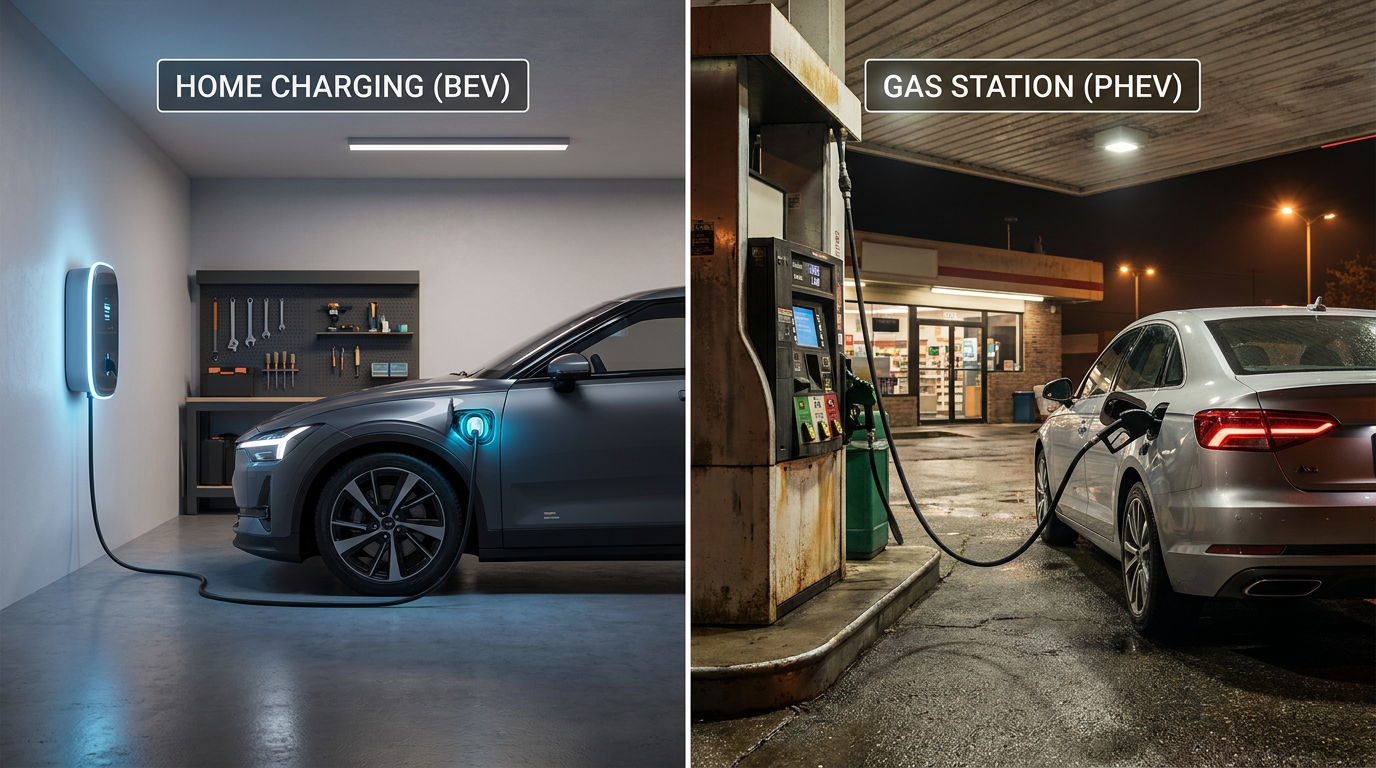
The feasibility of both EVs and PHEVs is inextricably linked to the state of charging infrastructure in 2026. While the public network has expanded massively—with hundreds of thousands of fast chargers now active globally—the experience of using them varies wildly. Pure EVs require Level 3 DC fast chargers for road trips, which can replenish a battery from 10 to 80 percent in roughly 20 to 35 minutes. PHEVs, on the other hand, typically lack fast-charging capabilities due to their smaller battery architecture; they rely on slower Level 2 AC chargers, meaning they are designed to be charged overnight at home or during the day at an office, rather than quickly topped up on the highway.[3][7]
The feasibility of both EVs and PHEVs is inextricably linked to the state of charging infrastructure in 2026.
Another critical factor in the 2026 decision matrix is battery longevity and warranty coverage. Early fears of rapid battery degradation have largely been dispelled by real-world data. Modern EVs utilize sophisticated thermal management systems that protect the battery chemistry, allowing them to easily outlast the typical 8-year or 100,000-mile warranties mandated by law. PHEV batteries, while smaller, undergo more frequent full charge-and-discharge cycles, which theoretically puts more stress on the cells. However, automakers have engineered robust buffers into these systems, ensuring that both pure electric and plug-in hybrid owners can expect their batteries to deliver reliable performance well into the next decade without requiring catastrophic replacement costs.[3]
Beyond the sticker price, the total cost of ownership in 2026 heavily favors vehicles that can be charged at home. Running an EV or a PHEV in electric mode costs approximately $4 to $6 per 100 kilometers when charged on a residential off-peak tariff, compared to $14 to $18 for a comparable gasoline vehicle. However, insurance premiums introduce a different dynamic; EVs generally cost about 10 to 16 percent more to insure than gas models due to the high cost of battery replacement in the event of an accident, while PHEVs sit in the middle. Maintenance costs, conversely, are where pure EVs shine, as they lack oil changes, spark plugs, and complex transmissions, cutting routine service expenses by roughly half over the vehicle's lifespan.[6][7]

The long-term financial picture is also being shaped by shifting environmental regulations and secondary market dynamics. In 2026, several major global cities are beginning to implement Zero-Emission Zones that charge fees to PHEVs if they enter while running on gasoline, pushing urban drivers toward pure electrics. Consequently, the resale value of full EVs from reputable brands is holding remarkably steady, while PHEVs are increasingly viewed by the secondary market as transitional technology, potentially leading to steeper depreciation curves over the next decade. Buyers must weigh whether the immediate convenience of a gas tank is worth the potential long-term hit to the vehicle's residual value.[9]
Synthesizing these trade-offs leads to clear consumer recommendations. A fully electric vehicle fits well when you have reliable access to Level 2 charging at home or work, your daily commute is predictable, and you view the occasional 30-minute fast-charging stop on a road trip as a welcome break rather than a frustrating delay. It does not fit when you live in an apartment complex with no dedicated charging infrastructure, frequently travel through rural corridors lacking reliable fast chargers, or regularly tow heavy loads over long distances, which can severely deplete battery range.[3][7]
Conversely, a plug-in hybrid fits well when you want to complete your daily school runs and grocery trips on pure electricity, but you regularly take spontaneous weekend road trips into remote areas where charging networks remain sparse. It is the ideal solution for a one-car household that wants to dabble in electrification without fully committing. However, a PHEV does not fit when you lack the discipline or the home infrastructure to plug the vehicle in every single night; without that daily charge, you are simply paying a premium for a heavy battery you aren't utilizing, resulting in worse overall efficiency than a standard hybrid.[1][7]

Finally, a traditional hybrid fits well when you want immediate savings at the fuel pump but cannot install a home charger, park on the street, or simply want the lowest possible upfront purchase price for an electrified vehicle. It remains the most pragmatic choice for high-mileage drivers who prioritize uninterrupted cross-country travel. A standard hybrid does not fit when your primary goal is to completely eliminate your tailpipe emissions, or if you want to take advantage of the rock-bottom per-mile costs of residential electricity and the near-silent, vibration-free driving experience that only a massive battery pack can provide.[6][7]
How we got here
Early 2010s
First-generation PHEVs like the Chevy Volt launch with roughly 35 miles of electric range.
2020
Average pure EV ranges begin crossing the 250-mile threshold, reducing initial range anxiety.
2023
Major automakers begin adopting the NACS (Tesla) charging standard, unifying the North American charging network.
2026
PHEV ranges surpass 50 miles while pure EVs normalize 300-plus mile ranges, fundamentally shifting the buying calculus.
Viewpoints in depth
Pure EV Advocates
Argue that any reliance on fossil fuels is outdated given the massive improvements in battery range and charging networks.
This camp, often supported by environmental groups and early tech adopters, points to the 300-plus mile ranges of modern EVs as proof that range anxiety is a solved problem. They emphasize that plug-in hybrids are a compromised 'worst of both worlds' technology that burdens owners with the maintenance of two separate powertrains. For these advocates, the immediate transition to zero-emission vehicles is both an environmental imperative and the smartest long-term financial play, especially as cities begin penalizing combustion engines.
PHEV Proponents
View plug-in hybrids as the ultimate pragmatic bridge technology for the current decade.
Supporters of PHEVs argue that the public charging infrastructure, while growing, is still too unreliable and slow for stress-free long-distance travel. They highlight that a 50-mile electric range covers 90 percent of daily driving needs, allowing owners to operate as an EV locally while relying on the gas engine for cross-country trips. This camp believes that forcing consumers into pure EVs too quickly creates unnecessary friction, making the PHEV the perfect compromise for one-car households.
Pragmatic Analysts
Focus strictly on the total cost of ownership and matching the vehicle to the driver's specific infrastructure.
Financial analysts and automotive pragmatists reject the ideological battle between EVs and PHEVs, focusing instead on spreadsheets and living situations. They argue that if a buyer cannot charge at home, both EVs and PHEVs are poor financial choices, making the traditional hybrid the clear winner. This viewpoint stresses that the 'best' vehicle is entirely conditional: EVs win for high-mileage commuters with home chargers, while hybrids win for apartment dwellers and budget-conscious buyers.
What we don't know
- How quickly secondary market values for PHEVs will drop as pure EVs become the dominant global standard.
- Whether public fast-charging infrastructure will expand quickly enough to meet the surging demand of holiday road-trip travel.
Key terms
- PHEV (Plug-in Hybrid Electric Vehicle)
- A vehicle with both a gas engine and a large battery that can be plugged in, allowing for 30-50 miles of pure electric driving before gas takes over.
- HEV (Hybrid Electric Vehicle)
- A traditional hybrid that uses a gas engine and a small battery charged by braking; it cannot be plugged in and relies entirely on gasoline.
- Level 2 Charging
- A 240-volt charging system typically installed in homes or workplaces that can fully recharge an EV overnight or a PHEV in a few hours.
- DC Fast Charging (Level 3)
- High-speed public chargers capable of replenishing an EV battery from 10 to 80 percent in 20 to 35 minutes.
- Regenerative Braking
- A system that captures the kinetic energy normally lost during braking and converts it into electricity to slightly recharge the battery.
Frequently asked
Do plug-in hybrids charge themselves while driving?
While PHEVs use regenerative braking to capture small amounts of energy, their large batteries must be plugged into an outlet to achieve their full 30-to-50 mile electric range. Without plugging in, they operate like standard hybrids.
Is it cheaper to charge an EV or buy gas?
In 2026, charging an EV at home on an off-peak electricity rate is significantly cheaper than buying gasoline, often saving drivers up to 70 percent on per-mile energy costs.
How long do EV batteries actually last?
Modern EV batteries are designed to outlast the vehicle itself, supported by advanced thermal management systems and federally mandated warranties of at least 8 years or 100,000 miles.
Can I use a fast charger on a plug-in hybrid?
Most plug-in hybrids cannot use Level 3 DC fast chargers because their smaller batteries are not designed to accept such high-voltage inputs. They rely on slower Level 2 charging.
Sources
Source coverage
9 outlets
3 viewpoints surfaced









[1]ForbesPHEV Proponents
PHEVs Are Having A Moment Even With Low Battery Range And High Prices
Read on Forbes →[2]AutoblogPHEV Proponents
The 4 PHEVs With the Most Range in 2026
Read on Autoblog →[3]GreenCarsPragmatic Analysts
EV vs PHEV: Which One Fits Your Driveway and Drive?
Read on GreenCars →[4]Top SpeedPHEV Proponents
The PHEV With The Highest Electric Range In 2026
Read on Top Speed →[5]RecurrentPure EV Advocates
2026 Longest Range EVs by Size
Read on Recurrent →[6]Cars.caPragmatic Analysts
Hybrids vs. PHEVs vs. EVs Comparison
Read on Cars.ca →[7]Hybrid PistonPragmatic Analysts
Hybrid vs Plug-In Hybrid vs EV: 2026 Best USA Buyer Guide
Read on Hybrid Piston →[8]Sierra ClubPure EV Advocates
The Best Affordable Long-Range Electric Vehicles of 2026
Read on Sierra Club →[9]Mobile Studio 24hPragmatic Analysts
PHEV vs. EV in 2026: Which Technology is Actually Better?
Read on Mobile Studio 24h →

Every angle. Every day.
Get guides stories with full source coverage and perspective breakdowns delivered to your inbox.