
How Science and Hydration Testing Are Ending MMA's Dangerous Weight-Cutting Era
Following years of dangerous dehydration practices, mixed martial arts organizations and athletic commissions are adopting rigorous hydration testing and sports science to protect fighters.
By Factlen Editorial Team
- Regulatory Commissions
- Athletic commissions view extreme weight cutting as a health crisis and a form of sanctioned cheating.
- Sports Science Advocates
- Performance institutes emphasize year-round nutrition and education over acute dehydration.
- Pioneering Promotions
- Organizations like ONE Championship believe dehydration must be banned entirely through mandatory testing.
- Combat Sports Traditionalists
- Weight cutting is an ingrained part of combat sports culture, and fighters will always seek a size advantage.
What's not represented
- · Amateur MMA organizations struggling to fund expensive hydration testing.
- · Fighters who have been forced to move up weight classes due to the new rules.
Why this matters
For decades, the most dangerous opponent a mixed martial artist faced wasn't in the cage, but on the scale. The shift toward hydration testing and continuous weight monitoring is saving fighters from kidney failure and brain trauma, fundamentally changing how the sport is contested.
Key points
- MMA fighters have historically dehydrated themselves to lose 10-15% of their body weight before weigh-ins.
- Severe dehydration increases the risk of kidney failure, cardiac arrest, and brain trauma.
- ONE Championship pioneered mandatory hydration testing using urine specific gravity to ban dehydration-based weight cuts.
- The California State Athletic Commission now cancels bouts if a fighter regains more than 15% of their contracted weight by fight day.
- The UFC Performance Institute is shifting the culture through education, recommending fighters stay within 8% of their target weight during fight week.
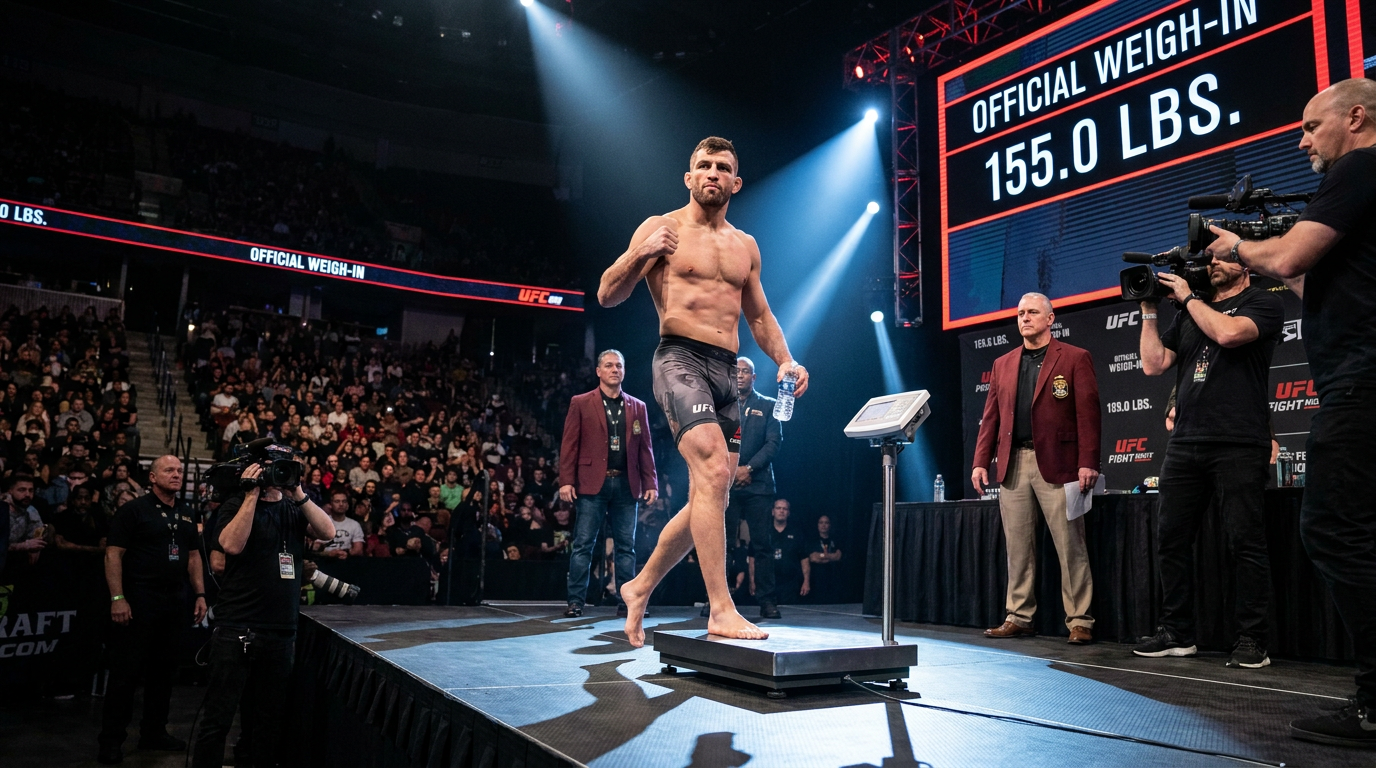
For decades, the most dangerous opponent a mixed martial artist faced was not standing across the cage, but waiting on the scale. The culture of combat sports has long been defined by the grueling ritual of weight cutting, a process where athletes systematically dehydrate themselves to compete in smaller weight classes. The underlying logic is simple: by shedding massive amounts of water weight just before a weigh-in, a fighter can rehydrate over the next twenty-four hours and step into the arena significantly larger and stronger than their opponent.[7]
The mechanics of a traditional weight cut are brutal and highly calculated. In the final week before a bout, fighters often eliminate carbohydrates from their diet entirely, a process known as glycogen depletion. Because water binds to glycogen in the muscles, emptying these energy stores naturally flushes pounds of water from the body without the athlete shedding a single drop of sweat. From there, fighters utilize water-loading techniques, salt restriction, and extreme heat exposure in saunas or sweat suits to wring the remaining moisture from their systems.[6]
This acute dehydration comes with severe physiological consequences. Stripping the body of ten to fifteen percent of its total mass in a matter of days thickens the blood, placing immense strain on the cardiovascular system and the kidneys. More alarmingly, severe dehydration reduces the volume of cerebrospinal fluid that cushions the brain inside the skull, leaving fighters highly vulnerable to traumatic brain injuries when they inevitably absorb strikes during competition.[6]

The combat sports industry was forced into a profound reckoning in December 2015. Yang Jian Bing, a twenty-one-year-old flyweight competing for ONE Championship, suffered fatal complications while cutting weight for a bout in the Philippines. The severe dehydration led to cardiac arrest, and his tragic death served as a wake-up call that the sport's traditional weight-management practices were fundamentally broken and unsustainable.[6]
In response to the tragedy, ONE Championship pioneered a radical new model that effectively banned dehydration-based weight cutting. The Asia-based promotion shifted the focus from a single scale reading to continuous physiological monitoring. Under their system, athletes are required to undergo mandatory hydration testing throughout fight week to ensure they are competing at their natural walking weight rather than a temporarily depleted state.[1][5]
In response to the tragedy, ONE Championship pioneered a radical new model that effectively banned dehydration-based weight cutting.
The cornerstone of ONE Championship's protocol is the urine specific gravity test. Medical technicians use a refractometer to analyze an athlete's urine; if the specific gravity registers above 1.025, the fighter is deemed dehydrated and is strictly prohibited from stepping on the scale. Furthermore, the promotion instituted a 105 percent rule for catchweight bouts, ensuring that even if a fight proceeds outside the contracted weight class, the size discrepancy between the two athletes remains within a safe, regulated margin.[1][5]

Regulatory bodies in the United States have also taken aggressive steps to curb sanctioned cheating and protect athletes. The California State Athletic Commission (CSAC), widely considered the most progressive regulatory body in combat sports, implemented a comprehensive ten-point plan to combat extreme weight cutting. This initiative included requiring physicians to verify that a fighter's chosen weight class is appropriate for their natural frame, effectively preventing athletes from attempting impossible cuts.[2][4]
CSAC's most impactful regulation targets the dangerous fight-day rebound. The commission now conducts mandatory weight checks on the day of the event. If a fighter has regained more than fifteen percent of their contracted weight—a clear indicator of extreme, unsafe dehydration prior to the official weigh-in—the commission will unilaterally cancel the bout. This rule directly targets the incentive to cut massive amounts of weight, as the perceived size advantage is now capped by regulatory oversight.[2][4]

While commissions focus on regulation, the Ultimate Fighting Championship (UFC) has invested heavily in sports science and education to change fighter behavior. The opening of the UFC Performance Institute in Las Vegas marked a shift toward providing athletes with access to world-class dietitians, sports scientists, and medical professionals. Rather than merely punishing fighters who miss weight, the promotion is actively teaching them how to manage their body composition safely year-round.[3]
The UFC Performance Institute established a critical guideline recommending that fighters arrive at fight week no more than eight percent above their contracted weight limit. By maintaining a closer proximity to their target weight throughout their training camps, athletes can avoid the desperate, last-minute dehydration tactics that compromise both their health and their in-cage performance.[3]

This educational approach emphasizes chronic fat loss over acute water loss. Nutritionists work with fighters to slowly reduce adipose tissue over an eight-week camp while maintaining muscle mass and energy levels. By the time fight week arrives, the athlete only needs to shed a minor amount of residual weight, allowing them to eat, drink, and sleep normally in the days leading up to the most important moments of their careers.[3]
The era of extreme weight cutting in mixed martial arts is slowly drawing to a close. Through a combination of rigorous hydration testing, strict regulatory oversight, and advanced nutritional science, the sport is evolving into a safer environment. As these protocols become the global standard, fights will increasingly be decided by technical skill, speed, and strategy, rather than who can survive the most dangerous dehydration process before the cage door locks.[7]
How we got here
Dec 2015
ONE Championship fighter Yang Jian Bing dies from weight-cutting complications, prompting an industry reckoning.
May 2016
The UFC institutes new guidelines requiring fighters to be within 8% of their target weight at the start of fight week.
May 2017
The California State Athletic Commission (CSAC) implements a 10-point plan to combat extreme weight cutting.
Oct 2019
CSAC passes a rule to cancel fights if a competitor weighs more than 15% above the contracted limit on fight day.
July 2026
CSAC increases the financial penalty for missing weight to 30% of a fighter's purse.
Viewpoints in depth
Regulatory Commissions
Athletic commissions view extreme weight cutting as a health crisis and a form of sanctioned cheating.
State athletic commissions, led by California's CSAC, argue that extreme dehydration is fundamentally unsafe and provides an unfair competitive advantage. By implementing fight-day weight limits and canceling bouts where fighters rebound by more than 15 percent, they aim to force athletes into weight classes that reflect their natural walking weight, prioritizing long-term health over short-term size advantages.
Sports Science Advocates
Performance institutes emphasize year-round nutrition and education over acute dehydration.
Experts at facilities like the UFC Performance Institute believe that education is the most effective tool for changing fighter behavior. They argue that chronic weight management—slowly reducing body fat over an eight-week camp—yields better athletic performance than last-minute water loss. By providing fighters with customized meal plans and hydration strategies, they aim to eliminate the need for dangerous saunas and sweat suits entirely.
Pioneering Promotions
Organizations like ONE Championship believe dehydration must be banned entirely through mandatory testing.
Following the tragic death of one of their athletes, ONE Championship took the stance that traditional weigh-ins are inherently flawed. They argue that the only way to ensure fighter safety is to mandate urine specific gravity testing throughout fight week. By requiring scientific proof of hydration before an athlete is allowed to weigh in, they have established a model that physically prevents the most dangerous aspects of weight cutting.
What we don't know
- Whether all state and international athletic commissions will eventually unify under a single hydration-testing standard.
- How fighters might develop new methods to 'game' urine specific gravity tests as regulations become stricter.
Key terms
- Weight Cutting
- The practice of rapidly shedding body mass, primarily through severe dehydration, in the days immediately preceding a weigh-in.
- Urine Specific Gravity (USG)
- A diagnostic test that compares the density of urine to water, utilized by MMA promotions to ensure athletes are adequately hydrated.
- Catchweight
- A bout negotiated at a specific, agreed-upon weight limit that does not adhere to the sport's traditional, standardized weight classes.
- Glycogen Depletion
- A dietary strategy where fighters eliminate carbohydrates to empty muscle energy stores, which simultaneously flushes out the water bound to those stores.
Frequently asked
Why do MMA fighters cut weight?
Fighters temporarily shed water weight to compete in a lower weight class, hoping to rehydrate and step into the cage with a significant size and strength advantage over their opponent.
How does ONE Championship test for hydration?
Fighters must submit urine samples that are tested with a refractometer. A specific gravity of 1.025 or lower is required to prove they are safely hydrated before they are allowed to weigh in.
What happens if a fighter misses weight in California?
Under CSAC rules, fighters face heavy fines. Furthermore, if they regain more than 15% of their contracted weight by the day of the event, the commission will cancel the bout entirely.
Sources
Source coverage
7 outlets
4 viewpoints surfaced







[1]ONE ChampionshipPioneering Promotions
Hydration & Weigh-In System
Read on ONE Championship →[2]California State Athletic CommissionRegulatory Commissions
CSAC broadens weight-cutting rules
Read on California State Athletic Commission →[3]UFC Performance InstituteSports Science Advocates
Performance Nutrition and Weight Management
Read on UFC Performance Institute →[4]theScoreRegulatory Commissions
CSAC passes rule to combat extreme weight-cutting
Read on theScore →[5]GroundedMMAPioneering Promotions
ONE Championship Weight-Cutting Rules (Simply Explained)
Read on GroundedMMA →[6]TheWrestlingFallacyCombat Sports Traditionalists
Weight Cutting and Hydration Tests in MMA: A double edged sword?
Read on TheWrestlingFallacy →[7]Factlen Editorial TeamSports Science Advocates
Synthesis by Factlen editorial team
Read on Factlen Editorial Team →
More in sports
See all 7 stories →Pro Volleyball Boom
How 2026 Became the Breakout Year for Women's Professional Volleyball in the U.S.
0 sources
Ski Mountaineering
What Is Skimo? The Grueling New Sport Making Its Olympic Debut in 2026
0 sources
Sports Analytics
From Stopwatches to Neural Networks: How AI and Computer Vision Rewrote Sports Analytics
0 sources

Pro Volleyball
How Women's Volleyball Became America's Fastest-Growing Professional Sport
0 sources
Every angle. Every day.
Get sports stories with full source coverage and perspective breakdowns delivered to your inbox.