
From Stopwatches to Neural Networks: How AI and Computer Vision Rewrote Sports Analytics
Modern sports science has abandoned basic statistics for real-time skeletal tracking and predictive biometrics, creating a $4 billion industry that is transforming how teams compete.
By Omar Haddad

Share this story
On the eve of the 1990 World Cup in Italy, the sports science revolution in English football was powered by what was then considered cutting-edge technology: a BBC microcomputer, a dot-matrix printer, and a handful of clunky Polar heart-rate monitors.
Professor John Brewer, the Football Association’s first head of human performance, faced deep skepticism from traditionalists as he tried to introduce basic fitness tracking and carbohydrate-heavy diets to a squad accustomed to pre-match swordfish steaks and strict alcohol bans. The medical team and coaching staff often viewed this evolving science as an unnecessary distraction from the pure, unquantifiable spirit of the game, highlighting a profound cultural resistance to data that defined the era.[1]
Thirty-six years later, as the 2026 World Cup unfolds across North America, the landscape of sports analytics is entirely unrecognizable from those early, primitive experiments. The era of gut instinct, basic statistical counting, and manual stopwatch timing has been comprehensively eclipsed by neural networks, computer vision, and biometric sensors that measure human exertion at the cellular level.
What began as a fringe experiment in human performance—often mocked by veteran managers—is now the foundational infrastructure of global professional sports. The analytical revolution that gained mainstream attention during the Moneyball era of baseball is now running on massive transformer models and GPU clusters, fundamentally rewriting how teams scout talent, design tactical game plans, and compete at the highest levels.[2]
The sheer economic scale of this technological transformation is staggering, reflecting a complete paradigm shift in how sports franchises operate. The artificial intelligence market in sports has reached an estimated $3.99 billion in 2026, and industry analysts project it to grow at a massive compound annual rate of nearly 30% through the end of the decade, potentially exceeding $11 billion by 2030.
Today, an overwhelming 82% of professional sports organizations have adopted AI technologies in some capacity, and three in four report tangible financial and competitive results. This is no longer a passing trend or a niche competitive advantage; it is a structural requirement for any franchise hoping to survive in the modern athletic ecosystem.
At the absolute heart of this modern revolution is computer vision—a sophisticated artificial intelligence technology that turns raw, chaotic match footage into highly structured, actionable data without requiring players to wear any physical sensors whatsoever.
Using advanced machine learning models trained on millions of hours of gameplay, high-definition cameras positioned around a stadium detect both the players and the ball, tracking their precise spatial movements up to 20 times per second. This optical tracking completely eliminates the friction of requiring athletes to wear bulky equipment, allowing analysts to gather pristine data from live feeds, broadcast archives, and tactical camera footage seamlessly.
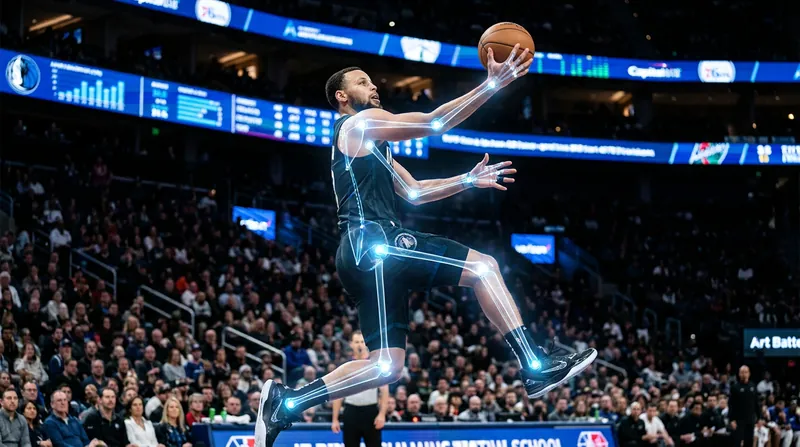
But modern computer vision goes far beyond simple two-dimensional location tracking on a pitch. The latest AI systems map the complex skeletal mechanics of every single athlete in real time, analyzing the precise biomechanical execution of a pass, a tackle, a jump, or a sprint.
This granular level of detail allows analytics platforms to understand not just where a player moved, but the specific tactical phase that triggered the movement, the physical efficiency of their stride, and the exact angle of their joints upon impact. Broadcasters use this same frame-perfect tracking data to generate the augmented reality overlays that modern fans expect, requiring absolute precision to avoid misidentifying players on global television.
A critical technical breakthrough that makes this ecosystem function is known as "identity persistence." In the chaotic, high-speed environment of a live professional match, players constantly cross paths, obscure one another from the camera's line of sight, and engage in heavy physical contact.
Older tracking models would frequently lose a player's identity during a tackle or a crowded corner kick. Modern AI models, however, are now capable of assigning a consistent digital ID to each player and maintaining it flawlessly through these visual occlusions, camera cuts, and pile-ups, ensuring that the resulting dataset is uninterrupted and highly reliable for post-match analysis.
While computer vision handles the external mechanics and spatial geometry of the game, a parallel and equally profound revolution is happening internally through the use of advanced biometric wearables. The clunky, restrictive heart-rate monitors of the 1990s have been entirely replaced by super-lightweight patches, smart fabrics, and micro-sensors that athletes wear seamlessly under their kits.
These modern devices track a staggering array of physiological data, including real-time blood oxygen levels, core skin temperature, heart rate variability, and even the quality of an athlete's sleep cycles, providing medical staffs with a comprehensive, 24/7 picture of human performance.[1]
This continuous, high-fidelity stream of physiological data is fed directly into predictive machine learning models designed specifically to optimize peak performance and prevent devastating injuries. By comparing an athlete's real-time biometric markers against vast databases of historical injury data, AI systems can accurately flag when a player's fatigue levels, muscle load, or movement asymmetries put them at an elevated risk for a soft-tissue tear.
This allows coaches and physiotherapists to intervene proactively—adjusting training loads or resting a star player—before a season-ending injury ever occurs, fundamentally changing the economics of player health.
The seamless integration of these technologies means that modern sports analytics is no longer strictly a post-match exercise relegated to the film room. Managers, tactical analysts, and medical staff now receive real-time, AI-processed insights directly on the touchline via tablets.
This immediate feedback loop enables them to make highly informed, data-driven substitution decisions in the heat of a crucial match based on an athlete's exact physiological load and tactical efficiency, rather than relying solely on the traditional "eye test" or a player's subjective claim that they are fit to continue playing.[2]
However, the exponential explosion of biometric data collection has sparked intense, ongoing debates over digital privacy and the fundamental ownership of an athlete's body. Biometric wearables capture extraordinarily sensitive personal health information, extending far beyond the pitch to include sleep quality, resting heart rate, and 24/7 exertion metrics. For professional players, this unprecedented level of biological surveillance raises legitimate and growing concerns about how the data might be weaponized against them during contract negotiations, public evaluations, or future employment opportunities if an algorithm flags them as "injury prone."
As a direct result of these privacy concerns, data ownership has rapidly become a major flashpoint in collective bargaining agreements across the world's premier professional leagues. Player unions are increasingly pushing back against unchecked surveillance, demanding strict, legally binding boundaries on what biometric data can be collected outside of official team activities.
They are fighting to determine exactly who has access to this sensitive information, how long it can be stored, and whether it can be commercialized or sold to third-party sports betting and broadcast partners by the league without the athlete's explicit consent.
Beyond the ethical and labor disputes, there is also a significant structural challenge within the AI models themselves, commonly referred to by data scientists as the "explainability gap."
While deep neural networks can process billions of recorded events to recommend a highly specific tactical adjustment or predict an opponent's play, it remains incredibly difficult for human coaches to interpret exactly why the model arrived at that specific conclusion. The algorithms often operate as a "black box," outputting brilliant strategic insights without providing the underlying logic that a human mind requires to trust the decision.
To bridge this critical gap in trust, sports data scientists are actively developing explainability layers—such as SHAP values and attention visualization techniques—that attempt to translate the AI's complex, multi-dimensional reasoning into human-interpretable insights. Yet, convincing a veteran coach, whose entire career has been built on intuition and experience, to alter a high-stakes game plan based on the output of an opaque algorithm remains one of the most significant cultural hurdles in the modern sports industry.[2]
Despite these friction points regarding privacy and explainability, the overarching trajectory of the industry is unmistakably clear and irreversible. The analytical revolution that began with basic spreadsheets, rudimentary counting stats, and the Moneyball philosophy is now running on massive GPU clusters, processing the game at a speed and depth that the human eye simply cannot match. The integration of AI into sports is no longer a competitive advantage for early adopters; it is the baseline standard required to step onto the pitch in the modern era.[2]
Despite these friction points regarding privacy and explainability, the overarching trajectory of the industry is unmistakably clear and irreversible.
From the dot-matrix printers and swordfish steaks of Italia 90 to the real-time skeletal mapping and predictive injury models of 2026, sports science has fundamentally rewritten the language of athletic competition. The teams that consistently lift championship trophies in the coming decades will not just be the ones blessed with the most physically gifted athletes. They will be the organizations that best understand, interpret, and act upon the invisible rivers of data flowing continuously beneath the surface of the game.[1][2]
The essentials
- The AI sports analytics market has reached $3.99 billion in 2026, driven by rapid advancements in machine learning.
- Modern computer vision tracks players up to 20 times per second, mapping skeletal mechanics without requiring physical sensors.
- Super-lightweight biometric wearables now track blood oxygen, skin temperature, and sleep to feed predictive injury-prevention models.
- Player unions are increasingly clashing with leagues over the privacy, ownership, and potential weaponization of 24/7 health data.
- The 'explainability gap' remains a hurdle, as coaches struggle to trust AI tactical recommendations that lack transparent human reasoning.
Timeline
1990
England's national team introduces basic heart-rate monitors and a BBC microcomputer at the World Cup, facing cultural resistance.
Early 2000s
The 'Moneyball' era popularizes statistical analysis and advanced counting metrics in professional sports front offices.
2010s
Wearable GPS trackers and basic biometric sensors become standard equipment in elite training facilities.
2026
AI-driven computer vision and neural networks process real-time skeletal mechanics and predict injuries during live matches.
- Sports Scientists & Analysts
- Argue that AI and biometrics unlock unprecedented human potential, allowing for tailored training, injury prevention, and optimized tactical decisions.
- Players & Unions
- Value the health benefits but express deep concern over the 24/7 surveillance of biometric tracking, fighting for strict data privacy in collective bargaining.
- Traditionalists & Observers
- Maintain that while data is a useful tool, the 'explainability gap' of neural networks cannot replace the human elements of gut instinct and leadership.
Perspectives this story doesn't cover
- Medical Ethicists
- Sports Bettors
Sources
Source coverage
2 outlets
3 viewpoints surfaced


- [1]The GuardianTraditionalists & Observers
Bleep tests, alcohol bans and Gazza: Italia 90 set the bar for England and sports science
Read on The Guardian → - [2]Factlen Editorial TeamTraditionalists & Observers
Synthesis by Factlen editorial team
Read on Factlen Editorial Team →

More in Sports
See all →Sports Biomechanics
How AI and Markerless Motion Capture Are Engineering Injuries Out of Sports
3 sources
Amateur Athletics
How Smartphone AI is Democratizing Sports Analytics for Amateur Athletes
7 sources

Soccer Analytics
Beyond Expected Goals: How 'Expected Threat' is Rewiring Soccer Analytics
3 sources

Baseball Biomechanics
How Invisible AI Cameras Are Solving Baseball's Pitching Injury Epidemic
4 sources

Comments
Every angle. Every day.
Get Sports stories with full source coverage and perspective breakdowns, free every day.