
The Virtual Production Revolution: How LED Volumes Are Rewriting the Rules of Filmmaking
Massive LED walls and real-time rendering engines are replacing traditional green screens, democratizing visual effects and slashing Hollywood's carbon footprint.
By Factlen Editorial Team
- Virtual Production Advocates
- Argue that LED volumes represent the ultimate evolution of filmmaking, offering unparalleled creative control and sustainability.
- Independent Creators
- Focus on the democratization of high-end visual effects and the leveling of the global playing field.
- Industry Pragmatists
- Caution that the hidden costs and technical complexities of virtual production are often underestimated.
What's not represented
- · Traditional Set Builders
- · Location Scouts
Why this matters
Virtual production is fundamentally changing how movies and shows are made, lowering the barrier to entry for independent creators while drastically reducing the massive carbon footprint of traditional Hollywood filming.
Key points
- Virtual production uses massive LED walls and real-time rendering to create digital environments on set.
- The technology eliminates the guesswork of green screens by allowing directors to capture visual effects in-camera.
- Once exclusive to blockbusters, budget-friendly virtual production tools are now empowering independent filmmakers globally.
- By replacing physical location shoots, virtual stages can cut a production's travel and energy carbon emissions by up to 50%.
- New creative hubs are emerging worldwide as production becomes less dependent on traditional Hollywood infrastructure.
The magic of Hollywood has always relied on illusion, but the mechanics of that illusion are undergoing their most profound shift since the transition from film to digital. Across the globe, soundstages are replacing physical sets and green screens with massive, glowing walls of light.[8]
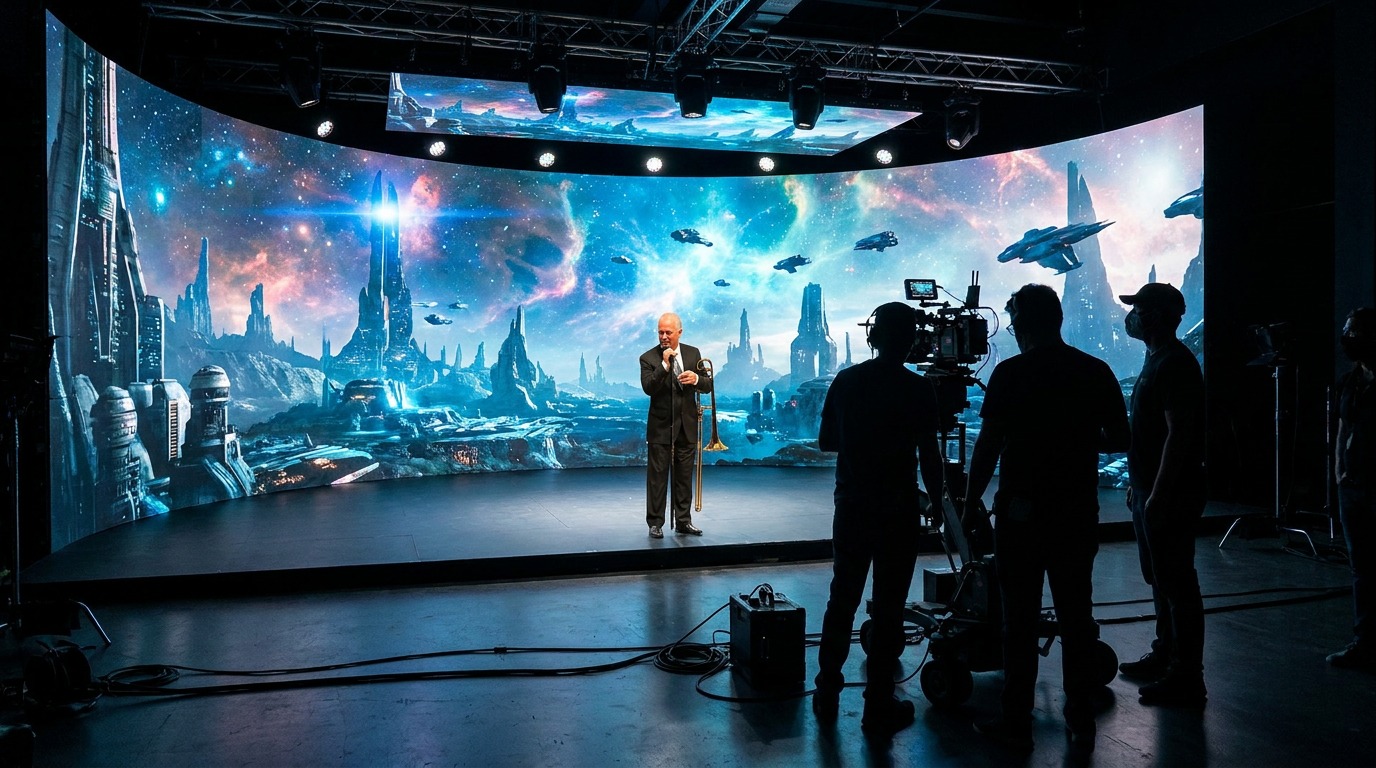
This is the era of virtual production, a filmmaking technique that fuses live-action cinematography with real-time computer-generated environments. At the heart of this revolution is the "LED volume"—a curved stage built entirely of high-definition video panels that display photorealistic 3D backgrounds.[8]
Unlike traditional green screens, which require actors to perform in front of a blank void while visual effects are added months later, an LED volume renders the final environment in real time. The digital worlds are powered by advanced game engines, most notably Epic Games' Unreal Engine, which can generate everything from alien landscapes to bustling city streets at 60 frames per second.[5]
The true breakthrough, however, lies in camera tracking. Sensors map the physical camera's movement and instantly feed that data to the game engine. As the camera pans or tilts, the digital background shifts in perfect parallax, tricking the lens into perceiving genuine depth.[5]

Furthermore, the LED panels themselves act as a dynamic lighting source. If a digital sunset is playing on the screen behind an actor, the amber light naturally reflects off their skin, wardrobe, and props. This "in-camera VFX" approach eliminates the dreaded color spill of green screens and drastically reduces the need for post-production compositing.[5]
When this technology first gained mainstream attention, it was widely viewed as a luxury reserved for nine-figure blockbusters. A state-of-the-art Hollywood LED volume can cost between $500,000 and $15 million to build, factoring in the panels, tracking systems, and rendering workstations.[5]
But the narrative of virtual production is rapidly shifting from exclusivity to democratization. The global virtual production market is projected to reach $12.25 billion by 2033, and as the technology scales, the barrier to entry is plummeting.[1]

Independent filmmakers are increasingly utilizing smaller, pop-up LED volumes or renting time on established stages for key sequences. By strategically blending practical mini-sets with digital background extensions, indie directors can achieve cinematic scope without inflating their budgets.[7]
Independent filmmakers are increasingly utilizing smaller, pop-up LED volumes or renting time on established stages for key sequences.
This democratization is having a profound impact on global cinema. In Nigeria's Nollywood—the world's second-largest film industry by volume—filmmakers are adopting consumer-grade GPUs and smaller LED walls to simulate historical settings and international locations.[4]
For an industry where the average production budget hovers between $25,000 and $75,000, virtual production is a game-changer. It allows Lagos-based studios to achieve visual effects that previously required multimillion-dollar Hollywood budgets, fundamentally altering the economics of global content creation.[4]
The technology is also decentralizing the industry geographically. Because virtual production relies less on physical proximity to traditional infrastructure, new creative hubs are sprouting in cities like Warsaw, Belfast, and Budapest. Filmmakers no longer need to flock to Los Angeles or London to access world-class production capabilities.[3]

Beyond the creative and economic shifts, virtual production is addressing one of Hollywood's most persistent liabilities: its massive environmental footprint. A traditional tentpole movie production can generate up to 3,370 metric tons of carbon emissions.[6]
Roughly half of a traditional production's carbon footprint stems from travel and on-site fuel use. Flying massive crews around the world, shipping heavy equipment, and running diesel generators on remote locations exact a heavy ecological toll.[2]
Virtual production slashes these emissions by bringing the location to the studio. Studies indicate that shooting on an LED stage can reduce carbon emissions from travel and energy consumption by 20% to 50%. A crew can shoot a sunrise in the Himalayas and a rainy night in Tokyo on the same day, all within a climate-controlled facility.[6]

Additionally, virtual sets significantly reduce physical waste. Traditional filmmaking requires the construction of massive wood, metal, and plastic sets that are routinely demolished and sent to landfills once filming wraps. Digital assets, by contrast, can be archived, modified, and reused indefinitely.[2]
Despite its clear advantages, the transition to virtual production is not without friction. The technology introduces new hidden costs, including expensive software licenses, massive data storage requirements—often terabytes per day—and the need for highly specialized real-time artists.[5]
The LED walls themselves also draw substantial electricity, requiring robust cooling systems and IT infrastructure that rival small data centers.[2]
Yet, as the hardware becomes more efficient and the software more intuitive, these hurdles are steadily diminishing. Virtual production is no longer just a novel visual effect; it is a fundamental restructuring of how stories are visualized, budgeted, and captured, offering a more sustainable and accessible future for filmmakers worldwide.[8]
How we got here
2019
The Mandalorian premieres, proving the viability of large-scale LED volumes for blockbuster television.
2021
The COVID-19 pandemic accelerates the adoption of virtual production as travel restrictions limit on-location filming.
2023
The global virtual production market surpasses $1.8 billion, with over 300 LED stages operating worldwide.
2026
Independent and international markets, including Nigeria's Nollywood, rapidly adopt budget-friendly virtual production tools.
Viewpoints in depth
Virtual Production Advocates
Argue that LED volumes represent the ultimate evolution of filmmaking, offering unparalleled creative control and sustainability.
This camp, which includes major studios, environmental groups, and technology developers, views virtual production as a necessary paradigm shift. They emphasize that the ability to render photorealistic worlds in real-time eliminates the guesswork of green screens and allows directors to make final creative decisions on set. Furthermore, environmental advocates highlight the massive reduction in carbon emissions achieved by eliminating international travel and physical set construction, framing the technology as Hollywood's best path to net-zero emissions.
Independent Creators
Focus on the democratization of high-end visual effects and the leveling of the global playing field.
For independent filmmakers and emerging international markets like Nollywood, virtual production is an economic equalizer. This camp argues that as the cost of consumer-grade rendering hardware falls, small studios can achieve cinematic scale without blockbuster budgets. They advocate for hybrid approaches—blending small practical sets with selective LED screen use—proving that world-building is no longer restricted to studios with nine-figure bank accounts.
Industry Pragmatists
Caution that the hidden costs and technical complexities of virtual production are often underestimated.
While acknowledging the benefits, pragmatists warn against viewing LED volumes as a magic bullet. They point out that the upfront hardware costs remain steep, and the backend requirements—such as massive data storage, expensive software licenses, and the need for highly specialized real-time artists—can easily blindside first-time adopters. This camp also notes the immense electricity required to power thousands of LED panels, suggesting that the environmental benefits must be weighed against the energy consumption of the stages themselves.
What we don't know
- How quickly the high upfront costs of top-tier LED panels will drop to consumer-friendly levels.
- The long-term impact of virtual production on traditional below-the-line jobs like set construction and location scouting.
- Whether the massive data storage and electricity requirements of LED stages will offset their travel-related carbon savings as the technology scales.
Key terms
- LED Volume
- A physical soundstage surrounded by high-definition LED video panels that display digital environments.
- Real-Time Rendering
- The process of generating 3D computer graphics instantly, allowing digital backgrounds to react live to camera movements.
- Parallax
- The visual effect where background objects appear to move slower than foreground objects as a camera pans, creating a sense of depth.
- In-Camera VFX
- Capturing visual effects directly through the camera lens during filming, rather than adding them later in post-production.
Frequently asked
Does virtual production completely replace green screens?
Not entirely. While LED volumes are replacing green screens for many complex environments, green screens remain a cost-effective tool for simpler shots or when extensive post-production manipulation is required.
How does an LED wall light the actors?
The LED panels emit actual light based on the digital environment they display. If the screen shows a bright blue sky, it casts natural blue light onto the actors and props, creating realistic reflections.
Is virtual production only for sci-fi and fantasy?
No. While popularized by sci-fi, it is heavily used for realistic settings like driving scenes, historical recreations, and inaccessible real-world locations.
Can independent filmmakers afford this technology?
Yes. While Hollywood-scale stages cost millions, indie creators are utilizing smaller pop-up screens, renting stage time by the hour, and using consumer-grade software to achieve similar effects.
Sources
Source coverage
8 outlets
3 viewpoints surfaced








[1]Content TechnologyIndependent Creators
VP Budget Calculator: Demystifying Virtual Production Costs
Read on Content Technology →[2]Future ObservatoryVirtual Production Advocates
Virtual Production and the Transition to Net Zero
Read on Future Observatory →[3]VFX VoiceVirtual Production Advocates
Virtual Production Stages Sprout Across the Globe
Read on VFX Voice →[4]EnvisioningIndependent Creators
Nollywood's Virtual Production Leap
Read on Envisioning →[5]TasteRayIndustry Pragmatists
The True Cost of Going Virtual
Read on TasteRay →[6]SP StudiosVirtual Production Advocates
How Virtual Production Reduces Environmental Impact
Read on SP Studios →[7]Independent Film Arts AcademyIndependent Creators
Virtual Production for Indie Filmmakers
Read on Independent Film Arts Academy →[8]Factlen Editorial TeamIndustry Pragmatists
Synthesis by Factlen editorial team
Read on Factlen Editorial Team →
Every angle. Every day.
Get entertainment stories with full source coverage and perspective breakdowns delivered to your inbox.