
How Biomimetic Science is Learning to Regrow Tooth Enamel
Emerging peptide gels and bioactive glasses are moving dentistry away from drilling and filling toward regenerating the tooth's natural structure.
By Factlen Editorial Team
- Biomaterials Researchers
- Focus on the molecular mechanisms of peptides and bioactive glass, aiming to fully replicate natural tooth structure.
- Clinical Dentists
- Cautiously optimistic about additive therapies, focusing on practical workflow integration and the limitations regarding deep decay.
- Public Health Advocates
- Emphasize the potential for low-cost, non-invasive treatments to address the massive global burden of untreated caries.
What's not represented
- · Dental Insurance Providers
- · Commercial Toothpaste Manufacturers
Why this matters
Tooth decay affects nearly half the global population, traditionally requiring permanent, invasive drilling. New regenerative therapies promise to painlessly rebuild teeth, preserving natural tissue and eliminating the anxiety of the dentist's chair.
Key points
- Traditional dentistry relies on drilling away decay and filling the void with synthetic materials.
- New biomimetic therapies use engineered peptides to attract calcium and rebuild natural enamel.
- Bioactive glass and electrical currents are also being used to accelerate remineralization.
- These treatments are painless and could drastically lower the cost of global dental care.
- Regenerative therapies only work on early-stage decay before the tooth structure collapses.
The sound of the dental drill is universally dreaded. For over a century, the standard of care for tooth decay has been inherently subtractive: dentists must drill away the diseased tissue and fill the resulting void with synthetic materials like amalgam or composite resin. While effective at halting decay, this process permanently removes natural tooth structure and often requires replacement over a patient's lifetime.[7]
Enamel is the hardest substance in the human body, composed of 90% mineral, primarily a crystalline structure called hydroxyapatite. However, because it contains no living cells, it cannot biologically heal itself once severely damaged by the acidic byproducts of oral bacteria.[2]
Now, a paradigm shift is underway in dental science. Researchers are pioneering "biomimetic" dentistry—therapies that mimic natural biological processes to coax the body into repairing its own teeth. Rather than replacing lost enamel with plastic or metal, these new technologies aim to regrow the mineral structure itself.[4][7]
At the forefront of this movement are peptide-based gels. Researchers at the University of Washington have engineered specialized peptides derived from amelogenin, the crucial protein that naturally builds enamel during childhood tooth development.[1]

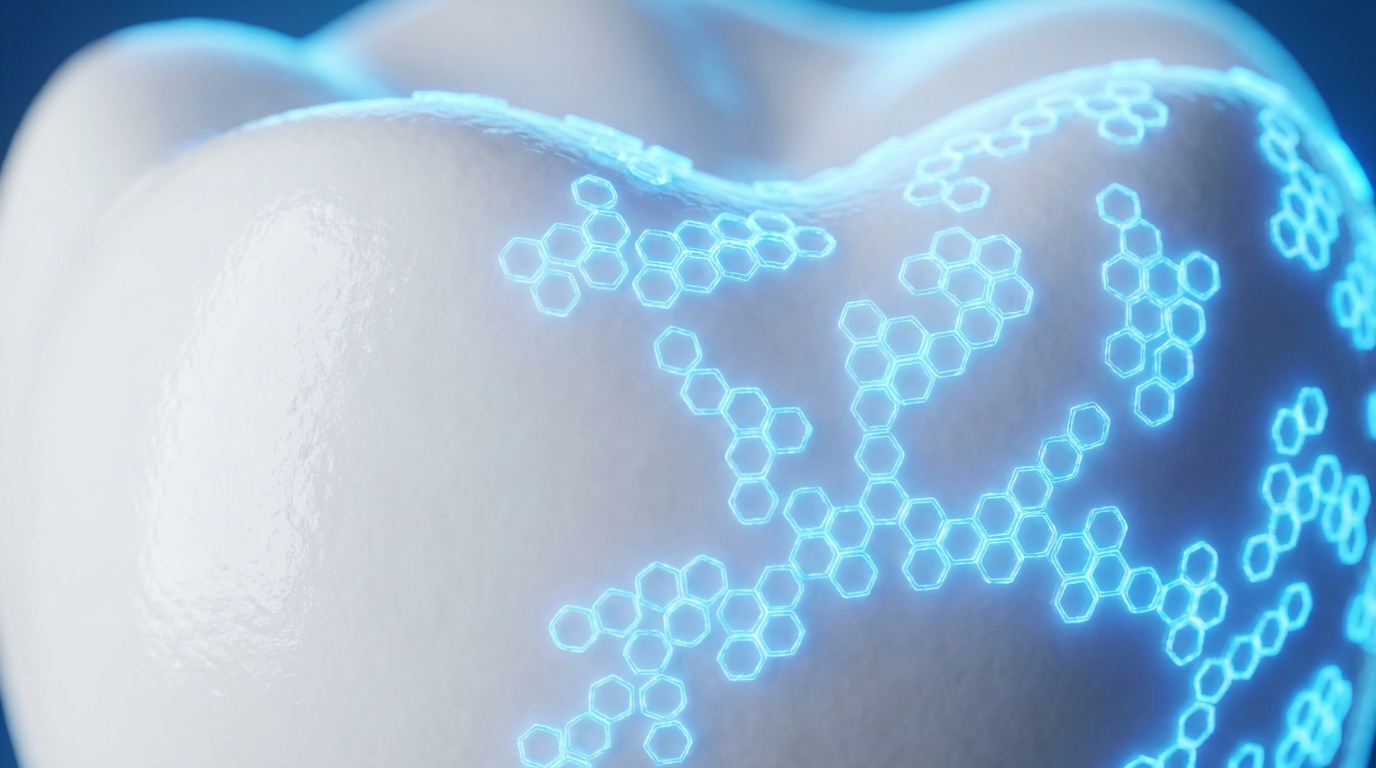
When applied to a microscopic early cavity, these engineered peptides bind to the damaged tooth surface and act as a microscopic scaffold. They actively attract calcium and phosphate ions from the patient's saliva, guiding them to crystallize into new, naturally structured hydroxyapatite.[1][2]
In laboratory settings, these peptide formulations have successfully deposited 10 to 50 micrometers of new enamel on damaged teeth. This effectively reverses early-stage decay without a single drill bit touching the tooth, restoring the structural integrity of the enamel layer.[1]
Another major breakthrough involves the application of bioactive glass. Originally developed decades ago for bone regeneration in orthopedic surgery, these specialized silica-based materials have recently been adapted for oral care.[5]
Another major breakthrough involves the application of bioactive glass.
When bioactive glass encounters saliva, it dissolves slightly, releasing a concentrated burst of calcium, phosphate, and fluoride. This creates a localized, highly mineralized environment that rapidly accelerates the tooth's natural remineralization process.[5]
Dentists are already beginning to use bioactive glass in air-abrasion systems and specialized clinical toothpastes. These applications are particularly effective at treating dentin hypersensitivity and halting early decay before it breaches the softer dentin layer beneath the enamel.[4][5]

Across the Atlantic, researchers at King's College London have developed a complementary technology known as Electrically Accelerated and Enhanced Remineralisation (EAER). This approach uses physics to enhance the biological repair process.[3]
The EAER technique uses a microscopic electrical current to drive calcium and phosphate minerals deep into the cavity site. The current is so small it cannot be felt by the patient, but it drastically speeds up the mineral uptake compared to passive topical treatments, forcing the minerals into the deepest parts of the lesion.[3]
The implications of these additive technologies extend far beyond the comfort of patients in high-income countries. The World Health Organization estimates that over 2 billion people worldwide suffer from untreated dental caries, making it one of the most prevalent health conditions on the planet.[6]
Traditional restorative dentistry is expensive, requires specialized equipment, and relies on highly trained personnel. Biomimetic treatments, particularly peptide lozenges or bioactive gels, could eventually be administered in public health settings or schools at a fraction of the cost, democratizing access to dental care.[6][7]

However, researchers caution that these treatments are not magic wands for advanced decay. Once a cavity has progressed deeply into the dentin or reached the tooth's sensitive pulp, the structural collapse is too severe for topical remineralization to fix. In those cases, traditional drilling and root canals remain necessary.[2][4]
How we got here
1990s
Bioactive glasses are first adapted from bone regeneration research for use in oral care.
2014
King's College London announces the development of the EAER electrical remineralization technique.
2018
University of Washington researchers publish findings on engineered peptides capable of depositing new enamel in the lab.
2024-2026
Accelerated clinical trials and commercialization efforts begin for advanced biomimetic gels and lozenges.
Viewpoints in depth
Biomaterials Researchers
Focus on the molecular mechanisms of peptides and bioactive glass.
For biomaterials scientists, the goal is to perfectly replicate the natural architecture of the tooth. They argue that synthetic fillings are fundamentally flawed because they do not bond perfectly with the biological tissue, eventually leading to micro-leakage and secondary decay. By using the body's own building blocks—calcium, phosphate, and amelogenin-derived peptides—researchers believe they can create repairs that are structurally identical to the original tooth, effectively curing the disease rather than just patching the symptom.
Clinical Dentists
Cautiously optimistic about additive therapies, focusing on practical workflow integration.
Practicing dentists welcome non-invasive treatments, as reducing patient anxiety and preserving natural tooth structure are core goals of modern dentistry. However, they emphasize the clinical limitations of remineralization. Biomimetic gels cannot reconstruct a tooth that has already cavitated (formed a physical hole) or where decay has reached the pulp. Dentists stress that while these technologies will revolutionize preventative care and the treatment of early 'white spot' lesions, the drill will remain a necessary tool for advanced decay for the foreseeable future.
Public Health Advocates
Emphasize the potential for low-cost treatments to address the global burden of untreated caries.
Public health officials view biomimetic dentistry as a potential equalizer. Traditional restorative care requires expensive infrastructure, electricity, sterile environments, and highly trained surgeons, leaving billions of people in low-income regions without access. If enamel-regenerating peptides can be formulated into stable lozenges or simple topical gels, they could be administered by community health workers or school nurses. This shift from surgical intervention to biochemical prevention could drastically reduce the global burden of oral disease.
What we don't know
- How long the newly generated biomimetic enamel will hold up against decades of mechanical chewing forces compared to natural childhood enamel.
- The exact timeline for when peptide-based regenerative gels will achieve widespread, affordable commercial availability globally.
Key terms
- Biomimetic
- Synthetic methods and materials that mimic biochemical processes occurring in nature.
- Hydroxyapatite
- The naturally occurring mineral form of calcium apatite that makes up 90% of tooth enamel.
- Amelogenin
- A crucial protein that regulates the formation of enamel during childhood tooth development.
- Remineralization
- The natural repair process where calcium and phosphate ions are redeposited into the enamel to reverse early decay.
Frequently asked
Can these gels fix a large, painful cavity?
No. Biomimetic remineralization is currently only effective for early-stage decay (microscopic lesions) before the tooth structure has physically collapsed.
Are peptide gels available at my dentist right now?
While some bioactive glass products are available, peptide-based enamel regeneration therapies are largely still in clinical trials and commercial development.
How does this differ from traditional fluoride?
Fluoride strengthens existing enamel by making it more acid-resistant, whereas peptide therapies aim to actually rebuild new layers of hydroxyapatite mineral from scratch.
Sources
Source coverage
7 outlets
3 viewpoints surfaced






[1]UW NewsBiomaterials Researchers
Researchers engineer a peptide to rebuild tooth enamel
Read on UW News →[2]NIH / PubMedPublic Health Advocates
Biomimetic approaches to enamel remineralization
Read on NIH / PubMed →[3]King's College LondonBiomaterials Researchers
Electrically Accelerated and Enhanced Remineralisation (EAER)
Read on King's College London →[4]American Dental AssociationClinical Dentists
Science & Research Institute: Emerging Biomaterials
Read on American Dental Association →[5]Journal of Dental ResearchBiomaterials Researchers
Clinical efficacy of bioactive glass in dentin hypersensitivity and remineralization
Read on Journal of Dental Research →[6]World Health OrganizationPublic Health Advocates
Global Oral Health Status Report
Read on World Health Organization →[7]Factlen Editorial Team
Synthesis by Factlen editorial team
Read on Factlen Editorial Team →
More in health
See all 9 stories →Sleep Science
The Brain's Nightly Wash Cycle: How Deep Sleep Clears Cellular Waste
0 sources
Bilingual Brain
How the Bilingual Brain Uses a Single 'Grammar Engine' for Multiple Languages
0 sources

Nutritional Psychiatry
The Emerging Science of Nutritional Psychiatry: How the Gut Microbiome Shapes Mental Health
0 sources

Digital Boundaries
The Evidence on Digital Tethering: How Location Tracking Affects Young Adults
0 sources

Every angle. Every day.
Get health stories with full source coverage and perspective breakdowns delivered to your inbox.