
The DIY Smartphone Revolution: How Right-to-Repair is Changing the Phones We Buy
New legislation and consumer demand are forcing major smartphone makers to embrace repairability, making it easier and cheaper to fix devices at home.
By Factlen Editorial Team
- Right-to-Repair Advocates
- Advocates argue that consumers should have unrestricted access to parts, tools, and repair manuals.
- Sustainable Manufacturers
- Niche brands build devices explicitly for modularity to capture eco-conscious buyers.
- Legacy Tech Giants
- Major brands are balancing incoming repair mandates with premium design requirements.
What's not represented
- · Independent local repair shop owners
- · E-waste recycling facility operators
Why this matters
Replacing a cracked screen or a dying battery yourself can save hundreds of dollars and add years to a phone's lifespan. As new laws force manufacturers to provide spare parts, the era of forced smartphone upgrades is ending.
Key points
- New EU and UK legislation will mandate that smartphone manufacturers provide spare parts for up to seven years.
- Brands like Fairphone and HMD are leading the market with modular designs that allow users to replace screens and batteries in minutes.
- Major manufacturers including Apple and Google have significantly improved the mechanical repairability of their devices.
- Software restrictions, known as parts pairing, remain a major hurdle for independent repair shops.
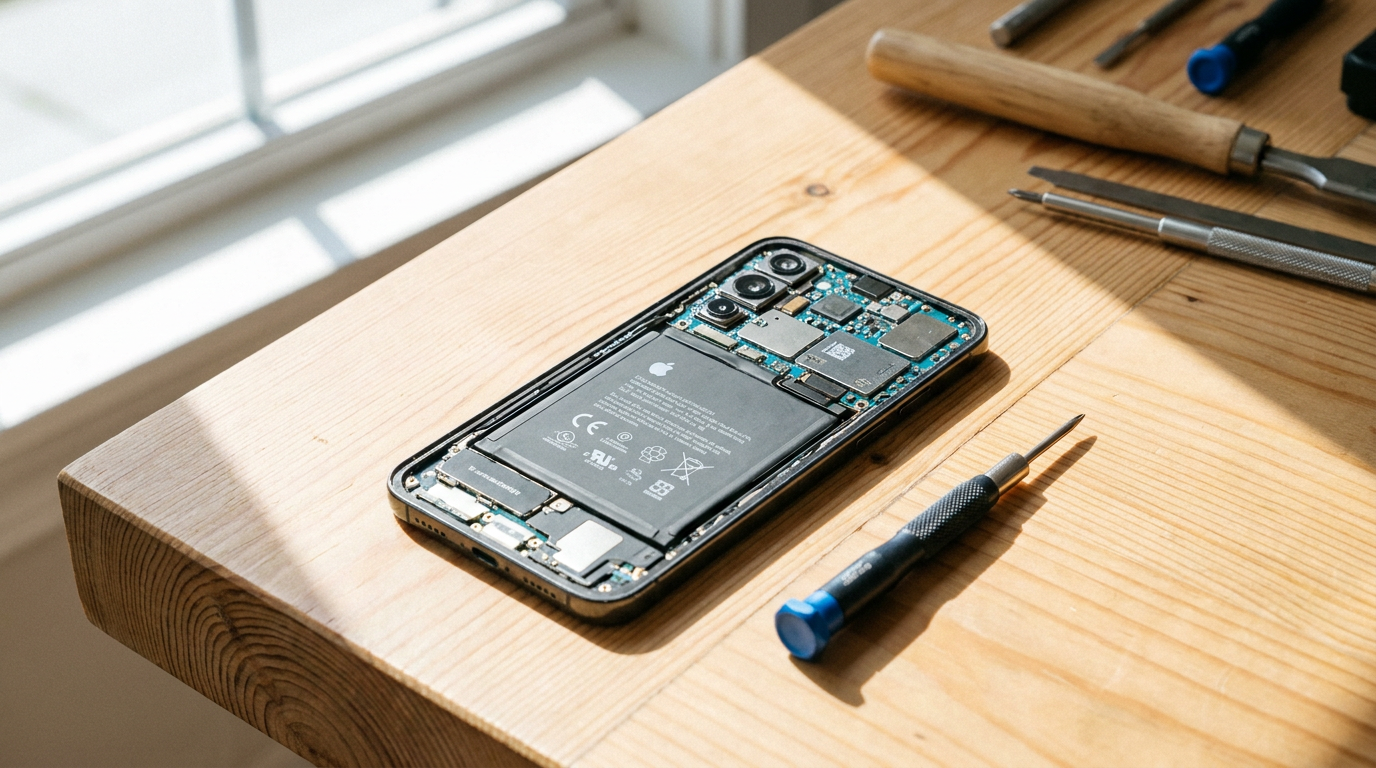
The era of the glued-together, disposable smartphone is quietly coming to an end. For the better part of a decade, a cracked screen or a degraded battery meant an expensive trip to an authorized service center, or worse, abandoning the device entirely for a brand-new model. Manufacturers utilized proprietary screws, industrial-strength adhesives, and complex internal layouts that made DIY fixes nearly impossible for the average consumer. But in 2026, the economics and mechanics of smartphone ownership are undergoing a radical shift. Driven by sweeping legislative changes and a vocal consumer movement, the industry is fundamentally redesigning its hardware. The new standard dictates that phones should be opened, fixed, and maintained by the people who own them, adding years to a device's lifespan and saving users hundreds of dollars in the process.
The primary catalyst for this hardware revolution stems from aggressive new regulations in Europe. The European Union's Ecodesign legislation, which took effect in 2025, laid the essential groundwork by mandating that consumer electronics be user-maintainable. The legislation specifically targets the most common point of failure—the battery—requiring manufacturers to produce phones that allow a layperson to easily remove and replace the power cell without specialized thermal equipment. If manufacturers want to avoid the replaceable battery mandate, they must prove their batteries can maintain 83% of their original capacity after 500 charge cycles, forcing a baseline improvement in component quality across the board.[4]
The United Kingdom has followed suit, confirming that its Right to Repair legislation will officially extend to smartphones and tablets by July 2027. Under these incoming rules, manufacturers will be legally required to supply spare parts—including batteries, screens, camera modules, and charging ports—to both professional repair shops and everyday consumers for at least seven years after a device is discontinued. "For UK buyers, the practical benefit is simple: smartphones bought from mid-2027 onwards will be genuinely easier and cheaper to repair," notes industry coverage of the new laws. The mandate also requires that devices allow battery replacement using commonly available tools, effectively outlawing the heavy adhesives that have frustrated DIY repairers for years.[5]

While legacy tech giants adapt their supply chains to these mandates, smaller manufacturers have already built their entire brand identities around modularity and sustainability. Dutch company Fairphone has long been the gold standard in this space. Its recent Fairphone 6 achieved a perfect 10 out of 10 repairability score from the DIY advocacy group iFixit, matching the unprecedented score of its predecessor. The Fairphone 6 allows users to replace critical components like the camera, earpiece, screen, and USB-C port using nothing more than a standard Phillips-head screwdriver.[1][8]
By offering spare parts directly to consumers and guaranteeing years of software updates, Fairphone aims to push the average smartphone lifespan well beyond the current global average of just three years. iFixit praised the device's architecture, stating, "In a world full of glued-together gadgets designed for obsolescence, the Fairphone 6 earns a well-deserved 10 out of 10 on our repairability scale. It's a phone that's made to outlast the hype cycle." While the mainboard still requires professional servicing, the ability to swap out a failing battery or shattered display in under five minutes at a kitchen table represents a paradigm shift in consumer tech.[1][8]
Mainstream challengers are also proving that repairability does not require sacrificing premium aesthetics or modern features. Human Mobile Devices (HMD), the manufacturer behind Nokia-branded phones, recently launched the Skyline, an upper-midrange Android device that earned a stellar 9 out of 10 from iFixit. The HMD Skyline introduces a novel screw-driven opening mechanism that bypasses the need for heat guns and prying tools. A single Torx screw releases the back cover, allowing users to pop off the casing with a simple guitar pick or plastic card.[2][6]
Mainstream challengers are also proving that repairability does not require sacrificing premium aesthetics or modern features.
HMD claims this "Gen2 repairability" makes screen replacements 65% easier than on their previous repair-focused models. Inside the Skyline, the screen is held in place using a foam gasket rather than glue, and while the battery still utilizes a mild adhesive, it is designed so that a gentle pull is enough to free it. If a user breaks their screen or depletes their battery, they can order a replacement part directly from HMD, which arrives bundled with a custom iFixit repair kit and step-by-step instructions.[2][6]

The mounting legislative pressure and shifting consumer expectations are forcing the industry's biggest players—Apple, Google, and Samsung—to change their engineering practices. According to the U.S. Public Interest Research Group's (PIRG) 2025 "Failing the Fix" scorecard, cellphones from major manufacturers are becoming significantly easier to disassemble. In the 2025 report, Apple and Google both earned a "B-" grade for their cellphone repairability, a stark and rapid improvement from the "F" and "D" grades they received just three years prior in 2022.[3]
Samsung lagged slightly behind its peers with a "C-" grade, but the overall trend points toward more accessible internal layouts across the flagship smartphone market. The PIRG report noted that Apple showed the most improvement in ease of disassembly, redesigning the internal chassis of its recent iPhones to allow entry from both the front and the back glass. However, the report also cautioned that while devices are getting more repairable mechanically, the progress is not happening fast enough to fully offset the environmental impact of the tech industry.[3]
Despite these mechanical improvements, a significant software hurdle remains: parts pairing. This controversial practice couples a specific hardware component, such as a screen, battery, or biometric sensor, to the device's motherboard via a digital serial number. If a user or an independent repair shop installs a replacement part without authenticating it through the manufacturer's proprietary software, the phone may disable certain features, disable True Tone displays, or show persistent warning messages to the user.[7]

iFixit and right-to-repair advocates argue that until parts pairing is completely abolished, true independent repair remains artificially restricted. Because only proprietary software can uncouple a device and its parts, the mechanical ease of replacing a battery is moot if the phone refuses to recognize the new component. Regulators in the EU and the US are increasingly scrutinizing parts pairing, viewing it as a monopolistic tactic designed to funnel consumers back to expensive first-party repair networks.[7]
Ultimately, the shift toward repairable smartphones represents a massive win for both consumer wallets and the global environment. With over 1.4 billion mobile phones sold worldwide each year, extending a device's life from three years to five or seven drastically reduces the volume of toxic electronic waste entering landfills. As the 2027 legislative deadlines approach, the smartphone market is transforming from a cycle of forced obsolescence into one of sustainable, long-term ownership. The next time your battery won't hold a charge, the solution won't be an $800 upgrade—it will be a $30 part and a screwdriver.[8]
How we got here
2021
The US FTC commits to prioritizing action against unfair repair restrictions imposed by tech manufacturers.
Aug 2023
The Fairphone 5 launches, earning a perfect 10/10 repairability score from iFixit.
Jul 2024
HMD releases the Skyline, introducing accessible 'Gen2 repairability' to the mainstream mid-range market.
Jun 2025
EU Ecodesign legislation takes effect, mandating user-maintainable designs and replaceable batteries.
Jul 2027
UK Right to Repair rules will officially mandate 7-year parts availability for all new smartphones.
Viewpoints in depth
Right-to-Repair Advocates
Advocates argue that consumers should have unrestricted access to parts, tools, and repair manuals.
Organizations like iFixit and U.S. PIRG view repairability as a fundamental consumer right. They argue that the mechanical improvements seen in recent smartphones are a step in the right direction, but they are insufficient as long as software locks remain. Advocates are heavily lobbying lawmakers to ban 'parts pairing'—the practice of digitally locking a component to a specific motherboard—which they see as an artificial barrier designed to maintain manufacturer monopolies over the repair market.
Sustainable Manufacturers
Niche brands build devices explicitly for modularity to capture eco-conscious buyers.
Companies like Fairphone and HMD approach repairability not as a compliance burden, but as a core product feature. By designing phones with standard screws, pull-tab batteries, and modular camera units, they cater to a growing demographic of consumers frustrated by disposable tech. These manufacturers argue that extending a phone's lifespan from three years to seven is the single most effective way to reduce the tech industry's massive carbon footprint and e-waste output.
Legacy Tech Giants
Major brands are balancing incoming repair mandates with premium design requirements.
Companies like Apple, Google, and Samsung have historically resisted right-to-repair legislation, citing concerns over user safety, device security, and water resistance. However, facing strict incoming laws in the EU and UK, they are adapting. These giants are redesigning their internal chassis to be more accessible, though they maintain that certain software authentications are necessary to ensure third-party parts do not compromise biometric security or battery safety.
What we don't know
- How strictly the EU and UK will enforce the 2027 mandates against companies that continue to use software parts pairing.
- Whether the increased availability of spare parts will lead to a significant drop in the cost of professional smartphone repairs.
Key terms
- Right to Repair
- A consumer and legislative movement advocating for the ability of individuals and independent shops to fix electronic devices without manufacturer restrictions.
- Parts Pairing
- A practice where hardware components are digitally serialized to a specific device, preventing unauthorized replacement parts from functioning correctly.
- Ecodesign
- European Union legislation requiring manufacturers to design products that are durable, energy-efficient, and user-maintainable.
- Torx Screw
- A type of screw head characterized by a 6-point star-shaped pattern, commonly used in electronics to secure components without stripping.
- Modularity
- A design approach where a device is built using separate, easily interchangeable components rather than being glued together as a single unit.
Frequently asked
What does the 2027 Right to Repair law mean for my phone?
Manufacturers must supply spare parts like batteries and screens for seven years and ensure batteries can be replaced with common tools.
Can I replace a smartphone battery myself?
On newer repair-focused devices like the Fairphone or HMD Skyline, yes, in minutes. On older flagship phones, it still requires melting strong adhesives.
What is parts pairing?
A software restriction where a replacement part, like a screen, is digitally locked to the phone's motherboard and won't work fully unless authenticated by the manufacturer.
Are Apple and Samsung phones getting easier to fix?
Yes, recent teardowns and PIRG scorecards show both companies are making their devices easier to open, though software restrictions remain a hurdle.
Sources
Source coverage
8 outlets
3 viewpoints surfaced








[1]PCMagSustainable Manufacturers
The Fairphone 6 is the latest phone from the company to get the best result from an iFixIt teardown
Read on PCMag →[2]How-To GeekSustainable Manufacturers
HMD announced its fourth repairable HMD smartphone today
Read on How-To Geek →[3]Resource RecyclingRight-to-Repair Advocates
In this year's 'Failing the Fix' scorecard, the U.S. Public Interest Research Group said cell phones overall are getting more repairable
Read on Resource Recycling →[4]TechHQLegacy Tech Giants
Recent EU laws endorsed at the end of June this year now mandate that phone manufacturers produce phones that allow a 'layman' to 'easily remove and replace' the battery
Read on TechHQ →[5]MyMobilesLegacy Tech Giants
UK Right to Repair Law Extended to Smartphones from 2027
Read on MyMobiles →[6]iFixitRight-to-Repair Advocates
HMD Skyline Repair
Read on iFixit →[7]StatistaLegacy Tech Giants
Smartphone repairability scores
Read on Statista →[8]FairphoneSustainable Manufacturers
The Fairphone 5 scores a perfect 10 on iFixit
Read on Fairphone →

Every angle. Every day.
Get shopping stories with full source coverage and perspective breakdowns delivered to your inbox.