
How Vertical Scrolling Webtoons Revolutionized the Global Comic Industry
Designed specifically for smartphones, vertical scrolling comics have bypassed traditional publishing gatekeepers to create a multi-billion dollar industry that empowers independent creators.
By Factlen Editorial Team
- Digital Comic Creators
- Independent artists who value the platform's democratization, direct monetization, and unique vertical pacing tools.
- Legacy Publishers
- Traditional comic houses adapting their iconic characters to mobile formats to reach younger, digital-native audiences.
- Industry Analysts
- Market researchers tracking the explosive financial growth and IP-licensing potential of the mobile comic ecosystem.
What's not represented
- · Traditional print comic retailers
- · Collectors of physical comic books
Why this matters
The vertical scrolling revolution has democratized the comic industry, allowing independent artists to reach millions of readers directly while transforming how a new generation consumes visual storytelling.
Key points
- Vertical scrolling comics are designed specifically for mobile devices, replacing traditional page turns with an infinite downward scroll.
- The global webcomics market is valued at over $8 billion in 2025 and is projected to experience massive growth over the next decade.
- The format democratizes publishing, allowing independent creators to upload directly to platforms and earn revenue through ads and micro-transactions.
- Traditional publishers like Marvel and DC have embraced the format, adapting their legacy characters to reach younger, mobile-first audiences.
- Streaming services increasingly view successful webtoons as pre-validated intellectual property, leading to numerous high-profile television adaptations.
For decades, the comic book industry was defined by the physical page turn. Readers navigated complex grids of panels, reading left to right, top to bottom, in a format that remained largely unchanged since the Golden Age of superheroes. But today, the fastest-growing segment of the comic industry has abandoned the page entirely.[5][7]
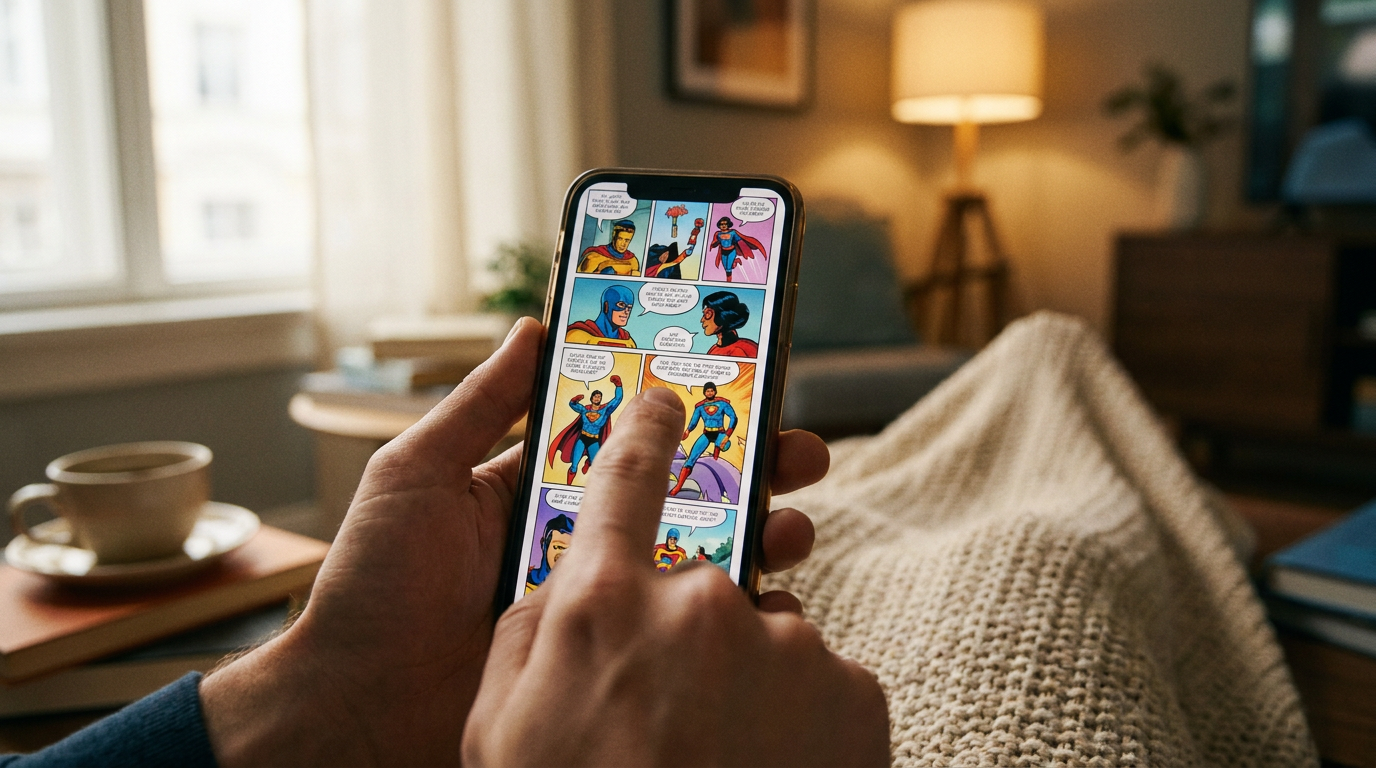
Enter the vertical scrolling comic, widely known as the "webtoon." Designed specifically for smartphones, this format replaces the traditional page with an infinite vertical canvas. Readers simply scroll downward with their thumbs, consuming full-color panels in a seamless, cinematic flow that feels more akin to scrolling a social media feed than reading a book.[5][7]
The financial footprint of this mobile-first medium is staggering. Market analysts value the global webcomics market between $8.17 billion and $11.8 billion as of 2025, with projections suggesting it could surge past $60 billion by the early 2030s. This explosive growth is driven by a simple reality: while not everyone visits a local comic shop, nearly five billion people worldwide carry a smartphone.[1][2][3]
The vertical format is not merely a digital port of print comics; it is a fundamentally different storytelling language. In traditional comics, artists use page layouts to guide the reader's eye and control pacing. In vertical comics, the primary tool for pacing is scroll distance, often referred to as the "scroll pause."[5][7]
By manipulating the vertical white space between panels, creators can dictate the speed of the narrative. A tight gap of 50 to 100 pixels implies rapid, continuous action. A medium gap allows the scene to breathe, while a massive stretch of empty space—requiring multiple swipes to traverse—creates a dramatic pause, building tension before a major revelation or time skip.[7]

This shift requires a steep learning curve for traditional artists. Because readers only see one or two panels on their screen at a time, creators lose the ability to design elaborate two-page spreads. However, they gain absolute control over the reveal, ensuring that a reader cannot accidentally glance at the bottom of a page and spoil a surprise.[5][7]
Beyond the artistic mechanics, the vertical scrolling revolution has completely upended the comic book creator economy. Historically, breaking into the industry required pitching to gatekeepers at major publishing houses. Today, platforms like Naver's WEBTOON and Kakao's Tapas operate on a democratized model, allowing anyone to upload their work to millions of potential readers.[4][5][7]
Beyond the artistic mechanics, the vertical scrolling revolution has completely upended the comic book creator economy.
This direct-to-consumer pipeline has generated unprecedented revenue streams for independent artists. Creators monetize their work through a combination of advertisement revenue sharing, subscription models, and micro-transactions, such as readers paying a small fee to unlock advanced chapters before their free release date.[2][4]
The financial ceiling for successful digital comic artists has never been higher. English-language creator payments on the WEBTOON platform alone surpassed $27 million between 2020 and 2022, and the numbers have only accelerated since. In South Korea, the birthplace of the format, top-tier creators can earn upwards of $1 million annually, with the highest earners pulling in multi-million dollar incomes.[4]

While the average independent creator earns a more modest living, the sheer volume of artists making sustainable income represents a massive shift. The platform model has essentially built a middle class of comic creators that struggled to exist in the traditional print market.[4][7]
The success of the vertical scroll has not gone unnoticed by the titans of the American comic industry. Both Marvel and DC Comics—the historic duopoly of superhero publishing—have aggressively pivoted to capture the mobile-first audience, recognizing that younger readers are more likely to discover characters on their phones than in a specialty shop.[6][7]
Marvel revamped its digital subscription service, Marvel Unlimited, to feature "Infinity Comics"—exclusive, full-screen vertical series designed specifically for phones and tablets. These stories adapt iconic characters like Spider-Man and the X-Men into the infinite scroll format, complete with the pacing techniques pioneered by South Korean creators.[7]

DC Comics took a more collaborative approach, partnering directly with WEBTOON to produce standalone series featuring their legendary roster. By placing characters like Batman and Superman on a platform with over 70 million active users, DC bypassed traditional distribution hurdles, offering stories that require no prior knowledge of decades-long comic continuity.[6]
The cultural impact of vertical comics now extends far beyond the apps themselves. Streaming giants like Netflix have realized that popular webtoons serve as pre-validated intellectual property, complete with built-in global fanbases and storyboards already optimized for screen adaptation.[3][4]
Hit series like Heartstopper, Lore Olympus, and numerous South Korean thrillers have made the leap from vertical scrolls to global television phenomena. When a trailer for a new adaptation drops, readership for the original digital comic routinely triples, creating a symbiotic marketing loop between the streaming service and the comic platform.[3][4]

As the medium continues to mature, the geographical boundaries of comic consumption are dissolving. While the Asia-Pacific region still dominates the market—accounting for roughly 60% of global share—North America and Europe are experiencing the fastest year-over-year growth in readership and revenue per user.[1][3]
The comic book is not dying; it has simply evolved to fit the screen we look at most. By combining the accessibility of social media with the immersive storytelling of sequential art, vertical scrolling comics have unlocked a new golden age for the medium, ensuring that the next generation of iconic characters will be discovered one swipe at a time.[7]
How we got here
2004
Naver launches the WEBTOON platform in South Korea, pioneering the vertical scroll format for digital comics.
2014
WEBTOON launches globally, introducing the Canvas platform that allows independent creators to self-publish.
2019
Major platforms introduce robust ad-revenue sharing and monetization programs for English-language creators.
2021
Marvel and DC aggressively enter the vertical space, launching Infinity Comics and partnering with WEBTOON.
2025
The global webcomics market surpasses $8 billion, driven by surging mobile readership and streaming adaptations.
Viewpoints in depth
The Creators' View
Digital artists emphasize the democratization of the medium and the creative freedom it provides.
Independent artists value the platform's ability to bypass traditional gatekeepers, allowing them to build direct relationships with their audiences. They praise the unique pacing tools of the vertical scroll, which allows for cinematic reveals and tension-building that print cannot replicate. However, some creators note the intense pressure of maintaining weekly, full-color release schedules to satisfy platform algorithms and retain readership.
The Legacy Publishers' View
Traditional comic houses view vertical formats as a crucial bridge to younger demographics.
For historic powerhouses like Marvel and DC, vertical comics represent a necessary evolution to reach Generation Z and Gen Alpha. Rather than viewing webtoons as a threat to print, these publishers see them as a top-of-funnel marketing tool. By adapting legacy characters into mobile-native formats, they hope to convert casual scrollers into lifelong fans of their broader superhero ecosystems.
The Industry Analysts' View
Financial researchers view the vertical comic space as a highly lucrative intellectual property incubator.
Market analysts highlight the massive compound annual growth rates of the webcomic sector, driven by mobile-first consumption trends. Beyond subscription and ad revenue, they point to the highly profitable cross-media pipeline where successful webtoons are rapidly licensed by streaming giants like Netflix for live-action and anime adaptations, creating a self-sustaining ecosystem of global IP.
What we don't know
- Whether the rapid growth of vertical digital comics will eventually cannibalize physical comic book sales, or if the two formats will continue to serve entirely distinct audiences.
- How the integration of generative AI art tools might alter the creator economy and the grueling production speed of weekly vertical comics.
- Whether Western platforms can successfully replicate the massive tipping and micro-transaction culture that drives the highest revenues in South Korea.
Key terms
- Webtoon
- A type of digital comic originating in South Korea, formatted to be read on smartphones via continuous vertical scrolling.
- Scroll Pause
- A storytelling technique in vertical comics where artists use long stretches of blank vertical space to control the reader's pacing and build tension.
- Fast-Pass
- A monetization model where readers pay a small micro-transaction fee to unlock and read upcoming comic chapters before their scheduled free release date.
- Infinity Comics
- Marvel's proprietary line of vertical-scrolling digital comics designed exclusively for phones and tablets.
Frequently asked
What is a vertical scrolling comic?
A digital comic designed specifically for smartphones, where readers scroll downward continuously rather than turning pages or swiping left-to-right.
How do webtoon creators make money?
Creators earn income through a mix of ad revenue sharing, platform subscriptions, and micro-transactions where readers pay to unlock episodes early.
Are traditional superheroes available in this format?
Yes. Both Marvel and DC have adapted their characters for vertical scrolling, with Marvel launching 'Infinity Comics' and DC partnering directly with the WEBTOON platform.
Why is there so much white space between panels?
The vertical white space acts as a pacing tool. A larger gap forces the reader to scroll longer, creating a dramatic pause or signaling a transition in time or location.
Sources
Source coverage
7 outlets
3 viewpoints surfaced







[1]Fortune Business InsightsIndustry Analysts
Webcomics Market Size, Share, Growth & Trends [2026-2034]
Read on Fortune Business Insights →[2]IMARC GroupIndustry Analysts
Webtoons Market Size, Share, Growth Analysis, Report 2034
Read on IMARC Group →[3]Mordor IntelligenceIndustry Analysts
Webtoons Market Size, Trends, Share, 2031 Growth Report
Read on Mordor Intelligence →[4]Business WireDigital Comic Creators
Building a Creator Economy for Comic Artists: English-Language WEBTOON Creator Payments Surpass $27 Million Since 2020
Read on Business Wire →[5]SKTCHDDigital Comic Creators
The Rise of Webtoon
Read on SKTCHD →[6]GamesRadarLegacy Publishers
DC and Webtoon partner to bring DC superheroes to 75 million mobile users
Read on GamesRadar →[7]Factlen Editorial TeamIndustry Analysts
Synthesis by Factlen editorial team
Read on Factlen Editorial Team →

Every angle. Every day.
Get entertainment stories with full source coverage and perspective breakdowns delivered to your inbox.