
How Intergenerational Co-Living is Solving the Loneliness and Housing Crises
A growing movement is replacing age-segregated housing with intergenerational communities, offering a structural solution to both senior isolation and young adult housing affordability.
By Factlen Editorial Team
- Housing & Urban Planners
- Focus on zoning reform, space optimization, and repurposing existing infrastructure to accommodate demographic shifts.
- Public Health Researchers
- Emphasize the measurable health benefits of social connection and the reduction of loneliness-related morbidities.
- Wellness & Lifestyle Advocates
- View intergenerational living as a holistic lifestyle choice that replaces age-segregated retirement with purpose-driven community.
What's not represented
- · Real estate developers focused on traditional single-family home construction
- · Healthcare providers managing acute medical needs in traditional nursing facilities
Why this matters
As global populations age and housing costs soar, the traditional model of isolated, single-family living is becoming unsustainable. Intergenerational co-living offers a proven blueprint for healthier, more affordable, and deeply connected communities.
Key points
- Intergenerational co-living intentionally integrates different age groups into shared residential communities.
- The model combats the dual crises of senior loneliness and young adult housing affordability.
- Shared spaces like kitchens and gardens engineer 'casual collisions' that build trust and social support.
- Studies show residents in community-led housing experience significantly lower rates of loneliness.
- Outdated zoning laws and planning policies remain the primary barriers to widespread adoption.
Across the developed world, two distinct demographic crises are colliding: an epidemic of loneliness among older adults and a crippling housing affordability crisis for younger generations. For decades, the standard approach to urban planning has treated these issues as entirely separate problems, resulting in a landscape of age-segregated living. Young professionals are clustered in dense, expensive urban apartments, while older adults are frequently isolated in suburban single-family homes or age-restricted retirement facilities. However, a growing coalition of public health researchers, urban planners, and wellness advocates are pointing to a single, elegant solution that addresses both challenges simultaneously. Intergenerational co-living—the intentional integration of different age groups within shared residential communities—is rapidly transitioning from a niche utopian concept to a pragmatic, evidence-backed housing model. By redesigning the built environment to foster daily interaction across generations, these communities are proving that the antidote to modern isolation might simply be a return to how humans lived for centuries, updated for the twenty-first century.[1][7]
The shift toward age-segregated housing is a relatively recent historical anomaly, driven by the post-war boom of the nuclear family and the subsequent commercialization of the "senior living" industry. As life expectancies increased, the market responded by creating specialized, isolated communities for older adults, effectively removing them from the daily fabric of civic life. While these facilities offer safety and specialized care, they often strip away a vital component of human well-being: a sense of purpose and spontaneous social connection. Researchers at the Harvard Joint Center for Housing Studies note that this segregation has not only exacerbated social isolation but also entrenched ageist stereotypes, as younger and older generations rarely interact outside of their immediate families. The cultural aspiration of complete independence in old age is now being reevaluated, as the psychological and physical tolls of that independence become impossible to ignore.[1][5]
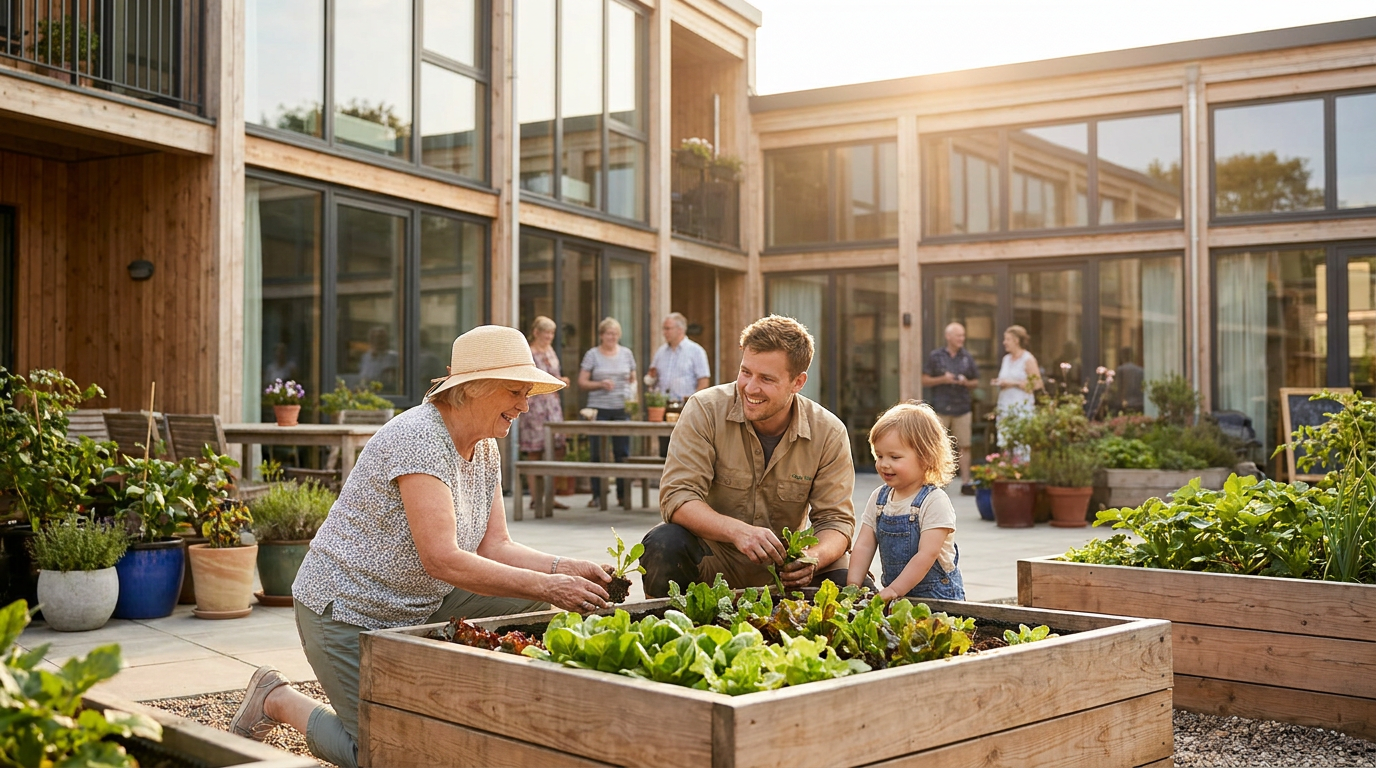
At its core, intergenerational co-living is an architectural and social mechanism designed to engineer connection. Unlike traditional apartment buildings where neighbors might share a hallway but never speak, co-living environments are intentionally structured around "casual collisions." The model typically features private, self-contained living quarters—ensuring residents maintain their autonomy and privacy—arranged around robust, shared communal spaces. These shared hubs often include large industrial kitchens, dining halls, community gardens, and recreation rooms. By moving daily activities like cooking, gardening, or relaxing into a shared sphere, the architecture itself gently forces residents to interact. This design philosophy transforms neighbors from strangers into a functional, interdependent support network, fundamentally altering the daily social diet of its residents.[7]

The empirical evidence supporting the health benefits of this model is becoming increasingly robust, particularly regarding the mitigation of loneliness. A comprehensive study conducted by the London School of Economics examined community-led housing models and found a stark contrast in the mental well-being of residents. Individuals involved in these intentional communities were significantly less likely to report feelings of loneliness compared to demographically similar members of the general public. Furthermore, the residents demonstrated a markedly higher degree of trust in their neighbors and a stronger sense of belonging to their local area. For older adults, who are statistically the most vulnerable to the severe health consequences of chronic isolation, this built-in social infrastructure acts as a protective psychological buffer.[2]
This protective effect is echoed in targeted research on elder populations within mixed-age environments. Data published in the Journal of Women & Aging, which surveyed residents across multiple cohousing neighborhoods, revealed that while loneliness is not entirely eradicated, its prevalence is substantially lower than national averages. The older adults in these communities, who moved specifically in search of a sense of community, reported high levels of personal satisfaction. Crucially, the presence of younger generations introduces a dynamic energy that prevents the community from feeling like a waiting room. Older residents find renewed purpose in mentoring younger neighbors, sharing life skills, or simply being a consistent, supportive presence in the lives of resident children.[3]

The benefits of intergenerational living flow in both directions, offering profound advantages for younger residents and families. For young professionals and students, co-living often provides a more affordable entry point into expensive housing markets, as the costs of utilities, internet, and shared amenities are distributed across the community. Beyond economics, young families gain access to an informal network of experienced caregivers. The University of Wisconsin–Madison School of Nursing highlights that children raised in intergenerational environments demonstrate more cooperative play, increased empathy, and improved mood management. Parents experience less worry and social isolation, knowing they are surrounded by a trusted network of surrogate grandparents who have the time and desire to engage with their children.[4]
The benefits of intergenerational living flow in both directions, offering profound advantages for younger residents and families.
Observing these interactions in practice reveals the profound cognitive and physical impacts on older adults. At intergenerational programs like Hope and a Future in Wisconsin, which integrates older adults with younger families and live-in staff, the results are tangible. Nursing professionals report that when seniors are integrated into environments with children and active young adults, they often begin functioning and communicating at noticeably higher levels. The daily requirement to engage, answer questions, and participate in the chaotic, vibrant rhythm of family life serves as a natural cognitive stimulant. It shifts the focus of elder care from mere survival and safety to genuine flourishing and continued personal growth.[4]
Governments and urban planners are beginning to recognize the scalable potential of this model, leading to innovative public-private partnerships. In Singapore, where the population of citizens over 65 is projected to reach 21 percent by 2026, the state is actively repurposing existing infrastructure to support intergenerational living. A prime example is the transformation of the former Henderson Primary School into a vibrant co-living space. By taking a decommissioned educational facility—already equipped with large halls, sports facilities, and central community access—and retrofitting it for both independent seniors and younger residents, the city-state is creating a blueprint for sustainable urban aging. This approach not only revitalizes aging neighborhoods but also maximizes the utility of state-owned properties.[6]

Similar structural innovations are taking root in North America, moving beyond single-building retrofits to entire neighborhood designs. The Treehouse Foundation in Massachusetts represents a pioneering approach, intentionally designing a community that brings together foster families, youth aging out of the welfare system, and older adults. Slated for expansion, this model leverages the surplus time and emotional capacity of seniors to provide stability for vulnerable youth, while giving the older adults a profound sense of daily purpose. These environments prove that housing can be utilized as a direct social intervention, solving multiple demographic vulnerabilities through the simple act of shared proximity.[1]
Despite the clear social and economic benefits, the widespread adoption of intergenerational co-living faces significant structural headwinds. The most immediate barrier is the rigid framework of modern zoning laws and planning policies. In many Western countries, municipal zoning codes are strictly tailored to single-family homes or highly regulated, age-restricted commercial care facilities. Co-living models, which blend private and communal spaces and often house multiple unrelated individuals, frequently run afoul of density limits and occupancy regulations. Urban planners argue that without a fundamental modernization of planning policies to explicitly recognize and permit community-led housing, these projects will remain difficult to finance and legally complex to build.[7]
Furthermore, the environmental and economic efficiencies of intergenerational co-living are becoming a major draw for environmentally conscious younger demographics. By consolidating resources, these communities significantly reduce their collective carbon footprint. Shared industrial kitchens, communal laundry facilities, and pooled transportation options mean less individual consumption and less waste. For older adults on fixed incomes and young people facing stagnant wages, this shared economy provides a buffer against inflation and rising utility costs. The architecture of sharing inherently promotes a more sustainable lifestyle, aligning the financial incentives of the residents with broader climate goals.[1][7]

Beyond legal and financial hurdles, the success of any co-living environment hinges on the delicate art of community management. The romanticized ideal of generations living in perfect harmony often collides with the friction of daily life. Differences in lifestyle, noise tolerance, and cleanliness standards can quickly escalate into community-fracturing disputes. Successful intergenerational communities do not rely on serendipity; they require robust, intentional governance structures. This typically involves regular community meetings, clear consensus-building processes, and explicit boundaries regarding the division of labor for shared spaces. The communities that thrive are those that treat social infrastructure with the same rigor as physical infrastructure.[7]
Ultimately, the transition toward intergenerational co-living requires a profound cultural shift. It demands that society unlearn the deeply ingrained narrative that success equates to a detached, single-family home and that aging is a process best managed in isolation. As the global wellness industry increasingly pivots away from age-segregated luxury toward purpose-driven, interconnected communities, the definition of a "good life" is expanding. Intergenerational housing is not merely a nostalgic attempt to recreate the villages of the past; it is a highly adaptable, necessary evolution of the urban fabric, designed to ensure that as populations live longer, they do not have to live alone.[5][7]
How we got here
Late 20th Century
The rise of the nuclear family and commercial senior living leads to widespread age-segregated housing.
2010s
Cohousing models gain traction in Europe as a grassroots response to urban isolation.
2020
The COVID-19 pandemic exposes the severe health risks and fragility of isolated, age-restricted senior care facilities.
2024
Harvard's Joint Center for Housing Studies publishes blueprints advocating for intergenerational living designs.
2025
Singapore announces the transformation of the Henderson Primary School into a state-backed intergenerational co-living space.
Viewpoints in depth
Public Health & Aging Experts
Focus on the medical and psychological necessity of social connection to combat the health risks of isolation.
For public health researchers, the push toward intergenerational living is fundamentally a medical intervention. Chronic loneliness is increasingly recognized as a public health crisis, carrying mortality risks comparable to smoking or obesity. By embedding older adults in vibrant, mixed-age environments, these experts argue that society can passively reduce the incidence of depression, cognitive decline, and cardiovascular disease among seniors. They view the architecture of co-living as a preventative healthcare measure that reduces the long-term burden on medical systems.
Urban Planners & Economists
Emphasize the efficiency of shared resources and the revitalization of existing urban infrastructure.
From a planning perspective, intergenerational co-living solves a critical spatial and economic equation. Economists point out that the current housing market is highly inefficient, with older adults often 'over-housed' in large, empty family homes while young families are priced out of the market entirely. Planners advocate for zoning reforms that allow for the repurposing of underutilized civic buildings—like schools or commercial spaces—into dense, shared-resource communities. This camp argues that co-living maximizes urban density without sacrificing the quality of life, creating financially resilient neighborhoods.
Wellness & Lifestyle Advocates
Frame co-living as a holistic, purpose-driven alternative to the traditional, leisure-focused retirement model.
The wellness industry is rapidly shifting its focus from individual optimization to community-centric health. Advocates in this space argue that the traditional 'golf course and cruise ship' model of retirement is fundamentally unfulfilling and leads to a loss of identity. Instead, they champion intergenerational communities as spaces where older adults can maintain a sense of purpose through mentorship and daily contribution. For this camp, the goal is not just to extend lifespan, but to ensure those extra years are rich with meaningful, cross-generational relationships.
What we don't know
- How quickly municipal governments will reform zoning laws to permit high-density, community-led housing models.
- The long-term financial viability of retrofitting large commercial or state-owned buildings for co-living.
- How these communities will adapt as their founding residents age and require more intensive medical care.
Key terms
- Intergenerational Co-living
- A residential model where people of different ages intentionally live together, sharing common spaces and resources while maintaining private quarters.
- Casual Collisions
- Unplanned, spontaneous social interactions engineered by the architectural layout of shared spaces.
- Community-Led Housing
- Housing developments designed and managed by the residents themselves, prioritizing social connection and shared governance.
- Age-Segregated Living
- The practice of separating demographics by age, typically seen in isolated suburban family homes and restricted senior retirement communities.
Frequently asked
Do residents in intergenerational co-living have their own private space?
Yes. The model relies on a balance of privacy and community, featuring fully private apartments or bedrooms alongside shared communal areas like kitchens and gardens.
How does this arrangement benefit younger people?
Younger residents gain access to more affordable housing, shared resources, built-in community support, and valuable mentorship or childcare assistance from older adults.
What happens if residents don't get along?
Successful co-living communities rely on structured governance, clear boundaries, and regular community meetings to mediate conflicts and manage shared responsibilities.
Sources
Source coverage
7 outlets
3 viewpoints surfaced







[1]Harvard Joint Center for Housing StudiesHousing & Urban Planners
Housing Researchers See Cultural Shift To Intergenerational Living
Read on Harvard Joint Center for Housing Studies →[2]London School of EconomicsPublic Health Researchers
'Those little connections': Community-led housing and loneliness
Read on London School of Economics →[3]Journal of Women & AgingPublic Health Researchers
Sense of community, loneliness, and satisfaction in five elder cohousing neighborhoods
Read on Journal of Women & Aging →[4]University of Wisconsin–Madison School of NursingPublic Health Researchers
Our House: The Benefits of Intergenerational Housing
Read on University of Wisconsin–Madison School of Nursing →[5]Global Wellness SummitWellness & Lifestyle Advocates
Trend: Age-Segregated 'Senior Living' Will Increasingly Be Retired in Favor of New Intergenerational Models
Read on Global Wellness Summit →[6]Trend HunterHousing & Urban Planners
Intergenerational Co-Living Spaces
Read on Trend Hunter →[7]Factlen Editorial TeamWellness & Lifestyle Advocates
Synthesis by Factlen editorial team
Read on Factlen Editorial Team →


Every angle. Every day.
Get lifestyle stories with full source coverage and perspective breakdowns delivered to your inbox.