
Travel Backpacks vs. Rolling Carry-Ons: The Definitive One-Bag Travel Comparison
As airlines tighten carry-on restrictions and fees rise, the debate between travel backpacks and rolling suitcases has become central to modern travel. This analysis breaks down the trade-offs in mobility, packing efficiency, and physical strain to help travelers choose the right gear.
By Factlen Editorial Team
- Mobility Purists
- Travelers who prioritize agility, hands-free movement, and the ability to navigate unpredictable terrain.
- Structured Travelers
- Travelers who prioritize physical relief, professional aesthetics, and organized packing.
- Hybrid Strategists
- Frequent flyers who combine a smaller rolling suitcase with a personal-item backpack to balance comfort and accessibility.
What's not represented
- · Travelers with physical disabilities who rely entirely on specific wheeled mobility aids
- · Airlines aiming to maximize cargo revenue by forcing gate-checks
Why this matters
As airlines aggressively increase checked bag fees and strictly enforce carry-on size limits, choosing the right luggage directly impacts your physical comfort and your wallet. Selecting the wrong bag can lead to unexpected gate-check fees, exhausting transit transfers, and a frustrating travel experience.
Key points
- Travel backpacks offer unmatched mobility for navigating stairs, cobblestones, and crowded public transit.
- Soft-sided backpacks weigh less and compress easily, reducing the risk of forced gate-checks on full flights.
- Rolling carry-ons eliminate physical strain, making them ideal for point-to-point travel and heavy packers.
- Hardshell suitcases provide superior protection for fragile items and keep professional clothing wrinkle-free.
- A hybrid approach—pairing a small roller with a personal-item backpack—offers a balanced compromise for frequent flyers.
One-bag travel has transitioned from a niche backpacking philosophy to a mainstream strategy for avoiding checked bag fees, bypassing baggage claims, and eliminating the risk of lost luggage. At the center of this shift is a fundamental gear decision that dictates how a traveler moves through the world: the travel backpack versus the rolling carry-on. The debate often focuses on aesthetics or habit, but the true difference lies in core design philosophy. A suitcase is built around stability, designed to hold its shape, protect belongings, and keep items separated in a structured, predictable manner. A travel backpack, on the other hand, is built around mobility. It is designed to move fluidly with the human body, adapt to tighter spaces, and allow travelers to carry their belongings in a way that feels natural when constantly in motion. Choosing between the two requires understanding how these design philosophies interact with the realities of modern travel.[1][2][5]
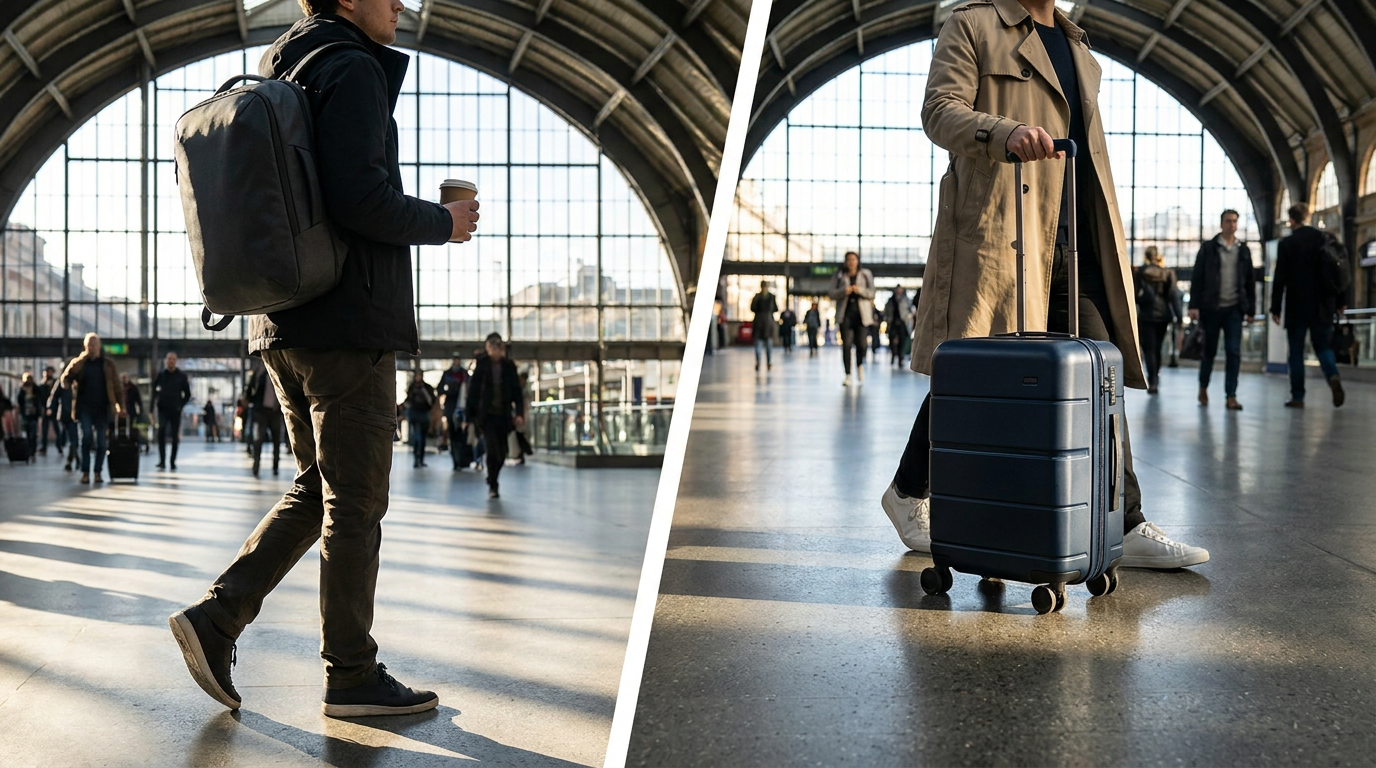
For mobility purists, the travel backpack offers an unmatched level of freedom and agility. By keeping the load securely fastened to the back, travelers maintain complete hands-free convenience for navigating digital boarding passes, holding a cup of coffee, or gripping handrails on moving trains. This setup excels in unpredictable environments where wheels become a liability. Travelers with backpacks can effortlessly bypass broken airport escalators, sprint through crowded terminals for tight connections, and navigate the notoriously uneven cobblestone streets of historic European cities without the loud, jarring drag of plastic wheels. In transit scenarios, a backpack wearer can easily squeeze onto a packed subway car or navigate the narrow aisles of a regional jet without blocking the path of other passengers, making the backpack the ultimate tool for dynamic, multi-stop itineraries.[4][8]
Beyond physical agility, travel backpacks offer a distinct mathematical advantage when it comes to strict airline regulations. A typical 40-liter travel backpack weighs between two and three pounds when empty, whereas a hardshell roller of the exact same volume often weighs between five and eight pounds due to the heavy telescopic handle and wheel housing. On international carriers with strict seven-kilogram weight limits, that extra five pounds of empty luggage can consume nearly half of a traveler's total weight allowance. Furthermore, soft-sided backpacks possess a natural compressibility. If a flight is full and overhead bin space is scarce, a backpack can often be squeezed into a tight gap or shoved under the seat in front of you, significantly reducing the risk of being forced to gate-check your luggage and wait at the baggage carousel upon arrival.[2][6][8]

However, the primary argument against the backpack strategy is the undeniable physical toll it exacts on the human body. Carrying 15 to 25 pounds of gear entirely on the shoulders and hips can lead to rapid fatigue, back strain, and the dreaded "sweaty back" syndrome upon arriving at a destination. While modern travel backpacks feature advanced ergonomic harnesses and load-lifter straps, they still require the traveler to bear the full brunt of their packing choices. For travelers with pre-existing back issues, older demographics, or those navigating exceptionally long layovers where they must walk miles through massive international terminals, carrying the entire weight of a travel wardrobe becomes a significant physical liability. The romance of hands-free travel quickly fades when every step requires physical exertion.[3][6]
Backpacks also struggle to adapt to formal environments and structured packing needs. Arriving at a corporate boardroom, a high-end restaurant, or an upscale hotel lobby with a bulky 45-liter pack strapped to one's back rarely projects the polished, professional image that many business travelers require. Additionally, while modern clamshell-style backpacks have vastly improved interior access, they still lack the rigid, lay-flat organization of a traditional suitcase. Packing a backpack often requires a strategic game of Tetris, utilizing packing cubes to keep clothing from shifting and wrinkling. If a traveler needs to retrieve a specific item from the bottom of the bag during a layover, they are frequently forced to unpack their belongings onto an airport floor, a stark contrast to the simple, organized access provided by a hardshell roller.[5][8]
Backpacks also struggle to adapt to formal environments and structured packing needs.
The case for the rolling carry-on centers entirely on physical relief and the effortless transport of heavy loads. On the smooth, polished floors of international airports, modern hotels, and paved city sidewalks, a four-wheel spinner suitcase glides gracefully with virtually zero weight transferred to the traveler's body. This mechanical advantage allows travelers to pack denser, heavier items—such as extra shoes, thick winter layers, or professional camera gear—without worrying about the physical consequences of carrying them. By letting the wheels do the work, travelers can arrive at their destination feeling fresh and relaxed rather than physically taxed from hauling their belongings across town. For point-to-point travel where the journey consists primarily of an Uber to the airport and a taxi to the hotel, the rolling suitcase is an unbeatable luxury.[4][7][8]

Rolling luggage also maximizes usable space within a rigid, predictable footprint. Because suitcases are shaped exactly like the rectangular sizing bins used by airlines, they often offer a true 40 to 45 liters of internal capacity without bulging outward and drawing the attention of gate agents. The hardshell exterior of modern polycarbonate rollers provides superior, crush-proof protection for expensive laptops, camera lenses, and fragile souvenirs picked up along the journey. Inside, the structured halves of a suitcase keep clothing neatly folded, separated, and wrinkle-free, often featuring built-in compression panels that lock everything firmly into place. For travelers who prioritize a tidy, closet-like packing experience and want to live directly out of their bag without unpacking at the hotel, the suitcase remains the gold standard.[2][5][7]
The fatal flaw of the rolling suitcase emerges the exact moment the terrain changes from smooth to rugged. Cobblestone streets, sandy beach paths, narrow train aisles, and multi-story walk-up apartments instantly turn a rolling bag from a convenience into a cumbersome anchor. When faced with a long flight of stairs or a gap between a train and the platform, travelers are forced to awkwardly carry their 20-pound suitcase by a thin side handle, completely defeating the purpose of the wheels. In crowded urban environments, dragging a wide suitcase behind you increases your physical footprint, making it difficult to weave through dense crowds or navigate tight subway turnstiles without clipping the ankles of fellow pedestrians.[3][4][8]

Furthermore, rolling luggage is highly susceptible to the increasingly strict sizing enforcement of global airlines. The wheels and telescopic handles are permanently included in the bag's overall dimensions, eating into valuable packing space while adding rigid length that cannot be compressed. A standard 21.25-inch roller fits the sizing requirements of roughly 54 percent of global airlines, meaning travelers switching from major domestic carriers to strict European or Asian budget airlines frequently face unexpected gate-check fees when their wheels protrude past the sizing bin limits. Additionally, the mechanical complexity of a roller introduces points of failure; a snapped telescopic handle or a blown-out spinner wheel in a foreign country can instantly ruin the logistics of a carefully planned trip.[2][6]
Recognizing the stark trade-offs between the two extremes, many frequent flyers have adopted a hybrid strategy to capture the best of both worlds. This approach involves pairing a slightly smaller, two-wheel or four-wheel rolling carry-on with a 15- to 20-liter personal-item backpack that slides securely over the suitcase's handle. The roller handles the bulk of the heavy clothing, shoes, and toiletries, while the backpack secures fragile electronics, travel documents, and in-flight essentials. When navigating smooth airports, the traveler pushes the combined unit effortlessly. When facing stairs or rough terrain, they can quickly strap the backpack on and carry the lighter suitcase by hand, offering a highly adaptable balance of physical relief and on-the-go accessibility without fully committing to a heavy 40-liter pack.[2][8]

Ultimately, the comparison between a travel backpack and a rolling carry-on comes down to a fundamental trade-off between speed and endurance. Backpacks optimize for speed, agility, and adaptability in unpredictable environments, allowing travelers to move seamlessly through crowds and complex transit systems. They fit perfectly when an itinerary involves multi-city hops, extensive use of public transportation, or destinations known for uneven terrain. Conversely, rollers optimize for endurance, preserving the traveler's physical energy and providing a structured, predictable packing experience. They fit perfectly when the trip is point-to-point, involving a direct flight to a single destination, or when the traveler needs to maintain a professional appearance and avoid physical strain. By honestly assessing their physical preferences and the logistical realities of their itinerary, travelers can select the gear that removes friction from their journey.[1][4][5]
How we got here
Pre-2000s
Checked luggage was standard and free on almost all major airlines, making carry-on optimization a niche concern.
2008
Major US airlines began charging fees for the first checked bag, sparking a massive consumer shift toward carry-on luggage.
2010s
The rise of digital nomadism and minimalist travel blogs popularized the 'one-bag' philosophy using large hiking backpacks.
2018–2020
Luggage brands introduced purpose-built, clamshell travel backpacks designed specifically for airline dimensions rather than wilderness hiking.
2024–2026
Airlines globally tightened carry-on size and weight enforcement, intensifying the debate over the space taken up by suitcase wheels.
Viewpoints in depth
Mobility Purists
Travelers who prioritize agility, hands-free movement, and the ability to navigate unpredictable terrain.
This camp argues that the modern travel experience is defined by friction—crowded terminals, broken escalators, and tight transit connections. By keeping their luggage on their backs, Mobility Purists believe they reclaim control over their journey. They point out that a backpack allows them to walk off a plane and immediately begin exploring a city without needing to drop bags at a hotel. They view the physical effort of carrying 20 pounds as a worthwhile trade-off for the ability to effortlessly navigate cobblestones, stairs, and narrow train aisles where wheeled luggage becomes a severe liability.
Structured Travelers
Travelers who prioritize physical relief, professional aesthetics, and organized packing.
Structured Travelers argue that vacations and business trips should not double as endurance workouts. They emphasize that navigating massive, modern airports with miles of smooth concourses is perfectly suited for four-wheel spinner suitcases, which transfer the burden of weight from the spine to the floor. This camp values the rigid protection a hardshell provides for electronics and the ability to keep clothing neatly folded and wrinkle-free. For them, the temporary inconvenience of carrying a roller up a flight of stairs is vastly outweighed by the hours of effortless gliding through airports and hotel lobbies.
Hybrid Strategists
Frequent flyers who combine a smaller rolling suitcase with a personal-item backpack to balance comfort and accessibility.
Recognizing the absolute limitations of both extremes, Hybrid Strategists refuse to commit to a single 40-liter bag. Instead, they advocate for a modular approach: a compact roller for heavy clothing and a 20-liter backpack for laptops, documents, and in-flight essentials. This camp argues that this setup maximizes total capacity while adhering to airline rules, allowing them to push the heavy load on smooth surfaces and easily carry the smaller bag when navigating rough terrain. They view the hybrid method as the ultimate pragmatic solution for long-term travel.
What we don't know
- How future airline regulations might further restrict the dimensions of personal items and carry-on bags.
- Whether the development of ultra-lightweight materials will eventually eliminate the weight penalty of wheeled suitcases.
Key terms
- One-Bag Travel
- A minimalist travel philosophy where a person packs all their belongings into a single carry-on bag to avoid checked luggage fees and save time.
- Clamshell Opening
- A backpack design that unzips completely and opens flat like a suitcase, allowing for easy packing and access to all contents.
- Gate-Check
- When an airline requires a passenger to surrender their carry-on bag at the boarding gate to be placed in the cargo hold, often due to a lack of overhead bin space.
- Personal Item
- A smaller piece of luggage, such as a daypack or purse, that airlines allow passengers to bring in addition to their carry-on, provided it fits under the seat.
- Load-Lifter Straps
- Adjustable straps located at the top of a backpack's shoulder straps that pull the weight of the pack closer to the body to improve balance and reduce shoulder strain.
Frequently asked
Will a 40L travel backpack fit under an airplane seat?
Generally, no. While soft-sided backpacks can compress, a fully packed 40L bag is designed for the overhead bin. A 20L to 28L bag is typically the maximum size for under-seat storage.
Are two-wheel or four-wheel rollers better for carry-on travel?
Four-wheel spinners excel on smooth airport floors for effortless gliding, while two-wheel rollers handle rougher terrain better and often provide slightly more internal packing space.
How do I avoid getting my carry-on gate-checked?
Board as early as your group allows, use a soft-sided backpack that doesn't look rigid, and ensure your bag strictly adheres to the airline's dimensional limits, including wheels and handles.
Is a travel backpack bad for your back?
It can be if overpacked or poorly fitted. Choosing a backpack with a padded hip belt and load-lifter straps helps transfer weight off the shoulders and onto the hips, significantly reducing strain.
Sources
Source coverage
8 outlets
3 viewpoints surfaced








[1]Factlen Editorial TeamHybrid Strategists
Synthesis by Factlen editorial team
Read on Factlen Editorial Team →[2]Pack HackerHybrid Strategists
Best Carry On Luggage for Travel
Read on Pack Hacker →[3]The Professional HoboStructured Travelers
How to Decide Between Backpacks vs Rolling Luggage
Read on The Professional Hobo →[4]BagsmartHybrid Strategists
Backpack vs Rolling Luggage: Which Travel Bag Fits Your Trip?
Read on Bagsmart →[5]Boundary SupplyMobility Purists
Carry-On Backpack vs Suitcase for Travel
Read on Boundary Supply →[6]Reddit OneBag CommunityMobility Purists
Backpack vs roller luggage : r/onebag
Read on Reddit OneBag Community →[7]Forbes VettedStructured Travelers
Best Carry-On Luggage 2026
Read on Forbes Vetted →[8]The Carry CollectiveHybrid Strategists
Carry-On Backpack vs Rolling Luggage: Which Should You Choose?
Read on The Carry Collective →



Every angle. Every day.
Get shopping stories with full source coverage and perspective breakdowns delivered to your inbox.