
Supreme Court to Decide if Immigrants Can Be Held Indefinitely Without Bond Hearings
The justices will hear a Trump administration appeal challenging a lower court ruling that granted release hearings to green card holders facing prolonged mandatory detention.
By Factlen Editorial Team
- Immigrant Rights Advocates
- Argue that indefinite imprisonment without a hearing violates the Fifth Amendment and constitutes arbitrary civil detention.
- Federal Administration
- Argues that federal law explicitly mandates detention for noncitizens with specific criminal records, and that due process does not guarantee bond hearings during removal proceedings.
- Legal & Judicial Observers
- Focus on the practical implications of the circuit split and the need for a unified constitutional standard to manage the massive backlog of detention cases.
What's not represented
- · Immigration Judges managing the docket backlog
- · Families of detained immigrants
Why this matters
If the Court sides with the administration, thousands of lawful permanent residents and asylum seekers could face indefinite imprisonment while fighting deportation, fundamentally altering due process rights within the U.S. immigration system.
Key points
- The Supreme Court will hear an appeal from the Trump administration regarding the mandatory detention of immigrants.
- The case centers on whether green card holders with past convictions are entitled to bond hearings after prolonged detention.
- A lower court previously ruled that the Fifth Amendment requires a hearing and that the government must prove the detainee is a flight risk.
- The administration argues that federal law mandates detention and that noncitizens in removal proceedings lack due process rights to demand bail.
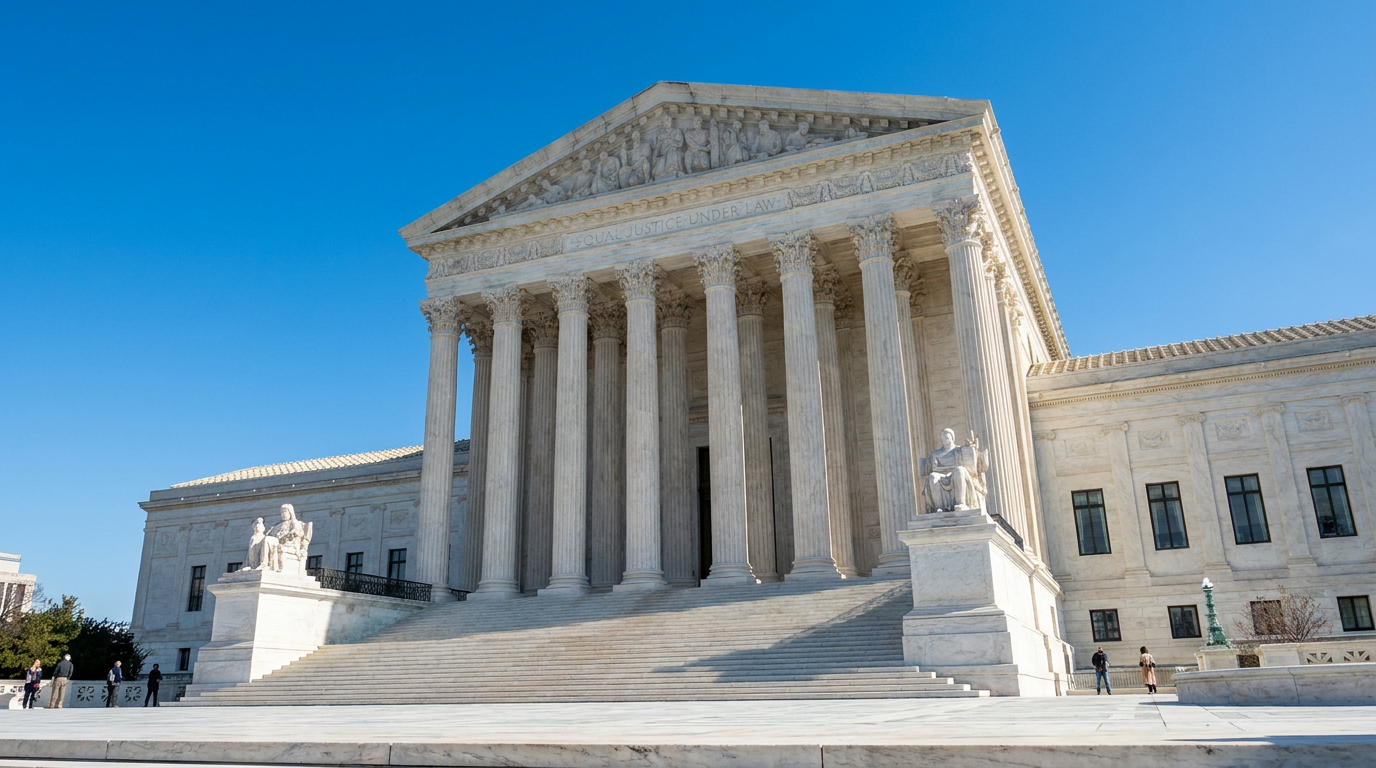
The U.S. Supreme Court agreed on Monday to take up a high-stakes case that will determine whether the federal government can indefinitely detain immigrants—including lawful permanent residents—without granting them a bond hearing. The justices will review a Trump administration appeal challenging a lower court ruling that granted release hearings to green card holders facing prolonged mandatory detention. The case, Genalo v. Black, adds to a growing docket of immigration battles before the high court and promises to resolve a long-simmering constitutional dispute over the limits of civil detention.[1][2][3]
At the center of the dispute are two lawful permanent residents, Carol Williams Black and Keisy G.M., who were detained by U.S. Immigration and Customs Enforcement (ICE) for seven and 21 months, respectively. Both men were placed in removal proceedings due to past criminal convictions, which triggered a provision of the Immigration and Nationality Act that mandates detention for certain noncitizens. Arguing that their prolonged confinement violated their constitutional rights, both men filed habeas corpus petitions seeking individualized hearings to assess whether they actually posed a flight risk or a danger to the community.[2][4]
The Manhattan-based 2nd U.S. Circuit Court of Appeals ultimately sided with the immigrants. The appellate court ruled that the Fifth Amendment's due process clause requires a bond hearing when detention becomes "unreasonably prolonged." Furthermore, the 2nd Circuit held that if the government wishes to keep an individual locked up under these circumstances, it bears the burden of proving by "clear and convincing evidence" that the detainee must remain in custody.[3][4]

The Justice Department fiercely contested that ruling and urged the Supreme Court to intervene. In its petition, the government argued that federal immigration law—specifically Section 1226(c)—calls for mandatory detention based strictly on an individual's aggravated-felony convictions. According to Solicitor General D. John Sauer, individualized findings about flight risk and danger are "irrelevant" under the statute, and the administration maintains that noncitizens in deportation proceedings do not possess a procedural due process right to demand a bond hearing.[1][2]
Immigrant rights advocates have forcefully pushed back against the administration's position, characterizing it as an "extreme theory" that strips fundamental liberties from longtime U.S. residents. Attorneys representing Black and Keisy G.M. cautioned the Court against endorsing the idea that detention without a bond hearing does not implicate any fundamental rights. Organizations like the American Civil Liberties Union and the National Immigration Law Center argue that an across-the-board policy refusing to release anyone swept up in removal proceedings violates constitutional protections against arbitrary and punitive civil imprisonment.[2][6][7]
cautioned the Court against endorsing the idea that detention without a bond hearing does not implicate any fundamental rights.
The upcoming Supreme Court showdown is poised to answer a constitutional question left unresolved from a landmark 2018 case, Jennings v. Rodriguez. In that decision, the Court ruled that the text of the immigration statute itself does not guarantee periodic bond hearings for detained noncitizens. However, the justices explicitly left open the question of whether the U.S. Constitution requires such hearings when detention stretches on for months or years. The government is now asking the Court to settle that exact issue once and for all.[2][3]

Since the Jennings ruling, a deep fracture has emerged among the federal appellate courts regarding how to handle prolonged immigration detention. While the 2nd, 3rd, 6th, and 9th Circuits have struck down mandatory detention policies that deny hearings, other jurisdictions—such as the 5th Circuit—have sided with the government, ruling that denying bond hearings is consistent with both the Constitution and federal law. This circuit split has created a patchwork system where an immigrant's right to a release hearing depends entirely on the state in which they are detained.[2][5]
The practical implications of the Supreme Court's impending decision are vast. If the justices rule in favor of the administration, the burden of proof would shift entirely onto the detained immigrants, who would be forced to file complex federal habeas corpus petitions to seek release. For the estimated 13.4 million lawful permanent residents living in the United States, the ruling could mean that even decades-old or minor convictions could trigger immediate and indefinite detention upon returning from international travel, with no administrative avenue to request bail while their cases drag through backlogged immigration courts.[1][7]

Interestingly, the specific cases that triggered this Supreme Court review may no longer present live controversies. Attorneys for the two men noted in their filings that Keisy G.M. was released from detention in 2022, and Black voluntarily left the United States for Jamaica last year, abandoning his effort to remain in the country. They argued it would be "passing strange" for the Court to entertain the government's legal theory in a context where the stakes are now purely academic. Nevertheless, the government urged the Court to rule on the underlying issue to establish a nationwide precedent.[1][2]
The Supreme Court is expected to hear oral arguments for Genalo v. Black during its next term, which begins in October, with a final decision likely arriving by the summer of 2027. The ruling will not only shape the enforcement capabilities of the current administration but will also define the boundaries of constitutional due process for millions of noncitizens navigating the American legal system.[3][4]
How we got here
Feb 2018
The Supreme Court rules in Jennings v. Rodriguez that immigration statutes do not guarantee periodic bond hearings, but leaves the constitutional question open.
2019
Carol Williams Black, a lawful permanent resident, is taken into ICE custody and held for seven months without a bond hearing.
2024
The 2nd Circuit Court of Appeals rules that prolonged detention without a bond hearing violates the Fifth Amendment's due process clause.
June 2026
The Supreme Court agrees to hear the Trump administration's appeal in Genalo v. Black, setting up a definitive ruling on the issue.
Viewpoints in depth
Federal Administration
The government argues that federal law explicitly mandates detention for noncitizens with specific criminal records.
The Department of Justice maintains that Section 1226(c) of the Immigration and Nationality Act requires mandatory detention based strictly on an individual's aggravated-felony convictions. According to the administration's filings, individualized findings about flight risk and danger are irrelevant under the statute. They argue that noncitizens in deportation proceedings do not possess a procedural due process right to demand a bond hearing, and that the lower courts have overstepped by imposing a 'clear and convincing evidence' standard on the government.
Immigrant Rights Advocates
Advocates argue that indefinite imprisonment without a hearing violates the Fifth Amendment.
Organizations like the American Civil Liberties Union and the National Immigration Law Center contend that an across-the-board policy refusing to release anyone swept up in removal proceedings constitutes arbitrary and punitive civil detention. They emphasize that even noncitizens have a liberty interest in freedom from imprisonment, and that stripping them of the right to a bond hearing fundamentally violates constitutional due process protections.
Legal Permanent Residents
Green card holders face the practical threat of losing their liberty for months or years over past offenses.
For the estimated 13.4 million lawful permanent residents in the U.S., the threat of mandatory detention means that even minor or decades-old convictions can result in immediate imprisonment upon returning from international travel. Without the ability to request bail, these individuals can be locked up indefinitely while navigating severely backlogged immigration courts, fundamentally disrupting their lives, employment, and families.
What we don't know
- It is unclear how the Supreme Court will rule, given that the justices explicitly left this constitutional question open in their 2018 Jennings v. Rodriguez decision.
- It remains to be seen whether the Court will dismiss the case as moot, since both original plaintiffs are no longer in ICE custody.
Key terms
- Habeas Corpus
- A legal petition through which a person can report an unlawful detention or imprisonment to a court and request that the court order their release.
- Lawful Permanent Resident (LPR)
- A noncitizen who has been granted authorization to live and work in the United States on a permanent basis, commonly known as a green card holder.
- Section 1226(c)
- A provision of the Immigration and Nationality Act that requires the mandatory detention of noncitizens who have committed certain crimes, pending their removal proceedings.
- Circuit Split
- A situation where different federal appellate courts interpret the same law or constitutional principle in conflicting ways, often prompting the Supreme Court to intervene.
Frequently asked
What is mandatory detention?
Under U.S. immigration law, certain noncitizens, including those with specific criminal convictions, must be detained by ICE while their deportation cases are processed, without the automatic right to request bail.
Does this case affect all immigrants?
The ruling will primarily impact noncitizens, including green card holders, who have past criminal convictions and are placed in removal proceedings. It will determine if they can be held indefinitely without a chance to prove they are not a flight risk.
When will the Supreme Court issue a decision?
The Court will hear oral arguments during its upcoming term beginning in October 2026, with a final decision expected by the summer of 2027.
Sources
Source coverage
7 outlets
3 viewpoints surfaced







[1]Los Angeles TimesLegal & Judicial Observers
Supreme Court will decide if 'criminal aliens' can be held indefinitely while they fight deportation
Read on Los Angeles Times →[2]Courthouse News ServiceLegal & Judicial Observers
Supreme Court adds three appeals to its fall docket concerning rights for immigrants and criminal defendants
Read on Courthouse News Service →[3]ReutersLegal & Judicial Observers
Supreme Court to hear Trump appeal involving lengthy detention of certain immigrants
Read on Reuters →[4]Washington ExaminerFederal Administration
Supreme Court to hear challenge to indefinite detention of criminal immigrants
Read on Washington Examiner →[5]WORLD News GroupFederal Administration
Supreme Court to rule on ICE detention policies
Read on WORLD News Group →[6]National Immigration Law CenterImmigrant Rights Advocates
NILC to Trump Administration: We are Prepared to Fight Any Attempt to Suspend Habeas Corpus in Court
Read on National Immigration Law Center →[7]American Civil Liberties UnionImmigrant Rights Advocates
Trump on Immigration: Tearing Apart Immigrant Families, Communities, and the Fabric of Our Nation
Read on American Civil Liberties Union →

More in news politics
See all 6 stories →Electoral Reform
Evidence Pack: Does Ranked-Choice Voting Actually Reduce Political Polarization?
0 sources
US-Iran Deal
US and Iran Reach Historic Deal to End War and Reopen Strait of Hormuz
0 sources

US-Iran Relations
US and Iran Sign Peace Agreement to End War and Reopen Strait of Hormuz
0 sources

US-Iran Deal
US and Iran Reach Deal to End War and Reopen Strait of Hormuz as Israel Vows to Maintain Buffer Zones
0 sources

Every angle. Every day.
Get news politics stories with full source coverage and perspective breakdowns delivered to your inbox.