
Women's Club Soccer Shatters Viewership and Revenue Records in Historic 2026 Season
The 2025/26 season has marked a watershed moment for women's club football, with the UEFA Women's Champions League seeing a 164% surge in live viewership and global prize pools reaching unprecedented highs.
By Factlen Editorial Team
- Global Governing Bodies
- Focuses on structural reforms, centralized broadcasting rights, and long-term financial sustainability to grow the game globally.
- Sports Business Analysts
- Views the growth through the lens of enterprise value, return on investment, and the shift toward performance-based corporate sponsorships.
- Broadcasters and Media
- Highlights the unprecedented global demand, record-breaking audience metrics, and the viability of women's soccer as a tier-one broadcast property.
What's not represented
- · Players' Unions and Associations
- · Grassroots and Youth Academy Directors
Why this matters
This explosive financial and cultural growth signifies that women's sports are no longer viewed as a philanthropic endeavor, but as a highly lucrative, tier-one global entertainment asset. For fans and investors alike, the massive influx of capital ensures better infrastructure, higher quality broadcasts, and a sustainable future for the sport.
Key points
- The UEFA Women's Champions League saw a 164% surge in live viewership following a shift to an 18-team league-phase format.
- UEFA's new distribution model allocates €37.7 million annually, with 50% shared equally as starting fees among participating clubs.
- FIFA launched the inaugural Women's Champions Cup with a record-breaking $2.3 million prize for the winning club.
- The US-based NWSL shattered opening weekend attendance records, drawing nearly 130,000 fans across eight matches.
- Corporate sponsorships have shifted from philanthropic initiatives to highly competitive, data-driven performance marketing investments.
The 2025/26 season has officially cemented women's club soccer as a commercial and cultural juggernaut, shattering previous ceilings for global viewership, stadium attendance, and institutional financial investment. Across both the European continent and the United States, the sport is definitively transitioning from a developmental growth project into a highly lucrative, tier-one global entertainment enterprise. For years, advocates of the women's game argued that if broadcasters and governing bodies provided the platform, the audience would follow. The data from the first half of 2026 has overwhelmingly validated that thesis, revealing a landscape where fan demand is actually outpacing historical projections. With major tournaments restructuring their formats to maximize competitive tension and domestic leagues expanding into new, hungry markets, the narrative has shifted entirely. Brands and broadcasters are no longer investing out of a sense of corporate social responsibility; they are aggressively bidding for a piece of one of the fastest-growing sectors in the global sports economy.[3][5][6]
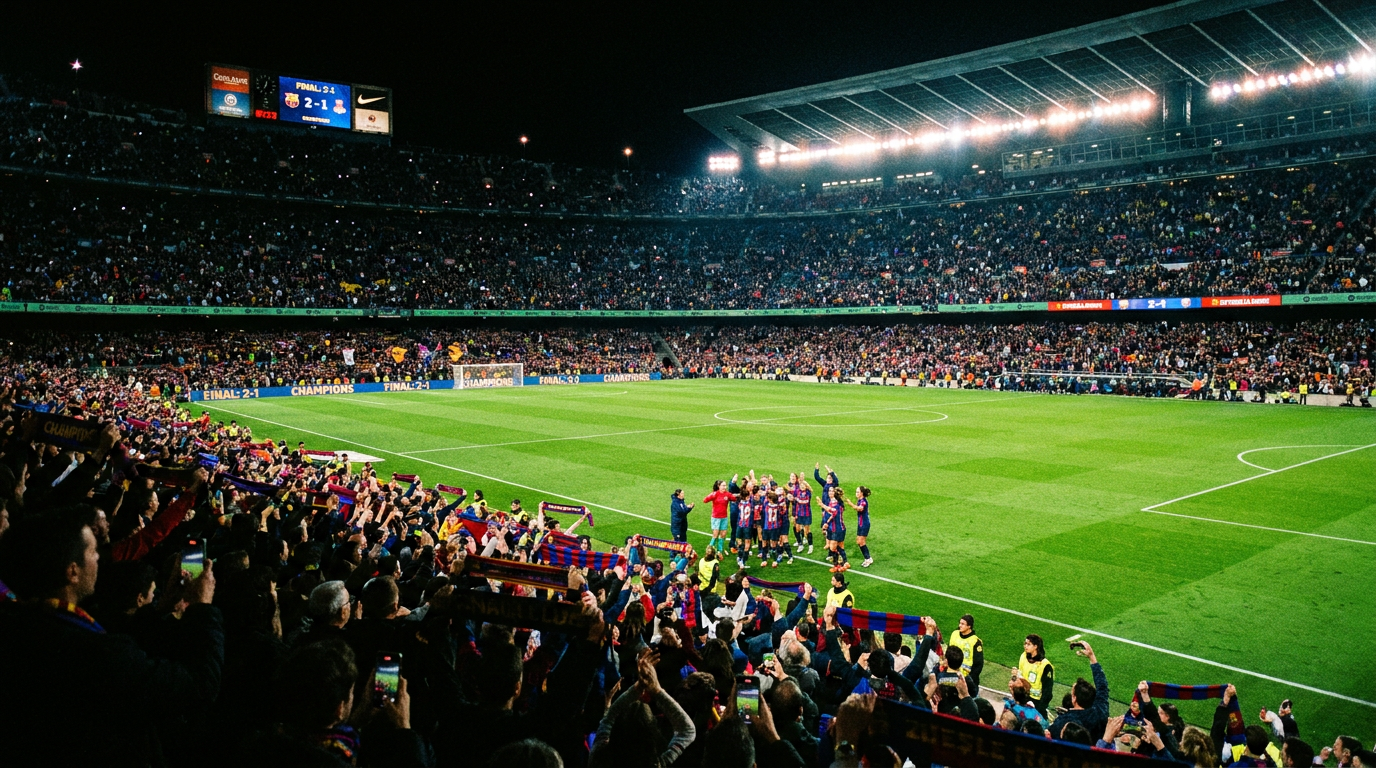
The most staggering metrics of this new era have emerged from the UEFA Women's Champions League (UWCL), which recently concluded a watershed campaign. Following a comprehensive structural overhaul by European football's governing body, the tournament experienced an astonishing 164% surge in live viewership compared to the same stage of the previous season. The digital engagement mirrored this broadcast explosion, with the competition's official channels amassing 947 million video views—a 50% year-over-year increase that highlights the sport's deep resonance with younger, digitally native demographics. Overall interactions across social platforms, including shares and comments, soared by 84%, proving that the audience is not just passively watching, but actively participating in the daily discourse of the sport. By the time the final match arrived, it was broadcast across 207 territories by more than 44 different media partners, making it the most widely available and consumed title match in the history of women's club football.[3][4]

UEFA attributes this unprecedented global reach directly to its newly implemented 18-team league-phase format, a bold structural adjustment that replaced the traditional, often predictable group stage. By guaranteeing more high-stakes matchups between top-tier clubs earlier in the calendar, the new format dramatically increased the competitive balance of the tournament. According to UEFA's end-of-season reports, nearly half of all matches were decided by a single goal or ended in a draw, while a full third of the games featured dramatic second-half comebacks. This unpredictability is the lifeblood of sports broadcasting, keeping audiences engaged deeper into the tournament and convincing casual viewers to tune in week after week. Broadcasters in key markets reaped the rewards immediately; Spain's RTVE, for instance, reported its highest UWCL audience ever, averaging well over a million viewers for the final alone, proving that domestic audiences will turn out in massive numbers for high-stakes continental clashes.[1][3][4]
The financial rewards generated by this viewership boom are scaling rapidly, fundamentally altering the economic reality for clubs across the continent. UEFA has unveiled a record-breaking revenue distribution model that allocates €37.7 million per season for the 2025-2027 cycle, a figure that is already projected to rise to €46.7 million annually between 2027 and 2030. This influx of capital represents a seismic shift in how women's football is funded, moving away from reliance on men's team subsidies and toward a self-sustaining commercial model. The centralized sale of media and sponsorship rights has allowed UEFA to package the tournament as a premium product, extracting maximum value from global broadcasters who are desperate for live, high-engagement sporting events to anchor their streaming platforms and linear television networks.[1]
Crucially, this capital is not just flowing to the eventual champions or the historic powerhouse clubs that routinely reach the final rounds. The newly ratified distribution model guarantees that 50% of the funds are allocated as starting fees, shared equally among all 18 participating clubs in the league phase. This means each club receives a baseline of €505,000 just for reaching the tournament proper, providing vital financial security. Furthermore, teams that are eliminated in the early qualifying rounds will draw from a dedicated €7.7 million solidarity pot. This ensures that the immense wealth generated at the pinnacle of the sport fortifies the broader European ecosystem, allowing smaller clubs in developing leagues to invest in their youth academies, upgrade their training facilities, and improve player welfare standards across the board.[1]

Crucially, this capital is not just flowing to the eventual champions or the historic powerhouse clubs that routinely reach the final rounds.
The global stage is reflecting this same aggressive financial escalation, driven by a desire to capitalize on the sport's surging worldwide momentum. In early 2026, FIFA officially launched the inaugural Women's Champions Cup, a landmark tournament designed to crown the premier women's club team across all six of the world's continental confederations. Modeled after the historic men's Club World Cup, the tournament brought together the champions of Europe, Asia, Africa, South America, North America, and Oceania in a single-elimination bracket. The introduction of this tournament fills a long-standing void in the women's calendar, providing a definitive answer to which club reigns supreme globally while simultaneously offering a massive new commercial vehicle for international broadcasters and sponsors eager to reach a truly global audience.[2]
To establish the tournament's prestige immediately and attract the absolute best talent without hesitation, FIFA set the winner's prize at a staggering $2.3 million. This represents the largest single payout ever awarded in the history of women's club football, setting a new global benchmark for compensation that domestic leagues will inevitably be measured against. The total prize pool for the six-team invitational approaches $4 million, with the runners-up earning $1 million and even the losing semi-finalists guaranteed $200,000 in participation payments. It is a clear, undeniable signal of the governing body's intent to accelerate the professionalization of the club game worldwide, ensuring that financial opportunity keeps pace with the exceptional athletic performances seen on the pitch and providing a massive cash injection to clubs outside the traditional European strongholds.[2]
Across the Atlantic, the United States' National Women's Soccer League (NWSL) is experiencing a parallel economic and cultural boom that is reshaping the North American sports landscape. The league's 2026 opening weekend shattered all previous attendance records, drawing nearly 130,000 fans across eight matches for a staggering average of over 16,000 supporters per game. Expansion franchises, once viewed as risky ventures requiring years of runway to build a fanbase, are proving immediately and wildly viable. The newly minted Boston Legacy FC drew over 30,000 fans for its inaugural match, setting a new high-water mark for the largest crowd ever at a club's first game in NWSL history. Meanwhile, established clubs like the Washington Spirit and Kansas City Current opened their campaigns with sold-out stadiums, proving that the demand is both deep and geographically diverse.[5]

This localized passion has translated into massive enterprise value, attracting a new class of billionaire investors and institutional capital to the American game. Recent financial valuations estimate that the NWSL's 14 teams are now collectively worth $2.6 billion, a figure that would have been unthinkable just half a decade ago. The league is led by heavyweights like Angel City FC, whose valuation has soared past $335 million, driven by a star-studded ownership group and a fiercely loyal Los Angeles fanbase. This influx of capital is allowing American clubs to build state-of-the-art, dedicated training facilities and privately financed stadiums, breaking the historical cycle of women's teams acting as secondary tenants in oversized or inadequate venues. The physical infrastructure of the sport is finally beginning to match the elite level of the athletes.[5][6]
This surge in tangible, verifiable value is fundamentally altering how major corporate brands interact with the sport on a global scale. For years, sponsorships in women's soccer were often categorized by marketing departments as philanthropic exercises or diversity initiatives. Today, they are highly competitive, data-driven performance marketing investments. With a young, diverse, and relatively affluent fanbase, the NWSL generated an estimated $39.5 million from league-wide sponsorships alone last season, bringing in blue-chip partners across the technology, healthcare, and cosmetics sectors. Brands are now demanding—and receiving—measurable impacts, such as direct retail conversions, app downloads, and deep fan retention metrics, rather than settling for passive perimeter board exposure. The narrative surrounding women's club soccer has irrevocably shifted; the infrastructure is built, the global audiences have arrived, and the capital is flowing freely, marking the definitive dawn of a fiercely competitive new era in sports entertainment.[4][6]
How we got here
August 2025
The NWSL sets a single-game attendance record when Bay FC draws over 40,000 fans against the Washington Spirit.
October 2025
UEFA implements its new 18-team league-phase format for the Women's Champions League, replacing the traditional group stage.
January 2026
FIFA announces the prize structure for the inaugural Women's Champions Cup, setting a record $2.3 million payout for the winner.
March 2026
The NWSL opens its 2026 season with record-breaking attendance, including over 30,000 fans for Boston Legacy FC's inaugural match.
May 2026
The UEFA Women's Champions League final is broadcast in 207 territories, capping off a season with a 164% surge in live viewership.
Viewpoints in depth
Governing Bodies' View
Emphasizing structural reform and centralized revenue distribution.
Organizations like UEFA and FIFA argue that the explosive growth of women's club soccer is not accidental, but the direct result of deliberate structural reforms. By centralizing media rights and replacing predictable group stages with high-stakes league formats, they have created a premium product that broadcasters are eager to purchase. Crucially, these bodies emphasize that their revenue distribution models—which include massive solidarity payments to eliminated teams—are designed to ensure that the wealth generated at the top fortifies the entire global ecosystem, preventing a monopoly of a few elite clubs.
Sports Investors' View
Focusing on enterprise value and high-ROI performance marketing.
Financial analysts and institutional investors view the current landscape of women's soccer as a highly lucrative, undervalued asset class that is rapidly correcting. They note that the narrative has shifted away from 'supporting women's sports' out of goodwill, and toward capitalizing on a young, affluent, and fiercely loyal demographic. Investors point to the skyrocketing valuations of NWSL franchises—now collectively worth $2.6 billion—as proof that dedicated infrastructure and data-driven performance marketing can yield massive returns that rival traditional men's sports properties.
Broadcasters' View
Highlighting unprecedented global demand and digital engagement.
Media partners and broadcasters focus on the sheer scale of the audience metrics, which have shattered historical projections. With the UWCL experiencing a 164% surge in live viewership and nearly a billion video views across digital platforms, broadcasters argue that women's club soccer has definitively proven itself as a tier-one media property. They emphasize that the sport's ability to generate deep engagement—evidenced by an 84% increase in social media interactions—makes it an ideal anchor for both linear television networks and modern streaming platforms looking to reduce subscriber churn.
What we don't know
- Whether the rapid influx of institutional capital will price out legacy, community-owned clubs in European domestic leagues.
- How the upcoming renegotiation of global media rights will value the sport once the current broadcast cycles expire in 2027.
- If the massive attendance figures for NWSL expansion teams will sustain themselves over a multi-year period once the novelty fades.
Key terms
- League-phase format
- A tournament structure where teams play a set number of matches against different opponents in a single large league table, replacing traditional small groups.
- Centralized media rights
- When a governing body sells the broadcasting rights for an entire tournament as a single package, rather than clubs selling their home games individually.
- Performance marketing
- Advertising campaigns where sponsors pay based on measurable user actions, such as clicks or sales, rather than just brand visibility.
- Solidarity pot
- A designated pool of funds distributed to lower-tier or eliminated teams to ensure financial stability across the broader sporting ecosystem.
Frequently asked
What caused the sudden surge in UEFA Women's Champions League viewership?
UEFA introduced a new 18-team league-phase format for the 2025/26 season, which increased competitive balance and resulted in a 164% surge in live viewership.
How much does the winner of the FIFA Women's Champions Cup receive?
The winning club receives $2.3 million, which is the largest single prize payout in the history of women's club football.
Are domestic leagues seeing similar financial growth?
Yes. The US-based NWSL recently saw expansion teams draw over 30,000 fans for their inaugural matches, while the league's collective valuation reached an estimated $2.6 billion.
How has corporate sponsorship of women's soccer changed?
Sponsorships have transitioned from philanthropic diversity initiatives into highly competitive, data-driven performance marketing investments aimed at a young, affluent fanbase.
Sources
Source coverage
6 outlets
3 viewpoints surfaced





[1]UEFAGlobal Governing Bodies
Record revenue distribution for UEFA women's club competitions
Read on UEFA →[2]FIFAGlobal Governing Bodies
FIFA Women's Champions Cup 2026: Everything you need to know
Read on FIFA →[3]ReutersBroadcasters and Media
Women's Champions League hits new audience benchmark, says UEFA
Read on Reuters →[4]ValueTheMarketsSports Business Analysts
UEFA Women's Champions League experienced a 164% surge in viewership
Read on ValueTheMarkets →[5]Sports Business JournalSports Business Analysts
Women's soccer investment accelerates across NWSL
Read on Sports Business Journal →[6]SportsProSports Business Analysts
NWSL commercial partners buoyed by rapid rate of growth
Read on SportsPro →

More in sports
See all 11 stories →Injury
PLL Injury Report: Xander Dickson's Triumphant Return Highlights a Week of Resilience and Roster Shifts
0 sources

MLB Milestones
Cubs' Pete Crow-Armstrong Hits First Cycle of the 2026 MLB Season
0 sources

Standings
Midseason Lacrosse Standings: Chaos Lead 'Wild West' as Defending Champion Atlas Stumble
0 sources

Women's Soccer
NWSL Awards 2026 Championship to Audi Field Amid Record Global Call-Ups
0 sources

Every angle. Every day.
Get sports stories with full source coverage and perspective breakdowns delivered to your inbox.