
How Solid-State Batteries Work: The Tech Promising to Double EV Range
Solid-state batteries replace flammable liquid electrolytes with rigid materials, promising to double electric vehicle range and eliminate fire risks. However, complex manufacturing hurdles remain before the technology reaches the mass market.
By Factlen Editorial Team
- Battery Developers & Automakers
- Focused on the transformative potential of the technology to eliminate range anxiety and drive mass EV adoption.
- Manufacturing Pragmatists
- Emphasizes the immense engineering and cost hurdles required to scale the technology outside the lab.
- Safety & Materials Researchers
- Prioritizes the elimination of thermal runaway and the fundamental chemistry of dendrite suppression.
What's not represented
- · Consumers waiting for affordable EVs
- · Lithium mining environmental advocates
Why this matters
If successfully commercialized, solid-state batteries will make electric vehicles capable of driving over 600 miles on a single 10-minute charge while fundamentally eliminating fire risks, removing the final major barriers to global EV adoption.
Key points
- Solid-state batteries replace flammable liquid electrolytes with rigid ceramics, glass, or sulfides.
- The technology aims to double EV range by utilizing pure lithium metal anodes.
- Solid electrolytes eliminate the risk of thermal runaway, making EVs fundamentally safer.
- Manufacturing challenges, including interfacial resistance and dendrite growth, remain significant hurdles.
- Major automakers target 2027-2030 for the initial launch of solid-state passenger vehicles.
For the past decade, the electric vehicle revolution has been powered by a single, ubiquitous technology: the lithium-ion battery. While these power cells have steadily improved, they are rapidly approaching their theoretical limits. Engineers are struggling to squeeze more miles out of the same physical space, and the inherent chemistry still carries rare but highly publicized fire risks. To push transportation into its next era, the industry is turning to a holy grail of energy storage: the solid-state battery.[1][5][7]
To understand why solid-state technology is so revolutionary, one must first look inside a conventional lithium-ion cell. Traditional batteries consist of a positive electrode (cathode), a negative electrode (anode), and a liquid chemical electrolyte separating them. When a device is charging or discharging, lithium ions swim back and forth through this liquid soup. A porous plastic separator sits in the middle to keep the anode and cathode from touching and short-circuiting.[3][5]
The liquid electrolyte is highly effective at conducting ions, but it is also the battery's greatest vulnerability. The organic solvents used in these liquids are highly flammable. If the battery is punctured in a crash, or if it overheats due to a manufacturing defect, the liquid can ignite, triggering a chain reaction known as thermal runaway. This is why EV fires, though statistically less common than gas car fires, burn with such intense, difficult-to-extinguish heat.[4][7]

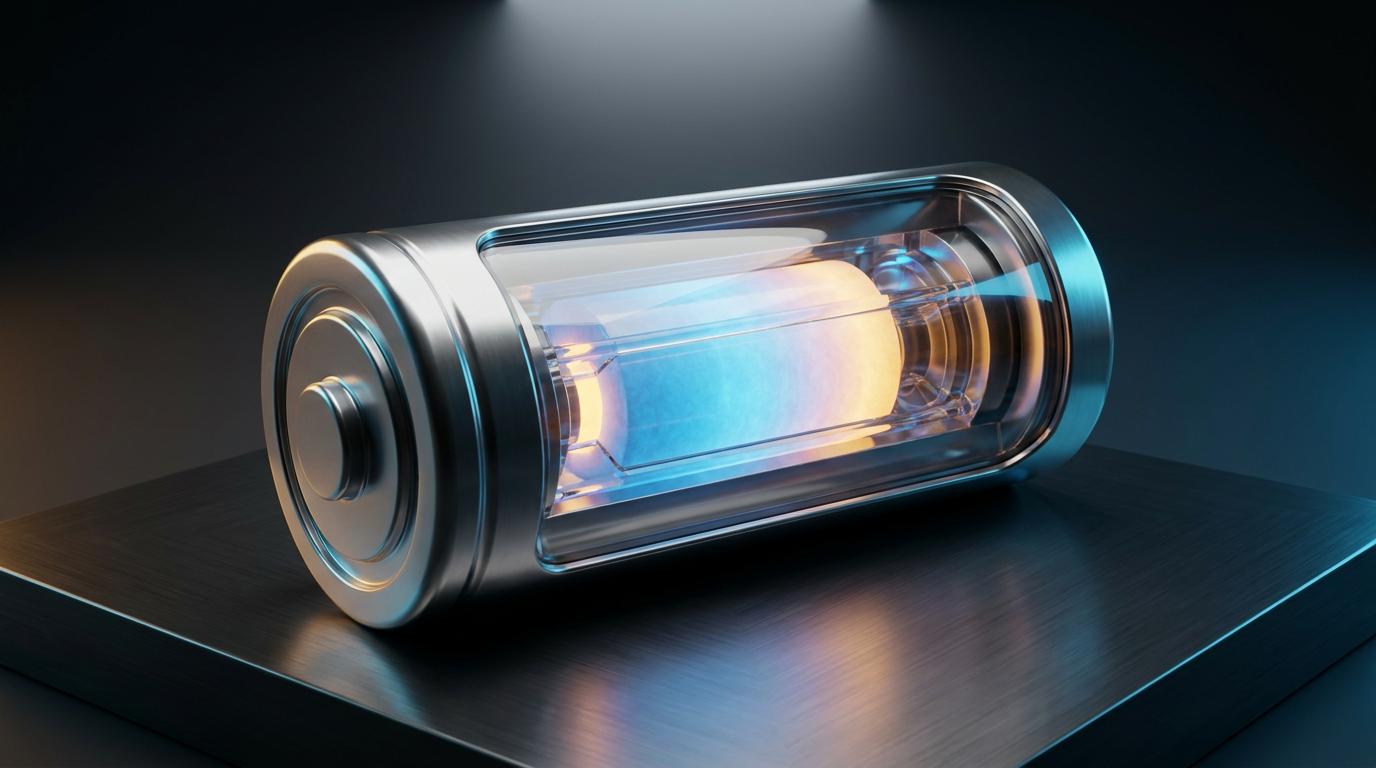
Solid-state batteries elegantly solve this problem by replacing the liquid soup and the plastic separator with a single piece of solid material. Depending on the manufacturer, this solid electrolyte is typically made of advanced ceramics, glass, or sulfide-based compounds. Because these solid materials are entirely non-flammable, the risk of a catastrophic battery fire drops to near zero. Testing shows that thermal events in solid-state systems do not even begin until temperatures reach roughly 247 degrees Celsius, compared to just 90 degrees for conventional lithium-ion cells.[2][5][7]
But safety is only half the equation; the true prize is energy density. Energy density measures how much power a battery can hold relative to its weight, typically expressed in watt-hours per kilogram (Wh/kg). Today's best lithium-ion batteries max out between 200 and 300 Wh/kg. Solid-state batteries currently in development are targeting 400 to 500 Wh/kg, with theoretical limits pushing even higher.[7]
This massive leap in capacity is made possible by a fundamental change to the battery's anode. In traditional batteries, the anode is made of graphite, which acts like a sponge to absorb lithium ions. Graphite is stable, but it is heavy and takes up a lot of physical space. Because a solid electrolyte is physically rigid, it allows engineers to discard the bulky graphite entirely and use an anode made of pure, metallic lithium.[3][5]

This massive leap in capacity is made possible by a fundamental change to the battery's anode.
Pure lithium metal can store up to ten times more energy than graphite by weight. In practical terms, this means an automaker could build an electric vehicle with a battery pack that is half the size and weight of today's packs, yet delivers the exact same range. Alternatively, they could keep the battery the same size and push the vehicle's range well past the 600-mile (1,000-kilometer) mark on a single charge.[7]
Charging speeds are also poised for a dramatic upgrade. Because solid electrolytes can tolerate much higher temperatures and electrical currents without degrading or catching fire, they can absorb power at blistering rates. Several leading developers anticipate that solid-state EV batteries will be able to charge from 10 percent to 80 percent in just 10 to 15 minutes, mirroring the time it takes to fill a traditional car with gasoline.[2][7]
If the benefits are so clear, why aren't solid-state batteries already in every driveway? The answer lies in the microscopic physics of the battery and the brutal realities of mass manufacturing. The first major hurdle is interfacial resistance. In a liquid battery, the fluid naturally coats every microscopic crevice of the electrodes, ensuring perfect electrical contact. Achieving that same seamless contact between two rigid solids is incredibly difficult, and any gaps will severely throttle the battery's power output.[5][7]
The second, and perhaps most notorious, challenge is the formation of dendrites. When a battery with a pure lithium metal anode is charged, the lithium does not always deposit smoothly. Instead, it can form microscopic, needle-like metallic spikes called dendrites. Over time, these spikes can grow long enough to pierce the solid electrolyte, creating an internal short circuit that kills the battery. While solid electrolytes are much tougher than liquid separators, engineering a material rigid enough to block dendrites but porous enough to let ions flow freely remains a delicate balancing act.[4][5]
Finally, there is the challenge of production scaling. Manufacturing solid-state batteries requires entirely new factory equipment and exacting environmental controls. Sulfide-based electrolytes, for example, are highly conductive but react violently with moisture in the air to produce toxic hydrogen sulfide gas. This means they must be manufactured in ultra-dry cleanrooms, which dramatically increases production costs. Ceramic electrolytes, meanwhile, require high-temperature sintering ovens that consume massive amounts of energy.[7]

Despite these hurdles, the industry is crossing the threshold from laboratory theory to commercial reality. As of 2026, major players like QuantumScape, Factorial Energy, and Solid Power have moved beyond test tubes and are operating pilot production lines. These facilities are churning out early batches of solid-state cells for automotive testing, proving that the chemistry works outside of a controlled academic environment.[6][7]
In the interim, the market is seeing the rise of semi-solid batteries. These hybrid cells use a mostly solid electrolyte but retain a small percentage of liquid—typically 5 to 15 percent—to help bridge the gap between the electrodes. Semi-solid batteries offer a middle ground, providing a noticeable bump in energy density and safety without requiring automakers to completely reinvent their manufacturing lines.[2][7]

The true inflection point for fully solid-state electric vehicles is expected between 2027 and 2030. Automotive giants like Toyota, BYD, and CATL have publicly committed to launching their first solid-state-equipped passenger vehicles within this window. Initially, these batteries will likely be reserved for premium, high-performance models due to their steep early production costs. But as manufacturing scales and the technology matures, solid-state cells are poised to cascade down to the mass market, fundamentally rewriting the rules of electric mobility.[6][7]
How we got here
19th Century
Solid electrolytes are first discovered, but practical applications remain elusive.
Late 2010s
Renewed interest and massive investments from automakers spark a race to commercialize the technology for EVs.
2024
Major developers achieve critical lab milestones, proving the chemistry can withstand hundreds of charge cycles.
2026
Pilot production lines open, and semi-solid hybrid batteries begin appearing in niche industrial applications.
2027–2028
Leading automakers target the launch of their first premium passenger vehicles equipped with fully solid-state batteries.
Viewpoints in depth
Battery Developers & Automakers
Focused on the transformative potential of the technology to eliminate range anxiety and drive mass EV adoption.
This camp views solid-state chemistry as the ultimate unlock for the electric vehicle market. By doubling energy density and slashing charge times to 15 minutes, they argue solid-state batteries will finally make EVs functionally superior to gas-powered cars in every metric. Automakers are aggressively pushing timelines, viewing the technology as a critical competitive moat for the late 2020s.
Manufacturing Pragmatists
Emphasizes the immense engineering and cost hurdles required to scale the technology outside the lab.
Manufacturing experts caution against overly optimistic timelines, pointing to the 'production hell' of scaling new battery chemistries. They highlight the extreme difficulty of maintaining perfect interfacial contact between solid materials and the high costs of ultra-dry cleanrooms. This group advocates for 'semi-solid' batteries as a necessary, decade-long stepping stone before pure solid-state becomes economically viable.
Safety & Materials Researchers
Prioritizes the elimination of thermal runaway and the fundamental chemistry of dendrite suppression.
For materials scientists, the primary victory of solid-state technology is intrinsic safety. They focus on the microscopic battle against lithium dendrites—the metallic spikes that cause short circuits. This camp is less concerned with commercial launch dates and more focused on perfecting the ceramic and sulfide structures that will permanently eliminate the fire risks associated with liquid organic solvents.
What we don't know
- Exactly how much a solid-state battery pack will cost when it first reaches the consumer market.
- Which of the three main solid electrolyte materials (polymers, oxides, or sulfides) will ultimately dominate the industry.
- Whether the technology will scale fast enough to meet the aggressive 2030 emissions targets set by global governments.
Key terms
- Electrolyte
- The medium inside a battery that allows ions to flow between the positive and negative sides.
- Anode
- The negative electrode of a battery, which stores lithium ions when the battery is charged.
- Cathode
- The positive electrode of a battery, which releases lithium ions during discharge.
- Dendrite
- Microscopic, needle-like metal formations that can grow inside a battery and cause short circuits.
- Thermal Runaway
- A dangerous chain reaction where a battery overheats uncontrollably, often leading to a fire.
- Energy Density
- The amount of energy a battery can store relative to its physical weight or size.
Frequently asked
Will my next electric vehicle have a solid-state battery?
If you buy a car before 2028, likely not. Early solid-state batteries will debut in premium, high-end models first, with mass-market availability expected closer to 2030.
Are solid-state batteries completely fireproof?
While no energy storage device is entirely immune to extreme heat, solid-state batteries eliminate the flammable liquid solvents that cause severe EV fires, making them exponentially safer.
Why are they taking so long to manufacture?
Building solid-state cells requires entirely new factory environments, including ultra-dry cleanrooms and high-temperature ovens, making them difficult and expensive to produce at scale.
Sources
Source coverage
7 outlets
3 viewpoints surfaced







[1]Factlen Editorial Team
Synthesis by Factlen editorial team
Read on Factlen Editorial Team →[2]The Battery Show AsiaBattery Developers & Automakers
What Are All-Solid-State Batteries?
Read on The Battery Show Asia →[3]Flash BatterySafety & Materials Researchers
The structure of a solid-state battery
Read on Flash Battery →[4]WikipediaSafety & Materials Researchers
Solid-state battery
Read on Wikipedia →[5]Volta FoundationManufacturing Pragmatists
Solid State Batteries
Read on Volta Foundation →[6]CleanTechnicaBattery Developers & Automakers
Solid-State Battery Progress
Read on CleanTechnica →[7]SolarTech OnlineManufacturing Pragmatists
Solid State Batteries: Comprehensive Guide
Read on SolarTech Online →
Every angle. Every day.
Get guides stories with full source coverage and perspective breakdowns delivered to your inbox.