
AI Unlocks the 2,000-Year-Old Secrets of the Herculaneum Scrolls
Using high-resolution 3D scans and machine learning, researchers have successfully read carbonized scrolls buried by the eruption of Mount Vesuvius, revealing lost philosophical texts from antiquity.
By Factlen Editorial Team
- Classical Papyrologists
- Scholars view this breakthrough as the greatest classical discovery of the modern era, offering a direct window into ancient thought.
- Computer Vision Researchers
- Technologists celebrate the project as a triumph of open-source collaboration and machine learning innovation.
- Cultural Preservationists
- Archivists and preservationists focus on how non-invasive scanning can save other fragile global heritage artifacts.
What's not represented
- · Modern Philosophers
- · Italian Heritage Authorities
Why this matters
This breakthrough provides a non-invasive way to read the only intact library surviving from the classical world. It opens the door to recovering thousands of lost historical, philosophical, and literary works that could fundamentally reshape our understanding of human history.
Key points
- AI has successfully deciphered text from the Herculaneum scrolls, which were carbonized by the eruption of Mount Vesuvius in 79 AD.
- Because both the ink and the papyrus are carbon-based, the writing was completely invisible to the human eye and standard X-rays.
- Researchers used particle accelerators to create ultra-high-resolution 3D scans of the intact scrolls.
- Machine learning algorithms were trained to detect microscopic textural changes on the papyrus fibers caused by the ink.
- The first decoded passages reveal previously unknown Epicurean philosophy discussing the relationship between scarcity and pleasure.
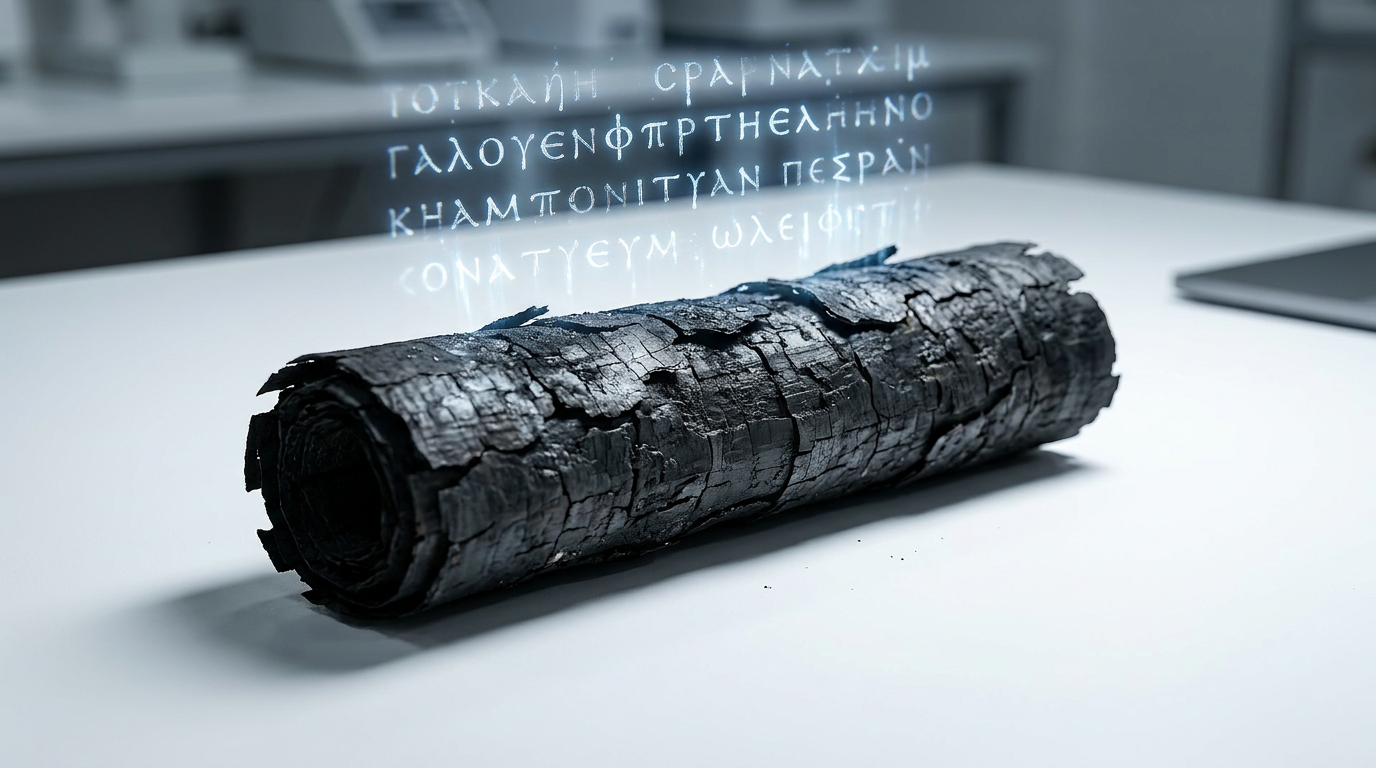
For more than two and a half centuries, the Herculaneum scrolls were considered one of archaeology’s most agonizing mysteries. Buried beneath a deluge of superheated volcanic ash, the ancient library was transformed into a collection of brittle, blackened lumps that resembled discarded charcoal. To the naked eye, they offered nothing. Yet, locked inside these carbonized cylinders were the unfiltered thoughts of the classical world, perfectly preserved but entirely inaccessible. Now, an unprecedented convergence of particle physics, crowdsourced citizen science, and artificial intelligence is finally coaxing these ancient voices out of the dark.[2][4]
The story of the scrolls begins in 79 AD, when Mount Vesuvius violently erupted, obliterating the Roman cities of Pompeii and Herculaneum. While Pompeii was buried in falling pumice, Herculaneum was engulfed by a massive pyroclastic surge—a wave of scorching gas and volcanic mud. This intense heat instantly carbonized organic material, flash-frying a luxury seaside estate believed to belong to Lucius Calpurnius Piso Caesoninus, the father-in-law of Julius Caesar. Inside this "Villa of the Papyri" lay the only large-scale library from classical antiquity to survive into the modern era.[2][4]
When farmworkers digging a well in 1752 accidentally struck the villa's marble pavement, excavators soon uncovered more than 1,800 of these carbonized scrolls. Early attempts to read them were catastrophic. Well-meaning researchers and monks tried to physically unroll the papyri using knives, rosewater, and rudimentary mechanical rigs. The fragile ash simply crumbled to dust, destroying hundreds of irreplaceable texts in the process. The remaining unopened scrolls were eventually locked away in storerooms in Naples and Paris, written off as an unsolvable puzzle.[3][5]
The fundamental roadblock to reading the Herculaneum papyri was a matter of chemistry. Unlike medieval manuscripts written with iron gall ink, ancient Roman and Greek scribes used a carbon-based ink made from soot and water. Because the volcanic eruption had turned the papyrus itself into carbon, the ink and the paper were chemically identical. To the human eye, and even to standard medical X-ray machines, the letters were completely indistinguishable from the charred pages they were written on.[2][6]

The paradigm began to shift through the pioneering work of Dr. Brent Seales, a computer scientist at the University of Kentucky. Seales spent two decades developing a non-invasive technique called "virtual unwrapping." Rather than physically opening a fragile artifact, his team used high-resolution X-ray tomography to peer inside, creating a three-dimensional digital model of the object's internal structure. Computer vision algorithms could then theoretically trace the crumpled layers of the material and flatten them into a readable two-dimensional sheet.[4][6]
Seales proved the viability of virtual unwrapping in 2015 when his team successfully read the En-Gedi scroll, a charred parchment from the Dead Sea region containing text from the Book of Leviticus. However, the En-Gedi scroll used a metal-based ink that glowed brightly on CT scans. When Seales applied the same technique to the Herculaneum scrolls, the carbon-on-carbon problem persisted. The layers could be digitally flattened, but the pages appeared entirely blank.[4]
Realizing that the sheer scale of the computational problem required a global effort, Seales partnered with Silicon Valley tech entrepreneurs Nat Friedman and Daniel Gross in March 2023. Together, they launched the Vesuvius Challenge, a crowdsourced machine learning competition offering over $1 million in prize money. They released thousands of 3D X-ray images of two intact scrolls to the public, challenging the global computer science community to build an AI capable of detecting the invisible ink.[2][3][6]
To give the AI a fighting chance, the scrolls first had to be scanned at an unprecedented resolution. Researchers took the fragile artifacts to particle accelerators, such as the Diamond Light Source in Oxfordshire, UK. These massive synchrotron facilities generate intensely bright X-rays capable of scanning the scrolls at a resolution of 2 micrometers—roughly one-fiftieth the width of a human hair. At this microscopic scale, the physical "texture" of the ink sitting on top of the papyrus fibers finally became visible.[1][4]
To give the AI a fighting chance, the scrolls first had to be scanned at an unprecedented resolution.
The challenge for the competitors was to train machine learning models to recognize these microscopic topographical changes. The AI had to learn the subtle "crackle" patterns and minute variations in thickness that occurred wherever a scribe's pen had deposited soot onto the ancient plant fibers. By feeding the algorithms thousands of examples of known ink patterns from small, already-opened fragments, the models slowly learned to predict where ink was present on the completely hidden layers of the intact scrolls.[5][6][7]

The first major breakthrough arrived in October 2023, courtesy of Luke Farritor, a 21-year-old computer science undergraduate at the University of Nebraska-Lincoln. Utilizing consumer-grade graphics processing units, Farritor's algorithm successfully detected a cluster of Greek letters hidden deep within a scroll. When papyrologists examined the output, they were stunned to read the word "πορφυρας" (porphyras), the ancient Greek term for purple dye. It was the first time in two millennia that a word had been read from an unopened Herculaneum scroll.[4][7]
The momentum rapidly accelerated. In February 2024, the Vesuvius Challenge awarded its $700,000 Grand Prize to a trio of researchers: Farritor, Youssef Nader, an Egyptian biorobotics graduate student in Berlin, and Julian Schilliger, a Swiss robotics engineer. By combining their approaches, the team developed a robust auto-segmentation tool that could trace massive sheets of papyrus through the 3D scans. Their combined AI model revealed 15 columns of continuous text, totaling more than 2,000 characters.[2][3][6]
When classical scholars finally translated the recovered text, they found themselves reading a previously unknown work of Epicurean philosophy. Experts believe the author is likely Philodemus of Gadara, a philosopher and poet who was the resident intellectual at the Villa of the Papyri. The text dives deeply into the nature of pleasure, which Epicureanism identifies as the highest good in human life, provided it is pursued with moderation and understanding.[2][4][5]
In the newly deciphered columns, the ancient author wrestles with the economic and psychological concept of scarcity. He questions whether the availability of goods, such as food or music, affects the pleasure they provide. Does a rare delicacy bring more joy simply because it is scarce? The author argues against this, writing: "As too in the case of food, we do not right away believe things that are scarce to be absolutely more pleasant than those which are abundant."[1][3]
The technology is now advancing at an exponential rate, moving beyond the initial prize-winning scroll. In early 2025, researchers applied generalized AI models to PHerc. 172, a Herculaneum scroll housed at the Bodleian Libraries in Oxford. The software successfully revealed multiple columns of text, including the repeated use of the ancient Greek word "διατροπή" (diatropē), meaning disgust. Because the AI models no longer need to be retrained for the unique internal geometry of every single scroll, the pace of discovery is rapidly scaling.[1]

The implications of these breakthroughs are sending shockwaves through the humanities. Recently, the technology was used to decode a scroll that pinpointed the exact burial spot of the philosopher Plato in Athens—a historical detail that had been lost to time. For classical papyrologists, the Herculaneum library represents the holy grail of archaeology. It is the only intact library from the classical world, offering an unedited window into the intellectual life of the Roman Empire right before its peak.[4][5]
The tantalizing prospect now facing scholars is what might be hidden in the remaining 800 unread scrolls, or in the thousands more that archaeologists believe are still buried in the unexcavated lower levels of the villa. The library could hold lost masterpieces of antiquity: missing plays by Sophocles or Aeschylus, complete scientific treatises by Archimedes, early Roman histories, or foundational texts of early Christianity that were otherwise destroyed during centuries of religious upheaval.[3][6]
Beyond Herculaneum, the success of the Vesuvius Challenge is poised to revolutionize the broader field of cultural preservation. Papyrologists and archivists are already preparing to deploy these AI-driven virtual unwrapping techniques on other severely damaged artifacts worldwide. From the carbonized scrolls of Petra in Jordan to water-logged manuscripts in European archives and fire-ravaged documents from modern conflicts, the technology offers a lifeline to history that was previously considered unsalvageable.[5]
What began as a tragedy in 79 AD has culminated in one of the most remarkable interdisciplinary triumphs of the 21st century. By bridging the gap between ancient scribes and modern machine learning, researchers have not just salvaged a few scraps of papyrus; they have built a time machine. The thoughts of our ancestors, locked in mud and ash for two millennia, are finally stepping out of the dark and back into the light.[1][3]
How we got here
79 AD
Mount Vesuvius erupts, burying the Villa of the Papyri and carbonizing its extensive library.
1752
Workers excavating Herculaneum discover the carbonized scrolls, with early physical unwrapping attempts destroying many.
2015
Dr. Brent Seales pioneers virtual unwrapping, successfully reading the charred En-Gedi scroll from Israel.
March 2023
The Vesuvius Challenge is launched, releasing 3D scans of the scrolls and offering a $1 million prize pool.
October 2023
21-year-old student Luke Farritor detects the first complete word, "porphyras" (purple), winning the First Letters Prize.
February 2024
A trio of researchers wins the $700,000 Grand Prize for deciphering 15 columns of continuous text.
2025–2026
AI models generalize, decoding new scrolls, expanding to archives in Oxford, and pinpointing Plato's burial spot.
Viewpoints in depth
Classical Papyrologists
Scholars view this breakthrough as the greatest classical discovery of the modern era, offering a direct window into ancient thought.
For historians and classicists, the true value of the Herculaneum scrolls lies in their unedited nature. Unlike medieval manuscripts, which were selectively copied and often altered by monks over centuries, these papyri are primary sources frozen in time. Papyrologists emphasize that recovering lost works by Epicurus, Philodemus, or potentially missing Greek tragedies could fundamentally rewrite our understanding of classical literature and the intellectual diversity of the Roman Empire before the rise of Christianity.
Computer Vision Researchers
Technologists celebrate the project as a triumph of open-source collaboration and machine learning innovation.
From a computer science perspective, the Vesuvius Challenge proved that crowdsourcing complex algorithmic problems can yield faster results than siloed academic research. Researchers highlight the immense technical difficulty of the "carbon-on-carbon" problem, noting that the winning models didn't just read text—they learned to interpret the microscopic, three-dimensional physical topography of ink sitting on plant fibers. The community is now focused on fully automating the 3D segmentation process to scale the deciphering from a few columns to entire libraries.
Cultural Preservationists
Archivists and preservationists focus on how non-invasive scanning can save other fragile global heritage artifacts.
For decades, the standard archaeological approach to damaged texts involved physical intervention, which often resulted in the catastrophic destruction of the artifact itself. Preservationists view the success of "virtual unwrapping" as a permanent paradigm shift. By proving that high-resolution X-ray tomography and AI can extract data without ever touching the object, experts are now preparing to apply these techniques to water-logged manuscripts, fire-damaged archives, and other delicate artifacts worldwide, ensuring their preservation for future generations.
What we don't know
- Exactly how many scrolls remain buried in the unexcavated lower levels of the Villa of the Papyri.
- Whether the library contains lost foundational texts of early Christianity or missing works from famous Greek playwrights.
- How quickly the AI segmentation process can be fully automated to read the remaining 800 recovered scrolls at scale.
Key terms
- Herculaneum Papyri
- A collection of over 1,800 carbonized scrolls discovered in the 18th century in a Roman villa buried by the eruption of Mount Vesuvius.
- Virtual Unwrapping
- A non-invasive technique using 3D X-ray tomography and computer algorithms to digitally flatten and read the internal layers of a rolled or folded object.
- Epicureanism
- An ancient Greek philosophical system founded by Epicurus that identifies the pursuit of modest, sustainable pleasure and the absence of pain as the highest good.
- Particle Accelerator
- A machine that propels charged particles to high speeds, used in this context to generate intensely bright X-rays for ultra-high-resolution CT scanning.
- Segmentation
- In computer vision, the process of digitally tracing and isolating the individual, crumpled layers of papyrus within a 3D scan so they can be flattened into a readable 2D image.
Frequently asked
Why couldn't researchers just unroll the scrolls?
The intense heat of Mount Vesuvius turned the papyrus into brittle lumps of carbonized ash. Early physical attempts to open them caused the scrolls to crumble into dust, destroying the texts.
How does the AI detect the invisible ink?
The AI is trained to recognize microscopic changes in the physical texture and "crackle" patterns of the papyrus fibers caused by the carbon-based ink, using ultra-high-resolution 3D CT scans.
What is the Vesuvius Challenge?
It is a crowdsourced machine learning competition offering over $1 million in prizes to researchers who can successfully develop algorithms to read the Herculaneum scrolls.
What do the decoded scrolls actually say?
The first decoded passages contain Epicurean philosophy, likely written by Philodemus, discussing the nature of pleasure, food, music, and whether scarcity makes things more enjoyable.
Are there more scrolls left to read?
Yes. Over 800 scrolls were recovered from the Villa of the Papyri and remain unopened, and scholars believe thousands more may still be buried in the unexcavated portions of the villa.
Sources
Source coverage
7 outlets
3 viewpoints surfaced






[1]The GuardianClassical Papyrologists
Writing on papyrus found at Roman mansion in Herculaneum revealed after 3D X-rays and software competition
Read on The Guardian →[2]National GeographicCultural Preservationists
AI just deciphered part of an 'unreadable' ancient scroll. Here's what it says.
Read on National Geographic →[3]Vesuvius ChallengeComputer Vision Researchers
Resurrect an ancient library from the ashes of a volcano
Read on Vesuvius Challenge →[4]National Endowment for the HumanitiesCultural Preservationists
The original scroll, decoded by AI
Read on National Endowment for the Humanities →[5]Italian InsiderClassical Papyrologists
AI technology used to decode scrolls poised to unlock ancient mysteries
Read on Italian Insider →[6]Understanding AIComputer Vision Researchers
How AI is reading the Herculaneum scrolls
Read on Understanding AI →[7]NVIDIA BlogComputer Vision Researchers
Deciphering Rome's Hidden History with GPUs
Read on NVIDIA Blog →
Every angle. Every day.
Get culture stories with full source coverage and perspective breakdowns delivered to your inbox.