
How High-Tech Sails Are Bringing Wind Power Back to Commercial Shipping
Faced with strict new emissions targets, the global maritime industry is retrofitting cargo ships with massive rigid wings and spinning rotors to harness the wind. Early data shows these automated systems can cut fuel consumption by up to 32 percent.
By Factlen Editorial Team
- Maritime Operators
- Focuses on the economic realities of balancing upfront capital costs against long-term fuel savings and carbon tax avoidance.
- Aerospace & Marine Engineers
- Focuses on the aerodynamic optimization, automated integration, and fluid dynamics required to maximize thrust.
- Environmental Regulators
- Views wind propulsion as a critical, immediate bridge technology to achieve strict 2030 carbon intensity targets.
What's not represented
- · Port Authorities
- · Seafarers & Crew
Why this matters
Shipping moves 80 percent of global trade but is a massive source of carbon emissions. Proving that wind power can profitably decarbonize heavy maritime transport is a critical milestone for global climate goals and consumer supply chains.
Key points
- The maritime industry is rapidly adopting Wind-Assisted Ship Propulsion (WASP) to meet strict new international carbon reduction targets.
- Modern systems include rigid airplane-like wings, spinning Flettner rotors, and active suction sails.
- Real-world trials on vessels like the Pyxis Ocean demonstrate fuel savings of up to 32 percent in optimal open-sea conditions.
- The technology relies heavily on automation and weather-routing software to maximize thrust without requiring additional crew.
To a casual observer on the shoreline, the silhouette of the modern cargo ship is beginning to look distinctly alien. Instead of a flat deck stacked exclusively with containers or bulk hatches, massive steel and composite towers are rising up to 50 meters into the air. It looks like a leap into science fiction, but it is actually a high-tech return to the maritime industry's oldest power source: the wind.
Commercial shipping is the invisible backbone of the global economy, responsible for transporting roughly 80 percent of all international trade. However, that heavy lifting comes with a steep environmental cost. The global merchant fleet consumes millions of barrels of heavy fuel oil daily, accounting for nearly 3 percent of all human-made greenhouse gas emissions.[5]
For decades, the industry relied on cheap, carbon-heavy bunker fuel, but the regulatory winds have shifted abruptly. The International Maritime Organization (IMO) has mandated a 40 percent reduction in the carbon intensity of international shipping by 2030. Simultaneously, the European Union has folded maritime transport into its Emissions Trading System (EU ETS), effectively placing a strict financial penalty on every ton of carbon emitted in European waters.[5][8]
Faced with volatile fuel prices and looming carbon taxes, shipowners are turning to Wind-Assisted Ship Propulsion (WASP). Unlike the canvas sails of the 19th century, WASP does not attempt to replace a ship's diesel engines entirely. Instead, it uses advanced aerodynamics to supplement the main engines, allowing the vessel to maintain its cruising speed while burning significantly less fuel.[5]

The technology is rapidly transitioning from experimental prototypes to commercial reality. By late 2024, over 60 large commercial vessels had been equipped with wind propulsion systems, and the global fleet is projected to surpass 100 installations by 2026. The broader WASP market, driven primarily by these retrofits, is forecast to grow into a $21.4 billion industry over the next decade.[7][8]
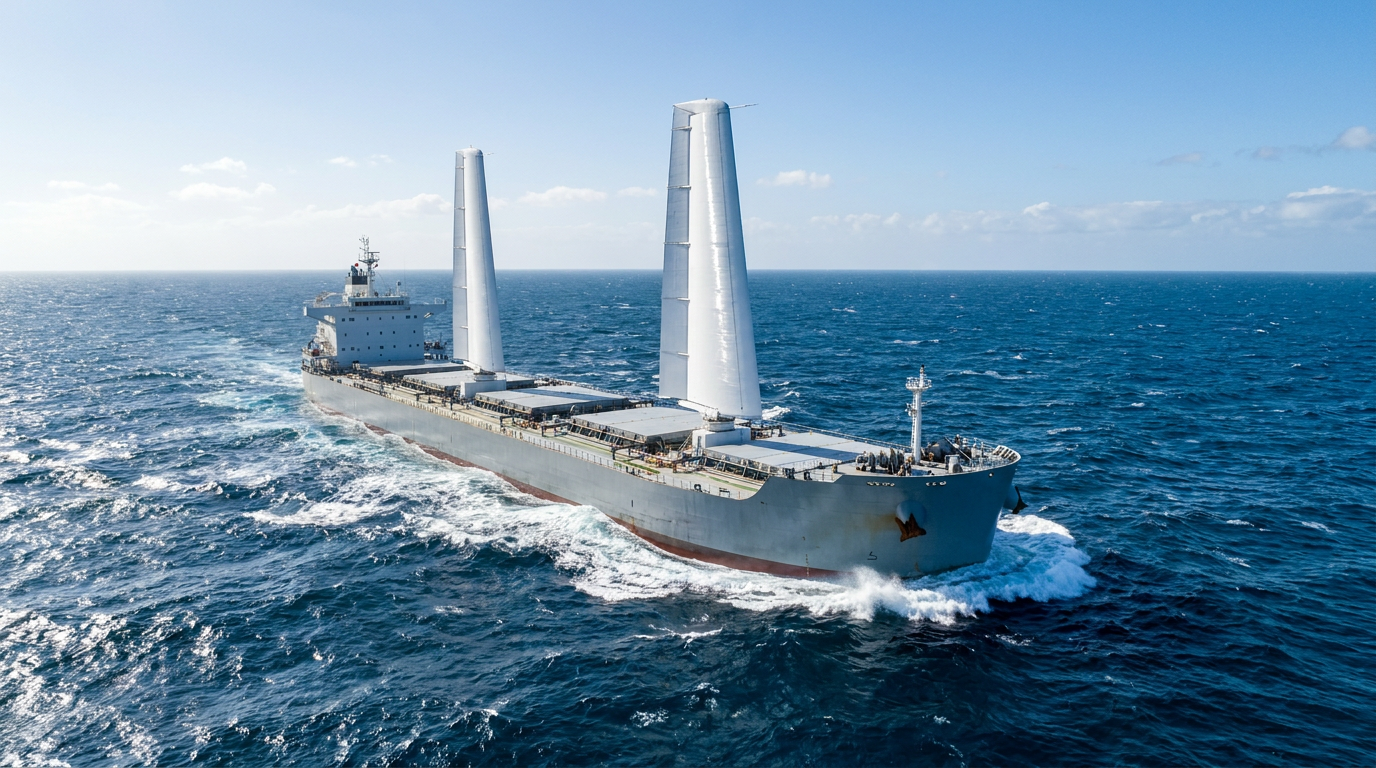
The most visually striking of these technologies are rigid wing sails, such as the WindWings developed by BAR Technologies. Rather than catching the wind like a parachute, these massive structures operate exactly like the wings of a commercial airliner, only stood upright on the deck.[4]
As wind flows over the curved surface of the rigid wing, it creates a pressure differential—lower pressure on one side and higher pressure on the other. This generates aerodynamic lift, which is translated into forward thrust for the ship. Because they are made of rigid composite materials, they can be shaped to achieve lift-to-drag ratios that traditional cloth sails could never manage.[5]
The real-world data for rigid wings is proving highly compelling. In August 2023, the Kamsarmax bulk carrier Pyxis Ocean, chartered by agricultural giant Cargill, was retrofitted with two 37.5-meter WindWings and sent on a global testing voyage.[1]
Over six months of traversing the Indian, Pacific, and Atlantic oceans, the results were rigorously tracked. The classification society DNV verified that in favorable weather conditions, the wings reduced the main engine's energy consumption by 32 percent per nautical mile. On optimal open-sea routes, the Pyxis Ocean saved up to 11 tonnes of fuel per day, validating the technology's commercial viability.[1][2]
Over six months of traversing the Indian, Pacific, and Atlantic oceans, the results were rigorously tracked.
While rigid wings mimic airplanes, another leading WASP technology relies on a completely different physical principle. Flettner rotors, or rotor sails, look like tall, spinning smokestacks mounted vertically on the ship's deck.[6]
These spinning cylinders generate thrust through the Magnus effect. As the cylinder rotates, it drags the boundary layer of air along with it. When natural wind hits the spinning rotor, the air accelerates on the side spinning with the wind and decelerates on the side spinning against it. This creates a powerful pressure difference that pushes the rotor—and the ship—forward.[6]

Companies like Norsepower and Eco Flettner have successfully deployed these rotors on ferries, tankers, and bulk carriers. Extensive studies, including parametric calculations conducted in the Indonesian Sea, demonstrate that Flettner rotors can reliably reduce fuel consumption by 10 to 25 percent, depending on the vessel's deadweight tonnage and the specific rotor dimensions.[6]
A third emerging category is the suction sail, such as the VentiFoil. These are non-rotating, vertical foils that use internal fans to suck in the boundary layer of air through vents on the surface. This active suction prevents aerodynamic stalling and generates massive forward thrust from a relatively compact footprint, making them ideal for smaller cargo vessels.[3]
What unites all these modern wind systems is their reliance on automation. There is no crew hauling on ropes or manually trimming sails. The systems are wired into the ship's bridge, where sensors continuously monitor wind speed and direction, automatically adjusting the angle of the wings or the spin rate of the rotors to maximize thrust.[1]
They are also designed to survive the harsh realities of commercial shipping. When a vessel approaches a port with low bridges, or when it encounters severe storm conditions, rigid wings can fold down flat onto the deck in a matter of minutes. Rotor sails, meanwhile, can simply be powered down to minimize aerodynamic drag.[4][6]
Despite the clear environmental and economic benefits, the transition is not without friction. The primary challenge is the inherent unpredictability of the wind. A ship sailing the notoriously windy North Atlantic will see massive fuel savings, but the same vessel navigating the doldrums near the equator will carry the heavy equipment as deadweight.[7]

To solve this, operators are pairing WASP hardware with advanced weather-routing software. By slightly altering a ship's course to chase optimal wind patterns—even if it means sailing a longer total distance—the vessel can arrive at its destination on time while burning a fraction of the fuel.[7]
The upfront capital expenditure also remains a hurdle. Retrofitting a ship with massive steel and composite structures is expensive, and the physical footprint of the sails reduces the total amount of cargo the ship can carry. Furthermore, port infrastructure, from loading cranes to bulk conveyors, must carefully navigate around the new deck equipment.[1][4]
Yet, the economic calculus is shifting rapidly. The EU's WASP project, which tested various installations in the North Sea, concluded that the combination of rising fuel prices and strict carbon legislation is turning wind propulsion from a niche green initiative into a standard operational requirement.[3]
For an industry that has spent a century relying on combustion, the paradigm is finally breaking. As alternative green fuels like ammonia and methanol remain years away from global scale, high-tech sails offer an immediate, proven way to decarbonize. The future of shipping, it turns out, is blowing in the wind.
How we got here
2018
The IMO agrees to its first major emissions target, aiming to halve greenhouse gas emissions by 2050.
2020-2023
The EU-funded WASP project retrofits five commercial vessels in the North Sea to validate fuel savings.
August 2023
The Pyxis Ocean embarks on its maiden voyage equipped with two 37.5-meter WindWings.
2024
The European Union officially includes maritime shipping in its Emissions Trading System (ETS).
2026
The global merchant fleet surpasses 100 large-vessel wind propulsion installations.
Viewpoints in depth
Maritime Operators
Focuses on the economic realities of retrofitting fleets.
For shipping companies, the adoption of wind technology is a strict mathematical calculation. They must balance the high upfront capital costs and the slight loss of cargo capacity against long-term fuel savings and the avoidance of steep carbon taxes. Early data proving a rapid return on investment is the primary driver of adoption.
Environmental Regulators
Views wind propulsion as a critical, immediate bridge technology.
Regulators and climate advocates emphasize that while zero-carbon fuels like green methanol and ammonia are still years away from global scale, wind power provides absolute emission reductions today. They view WASP as essential for meeting the IMO's aggressive 2030 carbon intensity targets.
Aerospace & Marine Engineers
Focuses on aerodynamic optimization and automated integration.
Engineers stress that modern wind propulsion is a highly complex discipline of fluid dynamics and software. They point out that maximizing thrust requires not just physical sails, but continuous, automated micro-adjustments based on real-time weather routing and boundary-layer suction, making it vastly different from historical sailing.
What we don't know
- How the long-term maintenance costs of massive, moving aerodynamic structures will impact the overall return on investment over a 20-year vessel lifespan.
- Whether port infrastructure globally will adapt quickly enough to handle the logistical challenges of loading and unloading ships with 50-meter deck towers.
- How effectively the technology will scale to the largest classes of ultra-large container vessels, which have less available deck space than bulk carriers.
Key terms
- Wind-Assisted Ship Propulsion (WASP)
- The use of modern aerodynamic technologies, such as rotors or rigid wings, to supplement a ship's motorized propulsion and reduce fuel use.
- Flettner Rotor
- A tall, spinning cylinder mounted on a ship's deck that generates forward thrust using the Magnus effect.
- Magnus Effect
- The aerodynamic phenomenon where a spinning object drags air with it, creating a pressure difference that results in a perpendicular force.
- Deadweight Tonnage (DWT)
- A measure of how much weight a ship can carry safely, including cargo, fuel, fresh water, and crew.
- Carbon Intensity Indicator (CII)
- A rating system developed by the IMO that measures how efficiently a ship transports goods, expressed in grams of CO2 emitted per cargo-carrying capacity and nautical mile.
Frequently asked
Do these ships run entirely on wind?
No, they are "wind-assisted." The sails supplement traditional diesel engines to reduce fuel consumption, rather than replacing them entirely.
What happens when there is no wind?
The ship relies entirely on its main engines, operating exactly like a standard commercial vessel until wind conditions improve.
How do these ships fit under bridges or port cranes?
Most rigid wing systems are designed to fold down flat onto the deck, while rotor sails are positioned to avoid interfering with standard cargo-loading equipment.
Sources
Source coverage
8 outlets
3 viewpoints surfaced








[1]Riviera Maritime MediaMaritime Operators
Pyxis Ocean wind-propulsion trials show 11 tonnes per day fuel savings
Read on Riviera Maritime Media →[2]Offshore EnergyAerospace & Marine Engineers
DNV confirms WindWings performance on MV Pyxis Ocean
Read on Offshore Energy →[3]Seatrade MaritimeEnvironmental Regulators
WASP project concludes with positive results
Read on Seatrade Maritime →[4]North StandardMaritime Operators
Decarbonising shipping with wind propulsion
Read on North Standard →[5]TransNav JournalEnvironmental Regulators
Wind-Assisted Ship Propulsion for Maritime Decarbonisation and Sustainable Shipping
Read on TransNav Journal →[6]Scientific.NetAerospace & Marine Engineers
Analysis of Flettner Rotor to Reduce Carbon Emissions in Container and Bulk Carriers
Read on Scientific.Net →[7]VaisalaAerospace & Marine Engineers
Optimizing wind-assisted shipping with precise wind measurements
Read on Vaisala →[8]Data InteloAerospace & Marine Engineers
Wind-Assisted Ship Propulsion Market Outlook 2025-2034
Read on Data Intelo →

Every angle. Every day.
Get transportation stories with full source coverage and perspective breakdowns delivered to your inbox.