
The Internet Is Quietly Upgrading to Post-Quantum Cryptography
Global tech platforms and standards bodies have successfully finalized and deployed new encryption algorithms, neutralizing the future threat of quantum computers before they arrive.
By Factlen Editorial Team
- Cryptographic Researchers
- Focuses on the mathematical hardness assumptions of lattice problems and the necessity of rigorous, ongoing cryptanalysis.
- Tech Implementers
- Prioritizes the practical rollout of hybrid protocols, managing key size overhead, and ensuring seamless user experiences.
- National Security Agencies
- Emphasizes defending against 'Store Now, Decrypt Later' tactics and mandating crypto-agility across critical infrastructure.
What's not represented
- · Legacy Industrial Control System Operators
- · IoT Device Manufacturers
Why this matters
For years, the theoretical ability of quantum computers to break modern encryption loomed as a digital doomsday. By proactively rolling out post-quantum standards today, the cybersecurity community is ensuring that your private messages, banking data, and health records remain secure for decades to come.
Key points
- Standards bodies have finalized new encryption algorithms designed to withstand attacks from future quantum computers.
- The new standards rely on complex 'lattice-based' mathematics rather than traditional prime factorization.
- Major platforms like Apple, Signal, and Cloudflare have already begun integrating these post-quantum protocols.
- The proactive upgrade neutralizes the 'Store Now, Decrypt Later' threat posed by nation-state actors.
- The transition requires managing larger cryptographic key sizes, which presents engineering challenges for smaller devices.
For over a decade, a theoretical threat has cast a long shadow over global cybersecurity: the advent of a cryptographically relevant quantum computer (CRQC). Experts warned that such a machine could instantly unravel the RSA and Elliptic Curve Cryptography (ECC) algorithms that currently secure the entire internet.[1][4]
But rather than waiting for "Q-Day" to arrive, the global cryptographic community mobilized. In an unprecedented, proactive overhaul of the internet's foundational plumbing, standards bodies and major tech platforms have successfully finalized and begun deploying Post-Quantum Cryptography (PQC).[1][7]
This migration represents one of the largest coordinated security upgrades in digital history. By shifting to entirely new mathematical frameworks, the industry is effectively neutralizing the quantum threat before the hardware even exists, securing everything from secure messaging to global banking.[7]
The urgency behind this transition is driven by a tactic known as "Store Now, Decrypt Later" (SNDL). Nation-state actors and advanced persistent threats have been harvesting encrypted data traffic today, storing it in vast data centers with the intention of decrypting it once quantum computers become viable.[3]

To counter this, the National Institute of Standards and Technology (NIST) initiated a global competition to find quantum-resistant algorithms. After years of rigorous peer review and aggressive stress-testing by the world's top cryptanalysts, NIST finalized its primary standards, including ML-KEM for key establishment and ML-DSA for digital signatures.[1]
The mechanism behind these new standards is a radical departure from classical encryption. RSA and ECC rely on the difficulty of factoring massive prime numbers or solving discrete logarithms—math problems that Peter Shor demonstrated in 1994 would be trivial for a quantum computer to solve using specialized algorithms.[4]
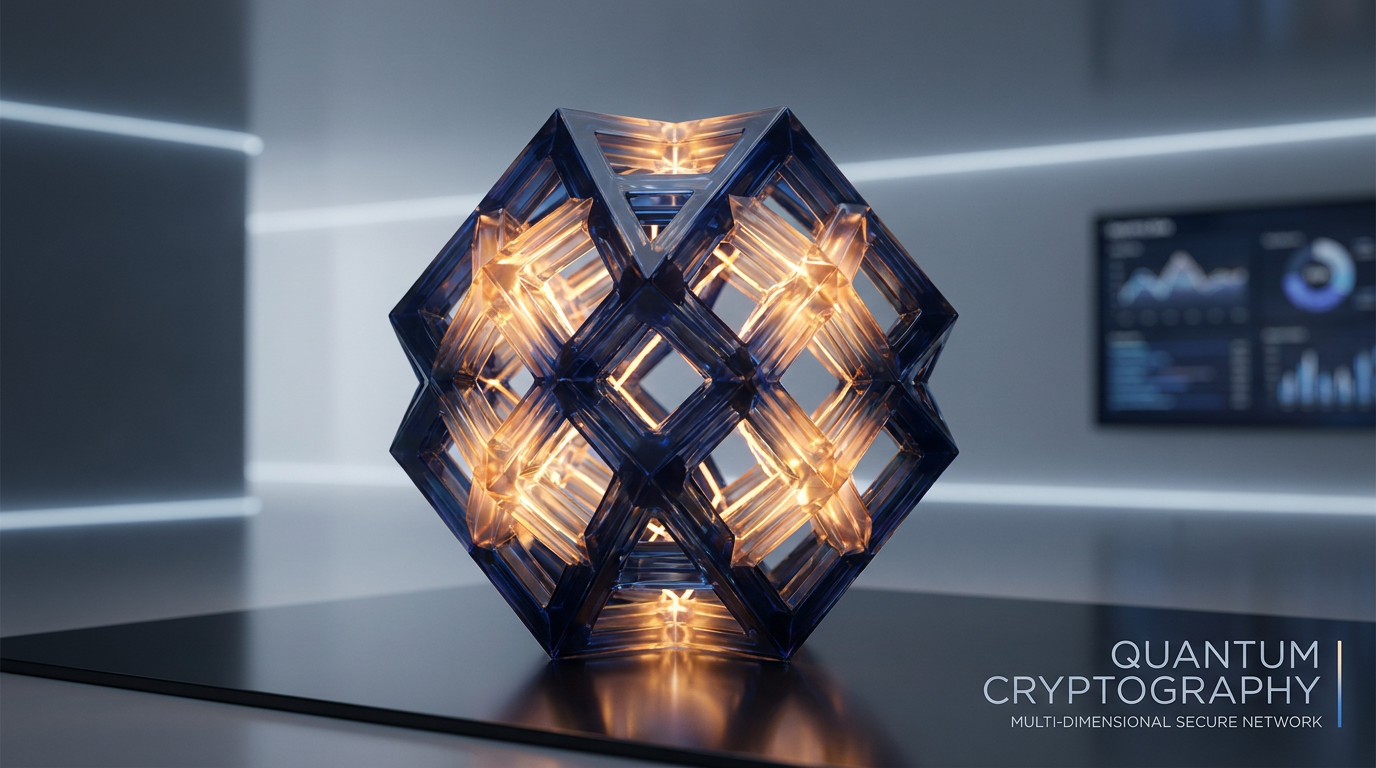
In contrast, the new NIST standards primarily rely on "lattice-based cryptography." Instead of prime numbers, these algorithms hide data within complex, multi-dimensional grid structures, adding deliberate mathematical noise to obscure the exact coordinates of the information.[1][4]
Finding the hidden information in a 500-dimensional lattice with added noise is a problem known as Learning With Errors (LWE). Crucially, there is currently no known quantum algorithm that can solve LWE efficiently, making it highly resistant to both classical supercomputers and future quantum machines.[4]

Finding the hidden information in a 500-dimensional lattice with added noise is a problem known as Learning With Errors (LWE).
The rollout of these complex algorithms is already well underway across the consumer tech landscape. Apple recently integrated PQ3, a post-quantum cryptographic protocol, into iMessage, achieving what it calls Level 3 security—protecting both initial key establishment and ongoing message exchange against quantum attacks.[5]
Similarly, the Signal Foundation upgraded its core protocol to include Post-Quantum Extended Diffie-Hellman (PQXDH). This hybrid approach combines classical elliptic curve cryptography with post-quantum algorithms, ensuring that even if the new math is somehow flawed, the encryption remains at least as strong as it is today.[6]
At the infrastructure level, companies like Cloudflare have enabled post-quantum TLS (Transport Layer Security) across their massive edge networks. This means that a significant portion of everyday web browsing is already being shielded by quantum-resistant tunnels without users noticing any degradation in speed or reliability.[2]
However, the evidence supporting post-quantum security is not absolute. Unlike the laws of physics, cryptographic security relies on computational hardness assumptions. We cannot mathematically prove that lattice-based cryptography is unbreakable; we only know that the world's smartest mathematicians haven't broken it yet.[4][7]

There is transparent uncertainty regarding the potential for classical algorithmic breakthroughs. Just as researchers continuously search for better ways to factor primes, cryptanalysts are actively probing lattice structures. A sudden breakthrough in classical mathematics could theoretically weaken these new standards, which is why NIST selected backup algorithms based on entirely different math, such as hash-based signatures.[1][4]
Another challenge lies in the performance overhead. Post-quantum algorithms generally require larger key sizes and signature sizes than their classical counterparts. ML-KEM keys, for instance, are significantly larger than ECC keys, which requires more bandwidth and memory to transmit and store.[2]
For high-speed fiber networks and modern smartphones, this overhead is negligible. But for constrained environments like Internet of Things (IoT) devices, smart cards, and legacy industrial control systems, fitting post-quantum keys into limited memory banks presents a tangible engineering hurdle that the industry is still working to optimize.[3][7]

To mitigate these risks, the Cybersecurity and Infrastructure Security Agency (CISA) and international counterparts are pushing a "crypto-agility" framework. Organizations are being urged to design systems where encryption algorithms can be swapped out like modular components, rather than being hardcoded deeply into the silicon.[3]
Ultimately, the successful standardization and ongoing deployment of PQC is a monumental victory for global digital infrastructure. It proves that the tech industry can look decades into the future, identify a catastrophic systemic risk, and cooperatively engineer a solution before the crisis ever materializes.[7]
How we got here
1994
Peter Shor publishes an algorithm demonstrating that a theoretical quantum computer could break RSA encryption.
2016
NIST announces a public competition to develop and standardize quantum-resistant cryptographic algorithms.
2022
NIST selects the first group of post-quantum algorithms, including CRYSTALS-Kyber and CRYSTALS-Dilithium, for standardization.
Early 2024
Apple and Signal announce the integration of post-quantum cryptographic protocols into their mainstream messaging apps.
Late 2024
NIST officially publishes the finalized FIPS standards for post-quantum cryptography, triggering global compliance mandates.
Viewpoints in depth
Cryptographic Researchers
Focuses on the mathematical hardness assumptions of lattice problems and the necessity of rigorous, ongoing cryptanalysis.
For the academic and research community, the finalization of the NIST standards is a milestone, but not the end of the road. Researchers emphasize that lattice-based cryptography relies on computational hardness assumptions—specifically the Learning With Errors (LWE) problem. Because there is no mathematical proof of absolute security, cryptanalysts are continuously probing these algorithms for weaknesses. This camp advocates for maintaining alternative mathematical approaches, such as hash-based signatures, as a fallback in case a sudden classical algorithmic breakthrough compromises lattice structures.
Tech Implementers
Prioritizes the practical rollout of hybrid protocols, managing key size overhead, and ensuring seamless user experiences.
Engineers at major tech platforms view the PQC transition as a massive logistical and performance challenge. Their primary concern is integrating algorithms that require significantly larger key sizes and computational overhead without degrading network speeds or draining smartphone batteries. To manage the risk of the new math failing, this camp heavily favors 'hybrid' deployments—running classical elliptic curve cryptography alongside the new post-quantum algorithms. This ensures that the system's baseline security never drops below current standards while the new protocols are battle-tested in the wild.
National Security Agencies
Emphasizes defending against 'Store Now, Decrypt Later' tactics and mandating crypto-agility across critical infrastructure.
For government agencies like CISA and the NSA, the quantum threat is already an active crisis due to 'Store Now, Decrypt Later' espionage. Adversaries are currently hoarding encrypted communications, expecting to unlock them in a decade. Consequently, this camp is aggressively pushing for rapid adoption of PQC across all federal agencies and critical infrastructure. They are also heavily promoting the concept of 'crypto-agility'—forcing organizations to design networks where encryption modules can be swapped out seamlessly, ensuring that future cryptographic upgrades won't require decades of painful legacy system overhauls.
What we don't know
- Exactly when a cryptographically relevant quantum computer (CRQC) will be successfully built.
- Whether a future breakthrough in classical mathematics could unexpectedly weaken lattice-based encryption.
- How long it will take to fully eradicate legacy classical encryption from deeply embedded industrial and IoT systems.
Key terms
- Lattice-Based Cryptography
- A mathematical approach to encryption that hides data within complex, multi-dimensional grid structures, making it highly resistant to quantum algorithms.
- Crypto-Agility
- The design principle of building software and hardware systems so that encryption algorithms can be easily updated or replaced without requiring a complete system overhaul.
- Learning With Errors (LWE)
- A complex mathematical problem involving finding hidden information in a lattice structure with added noise, forming the basis of the new NIST standards.
- Hybrid Cryptography
- A security approach that combines a traditional encryption algorithm with a new post-quantum algorithm, ensuring data remains secure even if one of the methods is compromised.
Frequently asked
What is 'Q-Day'?
Q-Day is the theoretical future date when a quantum computer becomes powerful enough to break the classical encryption algorithms that currently secure the internet.
Do I need to buy a new phone to get post-quantum security?
No. Major tech companies like Apple and Signal are rolling out post-quantum encryption via standard software updates to existing devices.
Are the new algorithms mathematically proven to be unbreakable?
No. Like most modern cryptography, they rely on computational hardness assumptions—meaning they are believed to be secure because the world's best mathematicians have not yet found a way to break them.
What is 'Store Now, Decrypt Later'?
It is a strategy where adversaries intercept and store encrypted data today, hoping to use a future quantum computer to decrypt and read the information years from now.
Sources
Source coverage
7 outlets
3 viewpoints surfaced






[1]NISTCryptographic Researchers
Post-Quantum Cryptography Standardization
Read on NIST →[2]CloudflareTech Implementers
Defending against future threats: Cloudflare goes post-quantum
Read on Cloudflare →[3]CISANational Security Agencies
Post-Quantum Cryptography Initiative
Read on CISA →[4]arXivCryptographic Researchers
The Security of Lattice-Based Cryptography: A Comprehensive Survey
Read on arXiv →[5]Apple Security EngineeringTech Implementers
iMessage with PQ3: The new state of the art in quantum-secure messaging
Read on Apple Security Engineering →[6]Signal FoundationTech Implementers
The PQXDH Key Agreement Protocol
Read on Signal Foundation →[7]Factlen Editorial Team
Synthesis by Factlen editorial team
Read on Factlen Editorial Team →
Every angle. Every day.
Get technology stories with full source coverage and perspective breakdowns delivered to your inbox.