
OLED vs. Mini-LED: The 2026 Television Trade-Off Analysis
As OLED and Mini-LED technologies converge in price and performance, choosing the right television in 2026 requires matching panel strengths to specific room environments.
By Factlen Editorial Team
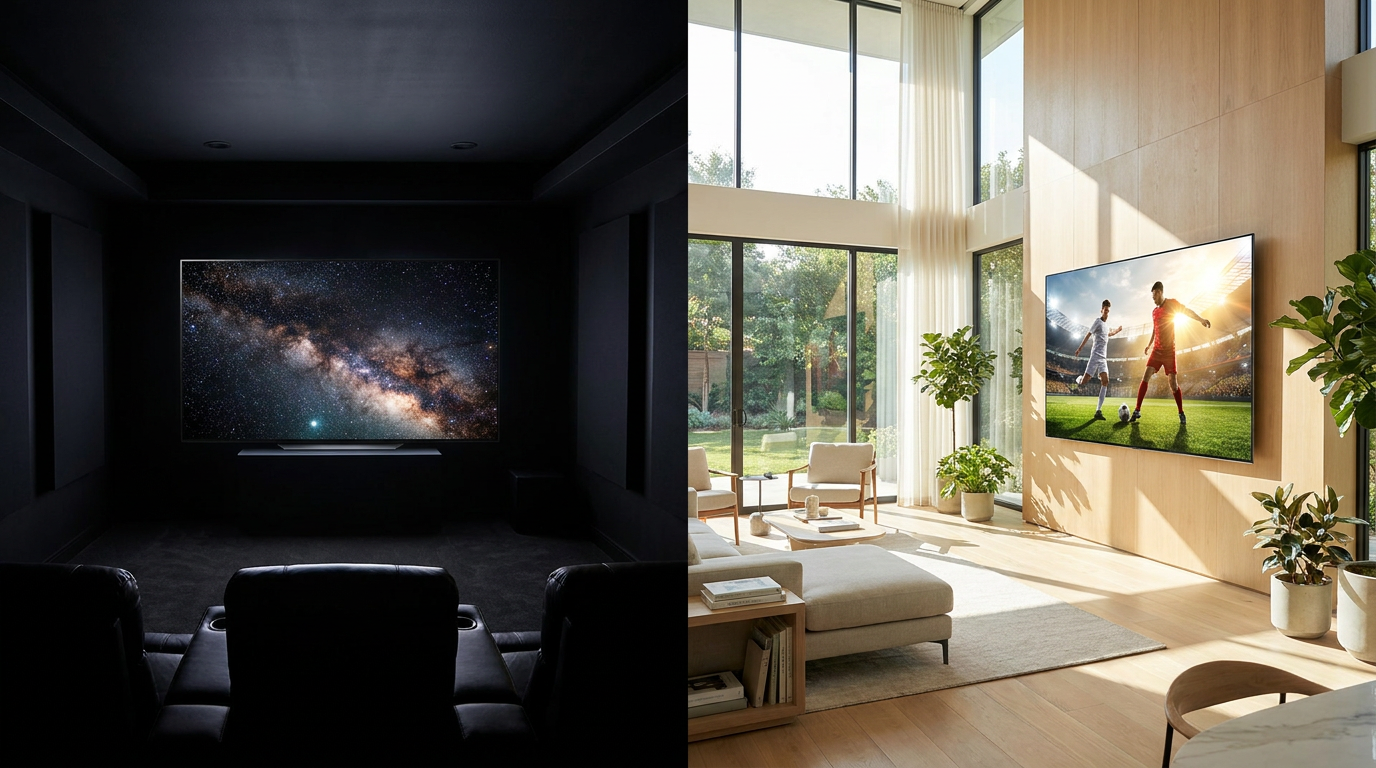
- Home Theater Purists
- Advocate for OLED's perfect blacks and contrast for cinematic viewing.
- Bright-Room Generalists
- Prioritize Mini-LED's peak brightness, glare reduction, and burn-in immunity.
- Competitive Gamers
- Focus on motion clarity, pixel response times, and HDR gaming impact.
- Value & Large-Format Buyers
- Seek the best price-to-performance ratio for screens exceeding 75 inches.
What's not represented
- · Micro-LED Early Adopters
- · Projector Enthusiasts
Why this matters
A premium television is a multi-year investment that dictates how you experience entertainment, gaming, and news. Understanding the specific trade-offs between OLED and Mini-LED prevents buyers from spending thousands on a display that fights their room's natural lighting.
Key points
- OLED delivers perfect black levels and infinite contrast by turning off individual pixels, making it ideal for dark home theaters.
- Mini-LED uses thousands of backlight zones to achieve extreme peak brightness, excelling in sunlit rooms and daytime viewing.
- Mini-LED carries zero risk of permanent burn-in, offering peace of mind for households that leave the TV on all day.
- OLED remains prohibitively expensive at sizes above 77 inches, while Mini-LED offers strong value up to 115 inches.
- 2026 innovations like Tandem OLED and RGB Mini-LED have significantly narrowed the performance gap between the two technologies.
The 2026 premium television market is defined by a fierce technological convergence between two dominant display types: OLED and Mini-LED. For consumers looking to upgrade their living rooms or home theaters, the choice is no longer simply about spending more for a better picture. Instead, it requires a careful side-by-side trade-off analysis based on room lighting, viewing habits, and screen size. While OLED continues to serve as the core pillar for ultra-premium home cinemas, Mini-LED has captured approximately 62 percent of the volume share by dominating the mass market and bright-room environments.[1]
To understand the comparison, it is essential to look at how each technology generates an image. OLED, or Organic Light-Emitting Diode, is a self-emissive technology where each of its 8.3 million pixels produces its own light and color. When a scene requires black, the individual pixels simply turn off completely. Mini-LED, by contrast, relies on a traditional LCD panel illuminated by a backlight. However, instead of a few large bulbs, it uses thousands of microscopic LEDs divided into hundreds or thousands of independent dimming zones that can brighten or darken dynamically.[2][3][4]
When analyzing the trade-offs, the argument for OLED centers entirely on its pixel-level precision and infinite contrast ratio. Because it can place a pure white pixel directly next to a completely deactivated black pixel, the technology delivers a level of depth and three-dimensionality that backlit screens struggle to replicate. Furthermore, OLED panels boast near-instantaneous pixel response times, drastically cutting down motion blur during fast-paced sports or competitive gaming.[2][3][4]

The evidence supporting OLED's dominance in dark environments is extensive. Testing by display analysts demonstrates that OLED panels achieve perfect black uniformity with zero light bleed. In side-by-side evaluations, OLED consistently eliminates the "haloing" effect—a faint glow that often surrounds bright objects, like white subtitles on a black background, which plagues even the best backlit televisions.[2][4]
Conversely, the argument against OLED focuses on its peak brightness ceiling and long-term durability. While 2026 innovations have pushed OLED brightness to roughly 2,100 nits, they still cannot match the sheer light output of top-tier backlit displays. Additionally, because the pixels are composed of organic materials, OLED carries a slight but persistent risk of permanent burn-in if exposed to static elements—such as news tickers or video game interfaces—for thousands of hours.[2][3][6]
Ultimately, OLED fits well when the primary use case involves watching cinematic movies or playing high-end, immersive video games in a light-controlled or darkened room. It provides the ultimate moody, high-contrast experience. However, OLED does not fit when the television will be left on for ten or more hours a day with static content, or when it is placed in a sun-drenched room with massive windows and no blackout curtains.[1][3][4]
Ultimately, OLED fits well when the primary use case involves watching cinematic movies or playing high-end, immersive video games in a light-controlled or darkened room.
On the other side of the aisle, the argument for Mini-LED centers on its extreme peak brightness, robust durability, and superior cost-to-performance ratio at massive screen sizes. Because it uses a powerful LED backlight, Mini-LED can easily overpower glare and reflections in the brightest of environments. Furthermore, the inorganic nature of the backlighting means the technology is entirely immune to permanent burn-in, making it a lower-regret investment for households that leave the television running all day.[1][2][4]

The evidence for Mini-LED's bright-room superiority is clear in real-world installation data. Industry reviewers note that the latest Mini-LED models can sustain high full-screen brightness without the aggressive automatic dimming that OLEDs employ to protect their panels from overheating. Furthermore, in the 75-inch to 115-inch category, Mini-LED offers a significantly more accessible price point, as manufacturing massive OLED panels remains prohibitively expensive.[2][3][4]
The argument against Mini-LED lies in its reliance on local dimming zones. Even with thousands of miniature lights, a single dimming zone still illuminates a cluster of pixels rather than an individual one. This limitation means that in high-contrast scenes—such as a starry night sky or a bright flashlight in a dark cave—some light inevitably spills into the surrounding black areas, creating a visible blooming or halo effect that compromises shadow detail.[2][7]
Therefore, Mini-LED fits well when the television acts as a multi-purpose hub in a bright, open-concept living room, or when the buyer wants a massive screen exceeding 80 inches without spending a premium. It is the ideal choice for daytime sports viewing and all-day news broadcasts. However, Mini-LED does not fit when the buyer is a strict home-theater purist who watches content exclusively in the dark and demands absolute perfection in shadow details and black levels.[1][2][4]

For gamers, the trade-offs are particularly nuanced. Both technologies now support 144Hz refresh rates, variable refresh rate (VRR) technology, and ultra-low input lag. OLED provides the cleanest motion clarity for competitive shooters due to its instant pixel response, while Mini-LED delivers a more blinding, impactful HDR experience for vibrant open-world games without any anxiety about heads-up display (HUD) burn-in.[3][5]
The landscape in 2026 has complicated the decision by blurring the historical lines between the two technologies. Manufacturers are deploying RGB Mini-LED architectures, such as those seen in the Hisense 116UX, which drastically improve color saturation and contrast control. Simultaneously, OLED manufacturers are utilizing stacked Tandem layers and QD-OLED panels, like the Samsung S95F and LG G5, to boost brightness to levels previously reserved for LCDs.[3][5][6]
Ultimately, the price convergence between high-end Mini-LED and mid-tier OLED models means consumers are no longer forced to choose based on budget alone. With premium models of both technologies retailing around similar price points in the standard 55-inch and 65-inch sizes, the decision is purely environmental.[1]
There is no single superior television technology in 2026; there is only the right tool for the specific viewing environment and the specific viewer's daily habits. By quantifying the trade-offs between absolute contrast and peak brightness, buyers can confidently select the panel that will best serve their living space for years to come.[1][4]
How we got here
2013
First commercial OLED TVs launch, establishing a new benchmark for perfect black levels.
2019
Mini-LED technology enters the consumer market, offering a high-brightness alternative with improved local dimming.
2022
QD-OLED technology is introduced, combining OLED contrast with quantum dot color brightness.
2025
Mini-LED captures over 60% of the premium volume share due to aggressive pricing in large formats.
2026
Tandem OLED and RGB Mini-LED architectures launch, blurring the performance gap between the two technologies.
Viewpoints in depth
Home Theater Purists
Enthusiasts who prioritize absolute contrast and perfect black levels above all else.
For this camp, the television is a dedicated cinema screen used almost exclusively in darkened rooms. They argue that the infinite contrast and pixel-level light control of OLED are non-negotiable for preserving the director's original intent in moody, shadow-heavy films. They view the blooming artifacts of Mini-LED as a dealbreaker that ruins the immersion of high-contrast scenes.
Bright-Room Generalists
Everyday users who need a versatile display that can fight heavy daytime glare.
This perspective values raw brightness and durability. Because their televisions are often placed in open-concept living rooms with large windows, they require a panel that can punch through sunlight without washing out. They favor Mini-LED for its sustained full-screen brightness and the peace of mind that comes from knowing static news tickers or sports scores will never cause permanent burn-in.
Competitive Gamers
Players who demand instantaneous response times and high refresh rates.
Gamers are split based on the titles they play, but competitive players lean heavily toward OLED. They cite the technology's near-instantaneous pixel response time, which virtually eliminates motion blur during rapid camera pans in first-person shooters. However, they acknowledge that Mini-LED is catching up rapidly, offering a compelling alternative for gamers who prefer visually explosive, bright HDR worlds.
What we don't know
- How quickly the new RGB Mini-LED architecture will drop in price to compete with standard Mini-LED models.
- Whether Micro-LED technology will eventually scale down in price enough to render both OLED and Mini-LED obsolete.
- The exact long-term lifespan of the new Tandem OLED panels when pushed to their maximum 2,100-nit brightness.
Key terms
- Blooming (Haloing)
- A visual artifact where light from a bright object spills into surrounding dark areas on a screen.
- Local Dimming Zones
- Specific sections of a TV's backlight that can independently dim or brighten to improve contrast.
- Nits
- A unit of measurement used to quantify the peak brightness of a display.
- Burn-in
- Permanent image retention caused by uneven degradation of pixels, typically from displaying static logos or interfaces.
- Pixel Response Time
- The speed at which an individual pixel can change from one color to another, affecting motion blur.
Frequently asked
Does OLED still suffer from burn-in in 2026?
While the risk has been significantly reduced by panel cooling and software protections, permanent burn-in remains a possibility if static elements are displayed for thousands of hours.
What is the difference between standard LED and Mini-LED?
Mini-LED uses thousands of microscopic light diodes instead of a few large ones, allowing for hundreds or thousands of independent dimming zones that vastly improve contrast.
Are Mini-LED TVs good for gaming?
Yes. They offer excellent HDR brightness, high refresh rates, and zero risk of HUD burn-in, though they lack the instantaneous pixel response time of OLEDs.
Why are OLED TVs so expensive at larger sizes?
Manufacturing flawless organic panels becomes exponentially more difficult and costly at sizes above 77 inches, whereas Mini-LED LCD production scales much more efficiently.
Sources
Source coverage
7 outlets
4 viewpoints surfaced







[1]ElectronicsHubValue & Large-Format Buyers
OLED vs Mini LED TV Comparison Guide for 2026
Read on ElectronicsHub →[2]RTINGSHome Theater Purists
Mini LED vs. OLED TVs: Which One Is The Best?
Read on RTINGS →[3]CurrysBright-Room Generalists
Mini LED vs OLED TVs: which should you buy in 2025?
Read on Currys →[4]CNETBright-Room Generalists
Mini-LED vs. OLED: Which TV Tech Should You Get?
Read on CNET →[5]What Hi-Fi?Home Theater Purists
Best TV 2026: flagship OLEDs and budget Mini LED sets tried and tested
Read on What Hi-Fi? →[6]Data Wire SolutionsCompetitive Gamers
Best TVs for 2026: 10 OLED and Mini-LED Picks by Room, Brightness, and Install Reality
Read on Data Wire Solutions →[7]UniluminValue & Large-Format Buyers
Mini LED vs. OLED: A Comparative Analysis
Read on Unilumin →
Every angle. Every day.
Get shopping stories with full source coverage and perspective breakdowns delivered to your inbox.