
The Invisible Architecture of the Drive-Thru: How Fast-Food Menus Are Engineered
Fast-food menus are meticulously designed using behavioral psychology and eye-tracking data to subtly guide consumer choices and maximize spending.
By Factlen Editorial Team
- Menu Engineers
- Focus on optimizing choice architecture to reduce friction and maximize profitability.
- Consumer Psychologists
- Highlight how subtle design nudges exploit cognitive biases to encourage overspending.
- Restaurant Operators
- View menu optimization as a necessary tool for survival in a low-margin industry.
What's not represented
- · Dietitians & Public Health Advocates
- · Frontline Fast-Food Workers
Why this matters
Understanding the psychological tricks embedded in fast-food menus empowers you to make conscious purchasing decisions. By recognizing these subtle nudges, you can avoid unintentional upselling and order exactly what you want, saving both money and calories.
Key points
- Menu designers use eye-tracking data to place high-margin items in the 'Golden Triangle' of visual attention.
- Limiting menu categories to 5-7 items prevents decision fatigue and speeds up ordering.
- Removing dollar signs and using charm pricing (.99) reduces the psychological pain of paying.
- Self-serve digital kiosks increase average order values by 10% through automated upselling and reduced social friction.
You walk into a fast-food restaurant or pull up to the drive-thru, intending to spend $8. You leave having spent $14. It wasn't just a sudden surge of hunger—it was engineering.[6]
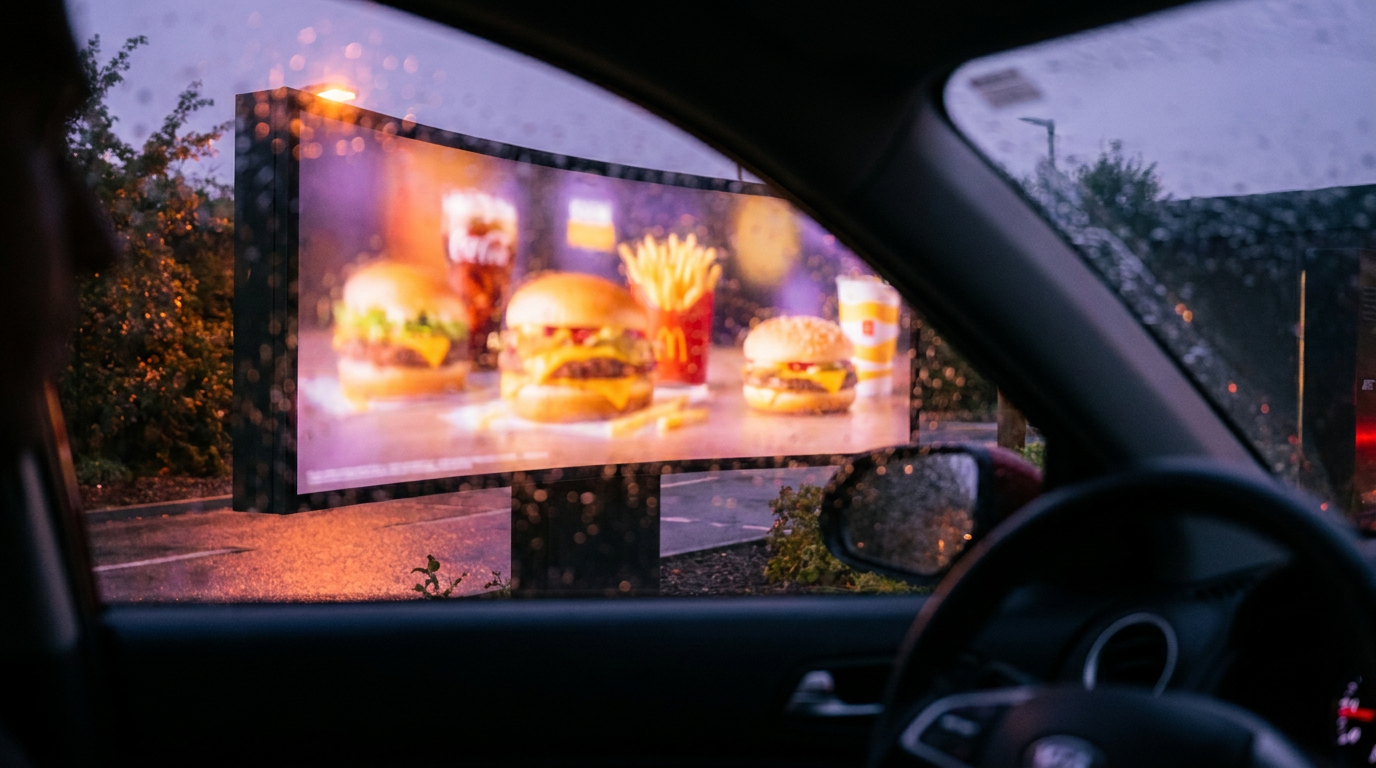
The glowing menu board above the register is not merely a list of food and prices. It is a highly optimized, data-driven piece of behavioral psychology known in the hospitality industry as "menu engineering."[1][4]
Every color, font size, photograph, and price placement is meticulously tested to guide consumer choices, minimize the psychological friction of spending, and maximize the restaurant's profit margins.[1][5]
The science begins the moment a customer looks up. Industry research shows that the average diner spends just under two minutes—often exactly 109 seconds—scanning a menu before making a final decision.[4]
In that brief window, the brain relies on visual shortcuts. Menu designers exploit a concept known as the "Golden Triangle." Eye-tracking studies reveal that a customer's gaze naturally gravitates to the middle of the board, then to the top right, and finally to the top left.[1][4]

Fast-food chains place their highest-margin items—not necessarily the most expensive, but the ones with the most favorable profit ratio—squarely in these high-attention zones to ensure they are the first things a hungry customer sees.[1][4]
Then comes the "Paradox of Choice." Behavioral psychologists have long established that presenting consumers with too many options leads to decision paralysis and anxiety.[1][4]
To combat this, modern fast-food menus are ruthlessly categorized. The industry standard is to offer no more than five to seven items per section. This sweet spot provides enough variety to satisfy cravings but prevents the customer from defaulting to the cheapest, safest option out of sheer overwhelm.[1][4]
Pricing strategy is equally psychological, relying on subtle visual cues to manipulate how cost is perceived. One of the most common tactics is the complete removal of the dollar sign.[5]
Pricing strategy is equally psychological, relying on subtle visual cues to manipulate how cost is perceived.
Behavioral economists note that a dollar sign acts as a subconscious trigger, reminding the brain of the "pain of paying." By listing a burger as simply "6.99" or even "7," the menu softens the financial blow, framing the number as a mere unit of value rather than hard currency leaving your wallet.[1][5]

"Charm pricing"—ending prices in .95 or .99—also remains a staple. Because humans read from left to right, the brain anchors on the first digit. A meal priced at $9.99 feels significantly cheaper than one priced at $10.00, even though the difference is a single penny.[2]
Color theory plays a massive role in fast-food environments. There is a deeply researched reason the industry is dominated by specific hues, particularly reds, yellows, and oranges.[1]
Red stimulates urgency and action, while yellow triggers feelings of comfort and grabs attention. Together, they subtly encourage customers to order quickly and move on. Conversely, green is deployed strategically to signal freshness, sustainability, and health, often surrounding salads or plant-based options.[1]
The layout also utilizes "decoy pricing." Restaurants will often place a premium, highly expensive item at the top of the menu or in a prominent box. The goal isn't necessarily to sell that specific item, but to establish a high price anchor.[2][4]
Compared to a $14 premium combo, the $9 standard meal suddenly looks like a sensible bargain, coaxing the customer into spending more than they might have if the $9 item was the most expensive option on the board.[2][4]
Today, the most profound shift in menu engineering is the transition away from static boards to digital self-serve kiosks and dynamic drive-thru screens.[3]
Kiosks are the ultimate upsell engines. Unlike human cashiers who might forget to ask or feel awkward pushing extras, a machine will relentlessly ask, "Would you like to add bacon?" or "Make it a large?" accompanied by high-definition, mouth-watering photography.[3]

Furthermore, kiosks remove the social friction of ordering. Customers ordering from a screen feel less judged for requesting extra cheese, a large fry, and a dessert. Industry data shows that customers using self-serve kiosks spend an average of 10% more than those ordering from a human cashier.[3]
Dynamic digital boards take this a step further by adjusting in real-time. They can promote hot coffee on a rainy morning or push cold milkshakes during a summer heatwave, optimizing the psychological appeal based on external conditions.[6]
Ultimately, menu engineering is a sophisticated blend of hospitality and calculated economics. By understanding the invisible architecture of the drive-thru, consumers can navigate the psychological nudges and make choices driven by their actual appetite, rather than a carefully designed algorithm.[6]
Viewpoints in depth
Menu Engineers & Designers
Menu engineering is about reducing friction and improving the guest experience.
Designers argue that a well-engineered menu is a win-win. By limiting choices and organizing items logically, they reduce customer anxiety and speed up the ordering process. Highlighting signature items helps indecisive diners find the restaurant's best offerings quickly, ensuring they leave satisfied rather than overwhelmed by a cluttered board.
Consumer Psychologists
Menu tactics exploit cognitive biases to encourage overspending.
Psychologists point out that techniques like charm pricing, decoy anchoring, and the removal of dollar signs are designed to bypass rational financial decision-making. By minimizing the 'pain of paying' and leveraging the lack of social judgment at digital kiosks, these designs subtly push consumers to order more food and spend more money than they initially planned.
Restaurant Operators
Optimized menus are essential for survival in a low-margin industry.
For restaurant owners, menu engineering is not about malicious manipulation, but basic economic survival. The fast-food industry operates on notoriously razor-thin profit margins. Operators rely on upselling and guiding customers toward high-margin items just to offset rising labor, real estate, and ingredient costs.
What we don't know
- How the widespread adoption of AI voice assistants in drive-thrus will further alter consumer spending habits.
- Whether consumers will eventually develop 'banner blindness' to digital menu board upselling tactics.
Key terms
- Menu Engineering
- The study of the profitability and popularity of menu items and how these factors influence their placement on a menu.
- Paradox of Choice
- A psychological phenomenon where having too many options causes anxiety and decision paralysis.
- Charm Pricing
- A pricing strategy that uses odd numbers, typically ending in .99 or .95, to make an item appear less expensive.
- Decoy Pricing
- Placing a high-priced item on a menu to make other items seem like a better value by comparison.
- Golden Triangle
- The specific visual pattern that a person's eyes naturally follow when first looking at a menu.
Frequently asked
Why do menus often leave off the dollar sign?
Removing the dollar sign reduces the psychological 'pain of paying,' making customers focus on the food rather than the cost.
What is the Golden Triangle in menu design?
It is the visual path the eyes naturally take when scanning a menu: starting in the middle, moving to the top right, and finally to the top left.
Do self-serve kiosks really make people spend more?
Yes, industry data shows customers spend about 10% more at kiosks due to automated upselling and a lack of social judgment.
Sources
Source coverage
6 outlets
3 viewpoints surfaced






[1]WebstaurantStoreMenu Engineers
Menu Psychology: The Science Behind Menu Design
Read on WebstaurantStore →[2]The TakeoutConsumer Psychologists
The sneaky ways fast food chains get you to spend more
Read on The Takeout →[3]Food RepublicConsumer Psychologists
How Self-Serve Kiosks Quietly Make You Spend More
Read on Food Republic →[4]Carte AIMenu Engineers
The Science of Menu Layout and Ordering Behavior
Read on Carte AI →[5]DelishConsumer Psychologists
The Psychology Behind Restaurant Menus
Read on Delish →[6]Factlen Editorial TeamRestaurant Operators
Synthesis by Factlen editorial team
Read on Factlen Editorial Team →
Every angle. Every day.
Get food drink stories with full source coverage and perspective breakdowns delivered to your inbox.