
Global Music Industry Surpasses Historic $30 Billion Milestone as Streaming and Live Tours Surge
The global recorded music industry has reached a record $31.7 billion in annual revenue, driven by a massive $11 billion payout from Spotify and a booming live concert market. The milestone highlights a thriving ecosystem where independent artists are capturing an unprecedented share of the profits.
By Factlen Editorial Team
- Independent Artists & DIY Creators
- Argues that the democratization of distribution has finally created a sustainable middle class, allowing musicians to build lucrative careers without major label backing.
- Major Streaming Platforms
- Emphasizes the sheer scale of the digital economy, pointing to record-breaking billion-dollar payouts as proof that streaming is the ultimate growth engine for global music.
- Industry Analysts
- Focuses on the macro convergence of live touring and physical media alongside streaming, noting that fans are willing to pay premium prices for tangible and in-person experiences.
What's not represented
- · Grassroots venue operators struggling with rising overhead costs
- · Touring crew members managing the logistical strain of back-to-back mega-tours
Why this matters
After decades of piracy-induced decline, the music industry's robust recovery proves that digital streaming and live experiences can create a sustainable, growing middle class of working musicians worldwide.
Key points
- Global recorded music revenues hit a historic $31.7 billion, marking 11 consecutive years of growth.
- Spotify paid out a record $11 billion to the music industry, with half going to independent artists.
- Over 13,800 artists generated at least $100,000 from Spotify alone last year.
- Live music ticket sales surpassed $40 billion and are projected to hit $50 billion by 2030.
- Vinyl sales grew by 13.7%, marking the 19th consecutive year of physical media growth.
The music industry has officially entered its most lucrative era in history. Mid-2026 data reveals that global recorded music revenues have shattered the $30 billion ceiling, reaching an unprecedented $31.7 billion.[1]
The milestone represents the eleventh consecutive year of growth for a sector that, just over a decade ago, was hollowed out by digital piracy and plummeting compact disc sales. Today, the recovery is absolute, driven by a matured streaming ecosystem and an insatiable global appetite for live experiences.[1][2]
Streaming remains the undisputed engine of this financial renaissance. Spotify’s 2026 “Loud & Clear” report confirmed the platform paid out a record $11 billion to the music industry over the past year, bringing its lifetime payouts to nearly $70 billion.[2][3][4]

Crucially, this wealth is no longer monopolized by a handful of megastars. The data points to a rapidly expanding middle class of working musicians. More than 13,800 artists generated at least $100,000 from Spotify alone last year, nearly doubling the figure from 2015.[3][4]
The independent sector is capturing a massive share of this windfall. For the second consecutive year, independent artists and labels generated roughly half of all royalties on the platform. The 100,000th highest-earning artist made over $7,300—a twentyfold increase from a decade ago, signaling a widening path for emerging talent who bypass traditional label structures.[3][7]
This growth is increasingly borderless, speaking multiple languages and crossing cultural lines. Genres like K-Pop, Latin trap, and Brazilian funk are seeing massive royalty surges, with songs in 16 different languages reaching the global Top 50 over the past year.[7][8]
This growth is increasingly borderless, speaking multiple languages and crossing cultural lines.
While streaming accounts for nearly 70% of global revenue, physical formats are experiencing a remarkable renaissance of their own. Vinyl sales grew by 13.7%, marking an astonishing 19th consecutive year of growth as fans seek tangible, premium connections to their favorite artists.[1]

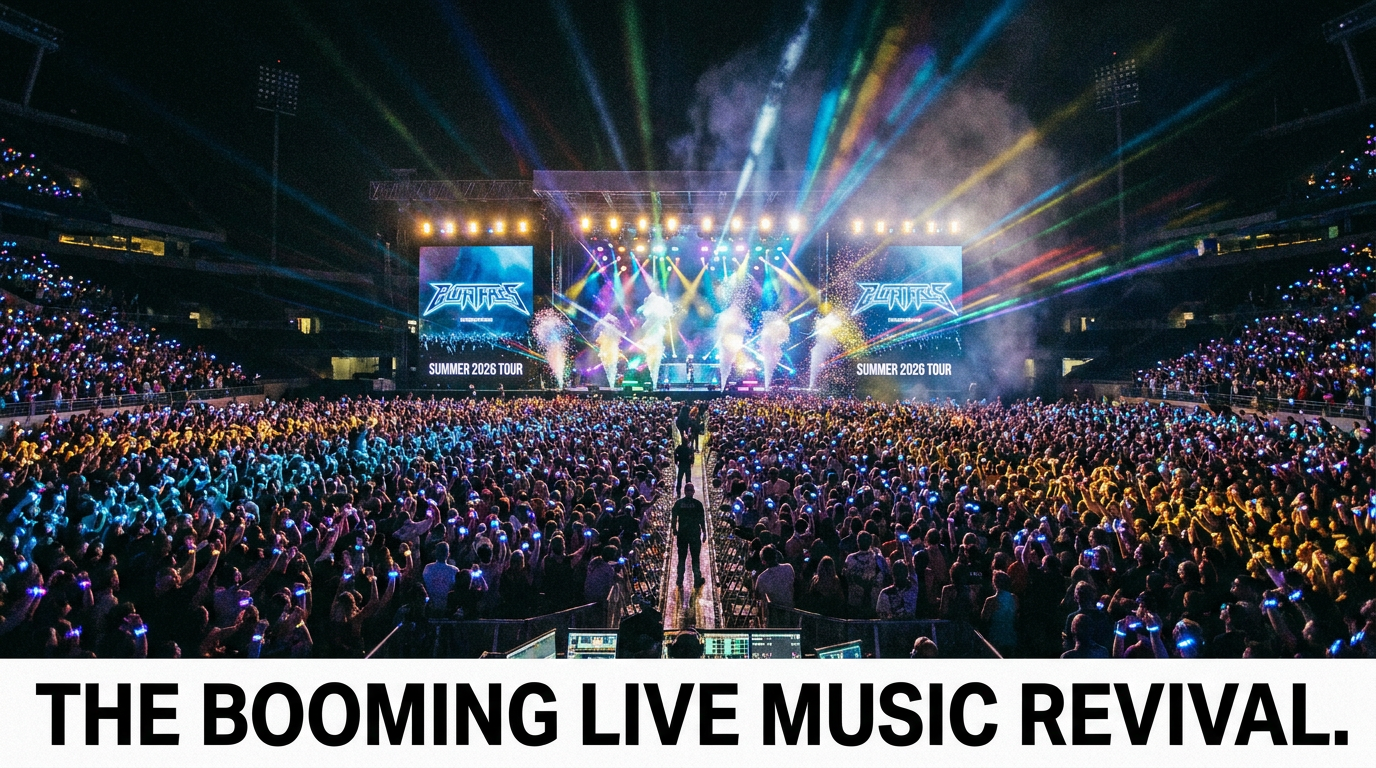
Beyond recorded music, the live sector is experiencing explosive, parallel growth. Ticket sales revenue from concerts and festivals surpassed $40 billion in 2025, with industry analysts projecting the market will hit $50 billion by 2030.[5]
The summer of 2026 is dominated by massive stadium runs, including Post Malone's sprawling stadium tour, Ariana Grande's highly anticipated return to the stage, and several high-profile rock reunions. These blockbuster tours are driving record attendance and premium ticket sales across the globe.[5][6]
Streaming platforms are actively fueling this live boom rather than cannibalizing it. Spotify reported that it has driven over $1.5 billion in gross concert ticket sales by connecting listeners directly to local tour dates, effectively turning passive streamers into active ticket buyers.[3][7]

Despite the record-breaking numbers, the industry still faces structural hurdles. The sheer volume of tracks uploaded daily means artists must fight harder for algorithmic attention, and the pro-rata streaming model still heavily favors top-tier acts who dominate total listening hours.[8]
Record companies are also navigating the complex integration of artificial intelligence. Labels are actively developing licensing models that generate new revenue opportunities while simultaneously cracking down on streaming fraud and unauthorized AI deepfakes that siphon royalties away from human creators.[1][2]
Ultimately, the 2026 data paints a picture of an industry that has successfully rebuilt itself from the ground up. By diversifying revenue streams across digital platforms, global markets, and live stages, the music business has established a sustainable, multi-billion-dollar foundation for the next generation of creators.[7][8]
How we got here
2014
Global recorded music revenues hit a low point of $13.1 billion due to the lingering effects of digital piracy.
2015
Only about 7,800 artists generate $100,000 or more in streaming revenue from Spotify.
2021
The live music industry begins a rapid post-pandemic rebound, setting the stage for record-breaking stadium tours.
March 2026
IFPI reports that global recorded music revenues have surpassed the $30 billion milestone for the first time in history.
June 2026
Massive global stadium tours, including Ariana Grande and Post Malone, drive live music revenues toward a projected $50 billion by 2030.
Viewpoints in depth
Independent Artists & DIY Creators
Argues that the democratization of distribution has finally created a sustainable middle class, allowing musicians to build lucrative careers without major label backing.
For independent musicians, the 2026 data is validation of a decade-long shift away from the traditional major label system. By utilizing direct-to-fan distribution platforms, DIY creators are capturing a larger share of the royalty pool than ever before. Advocates point out that the barrier to entry has vanished, allowing niche genres and regional sounds to find massive global audiences without needing a massive marketing budget. The fact that the 100,000th highest-earning artist on Spotify is now making over $7,300 proves that the 'long tail' of the internet is finally paying out.
Major Streaming Platforms
Emphasizes the sheer scale of the digital economy, pointing to record-breaking billion-dollar payouts as proof that streaming is the ultimate growth engine for global music.
Streaming executives argue that platforms like Spotify have single-handedly saved the music industry from the piracy era. By converting billions of free listeners into paid subscribers, they have created a $70 billion lifetime payout engine that benefits everyone from superstar acts to emerging indie bands. Furthermore, platforms highlight their role in the live music ecosystem, noting that their algorithmic recommendations and direct-to-fan ticketing integrations have driven over $1.5 billion in concert sales, proving that streaming and touring are symbiotic rather than competitive.
Industry Analysts
Focuses on the macro convergence of live touring and physical media alongside streaming, noting that fans are willing to pay premium prices for tangible and in-person experiences.
Financial analysts view the $31.7 billion milestone as a sign of a fully matured, diversified market. While streaming provides the baseline recurring revenue, analysts note that the real profit margins are increasingly found in premium physical media and live experiences. The 19-year growth streak of vinyl and the explosion of $40 billion in live ticket sales demonstrate that consumers still crave tangible connections to artists. However, analysts caution that the industry must carefully manage rising ticket prices and the influx of AI-generated content to maintain this historic growth trajectory.
What we don't know
- How the impending integration of AI music generation tools will impact the royalty pool for human artists.
- Whether the rapid increase in live concert ticket prices will eventually hit a ceiling with consumer spending.
- How streaming platforms will adjust their pro-rata payout models to better compensate mid-tier artists.
Key terms
- Pro-rata model
- A streaming payout system where all subscription revenue is pooled together and distributed based on an artist's share of total overall streams.
- Rights holders
- The entities—such as record labels, publishers, or independent distributors—that legally own the rights to a song and collect royalties on the artist's behalf.
- Gross merchandise value
- In live music, the total amount consumers spend on concert tickets before the revenue is split among artists, promoters, and venues.
- DIY Creators
- Independent musicians who write, record, and distribute their own music without the financial backing of a traditional major record label.
Frequently asked
How much did the global music industry make in 2025?
Global recorded music revenues reached a record $31.7 billion, marking the eleventh consecutive year of growth.
How much does Spotify pay artists?
Spotify paid out a record $11 billion to the music industry over the past year, though that money is distributed to rights holders (like labels and distributors) before reaching the artists.
Are independent artists making money from streaming?
Yes. Independent artists and labels generated roughly half of all royalties on Spotify, and over 13,800 artists generated at least $100,000.
Is live music still profitable?
Extremely. Global live music ticket sales surpassed $40 billion in 2025 and are projected to hit $50 billion by 2030, driven by massive stadium tours.
Sources
Source coverage
8 outlets
3 viewpoints surfaced








[1]Music Business WorldwideIndustry Analysts
10 quick (and crucial) takeaways from IFPI's Global Music Report 2026
Read on Music Business Worldwide →[2]Los Angeles TimesMajor Streaming Platforms
Spotify, once slammed for paltry royalties, touts gains for music artists
Read on Los Angeles Times →[3]HypebotIndependent Artists & DIY Creators
Spotify Loud & Clear Report 2026: $11B Paid as Global Musical Middle Class Expands
Read on Hypebot →[4]RelixMajor Streaming Platforms
Spotify Announce Record-Breaking Royalty Payouts in 2026 Loud & Clear Report
Read on Relix →[5]OmdiaIndustry Analysts
Omdia: Global live music market to exceed $50 billion by 2030
Read on Omdia →[6]StatistaIndustry Analysts
Chart: Live Music Revenues Continue Upward Trend
Read on Statista →[7]Spotify NewsroomMajor Streaming Platforms
As Spotify Turns 20, the Most Global and Diverse Music Industry in History Has Taken Shape
Read on Spotify Newsroom →[8]Artist RepublicIndependent Artists & DIY Creators
The Music Industry in 2026: Building Foundations That Last
Read on Artist Republic →


Every angle. Every day.
Get entertainment stories with full source coverage and perspective breakdowns delivered to your inbox.