
AI Models Are Designing Novel Proteins and Antibiotics From Scratch, Slashing Drug Development Costs
A wave of breakthroughs in generative AI is compressing drug discovery timelines from years to months, yielding novel antibiotics and making rare-disease treatments economically viable.
By Factlen Editorial Team
- Computational Biologists
- Focus on AI's ability to explore vast chemical spaces and generate novel molecules from scratch.
- Public Health Advocates
- Emphasize the urgent need to combat antimicrobial resistance and lower the economic barrier for rare disease treatments.
- Clinical Researchers
- Caution that computational predictions must still survive the rigorous gauntlet of physical laboratory and human testing.
What's not represented
- · Pharmaceutical Executives
- · Patients with Rare Diseases
- · Healthcare Economists
Why this matters
The traditional 10-to-15-year timeline for drug development has historically left rare diseases underfunded and allowed antibiotic-resistant superbugs to outpace medical science. By using AI to design novel molecules in a matter of hours, researchers are fundamentally lowering the economic barrier to life-saving treatments.
Key points
- Generative AI models are now capable of designing entirely new protein binders and therapeutic molecules from scratch.
- MIT researchers estimate AI could reduce the development costs of certain rare-disease drugs by hundreds of millions of dollars.
- Deep-learning systems have successfully identified hundreds of new antibiotic candidates by scanning animal venoms and the DNA of extinct organisms.
- New machine learning pipelines are overcoming 'mechanistic bias' to find genuinely novel antibiotics rather than just derivatives of existing drugs.
- Despite computational leaps, AI-designed drugs must still undergo rigorous physical synthesis and human clinical trials.
The artificial intelligence revolution has officially moved from the chatbot window to the wet lab. In a wave of mid-2026 breakthroughs, researchers at top institutions are proving that generative AI can design novel therapeutic proteins and discover entirely new classes of antibiotics in a fraction of the traditional time.[1][5]
For decades, pharmaceutical development has been governed by a brutal arithmetic. Bringing a single new drug to market typically requires 10 to 15 years of research and an estimated $2.6 billion in capital, with a failure rate exceeding 90 percent during clinical trials. This high barrier to entry has historically left ultra-rare diseases and complex bacterial infections chronically underfunded.[5]
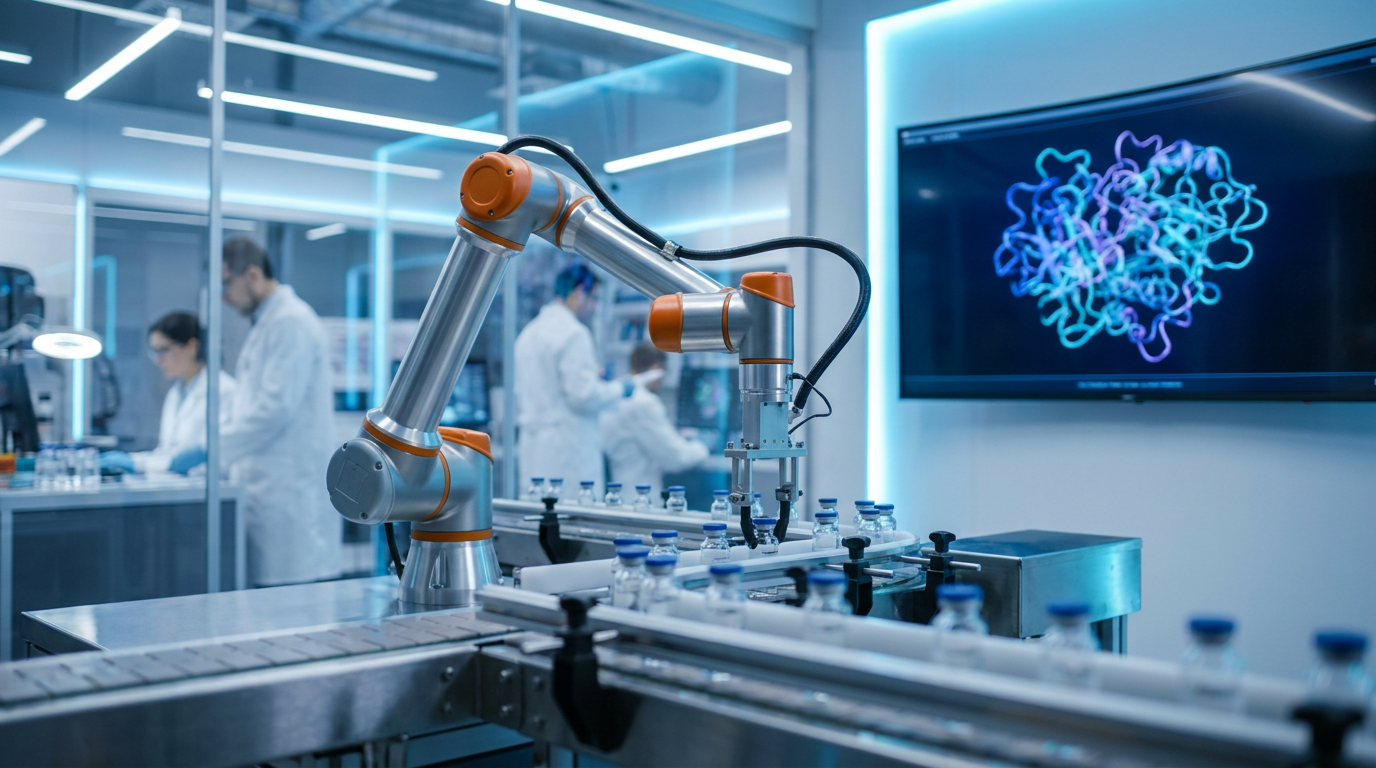
That calculus is now fracturing. At the Massachusetts Institute of Technology, researchers have deployed generative AI models—including systems dubbed BoltzGen and Boltz-2—that fundamentally rewrite the rules of protein drug development. Rather than merely screening existing molecular structures, these models generate entirely new protein binders from scratch, creating molecules that have never existed in nature.[1][5]

The economic implications are profound. In one recent case study involving an ultra-rare genetic disorder affecting fewer than 1,000 patients globally, the AI-driven approach eliminated years of failed synthesis attempts. Early estimates suggest the technology reduced development costs for the therapeutic candidate by approximately $340 million, suddenly making a previously "undruggable" target commercially viable to pursue.[5]
Beyond rare genetic disorders, AI is being deployed against one of humanity's most urgent public health threats: antimicrobial resistance. As traditional antibiotics lose their efficacy against mutating pathogens, the pipeline for replacement drugs has largely stalled.[2][4]
Beyond rare genetic disorders, AI is being deployed against one of humanity's most urgent public health threats: antimicrobial resistance.
To break the bottleneck, researchers at the University of Pennsylvania have turned to unconventional sources. Using a deep-learning system called APEX, scientists are mining the "extinctome"—the genetic material of extinct organisms like the woolly mammoth—as well as databases of animal venoms to identify hidden antimicrobial peptides.[2]
The speed of computational triage is staggering. In a recent screen of over 40 million venom-encrypted peptides from snakes and spiders, the APEX algorithm flagged 386 compounds with the molecular hallmarks of next-generation antibiotics in a matter of hours. When synthesized in the lab, dozens of these AI-selected peptides successfully killed drug-resistant bacteria without harming human cells.[2]

Discovery is only the first step; optimization is the second. A complementary AI platform known as ApexGO takes promising but weak antimicrobial molecules and systematically refines them through calculated structural modifications. Instead of blindly searching chemical space, the model navigates it with precise direction, transforming imperfect candidates into potent therapeutics.[4]
Yet, AI models are only as good as their training data, and early systems often suffered from "mechanistic bias"—they simply found derivatives of existing antibiotic classes rather than genuinely novel cures. A June 2026 paper published in bioRxiv by researchers from Princeton and Stanford addresses this exact flaw.[3]
The team developed a machine learning pipeline that explicitly prioritizes chemical novelty upfront. By employing a specialized mechanism-of-action classifier alongside graph neural networks, the system successfully identified non-toxic, bacterial-selective compounds that target cell membranes in ways structurally distinct from any known antibiotic.[3]

Despite the unprecedented computational acceleration, biotech analysts and clinical researchers caution that the "pilot-to-production gap" remains a formidable hurdle. AI can design a flawless molecule on a server, but that compound must still survive the rigorous, physical gauntlet of laboratory synthesis, animal testing, and multi-phase human clinical trials.[6]
Regulatory agencies are already adapting to this new paradigm, with the FDA and EMA issuing joint guidelines in early 2026 for AI in drug development. If these computationally designed molecules succeed in upcoming Phase III trials, the ultimate promise of this technology will be realized: not just cheaper R&D for pharmaceutical companies, but a fundamental expansion of what is medically curable.[6]
How we got here
Late 2024
Early generative AI models begin successfully predicting 3D protein structures with high accuracy.
Mid 2025
Researchers use AI to identify the first viable antibiotic candidates from the genetic material of extinct organisms.
Early 2026
The FDA and EMA issue their first joint regulatory guidelines for the use of AI in drug development.
June 2026
New machine learning pipelines successfully identify mechanistically novel antibiotics, overcoming the biases of earlier models.
Viewpoints in depth
Computational Biologists
Focus on AI's ability to explore vast chemical spaces and generate novel molecules from scratch.
For computational biologists, the breakthrough lies in moving beyond mere screening. Traditional drug discovery relied on testing existing libraries of compounds to see what might stick to a target. Generative AI models flip this paradigm by analyzing the target's structure and imagining an entirely new molecule designed specifically to bind to it. This allows researchers to explore a chemical space of trillions of possibilities in hours, turning previously 'undruggable' targets into solvable engineering problems.
Public Health Advocates
Emphasize the urgent need to combat antimicrobial resistance and lower the economic barrier for rare disease treatments.
Public health experts view the AI revolution as a lifeline for neglected medical crises. Antimicrobial resistance currently contributes to over a million deaths annually, yet pharmaceutical companies have largely abandoned antibiotic R&D due to low profit margins. By drastically reducing the cost and time required to discover new drugs, AI makes it economically viable to develop treatments for both superbugs and ultra-rare genetic disorders that affect too few patients to justify a traditional $2.6 billion investment.
Clinical Researchers
Caution that computational predictions must still survive the rigorous gauntlet of physical laboratory and human testing.
While acknowledging the staggering speed of AI discovery, clinical researchers maintain a grounded perspective on the 'pilot-to-production gap.' A molecule that performs flawlessly in a digital simulation can still fail in the real world due to unforeseen toxicity, poor absorption, or instability in the human body. They stress that AI does not replace the need for physical synthesis, animal models, and multi-phase human clinical trials, which remain the ultimate arbiters of a drug's safety and efficacy.
What we don't know
- It remains to be seen what percentage of these AI-generated molecules will successfully pass Phase III human clinical trials.
- The long-term safety profiles and potential off-target effects of 'new-to-nature' proteins designed entirely by algorithms are not yet fully understood.
Key terms
- Generative AI
- Artificial intelligence systems capable of creating entirely new content—in this case, novel molecular structures and protein sequences—rather than just analyzing existing data.
- Antimicrobial Resistance (AMR)
- The ability of bacteria and other microbes to evolve and withstand the drugs designed to kill them, creating dangerous 'superbugs.'
- Extinctome
- The collective genetic material and protein sequences of extinct organisms, which researchers are now mining for ancient biological defenses.
- Mechanism of Action (MoA)
- The specific biochemical interaction through which a drug substance produces its pharmacological effect on a pathogen or disease.
- In Vitro
- Medical or biological experiments performed outside of a living organism, such as in a test tube or petri dish.
Frequently asked
How does AI discover new drugs?
AI models analyze vast databases of chemical structures and biological targets, learning the rules of molecular binding. They can then generate entirely new molecules designed to perfectly fit and neutralize a specific disease target.
Will AI make prescription drugs cheaper?
By reducing the time and money spent on failed laboratory experiments, AI significantly lowers the R&D costs for pharmaceutical companies. Whether these savings will be passed on to consumers remains a complex issue of market pricing and insurance.
Are AI-designed drugs safe for humans?
AI-designed drugs are subject to the exact same rigorous safety regulations, animal testing, and multi-phase human clinical trials as traditionally discovered drugs before they can be approved for public use.
Sources
Source coverage
6 outlets
3 viewpoints surfaced






[1]MIT NewsComputational Biologists
New AI model could cut the costs of developing protein drugs
Read on MIT News →[2]Penn MedicinePublic Health Advocates
AI finds hundreds of potential antibiotics in snake and spider venom
Read on Penn Medicine →[3]bioRxivComputational Biologists
Machine Learning-Guided Discovery of Bacterial-Selective Membrane-Active Compounds Reveals Mechanistic Bias in Antibiotic Training Datasets
Read on bioRxiv →[4]Drug Target ReviewPublic Health Advocates
AI system transforms weak antibiotics into powerful treatments
Read on Drug Target Review →[5]BootcampComputational Biologists
MIT's Protein AI Revolution. Cutting Drug Costs by Billions
Read on Bootcamp →[6]CodePhusionClinical Researchers
The state of AI in biotech in 2026
Read on CodePhusion →

Every angle. Every day.
Get ai stories with full source coverage and perspective breakdowns delivered to your inbox.