
At-Home Brain Implant Restores Speech and Digital Autonomy for Man with ALS
A groundbreaking brain-computer interface allows a patient with severe motor neuron disease to communicate at 56 words per minute and work independently from home.
By Factlen Editorial Team
- Neurotechnology Researchers
- Focuses on the engineering breakthrough, decoding accuracy, and long-term viability of the BCI.
- Patient Advocates & Users
- Emphasizes the restoration of autonomy, emotional connection, and real-world independence for those with severe paralysis.
- Clinical Care Providers
- Highlights the practical transition of BCIs from highly controlled lab settings to at-home, caregiver-assisted daily use.
- Technology Analysts
- Examines the broader societal implications of assistive technology crossing the threshold into practical utility.
What's not represented
- · Insurance providers on the cost of commercializing BCIs
- · Patients with non-ALS forms of paralysis evaluating the technology
Why this matters
For decades, severe paralysis meant losing the ability to participate in spontaneous human conversation. This breakthrough proves that brain implants can reliably restore a patient's voice and digital independence at home, paving the way for a new era of assistive technology for conditions like ALS, stroke, and spinal cord injuries.
Key points
- A 47-year-old man with ALS has successfully used a brain-computer interface at home for nearly two years.
- The system translates his neural signals into text at 56 words per minute with 97.5% accuracy.
- Unlike previous lab-bound devices, the system is automated for independent, plug-and-play use by a caregiver.
- The BCI also enables cursor control, allowing the patient to browse the web, send emails, and maintain employment.
- The AI synthesizes the text into audio using a recreation of the patient's original voice, restoring emotional connection.
- The study proves that intracortical microelectrodes can function reliably over thousands of hours without severe signal degradation.
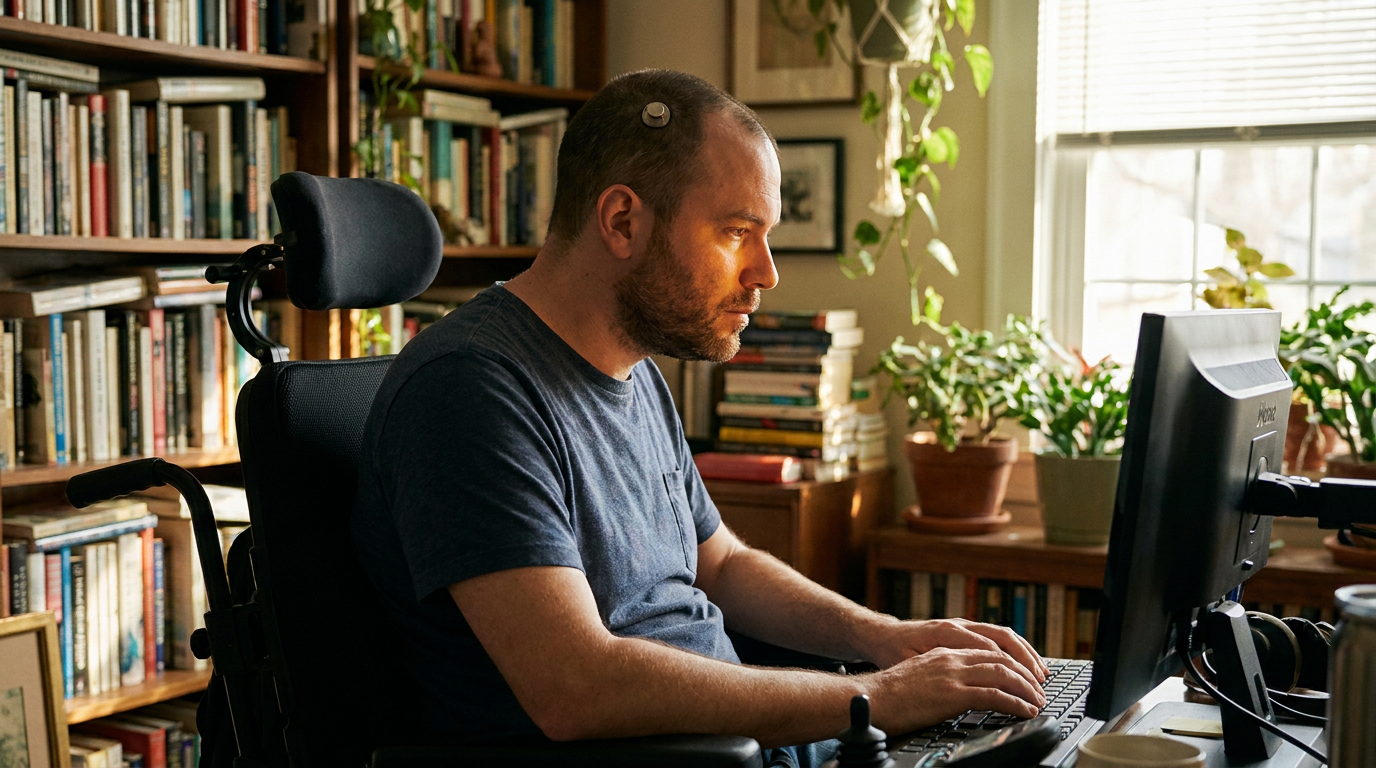
For years, Casey Harrell used his voice to advocate for the environment, speaking at public events and policy meetings as a climate activist. But five years ago, a diagnosis of amyotrophic lateral sclerosis (ALS) began to strip away his ability to communicate. The neurodegenerative disease systematically eroded the neural connections controlling the muscles in his lips, tongue, and throat, eventually rendering his speech unintelligible. He was trapped in a body that could no longer express the thoughts of his fully functioning mind. Today, however, Harrell is speaking again—not through a slow, eye-tracking keyboard, but through a groundbreaking brain-computer interface (BCI) that translates his neural intentions directly into words. Implanted with microelectrodes and powered by artificial intelligence, the system allows him to converse in real-time, using a synthesized voice modeled after his own.[3][8]
The achievement, detailed in a landmark study published in Nature Medicine, represents a watershed moment for neuroprosthetics. While brain implants have previously demonstrated the ability to decode speech in highly controlled laboratory settings, Harrell’s case marks the first time a patient has used an intracortical BCI independently at home for an extended period. Over the course of nearly two years, Harrell has logged more than 3,800 hours on the system, communicating over 1.9 million words without requiring a team of researchers hovering over his shoulder. This transition from a proof-of-concept experiment to a practical, daily assistive device proves that severe paralysis does not have to mean the end of rich, spontaneous human connection.[1][2][6]
The performance metrics of the new BCI system shatter previous benchmarks. According to the research team at the University of California, Davis, the device translates Harrell’s attempted speech at an average rate of 56 words per minute. For context, conversational English typically flows at about 150 words per minute, while traditional assistive devices for ALS patients often max out at a frustratingly slow five to ten words per minute. Furthermore, the system boasts a 97.5% accuracy rate across a staggering 125,000-word vocabulary. This unprecedented precision means Harrell can express complex ideas, use specialized jargon, and even interject with natural conversational fillers without the machine misinterpreting his intent.[1][4]

To understand the magnitude of this breakthrough, it is necessary to examine the biological cruelty of ALS, also known as motor neuron disease. The condition selectively destroys the motor neurons in the brain and spinal cord that control voluntary muscle movement. As these cells die, the brain loses its ability to send signals to the muscles, leading to progressive paralysis. However, the cognitive centers of the brain—the areas responsible for memory, personality, and the formulation of language—remain entirely intact. The patient is effectively locked inside a failing biological vessel. The UC Davis BCI bypasses the damaged neural pathways entirely, tapping directly into the brain's command center to intercept the signals before they ever reach the paralyzed muscles.[2][7]
Historically, the primary barrier to BCI technology has not been a lack of ambition, but the sheer logistical complexity of the hardware. Early iterations of brain-to-text systems required patients to be tethered to massive computing rigs in specialized clinics. A team of neuroscientists and engineers had to manually calibrate the decoders, monitor the signal quality, and troubleshoot the inevitable software crashes. The patient could only speak during scheduled research sessions. "For years, BCIs have been proof-of-concept devices that lived in highly controlled research labs," noted Dr. David Brandman, the UC Davis neurosurgeon who co-led the study. The goal of the BrainGate2 clinical trial was to build a system robust enough to survive the chaotic, unpredictable environment of a patient's living room.[2][5]
The surgical foundation of Harrell's newfound voice was laid in 2023, when Brandman implanted four microelectrode arrays into Harrell's left precentral gyrus—a region of the motor cortex responsible for coordinating the intricate dance of the jaw, lips, and tongue during speech. These arrays, each roughly the size of a baby aspirin, contain a total of 256 microscopic sensors that penetrate the surface of the brain. When Harrell attempts to speak a word, the neurons in this region fire in a specific, repeatable pattern. The electrodes capture these electrical impulses, which are then routed out of his skull through a small pedestal and fed into a computer running advanced deep-learning algorithms.[1][2][7]
The artificial intelligence powering the system does not attempt to read Harrell's abstract thoughts; rather, it decodes the specific motor commands he is trying to send to his vocal tract. The software breaks language down into its smallest phonetic components. "First we go from brain data to phonemes, and then from phonemes to words," explained Nicholas Card, the study's lead author. By mapping the neural signature of each phoneme, the AI can rapidly assemble them into words and sentences, even if it has never encountered that specific sequence before. This phonetic approach allows for a massive vocabulary and enables Harrell to generate novel sentences on the fly, rather than relying on a pre-programmed list of common phrases.[1][3]

The software breaks language down into its smallest phonetic components.
Crucially, the UC Davis team did not stop at speech decoding. They integrated a secondary function into the BCI: cursor control. By imagining the movement of his hands, Harrell can navigate a computer screen, click on links, and type out messages. This multimodal approach transforms the BCI from a mere communication tool into a comprehensive digital interface. Harrell uses the cursor function to browse the internet, manage his email, and interact with software, effectively restoring his ability to work and engage with the modern digital economy. The combination of rapid speech synthesis and independent computer navigation has allowed him to maintain his employment and continue his climate advocacy despite his profound physical limitations.[1][2][4]
The emotional resonance of the technology became apparent almost immediately after the system was activated. On the second day of using the BCI, Harrell was able to hold a fluid conversation with his young daughter for the first time in her memory. Because the researchers had access to audio recordings of Harrell speaking before his ALS progressed, they were able to train a voice synthesizer to mimic his original cadence and tone. Hearing his own voice fill the room—rather than the robotic monotone typical of older assistive devices—brought Harrell and his family to tears. The technology restored not just his ability to transmit information, but his unique identity and presence within his household.[3][7][8]
The true test of the system, however, was its transition to independent use. In the early months of the trial, researchers still had to visit Harrell's home to physically connect the cables and initialize the software. Over time, the engineering team systematically automated the calibration processes and simplified the user interface. Today, the system is entirely plug-and-play. Harrell's caregiver simply connects the cable to the pedestal on his head, and the software handles the rest. "He will wake up, get plugged in, and just start going," said co-principal investigator Sergey Stavisky. This level of autonomy is a massive leap forward, proving that complex neural decoders can maintain their accuracy without constant expert supervision.[2][3]
Harrell has fully embraced his role as the technology's first power user. He routinely operates the BCI for up to 12 hours a day, seamlessly switching between chatting with his family, drafting emails, and participating in virtual meetings. His relentless usage has provided the research team with an unprecedented dataset on the long-term viability of intracortical implants. One of the lingering fears in the field of neuroprosthetics has been that the brain's immune response might encapsulate the electrodes in scar tissue, degrading the signal quality over time. Yet, after nearly two years of continuous operation, Harrell's arrays continue to capture crisp, high-resolution neural data, validating the durability of the hardware.[1][3][6]

The implications of this success extend far beyond the ALS community. The ability to reliably decode motor intentions and translate them into digital actions offers a blueprint for treating a wide spectrum of neurological disorders. Patients suffering from locked-in syndrome due to brainstem strokes, individuals with severe spinal cord injuries, and those with advanced multiple sclerosis could all theoretically benefit from similar multimodal BCIs. By demonstrating that the technology can survive the rigors of daily life, the UC Davis study provides a crucial proof point for medical device manufacturers and regulatory agencies, paving the way for broader clinical trials and eventual commercialization.[4][6][7]
Despite the triumph, significant hurdles remain before BCIs can become a standard of care. The current system still requires open-brain surgery, which carries inherent risks of infection and bleeding. Furthermore, the hardware relies on a physical cable protruding from the skull, which can be cumbersome and requires meticulous hygiene to prevent complications. The next frontier in BCI engineering is the development of fully implantable, wireless systems that transmit data via Bluetooth or similar protocols, eliminating the need for external hardware. Several companies are already testing wireless arrays, though they have yet to match the sheer decoding speed and vocabulary size of the wired UC Davis system.[5][6]
Researchers are also pushing the boundaries of the neural decoding itself. While 56 words per minute is a massive improvement, it still falls short of the natural speed of human conversation. Future trials are slated to utilize next-generation arrays featuring up to 1,600 electrodes, exponentially increasing the bandwidth of data flowing from the brain. With more sensors, scientists hope to capture the subtle neural signals that dictate pitch, volume, and emotional inflection, allowing the synthesized voice to convey sarcasm, excitement, or sorrow in real-time. The ultimate goal is a neuroprosthesis so seamless that the listener forgets they are speaking to a machine.[6][8]

For Casey Harrell, the technology has already delivered on its most important promise: the restoration of his agency. He recently remarked through his device that living with ALS is supposed to mean diminished dreams, but he refuses to accept that fate. By crossing the threshold from the laboratory into the living room, this brain-computer interface has proven that the devastating silence of motor neuron disease can be broken. It is a profound testament to the power of neuro-engineering to reclaim the human experience from the ravages of biology.[2][3][6]
How we got here
2021
Casey Harrell is diagnosed with ALS, which gradually impairs his ability to speak.
2023
Surgeons implant four microelectrode arrays into the speech center of Harrell's brain.
August 2023
Harrell uses the BCI to hold a fluid conversation with his daughter for the first time in her memory.
June 2026
Researchers publish data showing Harrell has successfully used the system independently at home for nearly two years.
Viewpoints in depth
The Engineering View
Focus on the durability and autonomy of the hardware.
For the scientists and engineers developing these interfaces, the primary victory is durability and autonomy. Historically, intracortical arrays were plagued by signal degradation as the brain's immune system formed scar tissue around the electrodes. The fact that this system maintained 97.5% accuracy over 3,800 hours proves that long-term implantation is viable. Furthermore, automating the calibration process so that a caregiver can initialize the system without a PhD present crosses the critical threshold from a laboratory experiment to a practical medical device.
The Patient Perspective
Focus on the restoration of agency and emotional connection.
Advocacy groups emphasize that severe paralysis strips away more than just movement; it isolates individuals from their own families and identities. Traditional assistive devices, like eye-tracking keyboards, are often exhaustingly slow and rely on robotic, impersonal voices. By decoding speech in real-time and synthesizing it in the patient's original voice, this BCI restores the spontaneity and emotional nuance of human conversation. For patients facing locked-in syndrome, the technology represents a lifeline back to the world, allowing them to maintain relationships, employment, and personal dignity.
The Clinical & Ethical View
Focus on accessibility, surgical risks, and the future of neuro-privacy.
While celebrating the breakthrough, ethicists caution that the technology remains highly experimental and invasive. Open-brain surgery carries significant risks, and the current wired pedestal requires meticulous care to prevent infection. There are also concerns about equity: as these devices commercialize, they will likely be prohibitively expensive, potentially creating a divide between those who can afford to restore their voices and those who cannot. Finally, as arrays become denser and capture more neural data, ethicists are calling for strict privacy frameworks to ensure that only intended motor commands—and never private internal thoughts—are decoded.
What we don't know
- Whether the same high decoding accuracy can be achieved in patients whose motor cortex has been damaged by a stroke.
- How long the microelectrode arrays will ultimately last before the brain's immune response degrades the signal.
- When fully wireless, implantable versions of this high-bandwidth technology will be ready for widespread clinical use.
Key terms
- Brain-Computer Interface (BCI)
- A system that translates brain activity into commands for a computer or other external device.
- Amyotrophic Lateral Sclerosis (ALS)
- A progressive neurodegenerative disease that destroys the motor neurons controlling voluntary muscle movement.
- Intracortical Microelectrode Array
- A tiny grid of sensors implanted directly into the surface of the brain to record electrical signals from individual neurons.
- Precentral Gyrus
- A region of the brain's motor cortex responsible for executing voluntary movements, including the coordination of speech.
- Phoneme
- The smallest unit of sound in a language, which the BCI decodes before assembling them into full words.
Frequently asked
Can the brain implant read the patient's private thoughts?
No. The device only decodes the specific motor commands the brain sends when the patient actively attempts to speak or move.
Does the system require a researcher to operate it?
Not anymore. While early BCIs required constant expert supervision, this new system has been automated so that a caregiver can simply plug it in for independent use.
How fast can the patient communicate?
The system decodes attempted speech at an average rate of 56 words per minute, which is significantly faster than traditional eye-tracking keyboards.
Is the implant wireless?
This specific device is not wireless; it relies on a small pedestal protruding from the skull that connects to a cable. However, future generations of BCIs aim to be fully implantable and wireless.
Sources
Source coverage
8 outlets
4 viewpoints surfaced








[1]Nature MedicineNeurotechnology Researchers
Long-term independent use of an intracortical brain-computer interface for speech and cursor control
Read on Nature Medicine →[2]UC Davis HealthNeurotechnology Researchers
Study shows BCI system allows man to 'speak' accurately and operate digital platforms, unassisted, for prolonged period
Read on UC Davis Health →[3]MIT Technology ReviewPatient Advocates & Users
This man with ALS is 'the first power user' of a brain implant that lets him speak
Read on MIT Technology Review →[4]Medical XpressClinical Care Providers
Brain-computer interface enables independent, accurate communication for man living with ALS
Read on Medical Xpress →[5]The Washington PostPatient Advocates & Users
Two years, 2 million words: How a brain implant transformed an ALS patient's life
Read on The Washington Post →[6]Factlen Editorial TeamTechnology Analysts
Synthesis by Factlen editorial team
Read on Factlen Editorial Team →[7]Science News ExploresClinical Care Providers
A brain implant helped a paralyzed man speak again
Read on Science News Explores →[8]ZME SciencePatient Advocates & Users
A brain implant helped him sing again
Read on ZME Science →
Every angle. Every day.
Get science stories with full source coverage and perspective breakdowns delivered to your inbox.