
How Mass Timber is Reshaping the Global Skyline
Engineered wood products like Cross-Laminated Timber are allowing architects to build skyscrapers out of wood, offering a sustainable and efficient alternative to concrete and steel.
By Factlen Editorial Team
- Mass Timber Advocates
- Architects and developers pushing for rapid adoption to decarbonize the built environment.
- Environmental Skeptics
- Researchers warning that the climate benefits of mass timber are often overstated.
- Structural Engineers & Regulators
- Technical experts focused on load-bearing capabilities, fire safety, and code compliance.
What's not represented
- · Local communities near expanded logging operations
- · Traditional steel and concrete industry representatives
Why this matters
The construction industry is responsible for a massive portion of global carbon emissions. Transitioning to mass timber could significantly reduce the environmental impact of urban development while speeding up construction times and creating healthier indoor spaces.
Key points
- The 31-story Neutral Edison tower in Milwaukee is set to become the world's tallest mass timber building.
- Cross-Laminated Timber (CLT) achieves immense strength by gluing layers of wood perpendicularly.
- Mass timber drastically reduces the embodied carbon of a building compared to steel and concrete.
- In a fire, mass timber chars on the outside, creating an insulating layer that protects the structural core.
- Prefabricated timber components can reduce on-site construction time by up to 50 percent.
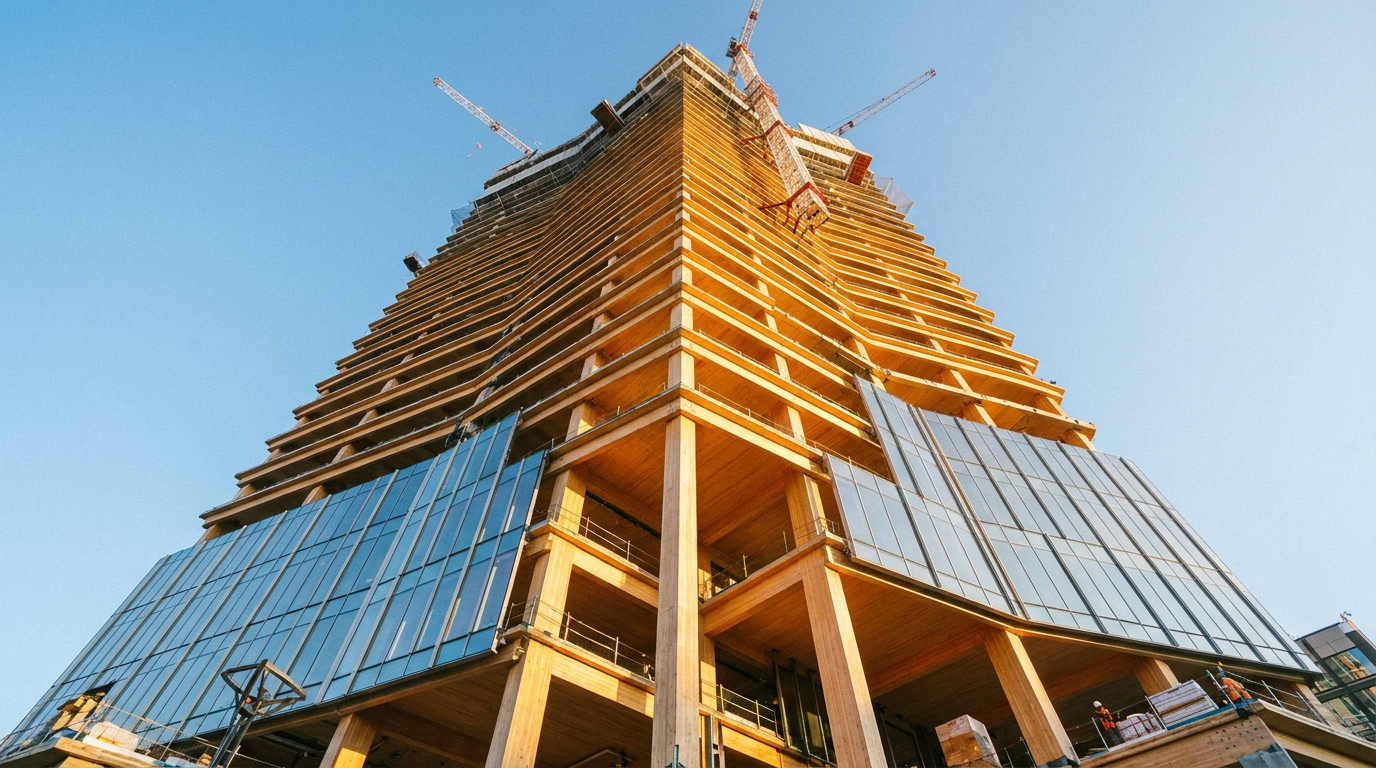
The skyline of Milwaukee is changing, and the material driving this transformation is not forged in a furnace, but grown in a forest. Construction is currently underway on the Neutral Edison, a 31-story residential and commercial tower that is set to redefine urban architecture.[1][2]
When it tops out in 2026, the 362-foot structure will officially become the tallest mass timber building in the world. It will surpass the current record holder, a 25-story tower named Ascent, which happens to be located less than a mile away in the same Wisconsin city. This concentration of wooden high-rises signals a profound shift in how developers and architects are approaching urban density.[1][2][3]
The material making these towering heights possible is "mass timber," a broad category of engineered wood products designed to rival the structural integrity of traditional heavyweights like concrete and steel. Unlike the standard two-by-four light-frame wood used in single-family home construction, mass timber involves binding smaller pieces of wood together to create massive, load-bearing panels and beams.[4][8]
The foundational technology behind this architectural movement is Cross-Laminated Timber, commonly known as CLT. To manufacture CLT, lumber boards are trimmed, dried, and stacked in alternating perpendicular layers—usually three, five, or seven plies deep. These layers are then bonded together using high-strength structural adhesives under immense pressure.[4][8]

This perpendicular alignment is the secret to the material's extraordinary strength. By crossing the grain of the wood at right angles, CLT panels achieve two-way spanning capabilities, meaning they can handle transfer loads in multiple directions while resisting the natural tendency of wood to warp or shrink. The resulting panels are stiff, dimensionally stable, and capable of serving as the primary structural floors and walls of a high-rise.[4][8]
The primary catalyst for the mass timber renaissance is the urgent need to decarbonize the construction industry. The built environment is a massive contributor to global greenhouse gas emissions, with the production of cement alone accounting for roughly eight percent of the world's carbon output. Steel manufacturing is similarly energy-intensive, requiring extreme heat generated largely by fossil fuels.[3][5][6]
Mass timber offers a compelling alternative by addressing both sides of the carbon equation. First, the manufacturing process for engineered wood requires significantly less energy than smelting steel or firing cement clinker, resulting in a drastically lower initial carbon footprint. Second, timber acts as a natural carbon sink; as trees grow, they absorb carbon dioxide from the atmosphere and store it within their cellular structure.[5][6]
A life-cycle assessment conducted by the Forest Products Laboratory compared a mass timber building structure to a functionally equivalent steel frame. The study found that substituting steel and concrete with mass timber resulted in a 19 percent reduction in embodied carbon emissions during the manufacturing and transportation phases. When factoring in the biogenic carbon stored within the wood itself, the net environmental benefit becomes even more pronounced.[6]

Despite these environmental credentials, the most immediate question raised by the prospect of a 31-story wooden skyscraper is one of safety: What happens in a fire? It is a counter-intuitive concept for many to grasp, but mass timber is engineered to be highly fire-resistant, relying on a natural mechanism known as charring.[7]
Despite these environmental credentials, the most immediate question raised by the prospect of a 31-story wooden skyscraper is one of safety: What happens in a fire?
When exposed to intense heat and flames, the outer layer of a massive wooden beam or panel burns and turns to char. This charred layer acts as a highly effective thermal insulator, protecting the unburned structural core of the wood from the heat of the fire. Because the char rate of mass timber is predictable, structural engineers can calculate exactly how thick a beam needs to be to maintain its load-bearing capacity for a specified duration during a fire.[7]
To validate these calculations, researchers at Oregon State University and the federal government have conducted exhaustive, large-scale compartment fire tests. In these rigorous scenarios, mass timber structures were subjected to severe fire conditions, and the data consistently showed that the material maintains its structural integrity and prevents fire from spreading, giving occupants ample time to evacuate and firefighters time to respond.[7]

Armed with this empirical data, regulatory bodies have begun to adapt. The International Building Code (IBC) has been updated to introduce new construction types that prescriptively allow mass timber buildings to reach up to 18 stories, a significant leap from previous restrictions. For taller structures like the Neutral Edison, developers work closely with city officials to secure special permitting based on advanced fire modeling and hybrid structural designs.[1][2][10]
Beyond sustainability and safety, mass timber is revolutionizing the logistics of construction. CLT panels and Glued-Laminated Timber (Glulam) beams are prefabricated off-site in highly controlled factory environments. They are cut to millimeter precision using computer numerical control (CNC) machines, with openings for doors, windows, and mechanical systems pre-routed before the wood ever leaves the facility.[4][8]
When these components arrive at the construction site, they are hoisted into place and bolted together almost like a piece of flat-pack furniture. This high degree of prefabrication can reduce overall construction time by up to 50 percent compared to traditional concrete pours, which require time-consuming formwork and curing periods. The process also requires fewer workers on site and generates significantly less noise and waste.[4]
However, the mass timber narrative is not without its uncertainties and vocal skeptics. Researchers from the World Resources Institute caution that scaling up mass timber to replace a significant portion of global concrete and steel could have unintended ecological consequences. They argue that harvesting wood is not inherently carbon-neutral, and that the accounting often overlooks the carbon debt incurred when a mature forest is logged.[5]
Furthermore, the production of mass timber is highly inefficient from a raw material perspective. When a tree is harvested, a substantial portion of its biomass—including roots, branches, and bark—is left behind to decompose or is burned, releasing carbon back into the atmosphere. Even during the milling process, a significant percentage of the log is lost as sawdust and offcuts.[5]
There is also the looming challenge of the "global land squeeze." If the demand for structural timber skyrockets, it could incentivize the rapid expansion of fast-growing plantation forests, potentially displacing natural ecosystems or competing with agricultural land needed for food production. The ultimate climate benefit of a mass timber building also depends heavily on its end-of-life scenario; if the wood is eventually demolished and sent to a landfill to rot, the sequestered carbon is released as methane.[5]
Despite these valid concerns, the architectural momentum behind mass timber continues to accelerate globally. In Sydney, the Atlassian Headquarters is currently under construction and aims to become the world's tallest hybrid timber tower at 42 stories. In Sweden, the Sara Kulturhus Centre stands as a 20-story testament to the region's forestry traditions, integrating a hotel and cultural spaces entirely within a wooden framework.[2][9]

For the people who live and work in these buildings, the appeal goes beyond carbon math. The biophilic design inherent in mass timber architecture—where the natural grain and warmth of the wood are left exposed on ceilings and columns—has been shown to reduce stress and improve occupant well-being. It creates interior spaces that feel fundamentally different from the sterile environments of traditional office towers.[9]
As the Neutral Edison begins its ascent into the Milwaukee skyline, it represents more than just a new height record. It serves as a highly visible proof of concept that the construction industry can evolve, blending cutting-edge engineering with one of humanity's oldest building materials to create a more sustainable urban future.[1][2]
How we got here
2012
Architect Michael Green publishes a manifesto advocating for tall wood buildings to combat climate change.
2021
The International Building Code is updated to prescriptively allow mass timber structures up to 18 stories.
2022
The Ascent building in Milwaukee is completed, setting a new height record for timber at 25 stories.
June 2025
Construction begins on the Neutral Edison tower in Milwaukee, designed to reach 31 stories.
2026
The Neutral Edison is projected to top out, becoming the world's tallest mass timber building.
Viewpoints in depth
Mass Timber Advocates
Architects and developers pushing for rapid adoption to decarbonize the built environment.
This camp views mass timber as the most viable solution to the construction industry's massive carbon footprint. They emphasize that engineered wood not only requires less energy to produce than steel or concrete but also actively sequesters carbon. Beyond environmental metrics, advocates highlight the logistical benefits: prefabricated CLT panels allow for faster, quieter, and less labor-intensive construction. They also point to the biophilic benefits of exposed wood, which has been shown to improve occupant well-being and command premium lease rates.
Environmental Skeptics
Researchers warning that the climate benefits of mass timber are often overstated.
Organizations like the World Resources Institute caution that mass timber is not a silver bullet. They argue that carbon accounting often ignores the 'carbon debt' incurred when mature forests are logged, as well as the significant amount of wood biomass lost as waste during the harvesting and milling processes. Skeptics also warn of a 'global land squeeze,' suggesting that scaling mass timber to meet global construction demands could drive the expansion of plantation forests at the expense of natural ecosystems and agricultural land.
Structural Engineers & Regulators
Technical experts focused on load-bearing capabilities, fire safety, and code compliance.
For this group, the primary concern is ensuring that wooden high-rises perform predictably under extreme stress. They rely on empirical data from large-scale compartment fire tests, which demonstrate that mass timber's predictable char rate provides sufficient time for evacuation. While they acknowledge the material's strength, engineers often advocate for hybrid designs—using concrete cores or steel exoskeletons alongside CLT—to manage wind loads and seismic activity in the tallest structures.
What we don't know
- Whether the global supply of sustainably managed forests can meet the demand if mass timber scales to replace a majority of concrete construction.
- The exact end-of-life carbon impact of these buildings, as few modern mass timber high-rises have reached the demolition phase.
- How long-term maintenance and moisture management will perform over a century in the tallest wooden structures.
Key terms
- Mass Timber
- A category of engineered wood products made by binding smaller pieces of wood together to form large, load-bearing panels and beams.
- Cross-Laminated Timber (CLT)
- A structural panel made by gluing layers of solid wood perpendicularly to one another, providing immense strength in two directions.
- Glulam
- Glue-laminated timber, created by bonding layers of wood with the grain running parallel, typically used for columns and beams.
- Embodied Carbon
- The total greenhouse gas emissions generated by the extraction, manufacturing, and transportation of building materials.
- Biogenic Carbon Storage
- The natural process by which trees absorb carbon dioxide from the atmosphere and store it within their wood.
- Char Rate
- The predictable speed at which the outer layer of mass timber burns, creating an insulating barrier that protects the structural core.
Frequently asked
Is mass timber the same as traditional wood framing?
No. Traditional framing uses small dimensional lumber like two-by-fours, while mass timber uses massive, engineered panels and beams capable of supporting high-rise structures.
Are wooden skyscrapers a fire hazard?
Mass timber is engineered to be highly fire-resistant. When exposed to fire, the thick wood chars on the outside, which insulates and protects the structural core from failing.
How does mass timber help the environment?
It requires significantly less energy to manufacture than concrete or steel, and the wood itself stores carbon dioxide that the tree absorbed during its lifetime.
Can mass timber completely replace concrete?
Not entirely. Most mass timber high-rises are 'hybrid' structures that still rely on concrete for their foundations, elevator cores, or stairwells.
Sources
Source coverage
10 outlets
3 viewpoints surfaced









[1]Construction DiveMass Timber Advocates
World's tallest mass timber building breaks ground in Wisconsin
Read on Construction Dive →[2]International ConstructionMass Timber Advocates
Construction of 'world's tallest' mass timber high-rise underway
Read on International Construction →[3]The GuardianMass Timber Advocates
Milwaukee plans to build tallest timber building in the world
Read on The Guardian →[4]ArchDailyMass Timber Advocates
What Is Mass Timber?
Read on ArchDaily →[5]World Resources InstituteEnvironmental Skeptics
Wood Is Not the Climate-friendly Building Material Some Claim it to Be
Read on World Resources Institute →[6]Forest Products LaboratoryStructural Engineers & Regulators
Comparison of Embodied Carbon Footprint of a Mass Timber Building Structure with a Steel Equivalent
Read on Forest Products Laboratory →[7]Oregon State UniversityStructural Engineers & Regulators
Burning it all down to figure out safe mass timber construction
Read on Oregon State University →[8]WoodWorksMass Timber Advocates
What is mass timber?
Read on WoodWorks →[9]gb&d magazineMass Timber Advocates
The Top 25 Tallest Mass Timber Buildings in the World
Read on gb&d magazine →[10]J.S. HeldStructural Engineers & Regulators
Mass Timber Fire Resistance: Sustainability, Code Compliance, and Fire Safety in Tall Buildings
Read on J.S. Held →

Every angle. Every day.
Get culture stories with full source coverage and perspective breakdowns delivered to your inbox.