
SpaceX's $86.2 Billion IPO Makes History With Unprecedented Retail Investor Access
Retail brokerage customers secured guaranteed shares in SpaceX's highly anticipated public offering, marking a major shift in how everyday investors access blockbuster tech debuts.
By Factlen Editorial Team
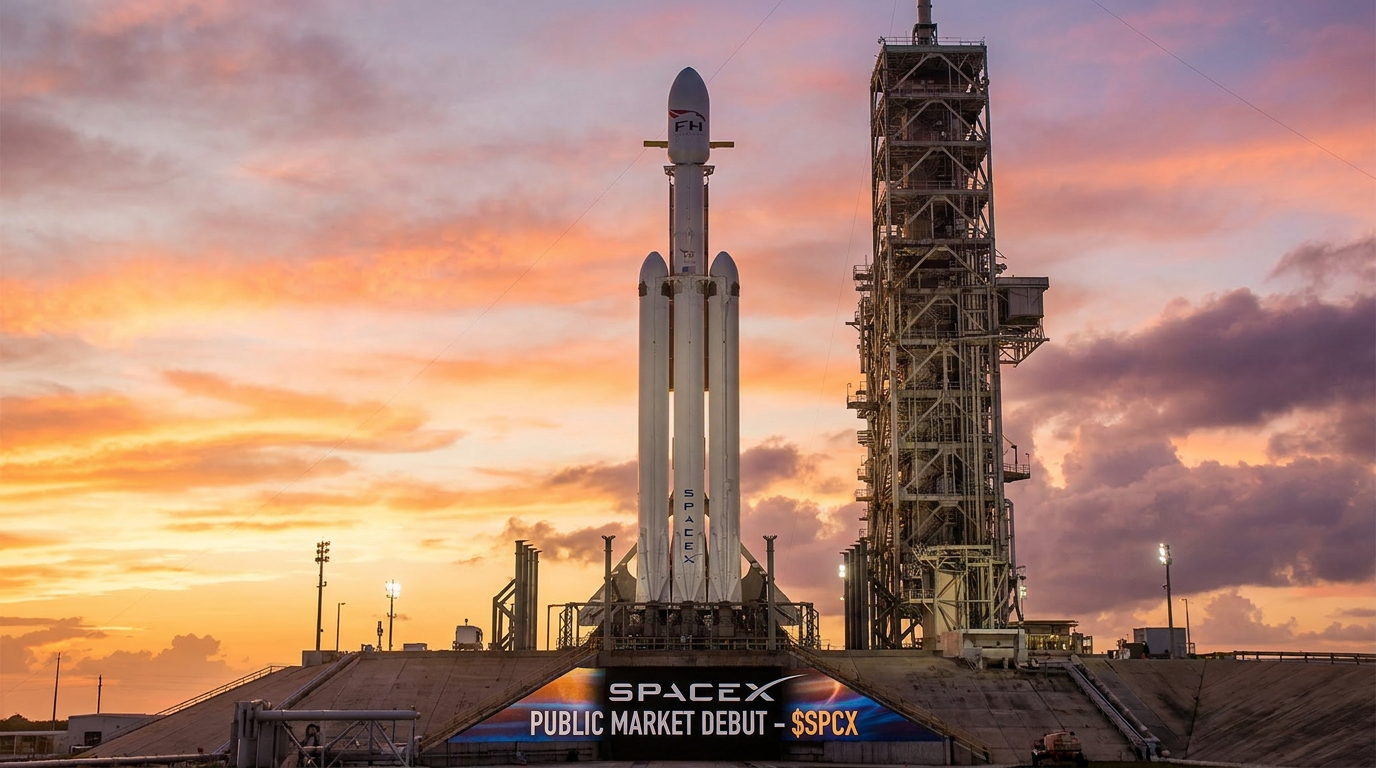
- Retail Advocates
- Argues that everyday people deserve access to wealth-generating early investments, celebrating the IPO as a victory for financial democratization.
- Market Analysts
- Views this as a structural shift in capital markets that future unicorns will be forced to emulate to satisfy public demand.
- Traditional Institutions
- Cautions that retail volatility could destabilize early trading and expresses frustration over reduced institutional allocations.
What's not represented
- · Pre-IPO private equity backers
- · Regulatory bodies overseeing retail trading risks
Why this matters
Historically, lucrative tech IPOs have been walled off for institutional investors and ultra-wealthy clients, leaving everyday traders to buy in only after the price surges. SpaceX's decision to guarantee retail allocation democratizes access to one of the decade's most significant financial events, potentially forcing future unicorns to follow suit.
Key points
- SpaceX's $86.2 billion IPO included a historic carve-out specifically for retail investors.
- Customers at major brokerages like Robinhood and Fidelity were guaranteed at least one share.
- The move bypasses traditional Wall Street gatekeeping, allowing everyday investors to buy in at the offering price.
- Institutional investors faced reduced allocations to accommodate the massive retail demand.
- Market watchers believe this could set a new precedent for future mega-cap tech debuts.
SpaceX's highly anticipated public debut has officially rewritten the playbook for retail investors, granting everyday brokerage customers unprecedented access to the $86.2 billion initial public offering. In a landmark move for financial democratization, customers at major US retail brokerages who requested access were guaranteed at least one share at the offering price, ensuring that Main Street could participate in the aerospace giant's first day of trading.[1][2]
The decision marks a stark departure from traditional Wall Street mechanics, where lucrative tech IPOs are typically walled off for institutional heavyweights, hedge funds, and ultra-high-net-worth clients. Historically, retail investors have been forced to wait until shares begin trading on the open market, often buying in only after the price has already surged and the initial wealth generation has been captured by insiders.[3][6]
By partnering directly with retail platforms like Robinhood, Fidelity, and Charles Schwab, SpaceX ensured that everyday investors could participate alongside the institutional giants. The allocation strategy was explicitly designed to give individual backers a sizable role in the company's next chapter, reflecting a long-stated desire by leadership to reward the public supporters of the company's interplanetary ambitions.[1][8]

Financial analysts note that the sheer scale of the retail participation is staggering. While companies like Rivian and Reddit previously carved out small retail tranches during their respective debuts, SpaceX's mandate that every requesting account receive at least a single share required a massive logistical coordination across brokerage networks that had never been attempted at this scale.[4][7]
The immediate market reaction has been overwhelmingly positive, with shares surging in early trading and retail investors celebrating their early gains. Social media platforms and retail trading forums have been flooded with screenshots of filled orders, transforming the IPO from an exclusive Wall Street event into a widespread cultural moment that has energized the retail trading community.[5][6]
The immediate market reaction has been overwhelmingly positive, with shares surging in early trading and retail investors celebrating their early gains.
However, the shift in allocation dynamics has not gone unnoticed by traditional financial institutions. Some institutional fund managers have privately expressed frustration over the reduced pool of available shares, noting that the massive retail carve-out forced them to scale back their own positions in the aerospace juggernaut and adjust their portfolio weightings accordingly.[3][4]

Despite these institutional grumblings, market advocates argue that the SpaceX model could serve as a blueprint for future mega-cap debuts. With several high-profile unicorns still waiting in the private markets, retail brokers are already using the success of the SpaceX offering to pitch similar democratization arrangements to other pre-IPO corporate boards.[2][8]
The broader implications for capital markets are profound. By proving that a massive, highly complex IPO can successfully integrate widespread retail participation without destabilizing the offering, SpaceX has effectively dismantled one of the last remaining barriers between everyday investors and early-stage wealth creation.[6][7]

Looking ahead, the focus now shifts to how these newly minted retail shareholders will behave in the secondary market. While institutional investors are typically viewed as stable, long-term holders, the retail segment is often characterized by higher volatility. Yet, early data suggests that many individual investors view their SpaceX shares as long-term holds, driven by a belief in the company's mission rather than short-term profit taking.[4][5]
Ultimately, the $86.2 billion debut stands as a watershed moment in corporate finance. Whether it remains an isolated phenomenon driven by a unique corporate brand or the catalyst for a permanent restructuring of the IPO landscape, the event has undeniably empowered a new generation of market participants and proven that Main Street can sit at the same table as Wall Street.[1][3]
How we got here
Early 2026
SpaceX confidentially files paperwork for its highly anticipated initial public offering.
May 2026
The company announces a groundbreaking partnership with major retail brokerages to reserve a portion of shares for everyday investors.
June 14, 2026
Retail brokerages finalize order books, confirming that every requesting account will receive at least one share.
June 15, 2026
SpaceX officially debuts on the public market at an $86.2 billion valuation, with shares surging in early trading.
Viewpoints in depth
Retail Advocates
Celebrating the democratization of early-stage wealth creation.
For years, retail advocates have criticized the traditional IPO process as a rigged game that enriches Wall Street insiders while leaving Main Street to buy the top. From this perspective, SpaceX's decision to guarantee allocation to everyday brokerage accounts is a monumental victory for financial equality. Advocates argue that the people who support a company's vision—and often fund it indirectly through taxes or consumer spending—deserve the same opportunity to build wealth as a hedge fund manager. They view this IPO not just as a successful stock debut, but as a blueprint that future companies must follow if they want to maintain public goodwill.
Traditional Institutions
Expressing caution over market volatility and disrupted allocation models.
Institutional investors and traditional syndicate managers view the massive retail carve-out with a degree of skepticism. While acknowledging the populist appeal of the move, they argue that institutional capital provides the necessary stability to anchor a newly public stock during its volatile early days. Some fund managers have expressed frustration that their carefully modeled allocations were slashed to accommodate single-share retail orders. Furthermore, there is concern that a heavily retail-owned float could subject the stock to meme-like volatility, driven by social media sentiment rather than fundamental financial metrics.
Market Analysts
Focusing on the structural shift in how tech unicorns will go public.
Financial analysts and market watchers are primarily focused on the precedent this sets for the broader capital markets. With several massive private companies still waiting in the wings, analysts believe that retail brokerages now have the leverage to demand similar access for their users in future deals. This perspective suggests that the balance of power in capital formation is permanently shifting. If a company as large and complex as SpaceX can successfully execute a retail-heavy IPO without destabilizing the offering, the traditional Wall Street argument that retail inclusion is 'too logistically difficult' has been effectively dismantled.
What we don't know
- How long the newly minted retail shareholders will hold their positions before taking profits.
- Whether other highly valued private companies will adopt this retail-first allocation model for their own IPOs.
- How the stock's volatility will compare to traditionally allocated tech debuts in the coming months.
Key terms
- Initial Public Offering (IPO)
- The process by which a private company offers shares to the public in a new stock issuance, allowing it to raise capital from public investors.
- Retail Investor
- An individual, non-professional investor who buys and sells securities for their personal account, rather than on behalf of an institution.
- Institutional Investor
- Large organizations, such as mutual funds, pensions, or hedge funds, that invest massive pools of money on behalf of their members or clients.
- Allocation
- The distribution of shares to participating investors and brokerages during an IPO before the stock begins trading on the open market.
Frequently asked
How many shares were retail investors guaranteed?
Customers at participating US retail brokerages who requested access were guaranteed at least one share at the IPO offering price.
Which brokerages participated in the offering?
Major retail platforms including Robinhood, Fidelity, and Charles Schwab facilitated the retail allocation for their users.
What was SpaceX's valuation at the IPO?
SpaceX went public with a massive valuation of $86.2 billion.
Why is this retail allocation unusual?
Traditionally, highly anticipated tech IPOs are reserved almost entirely for institutional investors and high-net-worth clients, forcing retail investors to buy shares on the open market at inflated prices.
Sources
Source coverage
8 outlets
3 viewpoints surfaced








[1]BloombergMarket Analysts
SpaceX Investors at US Retail Brokers Got at Least One IPO Share
Read on Bloomberg →[2]CNBCMarket Analysts
SpaceX IPO makes history with unprecedented retail investor allocation
Read on CNBC →[3]Wall Street JournalTraditional Institutions
Retail Brokers Celebrate as SpaceX IPO Democratizes Space Investment
Read on Wall Street Journal →[4]Financial TimesTraditional Institutions
Musk's SpaceX goes public at $86.2bn valuation, retail investors reap early rewards
Read on Financial Times →[5]ReutersMarket Analysts
SpaceX shares surge on debut after massive retail participation
Read on Reuters →[6]The VergeRetail Advocates
You can now own a piece of SpaceX: How the IPO changed the rules for everyday investors
Read on The Verge →[7]Fox BusinessRetail Advocates
Main Street wins big in SpaceX's blockbuster public offering
Read on Fox Business →[8]Yahoo FinanceRetail Advocates
Robinhood, Fidelity users secure SpaceX shares in landmark IPO
Read on Yahoo Finance →


Every angle. Every day.
Get business stories with full source coverage and perspective breakdowns delivered to your inbox.