
SpaceX Reserves Unprecedented 30% of $86.2 Billion IPO for Retail Investors
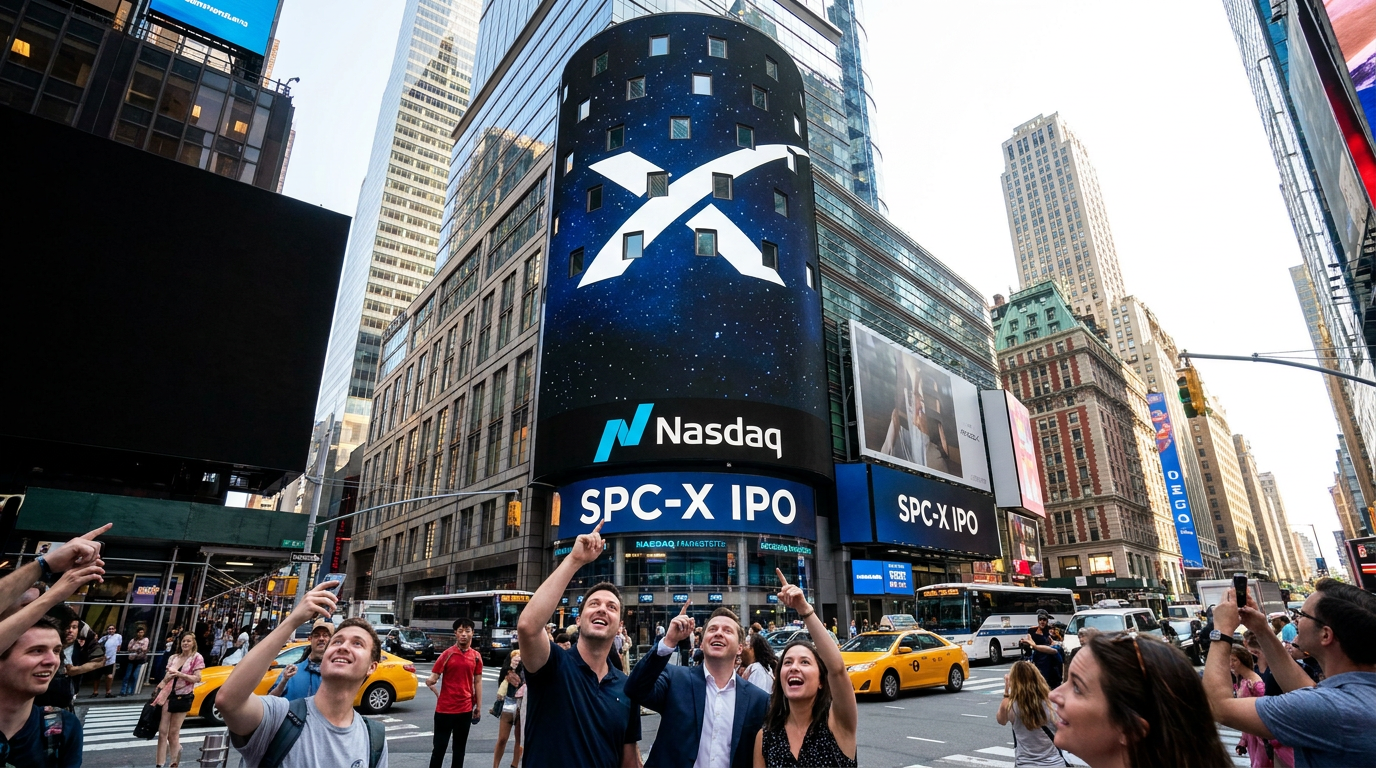
In a historic move for public markets, SpaceX has allocated nearly a third of its highly anticipated initial public offering to everyday retail investors. The decision democratizes access to the $86.2 billion space exploration giant, though brokerages are implementing strict rules to prevent short-term stock flipping.
By Factlen Editorial Team
- Retail Investors & Advocates
- Everyday investors view the 30% allocation as a long-overdue democratization of wealth creation.
- Institutional Skeptics
- Traditional analysts warn that the massive retail hype is masking significant underlying financial risks.
- Market Structure Experts
- Financial system analysts are focused on how the anti-flipping rules will impact market stability.
What's not represented
- · Venture Capitalists losing allocation share
- · Competitors in the aerospace sector
Why this matters
For decades, the biggest gains in tech were captured by venture capitalists before a company ever went public. By reserving 30% of its shares for everyday brokerage accounts, SpaceX is rewriting the rules of wealth creation, giving regular people day-one access to a generational monopoly in space and satellite internet.
Key points
- SpaceX is going public at an $86.2 billion valuation, marking one of the most anticipated market debuts in history.
- The company has reserved an unprecedented 30% of its IPO shares for retail investors, triple the standard Wall Street allocation.
- Major brokerages like Fidelity have lowered eligibility requirements, allowing customers with as little as $2,000 to participate.
- To prevent extreme volatility, brokerages are enforcing strict 15- to 30-day 'anti-flipping' holding periods for retail buyers.
SpaceX is going public at an $86.2 billion valuation, marking one of the most anticipated market debuts in history. But the real story is not just the sheer size of the aerospace giant's listing—it is who actually gets to buy in on day one.[1][6]
In a significant departure from Wall Street tradition, SpaceX has reserved an unprecedented 30% of its initial public offering for retail investors.[2][5]
Typically, highly sought-after tech IPOs allocate just 5% to 10% of their shares to everyday brokerage accounts, leaving the lion's share for institutional investors, hedge funds, and private equity firms.[2][4]
By tripling the standard retail allocation, SpaceX is effectively democratizing access to a generational space exploration and satellite internet monopoly. The 30% carve-out amounts to roughly $25 billion worth of shares directed straight to everyday brokerage accounts.[2][7]

The sheer volume of retail interest has been staggering. Preliminary reports indicate that retail orders have surpassed $70 billion, highlighting an exceptional level of enthusiasm from individual investors eager to gain exposure to the aerospace sector.[5]
Major brokerages have scrambled to accommodate the historic demand. Fidelity Investments announced it would make the IPO available to any customer with a retail brokerage account balance of at least $2,000—a significantly lower barrier to entry than typical offerings.[3]
"SpaceX has decided to reserve a much higher percentage of the offering... which means there should be more shares available to retail clients, which is why we have decided to reduce IPO eligibility," Fidelity noted in its participation guide.[3]
Other platforms, including Robinhood, SoFi, Morgan Stanley's E*Trade, and Trading 212, are also lining up to offer day-one access to their user bases.[2][4]
Other platforms, including Robinhood, SoFi, Morgan Stanley's E*Trade, and Trading 212, are also lining up to offer day-one access to their user bases.
Customers at several of the largest U.S. retail brokerages have already received confirmation that they will be allocated at least a single share, underscoring the company's commitment to a broad, decentralized shareholder base.[1]
However, this unprecedented access comes with strict guardrails. To prevent the stock from experiencing extreme volatility driven by day traders looking to make a quick profit, brokerages have implemented aggressive anti-flipping policies.[2][7]
Fidelity and Charles Schwab have warned investors that selling their allocated IPO shares within the first 15 days of trading will result in restrictions or outright bans from participating in future IPO deals.[2][3]
Robinhood and SoFi have gone even further, imposing 30-day holding requirements for retail participants. The policies are designed to instill stability in SpaceX's early trading days and deter speculative dumping.[2]
Beyond the retail mechanics, investors are closely scrutinizing SpaceX's underlying financials. The company's S-1 filing revealed a net loss of nearly $5 billion in 2025, primarily driven by massive capital expenditures.[2][6]

A significant portion of that cash burn is tied to Elon Musk's xAI business and the broader buildout of artificial intelligence infrastructure, as expenses related to securing advanced GPUs continue to soar.[2]
Despite the bottom-line losses, the company's core operations—reusable rocketry and the Starlink satellite internet constellation—continue to generate robust revenue streams and dominate the global launch market.[5][6]
The long-term performance of blockbuster IPOs remains a cautionary tale. Data shows that companies experiencing massive first-day pops often struggle to maintain momentum six months later, as lock-up expirations and the pressure of quarterly earnings set in.[2]
Looking ahead, market participants are already tracking SpaceX's path to major index inclusion. The Nasdaq has adopted a fast-entry rule that will allow the company to bypass traditional waiting periods.[2]

However, an expedited entry into the S&P 500—which would have automatically placed SpaceX into millions of retirement funds and pensions—was blocked, as the index reiterated its strict requirement that companies must be profitable for four consecutive quarters.[2][7]
Regardless of short-term price action, SpaceX's public debut represents a structural shift in capital markets. By forcing Wall Street to share the spoils of a mega-cap tech listing with everyday people, the company is rewriting the playbook for how the next generation of unicorns will go public.[1][5]
How we got here
October 2022
Elon Musk acquires Twitter (now X), beginning a broader restructuring of his tech portfolio.
2024 - 2025
SpaceX accelerates capital expenditures, investing heavily in Starlink expansion and xAI infrastructure.
Early 2026
SpaceX files its S-1 prospectus, revealing plans for an $86.2 billion public listing.
June 11, 2026
Reports emerge that retail demand for the IPO has surpassed $70 billion.
June 15, 2026
Major retail brokerages confirm that eligible customers will receive at least one share in the historic offering.
Viewpoints in depth
Retail Investors & Advocates
Everyday investors view the 30% allocation as a long-overdue democratization of wealth creation.
For decades, the most lucrative gains in the tech sector have been captured by venture capital firms and institutional gatekeepers while companies remained private. By the time a unicorn went public, retail investors were often left buying at a premium. Advocates argue that SpaceX's 30% carve-out fundamentally changes this dynamic, allowing everyday people to participate directly in the foundational growth of the commercial space economy.
Institutional Skeptics
Traditional analysts warn that the massive retail hype is masking significant underlying financial risks.
While the top-line revenue from Starlink and government launch contracts is undeniable, skeptics point to the company's $5 billion net loss in 2025. They argue that the massive capital expenditures required to fund Elon Musk's xAI ambitions and secure advanced GPUs represent a significant drag on profitability. Furthermore, analysts caution that heavily retail-backed IPOs often suffer from extreme volatility once the initial lock-up periods expire and the reality of quarterly earnings sets in.
Market Structure Experts
Financial system analysts are focused on how the anti-flipping rules will impact market stability.
The decision by major brokerages to enforce 15- to 30-day holding periods is an unprecedented experiment in market engineering. Experts note that while these policies may prevent a chaotic first-day dump, they also artificially constrain supply, which could lead to an exaggerated initial price pop. The broader question is whether this model—high retail allocation paired with strict behavioral guardrails—will become the new standard for mega-cap tech listings.
What we don't know
- How the stock will perform once the 15- and 30-day retail lock-up periods expire and anti-flipping restrictions lift.
- Whether SpaceX's massive investments in xAI infrastructure will yield profitability in the near term.
- If other major tech unicorns will adopt this high-retail-allocation model for their future public offerings.
Key terms
- Initial Public Offering (IPO)
- The process by which a private company offers its shares to the public for the first time, transitioning to a publicly traded entity.
- Retail Investor
- Individual, non-professional investors who buy and sell securities for their personal accounts, typically through brokerage platforms.
- Institutional Investor
- Large organizations, such as mutual funds, pensions, or private equity firms, that invest massive pools of capital on behalf of others.
- Anti-Flipping Policy
- Brokerage rules designed to discourage investors from buying IPO shares and selling them immediately for a quick profit, often enforced via penalties on future IPO access.
- Lock-up Expiration
- A predetermined date when company insiders and early investors are finally allowed to sell their shares in the public market.
Frequently asked
How much of the IPO is available to retail investors?
SpaceX has reserved up to 30% of its shares for retail investors, which is roughly three times the typical 5% to 10% allocation seen in traditional tech IPOs.
Can I sell my SpaceX shares immediately?
While you can sell, brokerages like Fidelity, Schwab, Robinhood, and SoFi have implemented 'anti-flipping' rules. Selling within the first 15 to 30 days may restrict you from participating in future IPOs.
Is SpaceX currently profitable?
Not currently. The company's S-1 filing revealed a net loss of nearly $5 billion in 2025, largely driven by heavy investments in AI infrastructure and GPUs for the xAI business.
Will SpaceX be added to the S&P 500?
Not immediately. While it is expected to get fast-tracked into the Nasdaq 100, the S&P 500 blocked early entry because SpaceX does not yet meet the requirement of four consecutive quarters of profitability.
Sources
Source coverage
7 outlets
3 viewpoints surfaced






[1]BloombergRetail Investors & Advocates
SpaceX Investors at US Retail Brokers Got at Least One IPO Share
Read on Bloomberg →[2]CNBCInstitutional Skeptics
SpaceX IPO: Here's What Retail Investors Need To Know
Read on CNBC →[3]Fidelity InvestmentsMarket Structure Experts
SpaceX IPO participation guide
Read on Fidelity Investments →[4]Trading 212Market Structure Experts
Trading 212 offers IPOs on their first day of public trading
Read on Trading 212 →[5]The Straits TimesRetail Investors & Advocates
SpaceX IPO Reserve 30% for Retail Investors
Read on The Straits Times →[6]ReutersInstitutional Skeptics
SpaceX targets $86.2 billion valuation in upcoming IPO
Read on Reuters →[7]The Wall Street JournalMarket Structure Experts
Brokerages impose anti-flipping restrictions on SpaceX shares
Read on The Wall Street Journal →
Every angle. Every day.
Get business stories with full source coverage and perspective breakdowns delivered to your inbox.