
The Evidence on Direct Admissions: How Proactive Acceptance is Flipping the College Script
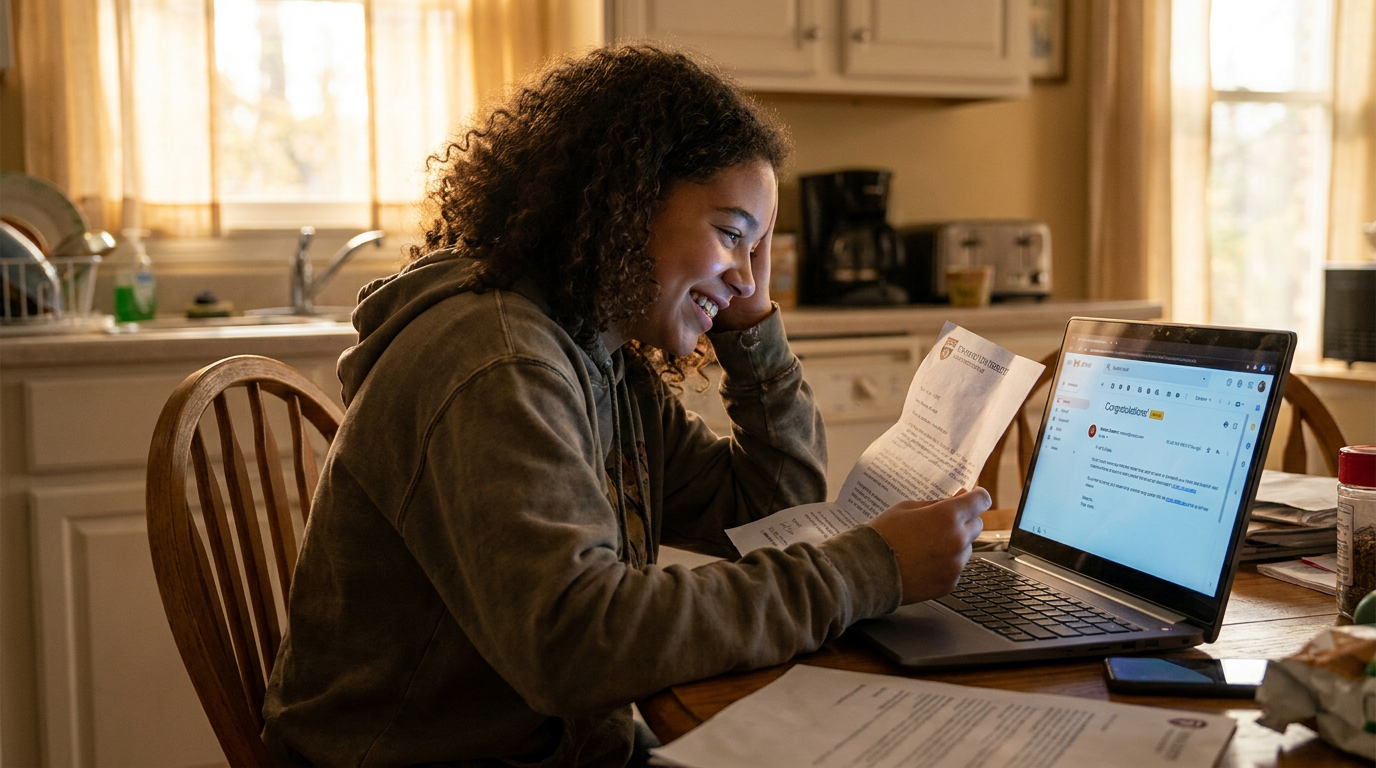
A rapidly expanding model known as 'direct admissions' is dismantling the anxiety of the college application process by proactively offering students guaranteed seats based on their high school data.
By Factlen Editorial Team
- Equity & Access Researchers
- Celebrates the removal of social capital barriers but warns that admission alone cannot overcome the affordability gap.
- Higher Education Administrators
- Focuses on stabilizing enrollment, simplifying the pipeline, and keeping local talent within state borders.
- Student Advocates
- Emphasizes the psychological relief of proactive acceptance and the shift away from a culture of rejection.
What's not represented
- · High school guidance counselors managing the transition to the new system.
- · Admissions officers at highly selective universities that do not participate in direct admissions.
Why this matters
By eliminating the anxiety, fees, and complex paperwork of traditional college applications, direct admissions is fundamentally changing who believes they belong in higher education. For millions of students—especially those from first-generation and low-income backgrounds—it transforms the college search from a daunting test of 'social capital' into a proactive invitation.
Key points
- Direct admissions flips the college application process by proactively offering students guaranteed seats based on verified high school data.
- The model has expanded rapidly since 2015, with over a dozen states and the Common App now participating.
- Evidence shows the policy increases college application rates by 12%, with the largest gains among first-generation and low-income students.
- Idaho's pioneering program successfully boosted in-state college enrollment by up to 15%.
- However, researchers warn that admission alone does not boost enrollment for the lowest-income students without attached financial aid.
- States are now evolving the model to pair proactive acceptance letters with transparent tuition promises.
The traditional college application process is a gauntlet of anxiety, fees, and complex paperwork that disproportionately deters first-generation students. But across the United States, a quiet revolution is dismantling this barrier. Known as "direct admissions," the model flips the traditional script: instead of students applying to colleges and hoping for acceptance, colleges proactively offer admission to students before they ever fill out an application.[5][6]
The mechanism is straightforward but transformative. Using data that students have already provided—such as high school GPAs verified by state education boards or profiles created on platforms like the Common App—participating colleges identify qualified seniors. The students then receive an official letter or email guaranteeing them a spot, often accompanied by waived application fees and simplified enrollment forms.[2][4]

What began as a localized experiment has rapidly scaled into a national movement. Idaho pioneered the first statewide direct admissions system in 2015, automatically qualifying public high school seniors for state institutions based on their academic records. By 2026, the policy has been adopted by over a dozen states, including Minnesota, Georgia, Wisconsin, and Connecticut, alongside massive national platforms.[4][5]
The Common App, which facilitates applications for over 1,000 institutions, has aggressively expanded its own direct admissions initiative. During the 2025–2026 admissions cycle, the platform partnered with 240 colleges to offer proactive admission to more than 800,000 students. The scale of this rollout has provided education researchers with a massive dataset to evaluate whether the intervention actually changes student behavior.[2]
The evidence strongly suggests that direct admissions successfully alters the psychology of college-going. A 2025 working paper published through the Annenberg Institute at Brown University analyzed data across four states and found that students who received a proactive guarantee of admission were 12% more likely to submit a college application overall.[1]
Crucially, the intervention moves the needle most for students who have historically been marginalized in higher education. The same Annenberg Institute study revealed that application rates increased by 4% for first-generation students and 5% for students from low-income backgrounds when they received a direct admissions offer. By removing the need for "social capital"—the insider knowledge of how to navigate the admissions process—the policy levels the playing field.[1][6]

Crucially, the intervention moves the needle most for students who have historically been marginalized in higher education.
The psychological impact is profound. For students who may have doubted their academic worth or assumed higher education was out of reach, receiving an unsolicited acceptance letter serves as a powerful validation. State officials in Minnesota, which operates a robust direct admissions network of 57 institutions, note that the program changes the narrative from "Am I good enough?" to "There is a place for you."[3][5]
However, while the data on applications is overwhelmingly positive, the evidence regarding actual enrollment is more nuanced. Idaho's decade-long program provides the clearest long-term data. Researchers found that Idaho's direct admissions policy successfully boosted first-time undergraduate enrollment by 4% to 8% across participating campuses, and increased in-state enrollment by up to 15%.[1]
Yet, the Idaho data also revealed a critical limitation: the policy had minimal to no impact on the enrollment rates of Pell-eligible students, a standard proxy for low-income status. While these students were applying at higher rates, they were not ultimately showing up on campus in greater numbers.[1]
This discrepancy highlights the primary uncertainty surrounding direct admissions: the affordability gap. Education policy experts emphasize that while direct admissions removes administrative and psychological barriers, it does not solve the financial realities of higher education. A guaranteed seat is only actionable if the student can afford the tuition.[1][6]

Recognizing this limitation, states and platforms are evolving their direct admissions models to pair acceptance letters with transparent financial aid offers. In Minnesota, the state is integrating information about its "Tuition Promise"—a program covering tuition for families earning $55,000 or less—directly into the admissions letters sent to the high school class of 2025.[3][4]
Similarly, the Common App's partnerships with state systems, such as the Connecticut Automatic Admission Program (CAAP), are refining how and when students are notified. By allowing students to self-report GPAs earlier in the fall, the program gives families more time to evaluate financial aid packages and make informed decisions, resulting in a massive surge in engagement among Connecticut seniors.[2]
The shift toward direct admissions also offers a strategic advantage for the colleges themselves. Amid widespread concerns about declining high school graduation numbers and a looming "enrollment cliff," regional public universities and community colleges are using proactive admissions to stabilize their incoming classes and keep local talent within state borders.[4][5]
Ultimately, the evidence pack on direct admissions points to a highly effective, low-cost intervention that successfully dismantles the anxiety of the college search. While it is not a silver bullet for the systemic issue of college affordability, it represents a fundamental shift in higher education—one that treats college access as a public good to be offered, rather than an exclusive club to be petitioned.[6]
How we got here
2015
Idaho launches the nation's first statewide direct admissions program, proactively admitting public high school seniors.
2021
The Common App begins piloting direct admissions with a small cohort of participating colleges.
2023
States like Georgia and systems like the State University of New York launch their own proactive admission networks.
2025
The Common App expands its program to 240 colleges, offering admission to over 800,000 students nationwide.
Viewpoints in depth
Higher Education Administrators
Focuses on stabilizing enrollment, simplifying the pipeline, and keeping local talent within state borders.
For regional public universities and community colleges, direct admissions is a strategic survival tool. Facing a looming 'enrollment cliff' driven by declining high school graduation rates, these institutions use proactive offers to secure their incoming classes early. Administrators argue that the traditional application process creates unnecessary friction for students who are already academically qualified, and that removing this friction keeps talented students from migrating out of state.
Equity & Access Researchers
Celebrates the removal of social capital barriers but warns that admission alone cannot overcome the affordability gap.
Education researchers view direct admissions as a massive win for equity, as it bypasses the need for the 'social capital' required to navigate the traditional admissions gauntlet. Data clearly shows that first-generation and minority students apply at significantly higher rates when proactively invited. However, these experts caution against viewing the policy as a silver bullet. They point to data showing that Pell-eligible enrollment remains flat under direct admissions unless the acceptance letter is paired with robust, transparent financial aid.
Student Advocates
Emphasizes the psychological relief of proactive acceptance and the shift away from a culture of rejection.
Advocates for high school students highlight the immense psychological toll of the modern college search, which is often defined by anxiety, rejection, and expensive application fees. For students in underfunded high schools with limited access to college counselors, an unsolicited acceptance letter provides profound validation. Advocates argue that direct admissions fundamentally changes the narrative of higher education from an exclusive club that must be petitioned to a public good that actively welcomes students.
What we don't know
- Whether direct admissions can significantly boost actual enrollment for the lowest-income students without massive increases in state financial aid.
- How highly selective, elite universities might adapt to or ignore the direct admissions movement as it becomes the norm for regional public colleges.
Key terms
- Direct Admissions
- A policy where colleges proactively offer admission to high school seniors based on verified data (like GPA) before the student formally applies.
- Common App
- An online portal used by over 1,000 colleges that allows students to submit a single application to multiple institutions.
- Pell-eligible
- Students who qualify for the federal Pell Grant, widely used in educational research as a proxy for low-income status.
- Social Capital
- The networks, insider knowledge, and resources that help students navigate complex systems like college admissions.
Frequently asked
Do students still have to apply to the college?
Yes, but the process is heavily simplified. Students typically submit a short, fee-waived form to 'claim their spot' rather than a competitive application with essays and recommendations.
Does direct admission guarantee financial aid?
No. While the academic seat is guaranteed, students must still complete the FAFSA to determine their financial aid package, which remains a significant hurdle for low-income families.
Are highly selective universities participating?
Mostly no. The program is currently championed by open-access institutions, regional public universities, and community colleges looking to expand access and stabilize enrollment.
Sources
Source coverage
6 outlets
3 viewpoints surfaced






[1]EdWorkingPapersEquity & Access Researchers
Experimental Evidence on "Direct Admissions" from Four States: Impacts on College Application and Enrollment
Read on EdWorkingPapers →[2]Common AppEquity & Access Researchers
Expanding postsecondary access through statewide direct admissions: Learnings from a multiyear partnership
Read on Common App →[3]Minnesota Office of Higher EducationHigher Education Administrators
Direct Admission Minnesota Annual Report, 2025
Read on Minnesota Office of Higher Education →[4]Higher Ed DiveHigher Education Administrators
How to try direct admissions — from experts who have been there
Read on Higher Ed Dive →[5]The Washington PostStudent Advocates
States to prospective students: 'There is a place for you'
Read on The Washington Post →[6]Factlen Editorial TeamStudent Advocates
Synthesis by Factlen editorial team
Read on Factlen Editorial Team →

More in education
See all 11 stories →College Funding
The Rise of Micro-Scholarships: How Students Are 'Stacking' Their Way to College Funding
0 sources

Green Jobs
The Green-Collar Boom: How Vocational Training is Racing to Staff the Clean Energy Transition
0 sources

AI Tutoring
How AI Tutors Are Rewriting the Rules of Personalized Learning
0 sources

Higher Ed Affordability
The Rise of Zero-Textbook-Cost Degrees: How Open Educational Resources Are Reshaping Higher Ed
0 sources

Every angle. Every day.
Get education stories with full source coverage and perspective breakdowns delivered to your inbox.