
The Agentic Stack: How Autonomous AI is Giving Small Businesses Enterprise-Grade Scale
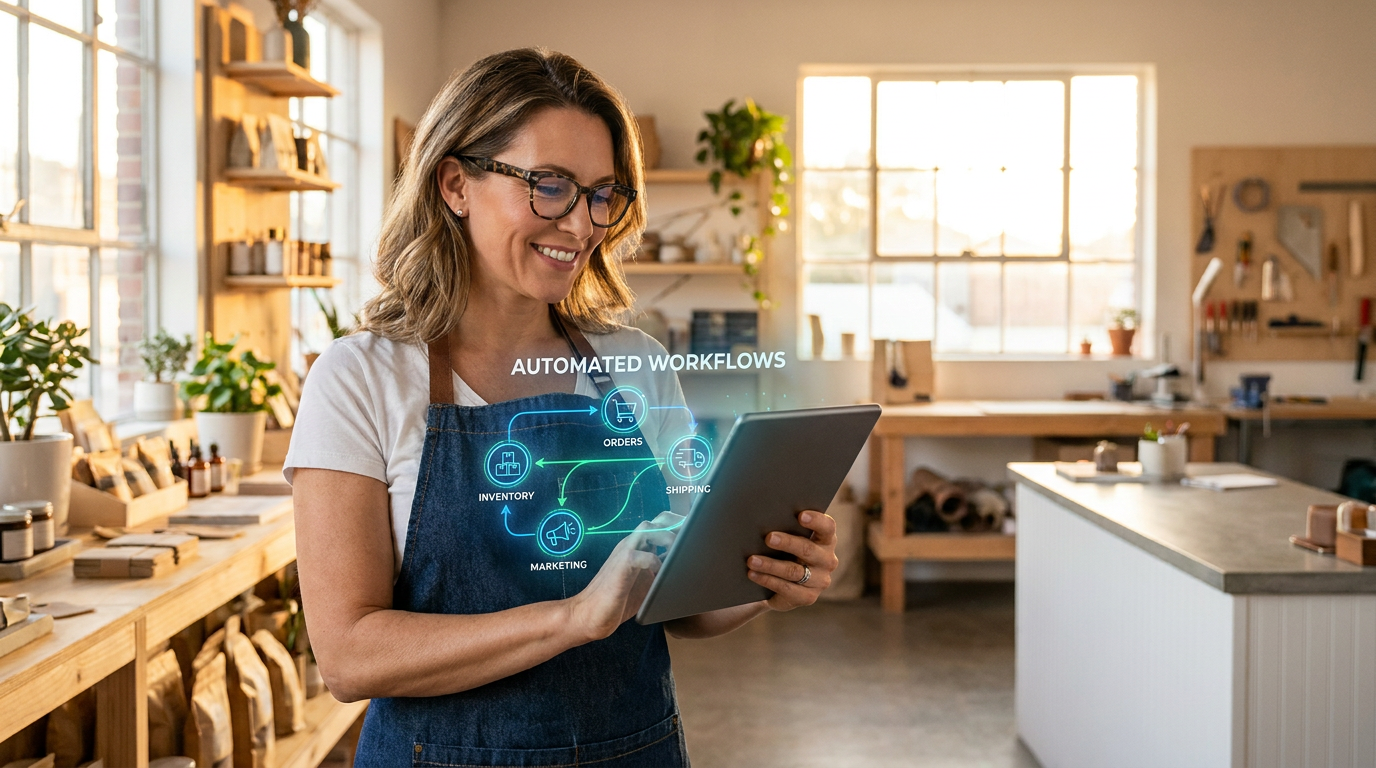
The transition from AI "copilots" to autonomous "agents" is allowing independent merchants and solopreneurs to execute complex workflows without hiring large administrative teams. This shift is rapidly democratizing logistics, bookkeeping, and customer service, leveling the playing field against corporate giants.
By Factlen Editorial Team
- Tech Optimists & Solopreneurs
- View agentic AI as a great equalizer that removes the administrative friction of scaling a business.
- Labor Economists
- Focus on the macroeconomic shifts, noting massive productivity gains but questioning the long-term impact on entry-level administrative jobs.
- Reliability Skeptics
- Warn that delegating financial and contractual authority to LLMs introduces catastrophic liability risks for small businesses.
What's not represented
- · Entry-level administrative workers facing displacement
- · Enterprise corporations losing their scale advantage
Why this matters
For decades, scaling a business meant hiring a large administrative workforce, creating a massive barrier to entry. The commoditization of autonomous AI agents means small businesses can now operate with the logistical and analytical power of a Fortune 500 company at a fraction of the cost, fundamentally changing who can succeed in the modern economy.
Key points
- AI is shifting from 'copilots' that require prompting to 'agents' that execute multi-step tasks autonomously.
- Small businesses are using these tools to manage logistics, inventory, and customer service without hiring large teams.
- Early adopters in the micro-enterprise sector are seeing up to a 3.2x increase in revenue per employee.
- Experts warn of liability risks if autonomous systems hallucinate and make incorrect financial decisions.
- The industry is adopting 'human-in-the-loop' safeguards to require manual approval for high-stakes transactions.
For the past century, the defining advantage of a large corporation over a small business has not necessarily been product quality, but administrative scale. A multinational retailer can afford dedicated teams for supply chain management, dynamic pricing, and 24/7 customer service. A local boutique or independent e-commerce brand cannot. But over the last eighteen months, a quiet revolution in artificial intelligence has begun to erase that structural advantage.[7]
The shift centers on the evolution from AI "copilots" to autonomous "agents." While the generative AI boom of 2023 and 2024 introduced tools that could draft emails or write code, those systems still required constant human supervision and prompting. They were assistants waiting for instructions. The new "agentic stack," which reached commercial maturity in early 2026, operates differently: it is given a goal, and it executes multi-step workflows across different software platforms entirely on its own.[4]
This transition represents a profound paradigm shift for micro-enterprises and solopreneurs. Instead of using AI to write a polite response to a customer complaint, an autonomous agent can read the complaint, check the shipping status via an API, issue a partial refund in the payment gateway, and draft a personalized apology—all without the business owner ever clicking a button.[1][4]
The technical breakthrough enabling this is the dramatic improvement in how large language models interact with external tools and APIs. Modern agentic systems possess the contextual awareness to recognize when a task requires pulling data from a spreadsheet, querying a database, or sending a webhook to a supplier. They string these actions together into coherent, goal-oriented loops.[5]

In practice, this looks like a "zero-employee" scaling phenomenon. Independent merchants are increasingly deploying specialized agents to handle discrete business functions. A logistics agent monitors inventory levels, cross-references them with seasonal demand forecasts, and automatically emails purchase orders to overseas manufacturers when stock runs low. A marketing agent monitors ad spend across social platforms, reallocating budget in real-time based on conversion rates.[1][5]
The economic data surrounding this adoption is striking. A recent working paper from the National Bureau of Economic Research (NBER) tracked productivity metrics among micro-enterprises—businesses with fewer than ten employees—that integrated autonomous workflows into their operations. The researchers found a staggering 3.2x increase in revenue per employee among early adopters over an 18-month period.[2]
This productivity explosion is largely driven by time reallocation. By offloading routine administrative and logistical drudgery to software, business owners are redirecting their focus toward high-leverage activities: product development, relationship building, and strategic growth. The NBER study noted that founders using agentic tools spent 60% less time on back-office tasks compared to their peers.[2]
Adoption is accelerating rapidly across the broader small business landscape. According to the U.S. Chamber of Commerce's 2026 Technology Adoption Report, 42% of small businesses are now actively testing or deploying autonomous workflows in some capacity. This represents the fastest penetration rate of any enterprise technology in the last two decades, outpacing even the early adoption of cloud computing.[3]
Adoption is accelerating rapidly across the broader small business landscape.
The driving force behind this rapid uptake is the collapse in cost. Capabilities that previously required a six-figure logistics manager or a retained marketing agency can now be accessed via SaaS subscriptions averaging less than $50 per month. This price compression is democratizing access to sophisticated operational tools, allowing a two-person operation in Ohio to manage a global supply chain with the precision of a major conglomerate.[3][7]

The impact is not limited to digital-first e-commerce brands. Brick-and-mortar retailers, local service providers, and independent clinics are utilizing agents to manage appointment scheduling, optimize local inventory, and handle vendor negotiations. By automating the "invisible" work of running a business, local shops are finding new ways to survive and thrive against big-box competitors.[1][7]
However, delegating core business functions to autonomous software is not without significant risks. The primary concern among researchers and cautious adopters is the reliability of these systems when operating outside of tightly constrained parameters. When an AI copilot hallucinates, a human catches the error before hitting send. When an autonomous agent hallucinates, the consequences are executed immediately.[4][6]
Researchers at the Stanford Institute for Human-Centered AI (HAI) have extensively studied these failure modes in commercial settings. They identified a phenomenon known as "cascading errors," where a minor misinterpretation of data early in a workflow leads to drastically incorrect actions downstream. For example, an agent misreading a currency symbol could autonomously authorize a purchase order that is ten times the intended budget.[6]
The liability implications of these errors remain a gray area. If an autonomous agent violates a vendor contract or makes a financially ruinous purchasing decision, the business owner ultimately bears the cost. Software providers universally include indemnification clauses in their terms of service, placing the burden of oversight squarely on the merchant.[1][6]
To mitigate these risks, the industry is coalescing around "human-in-the-loop" circuit breakers for high-stakes actions. In these setups, the agent handles 99% of the workflow—gathering data, drafting communications, and preparing transactions—but requires a single human click to execute any action that moves money or alters a contract. This hybrid approach balances the speed of autonomy with the safety of human oversight.[1][5]

Data privacy and security also present ongoing challenges. For an agent to be truly effective, it requires deep, unfettered access to a company's most sensitive information: bank accounts, customer databases, and proprietary supplier lists. Small businesses must navigate complex permission architectures to ensure their data is not inadvertently exposed or used to train public models.[3][6]
Despite these hurdles, the trajectory of the technology is clear. As the reliability of underlying models improves and specialized, industry-specific agents become more robust, the barrier to entry for starting and scaling a business will continue to fall. The historical advantage of sheer corporate size is being steadily eroded by intelligent automation.[4][7]
Macroeconomists suggest this could lead to a renaissance for niche, highly specialized small businesses. When the friction of administration is removed, the market naturally favors businesses that can offer unique, personalized products and services. The future of commerce may look increasingly fragmented on the outside, characterized by millions of independent brands.[2][7]
Ultimately, the rise of the agentic stack is not about replacing human creativity, but liberating it from administrative drudgery. By equipping solopreneurs with the operational leverage of a multinational corporation, autonomous AI is rewriting the rules of scale, proving that in the modern economy, a business no longer needs to be big to be powerful.[1][7]
How we got here
2023-2024
Generative AI copilots become mainstream, assisting workers with drafting and coding but requiring constant supervision.
Late 2025
Breakthroughs in API integration and tool-use allow LLMs to reliably execute multi-step actions across different software platforms.
Early 2026
Commercial 'agentic stacks' mature, dropping in price and becoming widely accessible to independent merchants.
Mid 2026
Adoption rates among small businesses surge past 40%, driving measurable macroeconomic shifts in micro-enterprise productivity.
Viewpoints in depth
Solopreneurs & Small Business Owners
View autonomous agents as a liberating force that removes the friction of scaling.
For independent merchants, the agentic stack represents freedom from the administrative drudgery that traditionally consumes a founder's time. By offloading inventory management, bookkeeping, and routine customer service to software, owners can focus entirely on product quality and customer relationships. They view this technology not as a way to replace human workers, but as a way to build million-dollar businesses without the overhead and stress of managing a large corporate hierarchy.
Enterprise Competitors
Recognize that their historical moat of administrative scale is rapidly evaporating.
Large corporations have long relied on their massive logistical infrastructure to outcompete local businesses on price and efficiency. As AI democratizes these capabilities, enterprise leaders are realizing that their size may transition from an advantage to a liability. If a two-person startup can manage a global supply chain as efficiently as a Fortune 500 company, the competitive landscape shifts entirely toward product innovation and brand authenticity—areas where small, agile businesses often hold the upper hand.
Reliability Skeptics
Highlight the catastrophic risks of unsupervised AI making financial and contractual decisions.
AI safety researchers and legal experts point out that large language models are inherently probabilistic and prone to hallucinations. While a hallucination in a drafted email is merely embarrassing, a hallucination in an autonomous supply chain agent could result in ordering 10,000 units of the wrong product. Skeptics argue that until the liability framework catches up to the technology, small businesses are taking on massive, poorly understood risks by granting software unfettered access to their bank accounts and vendor contracts.
What we don't know
- How courts will assign liability when an autonomous agent makes a costly error that breaches a vendor contract.
- Whether the productivity gains will lead to a boom in new small businesses or simply allow existing ones to operate with fewer employees.
- How enterprise corporations will adjust their strategies once their logistical scale is no longer a unique competitive advantage.
Key terms
- Agentic AI
- Artificial intelligence systems designed to pursue complex goals autonomously by planning, reasoning, and executing actions across multiple software tools.
- Copilot
- An AI assistant that works alongside a human user, requiring prompts to generate text, code, or analysis, but lacking the ability to take independent action.
- Human-in-the-loop
- A system design where an automated process pauses at critical junctures to require human review and approval before proceeding.
- Cascading Errors
- A failure mode where a small mistake made early in an automated workflow compounds into massive, unintended consequences downstream.
Frequently asked
What is the difference between an AI copilot and an AI agent?
A copilot acts as an assistant that requires a human to prompt it and execute its suggestions. An agent is given a high-level goal and autonomously executes multi-step workflows across different software platforms to achieve it.
Is it safe to give AI access to business finances?
There are significant risks. Experts recommend using 'human-in-the-loop' systems where the AI prepares the workflow but a human must explicitly approve any action that moves money or alters contracts.
How much do these enterprise-grade AI tools cost?
Costs have compressed significantly. Many small businesses are accessing sophisticated autonomous workflow tools via SaaS subscriptions that average less than $50 per month.
Sources
Source coverage
7 outlets
3 viewpoints surfaced







[1]Harvard Business ReviewTech Optimists & Solopreneurs
The Autonomous SME: How Agentic AI Levels the Playing Field
Read on Harvard Business Review →[2]National Bureau of Economic ResearchLabor Economists
Productivity Gains in Micro-Enterprises Adopting Autonomous Workflows
Read on National Bureau of Economic Research →[3]U.S. Chamber of CommerceLabor Economists
2026 Small Business Technology Adoption Report
Read on U.S. Chamber of Commerce →[4]MIT Sloan Management ReviewReliability Skeptics
From Copilots to Agents: The Evolution of Business AI
Read on MIT Sloan Management Review →[5]Shopify EngineeringTech Optimists & Solopreneurs
Democratizing Logistics: AI Agents for Independent Merchants
Read on Shopify Engineering →[6]Stanford Institute for Human-Centered AIReliability Skeptics
Evaluating the Reliability of Autonomous Agents in Commercial Settings
Read on Stanford Institute for Human-Centered AI →[7]Factlen Editorial Team
Synthesis by Factlen editorial team
Read on Factlen Editorial Team →

More in business
See all 5 stories →SpaceX IPO
SpaceX's $86.2 Billion IPO Makes History With Unprecedented Retail Investor Access
0 sources
Energy Markets
US-Iran Deal to Reopen Strait of Hormuz Sends Oil Tumbling, But Economic Scars Will Linger
0 sources

Retail Investing
SpaceX's Record $86.2 Billion IPO Rewrites Wall Street Rules With Massive Retail Allocation
0 sources
Every angle. Every day.
Get business stories with full source coverage and perspective breakdowns delivered to your inbox.