
SpaceX Completes Record $75 Billion IPO, Pushing Market Capitalization Past $2.2 Trillion
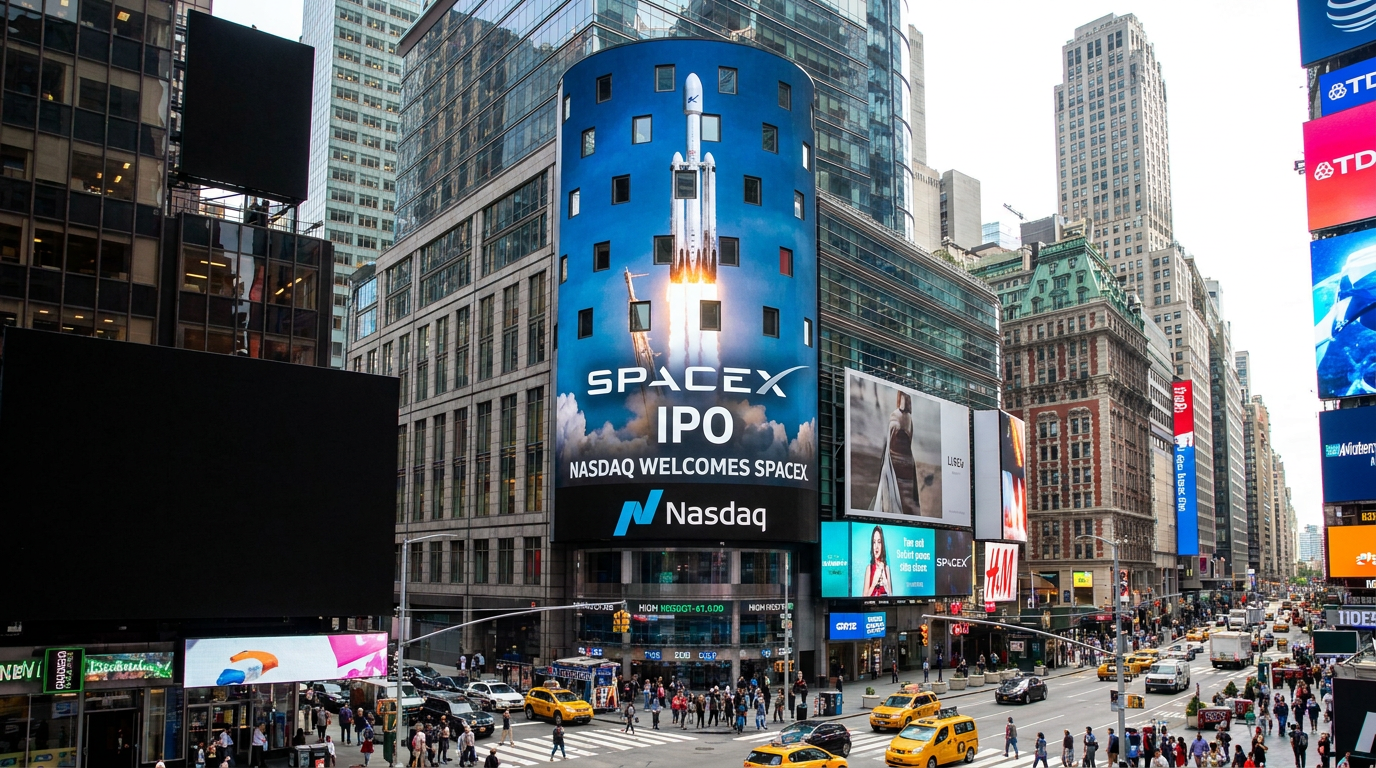
SpaceX has executed the largest initial public offering in history, raising $75 billion and minting founder Elon Musk as the world's first trillionaire. The landmark market debut signals a massive capital shift toward the commercial space economy and advanced aerospace technologies.
By Factlen Editorial Team
- Space Economy Bulls
- Investors who view SpaceX as a multi-decade monopoly on orbital infrastructure and satellite internet, justifying the premium valuation.
- Traditional Value Investors
- Skeptics who argue that a $2.2 trillion valuation is dangerously high for a capital-intensive aerospace company facing immense engineering risks.
- Macroeconomic Analysts
- Market observers focused on how a $75 billion liquidity drain and massive index concentration will impact the broader equities market.
What's not represented
- · Legacy aerospace workers facing industry consolidation
- · Astronomers concerned about orbital light pollution from expanded satellite networks
Why this matters
The sheer scale of the $75 billion capital raise fundamentally alters the global equities market, absorbing unprecedented institutional liquidity while establishing commercial space exploration as a foundational asset class for retail and institutional portfolios alike.
Key points
- SpaceX executed the largest IPO in history, raising $75 billion.
- The company's market capitalization reached approximately $2.2 trillion on its first day of trading.
- Shares popped 19% upon debut, rewarding early institutional and retail buyers.
- The surging valuation officially made founder Elon Musk the world's first trillionaire.
- Capital will fund the expansion of the Starlink network and the development of the Starship Mars program.
- The massive valuation introduces new concentration risks for major stock indices.
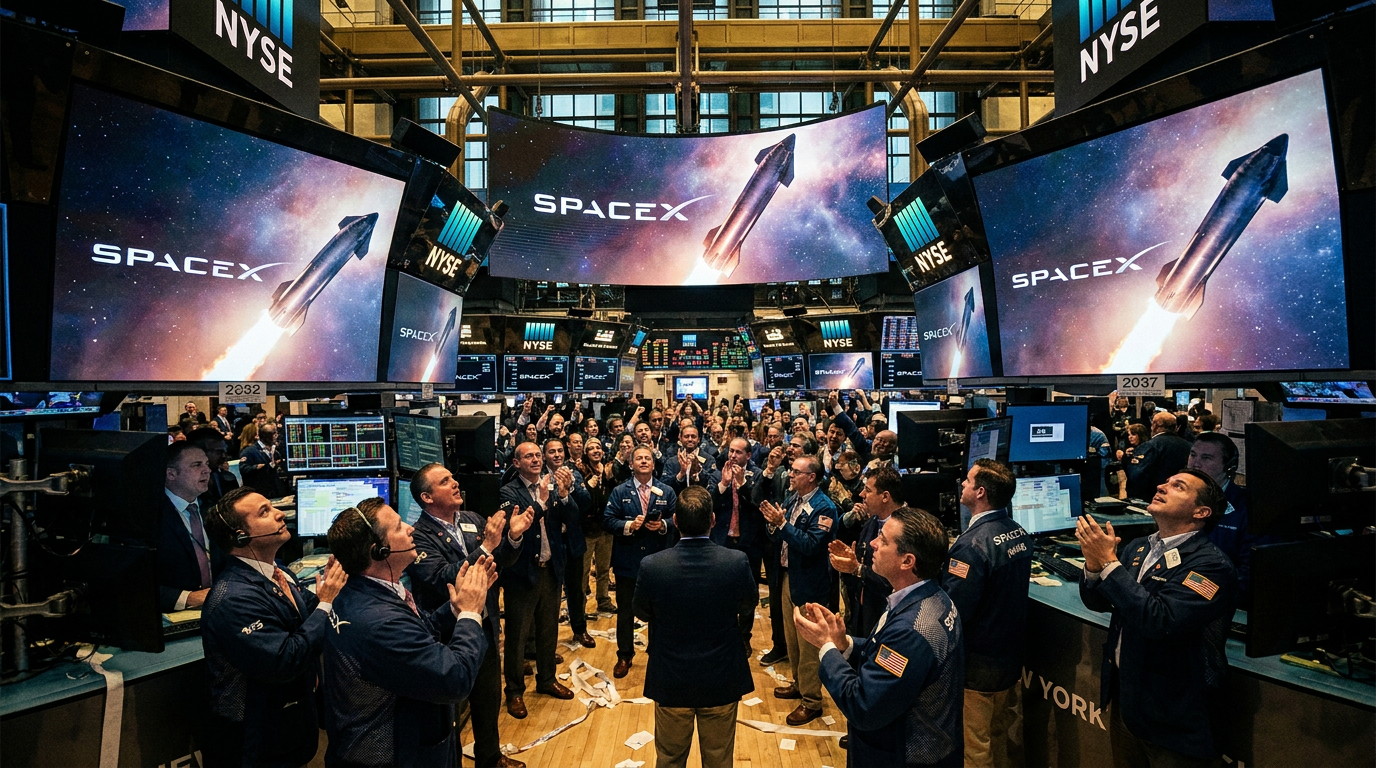
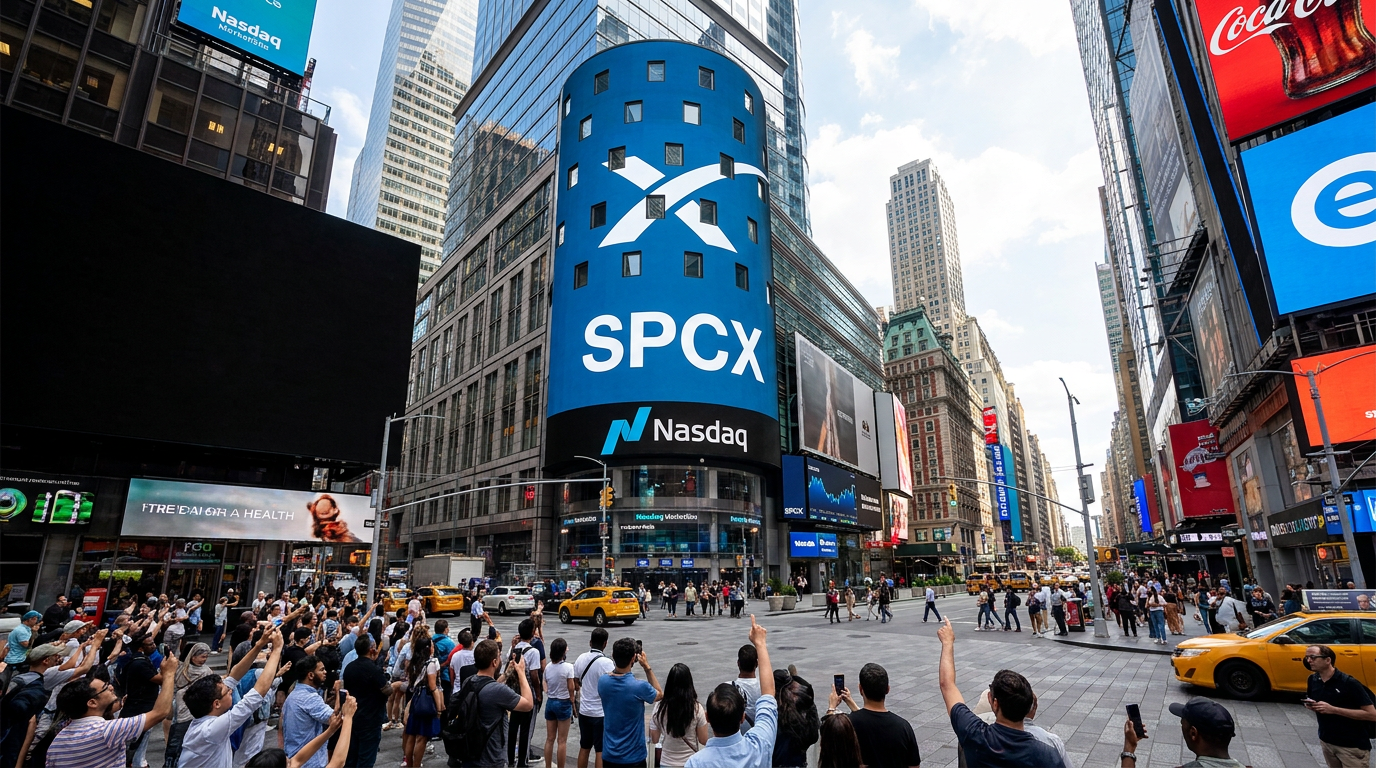
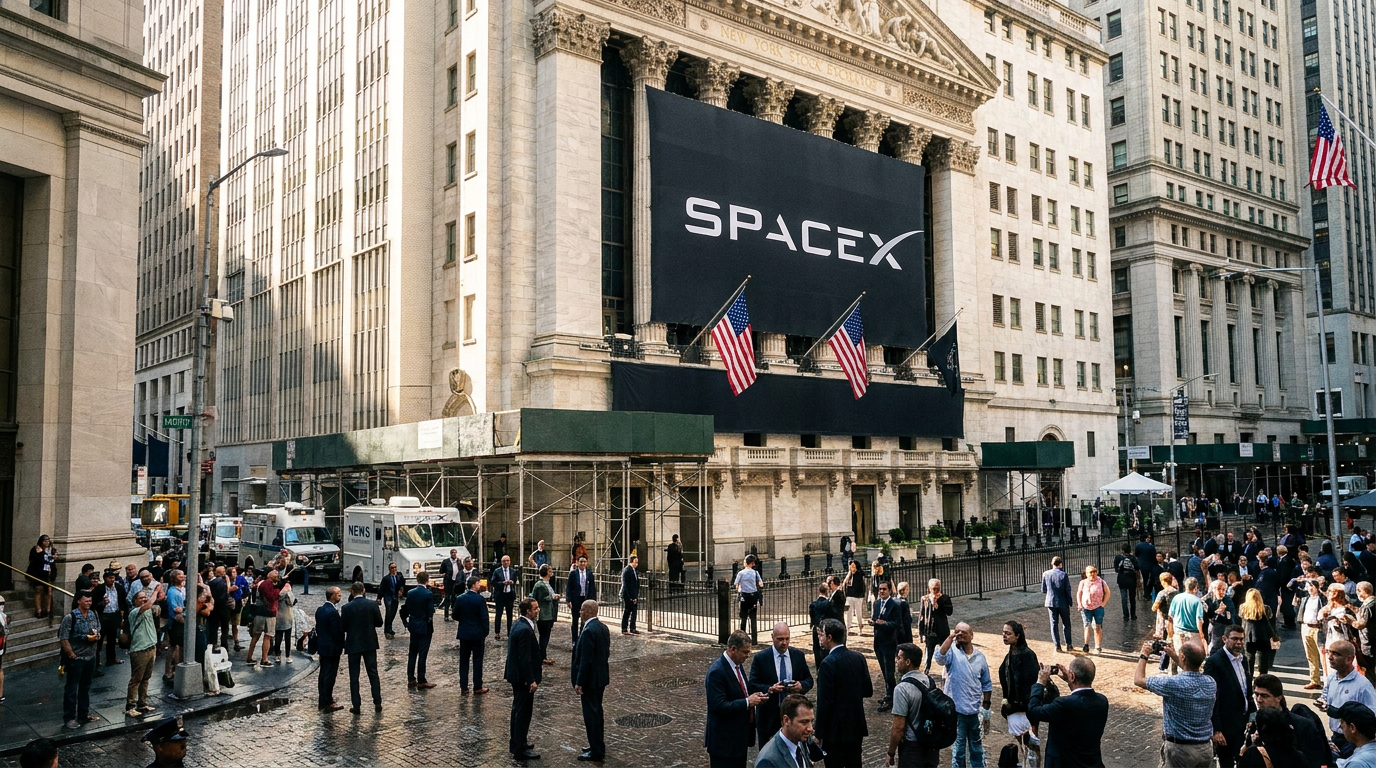
On June 12, 2026, Space Exploration Technologies Corp. fundamentally rewired the global equities market, executing the largest initial public offering in financial history. Raising a staggering $75 billion, the IPO catapulted SpaceX to an end-of-day market capitalization of approximately $2.2 trillion. The sheer gravity of the offering absorbed unprecedented levels of institutional liquidity, marking a watershed moment in the commercialization of space. For retail and institutional investors alike, the debut offered the first direct public access to the company that has dominated global launch markets and satellite internet delivery over the past decade.[1][5]
The mechanics of the debut defied conventional market gravity. Shares priced at the top of their expected range, yet still experienced a massive surge of demand upon the opening bell. By the close of trading, buyers of the IPO had secured a 19% return on their initial allocation. This immediate pop added hundreds of billions to the company's valuation in a matter of hours, cementing its status as one of the most valuable public entities on Earth, rivaling legacy tech giants that took decades to reach similar market caps.[1][7]
Beyond the corporate milestone, the IPO triggered a historic shift in personal wealth. The surging valuation of his retained equity stake pushed SpaceX founder and CEO Elon Musk's net worth past the thirteen-digit threshold, officially minting him as the world's first trillionaire. This unprecedented concentration of individual wealth immediately drew comparisons to the Gilded Age, with financial historians noting that Musk's ascension mirrors John D. Rockefeller becoming America's first billionaire in 1916.[2][4]
The timing of the IPO represents a strategic pivot for the company. For years, Musk had publicly maintained that SpaceX would only go public once humans were regularly flying to Mars. However, shifting macroeconomic winds and the explosive growth of the artificial intelligence sector accelerated the timeline. The AI boom has driven unprecedented demand for global data infrastructure, positioning SpaceX's Starlink satellite constellation as a critical, high-margin asset that requires massive capital to scale at the pace of global demand.[3][6]

Floating a $75 billion offering requires an orchestration of capital rarely seen outside of sovereign debt issuance. To absorb this level of equity, a massive underwriting syndicate comprising every major Wall Street bank was assembled. These underwriters conducted a grueling global roadshow, securing anchor investments from sovereign wealth funds, massive pension portfolios, and top-tier mutual funds before a single share was available to the retail public. The goal was to ensure the market could digest the massive float without triggering a liquidity crisis in adjacent tech sectors.[5][6]
The core engine driving this astronomical valuation is Starlink. While SpaceX's reusable Falcon 9 and Starship rockets capture the public imagination, institutional investors are primarily valuing the company as a global telecommunications monopoly. Starlink's low-earth orbit constellation provides high-speed internet to remote regions, maritime fleets, and aviation, generating recurring subscription revenue with software-like margins. Analysts project that Starlink's cash flow will serve as the financial bedrock for the company's more ambitious, capital-intensive interplanetary goals.[7][8]
The core engine driving this astronomical valuation is Starlink.
To understand the valuation, analysts divide the company into two distinct financial profiles. The launch division operates as a highly efficient, high-volume logistics provider, utilizing reusable boosters to undercut global competitors and secure lucrative government contracts. In contrast, the Starlink division operates as a high-growth technology platform. This dual-engine model allows the company to dominate the physical infrastructure of space while simultaneously capturing the downstream software and service revenues, a vertical integration strategy that justifies its unprecedented market premium.[6][8]

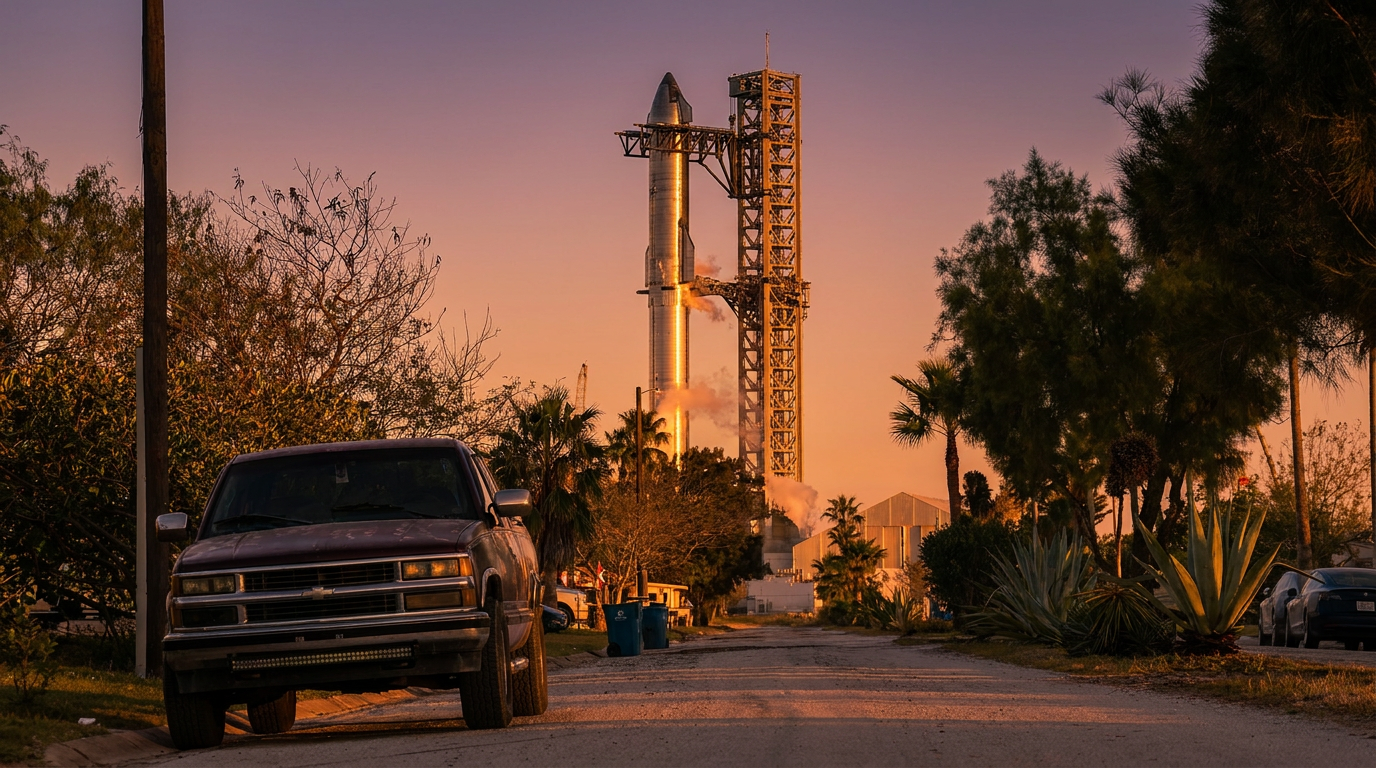
Those interplanetary goals remain the ultimate destination for the $75 billion war chest. The development, testing, and mass production of the Starship launch vehicle—the largest and most powerful rocket ever built—requires capital expenditures that dwarf traditional aerospace budgets. By tapping the public markets, SpaceX has secured the runway necessary to build a fleet of Starships, construct off-world infrastructure, and fund the initial uncrewed and crewed missions to the Martian surface without relying on sporadic private funding rounds.[1][3]
Retail investors, long locked out of the company's meteoric private market rise, flooded brokerages to secure shares. Financial commentators have advised caution regarding the immediate volatility, while acknowledging the unique nature of the asset. CNBC's Jim Cramer noted that despite the massive valuation, it is not too late to buy into the company, provided investors view the stock as a multi-decade, long-term bet on the expansion of the human economic sphere into the solar system, rather than a short-term momentum trade.[8]
However, the sheer size of SpaceX's market capitalization introduces new structural dynamics to index investing. At $2.2 trillion, the company will immediately command a massive weighting in major indices like the S&P 500 and Nasdaq 100 once eligible. This forces passive index funds to automatically purchase billions of dollars of the stock, further driving up the price and increasing the concentration risk for everyday retirement accounts, which are now heavily exposed to the success or failure of experimental aerospace engineering.[6][7]

Skeptics and value investors have raised concerns about the multiples applied to the company. While Starlink provides a solid revenue floor, the $2.2 trillion valuation prices in flawless execution of Mars colonization and point-to-point Earth transport—markets that do not yet exist. Bears argue that aerospace is inherently a low-margin, high-risk, capital-intensive industry, and that a single catastrophic failure of a Starship carrying commercial payloads or human passengers could trigger a massive recalibration of the stock's premium.[5][6]
The geopolitical implications of a publicly traded SpaceX are equally profound. The company is deeply intertwined with US national security, serving as the primary launch provider for military and intelligence satellites. As a public entity, SpaceX will face increased transparency requirements and pressure from international shareholders, which must be balanced against stringent US export controls and defense directives. The US government will likely monitor the company's foreign ownership levels closely to protect sensitive aerospace technologies.[3][7]

Competitors in the legacy aerospace sector are now facing an existential capital disadvantage. Companies like Boeing, Lockheed Martin, and European launch providers must now compete against a rival armed with $75 billion in fresh liquid capital. Industry analysts expect this to trigger a wave of consolidation among smaller space startups and force legacy defense contractors to spin off their space divisions in an attempt to unlock value and attract investment in a market now entirely dominated by SpaceX's financial gravity.[5][6]
Ultimately, the SpaceX IPO is more than a financial transaction; it is the formal financialization of the cosmos. By assigning a daily, publicly traded price to the infrastructure of space exploration, the global market has explicitly endorsed the economic viability of the orbital economy. As the dust settles on the largest public offering in history, the focus shifts from the spectacle of the debut to the grueling reality of executing on a multi-trillion-dollar promise.[1][7]
How we got here
2002
Elon Musk founds Space Exploration Technologies Corp. with the ultimate goal of colonizing Mars.
2020
SpaceX becomes the first private company to send human astronauts to the International Space Station.
2024
The massive Starship rocket achieves consistent orbital flights, proving the viability of fully reusable super-heavy launch vehicles.
Early 2026
SpaceX confidentially files its IPO prospectus with the SEC, assembling a massive underwriting syndicate.
June 12, 2026
SpaceX debuts on the public markets, raising $75 billion and pushing its valuation to $2.2 trillion.
Viewpoints in depth
Institutional Growth Investors
Focused on the monopolistic potential of SpaceX's dual-engine business model.
Growth-oriented institutional investors argue that traditional valuation metrics fail to capture SpaceX's unique position. By controlling both the cheapest launch logistics in the world and the most expansive satellite internet constellation, the company has effectively built a toll road to low-earth orbit. These investors view the $2.2 trillion valuation not as a reflection of current rocket sales, but as a forward-pricing of a future where Starlink serves as the primary data backbone for global AI infrastructure and autonomous systems.
Aerospace Industry Competitors
Legacy defense contractors and international space agencies reacting to the capital imbalance.
For legacy aerospace firms like Boeing, Lockheed Martin, and Arianespace, the SpaceX IPO represents an existential threat. Competitors argue that competing against a rival armed with $75 billion in liquid capital is nearly impossible under current defense procurement models. Industry lobbyists are already pressuring lawmakers to ensure government contracts are distributed to maintain a competitive industrial base, warning that allowing SpaceX to establish a total monopoly over national security launches poses a strategic risk to the United States.
Macroeconomic Analysts
Market strategists concerned about the structural impact of a $2.2 trillion company entering the public float.
Macroeconomic analysts are closely monitoring the 'gravitational pull' of the SpaceX stock on the broader market. Because passive index funds must buy shares in proportion to a company's market capitalization, a $2.2 trillion entry forces billions of dollars to be reallocated away from other sectors. Analysts warn that this creates a fragility in the market, where a single engineering failure—such as a catastrophic Starship explosion—could trigger a massive sell-off that drags down major indices and impacts everyday retirement accounts.
What we don't know
- How quickly SpaceX will be added to major indices like the S&P 500, which will trigger massive mandatory buying from passive funds.
- Whether the $75 billion raised will be sufficient to fully fund a crewed Mars mission without requiring further debt issuance.
- How international regulators will respond to a single publicly traded US company dominating global satellite internet infrastructure.
Key terms
- Initial Public Offering (IPO)
- The process by which a private company offers shares of its stock to the public for the first time, raising capital from retail and institutional investors.
- Market Capitalization
- The total dollar market value of a company's outstanding shares of stock, calculated by multiplying the current stock price by the total number of shares.
- Underwriting Syndicate
- A group of investment banks and brokerages that work together to sell new offerings of equity or debt to investors, sharing the risk and distribution responsibilities.
- Low-Earth Orbit (LEO)
- An Earth-centered orbit with an altitude of 2,000 km or less, where SpaceX's Starlink satellites operate to provide low-latency internet.
Frequently asked
Why did SpaceX go public now?
While originally planned for when Mars flights became routine, the explosive growth of the AI sector created massive demand for Starlink's data infrastructure, accelerating the need for a massive capital injection.
How much did the IPO raise?
The initial public offering raised $75 billion, making it the largest IPO in global financial history, surpassing Saudi Aramco's $29.4 billion debut.
What will SpaceX do with the $75 billion?
The capital will primarily be used to fund the mass production of the Starship launch vehicle, expand the Starlink satellite constellation, and finance the infrastructure required for future Mars missions.
How did the IPO affect Elon Musk's wealth?
The surging valuation of his retained equity in SpaceX pushed Musk's net worth past $1 trillion, making him the first individual in history to reach that milestone.
Sources
Source coverage
8 outlets
3 viewpoints surfaced







[1]BloombergSpace Economy Bulls
Inside SpaceX and Elon Musk’s $75 billion IPO
Read on Bloomberg →[2]NYT
Musk Is the World’s First Trillionaire. Who Was the First Billionaire?
Read on NYT →Why Musk Raced to Take SpaceX Public in the World’s Biggest IPO
Read on Bloomberg →[4]ForbesMacroeconomic Analysts
How Elon Musk Just Became The World's First Trillionaire
Read on Forbes →[5]Wall Street JournalTraditional Value Investors
SpaceX Completes Historic $75 Billion IPO, Reshaping Global Markets
Read on Wall Street Journal →[6]Financial TimesTraditional Value Investors
Retail and Institutional Investors Clash Over SpaceX's $2.2T Valuation
Read on Financial Times →[7]ReutersMacroeconomic Analysts
Global Markets Rally as SpaceX Absorbs Record Liquidity on Debut
Read on Reuters →[8]CNBCSpace Economy Bulls
Jim Cramer says it's not too late to buy SpaceX — under one condition
Read on CNBC →
More in business
See all 14 stories →SpaceX IPO
SpaceX Completes Historic $75 Billion IPO, Pushing Elon Musk to Trillionaire Status
0 sources
Space Economy
SpaceX Completes Historic $75 Billion IPO, Reshaping Global Equity Markets
0 sources
Robotics Industry
The Billion-Dollar Race to Commercialize Humanoid Robots
0 sources

Space Economy
SpaceX Completes Historic IPO, Reaching $2 Trillion Market Valuation on First Day of Trading
0 sources
Every angle. Every day.
Get business stories with full source coverage and perspective breakdowns delivered to your inbox.