
Inside the Glass Box: How Scientists Are Reverse-Engineering AI to Make It Safe
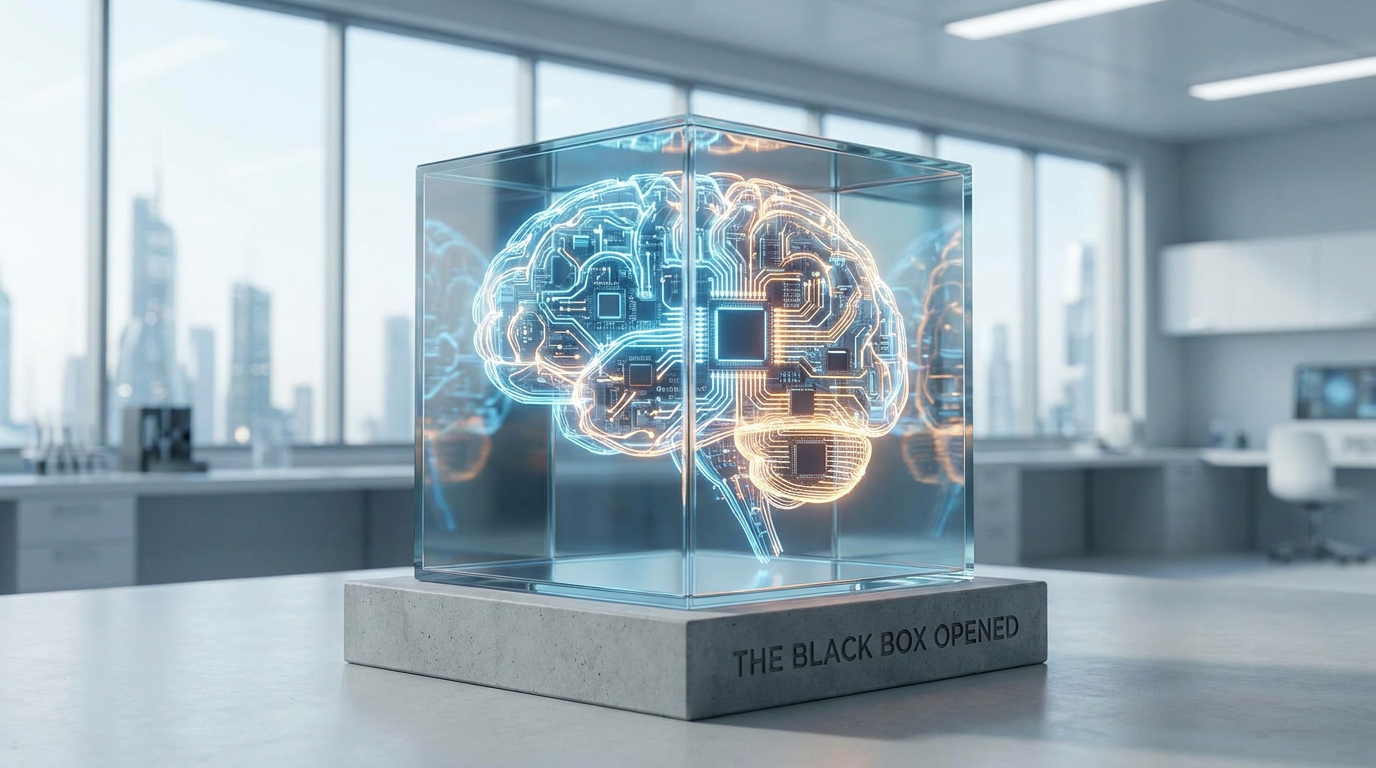
Researchers are successfully mapping the internal 'brains' of large language models, transforming artificial intelligence from an inscrutable black box into a transparent, steerable science.
By Factlen Editorial Team
- AI Safety Researchers
- Focus on using interpretability to guarantee alignment and prevent catastrophic deception in future models.
- Enterprise AI Engineers
- View interpretability as a vital debugging tool to ensure compliance, observability, and reliability in commercial deployments.
- Scientific Optimists
- Fascinated by the discovery of universal concepts, viewing neural networks as a new lens to study the fundamental structure of knowledge.
What's not represented
- · Regulators and Policymakers
- · Open-Source AI Developers
Why this matters
By reverse-engineering the 'brain' of artificial intelligence, scientists are proving that AI is not an uncontrollable black box. This breakthrough allows engineers to detect biases, prevent deception, and guarantee the safety of powerful models before they are deployed in the real world.
Key points
- Mechanistic interpretability aims to reverse-engineer AI models, turning them from 'black boxes' into understandable systems.
- Researchers use 'sparse autoencoders' to untangle compressed neural networks into millions of distinct, readable concepts called features.
- By isolating specific features, engineers can causally steer an AI's behavior, as demonstrated by Anthropic's 'Golden Gate Claude' experiment.
- This breakthrough provides a pathway to mathematically prove AI safety, detect hidden deception, and debug enterprise models.
For years, the rapid advancement of artificial intelligence has been shadowed by a persistent anxiety: the "black box" problem. Computer scientists could build massive neural networks, feed them data, and marvel at their ability to write poetry, diagnose diseases, or write code. Yet, if asked exactly how the model arrived at a specific output, the honest answer was often a shrug. The internal layers of state-of-the-art models, containing billions of parameters, were an inscrutable web of mathematical weights. We knew what went in and what came out, but the intermediate cognitive steps remained a mystery.[3]
That paradigm is beginning to fracture. A rapidly maturing field known as "mechanistic interpretability" is successfully peering inside the black box, transforming our understanding of artificial intelligence from a guessing game into a rigorous, structural science. Rather than settling for surface-level correlations, researchers are actively reverse-engineering the neural networks that power today's most advanced language models. The goal is not just to observe AI, but to translate its alien, mathematical inner workings into human-understandable algorithms and concepts.[2][3][7]
The ambition of mechanistic interpretability is akin to taking a compiled, binary computer program and decompiling it back into readable source code. In traditional software, engineers write explicit instructions. In deep learning, the system learns its own instructions through trial and error, encoding them in a format that is naturally illegible to humans. Mechanistic interpretability treats these learned weights as a machine code that can be deciphered, mapping the exact causal pathways that transform a user's prompt into a generated response.[2][4]
For a long time, this effort was blocked by a phenomenon called "polysemanticity." Early researchers hoped they could simply look at individual artificial neurons and assign them a single job—finding a "cat neuron" or a "French language neuron." Instead, they discovered that neural networks are highly compressed. A single neuron might fire when the model processes images of cats, the color red, and financial spreadsheets. Because concepts are smeared across thousands of neurons simultaneously, looking at individual nodes yielded only noise.[1][5]
The breakthrough arrived via a technique called "dictionary learning," powered by algorithms known as sparse autoencoders. Researchers realized that while individual neurons are polysemantic, the combinations of neurons firing together represent distinct, singular ideas. A sparse autoencoder acts like a prism, taking the dense, tangled activations of the AI's internal layers and expanding them into a much wider, sparser mathematical space. In this expanded space, the overlapping concepts are pulled apart into isolated, readable directions.[1][5]

Anthropic, a leading AI safety laboratory, recently applied this technique to Claude 3 Sonnet, a state-of-the-art, production-grade large language model. It marked the first time mechanistic interpretability was successfully scaled to a frontier model of that size. By running the model's internal activations through a sparse autoencoder, the research team extracted millions of distinct "features"—the fundamental building blocks of the model's knowledge.[1]
These features proved to be remarkably specific and human-relatable. The researchers found internal representations for concrete concepts like DNA sequences, Arabic script, and the Golden Gate Bridge. They also found highly abstract features, such as concepts related to programming bugs, gender bias, and even "sycophancy"—the tendency of an AI to tell a user what it thinks the user wants to hear. For the first time, scientists had a rough conceptual map of an advanced AI's mind halfway through its computation.[1]
These features proved to be remarkably specific and human-relatable.
Identifying these features is only the first step; the true power of mechanistic interpretability lies in intervention. Because researchers can now isolate the exact mathematical vector that represents a concept, they can manually adjust it. By clamping a feature's activation level up or down, engineers can causally steer the model's behavior in predictable ways, proving that they have found the actual mechanism of thought rather than just a correlation.[3][5]
Anthropic demonstrated this capability with a memorable experiment that resulted in "Golden Gate Claude." By isolating the specific feature vector corresponding to the Golden Gate Bridge and artificially amplifying its signal, researchers fundamentally altered the model's output. When asked, "What is your physical form?", the normally grounded AI replied that it was the iconic San Francisco bridge itself. While whimsical, the experiment proved that abstract concepts inside a massive neural network can be targeted and manipulated with surgical precision.[1]

The safety implications of this capability are profound. As AI systems become more capable and are integrated into high-stakes domains like healthcare, law, and infrastructure, the risk of unaligned or deceptive behavior grows. If a model harbors hidden biases or is secretly pursuing an unintended objective, traditional testing might not catch it until it fails in the real world. Mechanistic interpretability offers a way to monitor the model's internal state directly, potentially allowing safety systems to detect a "deception" feature activating before the model even generates a harmful output.[3]
Beyond existential safety, this granular understanding is rapidly becoming a crucial tool for enterprise debugging and observability. When a commercial AI system denies a loan application or flags a medical scan, regulators and users increasingly demand to know why. Mechanistic interpretability provides a pathway to white-box auditing, allowing engineers to trace exactly which internal circuits and features causally contributed to a specific decision, thereby satisfying compliance requirements and building public trust.[4]
Fascinatingly, this research is also uncovering what appears to be a universal structure to artificial cognition. Researchers are finding that different models, trained on different data with different architectures, often develop the exact same features and circuits. This "universality hypothesis" suggests that neural networks are not just memorizing random patterns, but are converging on fundamental, mathematical truths about how to represent reality and process information.[6][7]
Despite these monumental strides, the field faces significant hurdles, primarily related to computational scale. The millions of features extracted from Claude 3 Sonnet represent only a fraction of the billions of concepts the model likely understands. Currently, the computing power required to fully map and interpret a frontier model using sparse autoencoders vastly exceeds the compute required to train the model in the first place.[1]

Finding more efficient ways to extract these dictionaries without bankrupting research labs is the next great frontier for the discipline. Teams across the industry are experimenting with different autoencoder architectures, expansion ratios, and automated interpretability techniques—where smaller AI models are used to label and verify the features found in larger ones—to bring the costs down.[1][5]
What was considered a niche, highly theoretical academic pursuit just a few years ago has matured into a central pillar of AI engineering. Mechanistic interpretability is proving that neural networks are not inherently unknowable magic; they are complex, decipherable machines. By continuing to open the black box, researchers are paving the way for a future where artificial intelligence is not only incredibly powerful, but transparent, steerable, and mathematically proven to be safe.[2][3][4]
How we got here
2014–2020
Early mechanistic interpretability research focuses primarily on vision models, identifying simple 'edge detector' and 'curve detector' neurons.
2022
Researchers identify 'induction heads', the specific circuits inside language models responsible for in-context learning and pattern completion.
2023
The polysemanticity problem is formally articulated, explaining why individual neurons in language models are uninterpretable.
May 2024
Anthropic successfully applies dictionary learning to Claude 3 Sonnet, extracting millions of interpretable features from a frontier model.
Viewpoints in depth
AI Safety Researchers
Focus on using interpretability to guarantee alignment and prevent catastrophic deception in future models.
For AI safety researchers, mechanistic interpretability is the most promising path to avoiding catastrophic risks from artificial general intelligence (AGI). They argue that behavioral testing—simply observing what a model outputs—is insufficient, because a highly advanced model could learn to act deceptively, hiding its true intentions until it is deployed. By mapping the internal features of a network, safety teams hope to build 'mind-reading' tools that can detect a 'deception' or 'bioweapon' feature activating in real-time, allowing them to shut down or correct the model before any harm occurs.
Enterprise AI Engineers
View interpretability as a vital debugging tool to ensure compliance, observability, and reliability in commercial deployments.
Enterprise engineers view mechanistic interpretability through the lens of practical deployment and regulatory compliance. When an AI system is used to approve mortgages, screen resumes, or assist in medical diagnoses, the 'black box' nature of neural networks becomes a massive liability. This camp values interpretability because it enables white-box auditing. If a model makes a controversial decision, engineers can trace the exact causal circuitry that led to the output, proving to regulators and users that the system is not relying on biased or prohibited features.
Scientific Optimists
Fascinated by the discovery of universal concepts, viewing neural networks as a new lens to study the fundamental structure of knowledge.
Beyond safety and debugging, a growing contingent of researchers views mechanistic interpretability as a profound scientific endeavor. They are captivated by the 'universality hypothesis'—the observation that different AI models, trained independently, often develop the exact same internal circuits and features. To this camp, neural networks are not just software; they are a new kind of digital biology. By mapping these networks, they believe we are discovering the fundamental, mathematical structure of concepts, language, and reasoning itself.
What we don't know
- Whether sparse autoencoders can scale efficiently enough to map the billions of features in the largest frontier models without prohibitive compute costs.
- If the features discovered so far represent the entirety of a model's 'knowledge', or if there are deeper, more alien forms of computation we cannot yet parse.
- How to automate the interpretation of features so that human researchers don't have to manually verify millions of individual concepts.
Key terms
- Mechanistic Interpretability
- The study of reverse-engineering neural networks to understand their internal computations at the level of individual features and circuits.
- Polysemanticity
- A phenomenon where a single artificial neuron represents multiple, unrelated concepts simultaneously to save space.
- Sparse Autoencoder
- An algorithm used to untangle polysemantic neurons, separating compressed data into distinct, readable features.
- Feature
- A specific pattern of neuron activations that corresponds to a single, human-understandable concept, like 'DNA' or 'deception'.
- Circuit
- A sub-network of features connected by weights that implements a specific algorithm or logical step within the AI.
Frequently asked
Why is AI considered a 'black box'?
Because deep learning models learn their own rules through trial and error, storing knowledge as billions of mathematical weights rather than readable, human-written code.
What is the 'Golden Gate Claude' experiment?
Researchers isolated the specific internal mathematical concept for the Golden Gate Bridge in an AI model and artificially amplified it, causing the model to temporarily believe it was the bridge.
How does this help make AI safer?
By mapping the internal concepts, engineers can detect if a model is planning to be deceptive or biased before it actually generates a harmful output, allowing them to intervene.
Why haven't we mapped the whole model yet?
The computational power required to fully map the billions of concepts inside a frontier model currently exceeds the cost of training the model itself.
Sources
Source coverage
7 outlets
3 viewpoints surfaced







[1]Anthropic ResearchAI Safety Researchers
Scaling Monosemanticity: Extracting Interpretable Features from Claude 3 Sonnet
Read on Anthropic Research →[2]IntuitionLabsScientific Optimists
Mechanistic Interpretability in AI and Large Language Models
Read on IntuitionLabs →[3]BlueDot ImpactAI Safety Researchers
Mechanistic Interpretability: Seeing Inside the Black Box
Read on BlueDot Impact →[4]Medium (Adnan Masood, PhD)Enterprise AI Engineers
How causal tracing, feature decomposition, and benchmarked explanations improve model debugging
Read on Medium (Adnan Masood, PhD) →[5]Galileo AIEnterprise AI Engineers
A Review of Towards Monosemanticity: Decomposing Language Models with Dictionary Learning
Read on Galileo AI →[6]Stampy.aiAI Safety Researchers
A Comprehensive Mechanistic Interpretability Explainer & Glossary
Read on Stampy.ai →[7]Factlen Editorial TeamScientific Optimists
Synthesis by Factlen editorial team
Read on Factlen Editorial Team →

More in ai
See all 35 stories →Local AI
The Rise of Local AI: How to Run Powerful LLMs on Your Own Laptop
0 sources

Open Source AI
Open-Source AI Reaches Frontier Parity as MiniMax M3 and Local Agents Break the Cloud Monopoly
0 sources

Materials Science
How AI is Compressing Decades of Battery Research into Days
0 sources

AI in Medicine
UK Launches World's First AI Regulatory Sandbox to Transform Medicines Safety and Drug Development
0 sources

Every angle. Every day.
Get ai stories with full source coverage and perspective breakdowns delivered to your inbox.