
How to Evaluate Scientific Studies: An Expert Guide to Reading Past the Headline
Sensationalized headlines often misrepresent complex research. Learning to navigate the structure of a primary scientific paper empowers readers to evaluate evidence and spot misinformation.
By Factlen Editorial Team
- Scientific Researchers
- Focus on methodology, reproducibility, and the slow, cumulative nature of scientific consensus.
- Science Communicators
- Focus on translating complex jargon into accessible concepts without losing accuracy or nuance.
- Public Consumers
- Focus on practical takeaways, actionable advice, and clear indicators of a study's credibility.
What's not represented
- · Journal Editors
- · Peer Reviewers
Why this matters
In an era of rampant health fads and conflicting data, the ability to read and evaluate primary scientific sources is a crucial defense against misinformation. Understanding how research is structured allows you to make evidence-based decisions about your health, finances, and worldview.
Key points
- Most scientific papers follow the IMRAD structure: Introduction, Methods, Results, and Discussion.
- The abstract is a helpful summary, but it rarely details the study's limitations or nuances.
- A study's conclusions are only as reliable as its methodology and sample size.
- Observational studies can identify correlations, but they cannot definitively prove cause and effect.
- Peer review is a crucial quality-control step, though it does not guarantee a paper is flawless.
- The strongest scientific claims rely on a consensus of multiple studies rather than a single breakthrough.
Every day, news feeds are flooded with headlines beginning with the phrase "a new study says." These articles promise breakthroughs in longevity, warn of hidden dangers in everyday foods, or claim to overturn established physics. For the average reader, navigating this barrage of scientific claims can feel like walking through quicksand. The modern information ecosystem often strips away the nuance, caveats, and uncertainty that researchers carefully baked into their original work, leaving behind sensationalized soundbites designed to generate clicks rather than understanding. However, relying solely on media interpretations leaves consumers vulnerable to misinformation and whiplash, as coffee is declared a miracle cure one week and a deadly toxin the next. The antidote to this confusion is not to ignore science reporting, but to go directly to the source.[6]
Learning how to read a primary scientific paper is one of the most empowering skills a modern media consumer can develop. While the dense jargon and complex formatting can initially appear intimidating, you do not need a doctorate to evaluate the core claims of a study. Scientific papers are highly structured documents, built on a predictable architecture designed to communicate exactly what was done, what was found, and what it means. By understanding this framework, any reader can bypass the sensationalized headline and assess the actual evidence. This process of critical evaluation transforms passive consumers of news into active investigators, capable of distinguishing robust discoveries from preliminary hypotheses.[1][2]
The foundation of almost all modern scientific literature is the IMRAD structure: Introduction, Methods, Results, and Discussion. This standardized template ensures that researchers present their work logically, allowing peers to evaluate the validity of the findings. Before diving into the main text, readers first encounter the title and the author list. The title provides the first clue about the paper's focus, while the author list reveals the team behind the work. Typically, the first author is the researcher who conducted the bulk of the experiments and wrote the manuscript, while the last author is usually the senior scientist or principal investigator who secured the funding and oversaw the project.[1][2]

Immediately following the title is the abstract, which serves as the movie trailer for the research paper. In a single, dense paragraph, the abstract summarizes the background, the methodology, the primary results, and the authors' conclusions. Because full scientific articles are often hidden behind expensive paywalls, the abstract is frequently the only part of a study available for free, making it the most widely read section. While it provides a helpful overview, science communicators and researchers uniformly warn against stopping at the abstract. Abstracts lack the space for nuance and rarely detail the limitations of the study, making it dangerously easy to misinterpret the strength of the findings if one does not read further.[2][5]
To truly understand the context of a discovery, readers must move to the Introduction, sometimes labeled as the Background. This section sets the stage by summarizing what is already known about the topic and identifying the specific gap in knowledge that the current study attempts to fill. A well-written introduction acts as a mini-review of the field, citing previous research and explaining why the new experiment is necessary. For non-experts, this is often the most accessible part of the paper, as it is written in broader terms and provides the essential vocabulary needed to understand the rest of the document. It answers the fundamental question of why the research matters in the first place.[2]
The true heart of any scientific claim lies in the Methods section. This is the recipe book of the experiment, detailing exactly how the researchers conducted their study, who or what was tested, and how the data was collected. While it can be the driest and most technical part of the paper, it is also the most critical for evaluating the validity of the results. A study's conclusions are only as strong as its methodology. If the methods are flawed, biased, or inappropriate for the question being asked, the resulting data cannot be trusted, regardless of how exciting the conclusions might seem.[1][2]
When evaluating the Methods section, the first detail to look for is the study design. In medical and health research, the gold standard is the randomized controlled trial (RCT), where participants are randomly assigned to either receive a treatment or a placebo, minimizing bias. However, many studies are observational, meaning researchers simply track people over time without intervening. Observational studies are valuable for spotting trends, but they cannot definitively prove cause and effect. Additionally, readers must check the sample size—a study tracking ten people is vastly less reliable than one tracking ten thousand—and note whether the research was conducted on human subjects, mice, or isolated cells in a petri dish.[2][3]

When evaluating the Methods section, the first detail to look for is the study design.
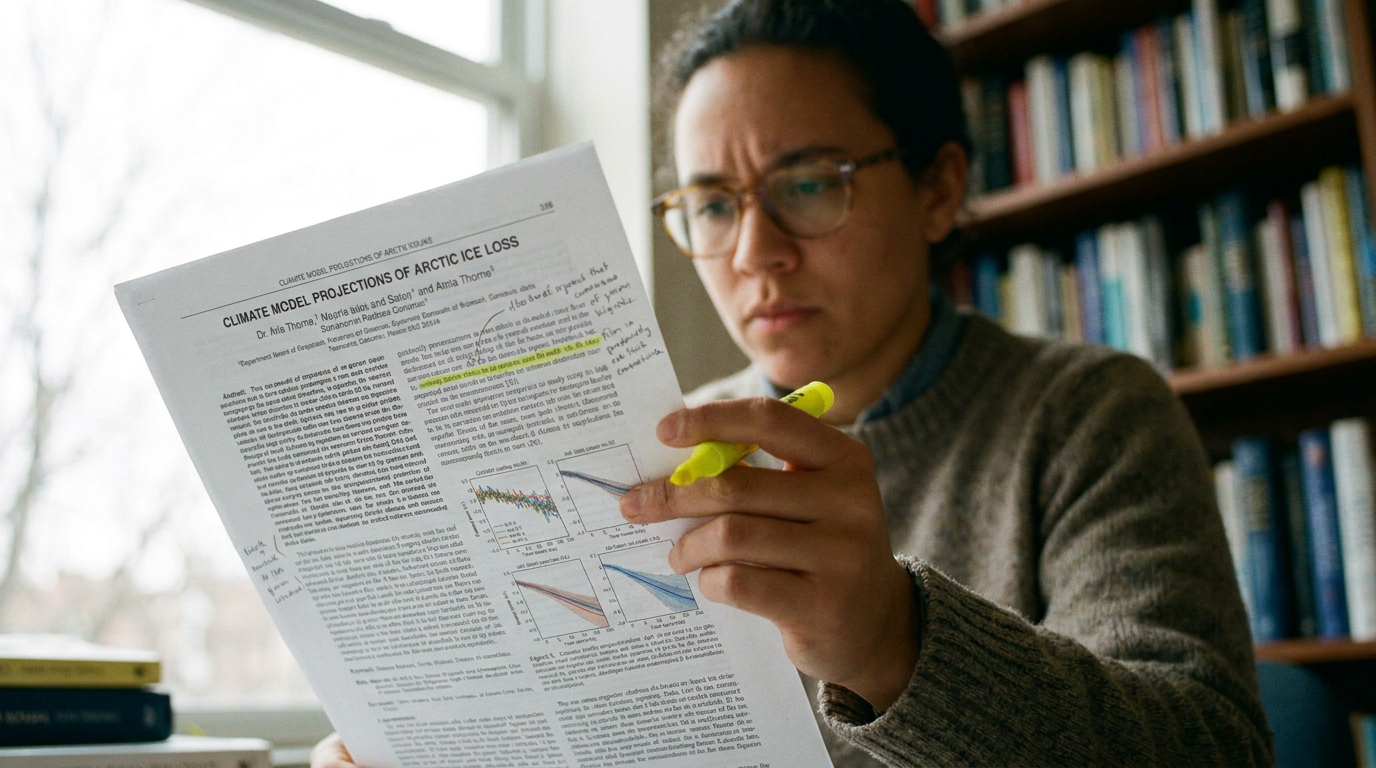
Following the methodology, the Results section presents the raw data. This is where researchers state exactly what they found, without interpretation or spin. The text is typically accompanied by figures, charts, and tables, which often contain the bulk of the critical information. For a lay reader, this section can be a dense thicket of statistics and p-values. The p-value is a mathematical metric used to determine statistical significance; traditionally, a p-value of less than 0.05 indicates that there is less than a 5 percent probability that the observed results occurred purely by chance. However, statistical significance does not automatically equate to real-world importance.[1][3]
A common pitfall in reading the Results section is confusing a statistically significant finding with a practically meaningful one. For example, a massive study might find that a new diet pill causes a statistically significant weight loss, but if that loss averages only half a pound over a year, the finding is practically useless. Readers should look for the "effect size," which measures the actual magnitude of the difference or relationship observed. Furthermore, the figures and graphs must be examined carefully. Check the axes on charts to ensure they are not manipulated to make a tiny difference look massive, a common visual trick that can exaggerate the impact of the data.[1][5]
Once the data is laid out, the authors move to the Discussion or Conclusion section to interpret their findings. This is where the researchers explain what they believe the results mean, how they fit into the broader context of the field, and why they are important. If the Results section is the "what," the Discussion is the "so what." This is also where authors are expected to explicitly state the limitations of their own work. A trustworthy scientific paper will always include a robust discussion of its flaws, whether that involves a small sample size, a short follow-up period, or potential confounding variables that could not be controlled.[1][2]
Before a paper makes it into a reputable journal, it must pass through the gauntlet of peer review. In this process, the journal editor sends the manuscript to independent experts in the same field who evaluate the methodology, data analysis, and conclusions. These reviewers act as a quality control filter, identifying errors, demanding additional experiments, or rejecting fundamentally flawed work. While peer review is a cornerstone of scientific integrity, it is not infallible. Reviewers rarely have access to the raw data to check for outright fraud, and bad papers do occasionally slip through. Therefore, publication in a peer-reviewed journal is a baseline requirement for credibility, not an absolute guarantee of truth.[3][6]

When evaluating scientific claims in the wild, several major red flags should prompt immediate skepticism. The most common error in science communication is conflating correlation with causation. Just because two variables trend in the same direction—such as ice cream sales and shark attacks rising in the summer—does not mean one causes the other. Observational studies can only establish correlation, yet headlines frequently frame these findings as causal. If a news article claims that eating a specific vegetable "causes" a reduction in cancer risk based on an observational survey, the claim has fundamentally misrepresented the underlying science.[3][6]
Another pervasive red flag is the over-extrapolation of animal or in vitro models. Basic research using mice, fruit flies, or cultured human cells is vital for understanding biological mechanisms and developing early-stage drugs. However, the vast majority of treatments that succeed in mice fail completely when tested in human clinical trials. When a headline promises a miraculous new cure for Alzheimer's disease, a quick check of the paper's methodology often reveals that the "patients" were genetically modified rodents. Recognizing the difference between early-stage exploratory research and late-stage human trials is essential for maintaining realistic expectations about scientific progress.[1][3]

Transparency regarding funding and potential conflicts of interest is another critical metric for evaluating research. At the end of every legitimate scientific paper, the authors must declare who paid for the study and whether they have any financial ties to companies that could benefit from the results. While industry funding does not automatically invalidate a study, it demands a higher level of scrutiny from the reader. A paper concluding that a specific brand of sports drink is superior for hydration, funded entirely by the manufacturer of that drink, should be read with a critical eye toward how the study was designed and whether the methodology was skewed to guarantee a favorable outcome.[2][3]
Ultimately, science is a cumulative, iterative process. A single paper, no matter how rigorous, rarely overturns decades of established knowledge on its own. The most reliable scientific claims are those supported by a broad consensus of multiple studies conducted by different research teams over time. When evaluating a controversial or groundbreaking claim, readers should look for systematic reviews or meta-analyses, which pool the data from dozens of individual papers to draw a more comprehensive conclusion. By learning to navigate the structure of scientific literature, readers can step off the rollercoaster of daily news hype and build a stable, evidence-based understanding of the world.[3][4]
How we got here
1665
The Philosophical Transactions of the Royal Society is published, establishing the concept of the scientific journal.
Mid-20th Century
The peer-review process becomes a standardized requirement for major scientific publications.
1990s
The internet revolutionizes scientific publishing, making abstracts widely accessible to the public.
2000s
The Open Access movement begins, pushing to make full scientific papers free for anyone to read.
2020s
The rise of pre-print servers accelerates data sharing but introduces non-peer-reviewed claims to the public.
Viewpoints in depth
Scientific Researchers
Focus on methodology, reproducibility, and the slow, cumulative nature of scientific consensus.
For practicing scientists, a single paper is rarely viewed as a definitive answer; rather, it is a single data point in a much larger, ongoing conversation. Researchers emphasize that science is an iterative process where early findings are frequently modified or overturned by subsequent, more rigorous experiments. They urge readers to pay close attention to the Methods section, as a study's design dictates the strength of its conclusions. From this perspective, the public's demand for immediate, black-and-white answers is fundamentally at odds with how the scientific method actually operates.
Science Communicators
Focus on translating complex jargon into accessible concepts without losing accuracy or nuance.
Science journalists and communicators sit at the difficult intersection of academic rigor and public accessibility. Their primary goal is to contextualize new findings, explaining not just what a study discovered, but why it matters and what its limitations are. This camp frequently battles against the sensationalism of mainstream headlines, warning that overhyping preliminary animal studies or observational correlations damages public trust in science. They advocate for greater media literacy, teaching readers how to spot red flags like small sample sizes and industry-funded bias.
Public Consumers
Focus on practical takeaways, actionable advice, and clear indicators of a study's credibility.
For the general public, the primary concern when reading about a new scientific study is how it applies to their daily lives, health, or worldview. Consumers are often overwhelmed by the sheer volume of conflicting information—such as shifting dietary guidelines or new medical warnings. This viewpoint values clear, bottom-line assessments of risk and benefit. Consequently, public consumers benefit most from understanding the hierarchy of evidence, learning to place more trust in meta-analyses and randomized controlled trials rather than panicking over a single, sensationalized observational study.
What we don't know
- How the rise of AI-generated research summaries will impact public understanding of primary scientific literature.
- Whether the push for Open Access publishing will successfully eliminate paywalls for all publicly funded research globally.
- How to effectively regulate or label pre-print servers so the public does not confuse preliminary findings with peer-reviewed consensus.
Key terms
- Peer Review
- The process where independent experts evaluate a manuscript for quality and accuracy before it is published.
- P-value
- A statistical measurement indicating the probability that the observed results occurred purely by chance.
- Randomized Controlled Trial (RCT)
- A study design where participants are randomly assigned to a treatment or control group, considered the gold standard for clinical research.
- Observational Study
- Research where scientists simply observe and track subjects over time without intervening or assigning treatments.
- Meta-analysis
- A statistical technique that combines the results of multiple independent studies to arrive at a more comprehensive conclusion.
- In vitro
- Experiments performed outside of a living organism, typically in a test tube or petri dish.
Frequently asked
Do I need a science degree to read a research paper?
No. While the Methods and Results sections can be highly technical, the Introduction and Discussion are usually written in plain language that explains the context and conclusions for a general audience.
Why do scientists use so much jargon?
Jargon allows researchers to communicate highly specific concepts precisely and efficiently with other experts in their field, though it can create a barrier for the general public.
What does it mean if a paper is a 'pre-print'?
A pre-print is a completed research paper that has been shared publicly before undergoing the formal peer-review process. Its findings should be treated as preliminary.
Is industry-funded research always biased?
Not always, but it requires extra scrutiny. Industry funding can influence how a study is designed or what data is published, so readers should carefully evaluate the methodology.
Sources
Source coverage
6 outlets
3 viewpoints surfaced






[1]The Open NotebookScience Communicators
How to Read a Scientific Paper
Read on The Open Notebook →[2]Understanding Health ResearchPublic Consumers
How to read a scientific paper
Read on Understanding Health Research →[3]Study.comPublic Consumers
How to Evaluate Scientific Claims & Arguments
Read on Study.com →[4]Science NewsScience Communicators
Evaluating scientific claims with new evidence
Read on Science News →[5]Purdue University LibrariesScientific Researchers
How to Read a Scientific Paper
Read on Purdue University Libraries →[6]Factlen Editorial TeamScience Communicators
Synthesis by Factlen editorial team
Read on Factlen Editorial Team →

More in meta
See all 9 stories →Media Trust
How 'Solutions Journalism' is Rewiring the Media to Fight News Avoidance
0 sources

Open-Source AI
How Meta's Llama 4 Works: Inside the Architecture Powering 2026's Open-Source AI Boom
0 sources

AI Evaluation
Evaluating AI: The Trade-Off Between Static Benchmarks and Human Preference
0 sources

Local AI
How to Run Local AI Models on Your Own Hardware: The 2026 Guide
0 sources

Every angle. Every day.
Get meta stories with full source coverage and perspective breakdowns delivered to your inbox.