
How Self-Driving Labs Are Automating Scientific Discovery
By combining agentic artificial intelligence with advanced robotics, autonomous laboratories are closing the 'execution gap' in science, compressing decades of materials and drug discovery into days.
By Factlen Editorial Team
- Automation Optimists
- Argue that self-driving labs will compress decades of research into days, solving critical bottlenecks in materials and drug discovery.
- Scientific Traditionalists
- Emphasize the need for mechanistic understanding, warning against 'black-box' AI that finds solutions without explaining the underlying chemistry.
- Infrastructure Advocates
- Focus on the massive engineering, data standardization, and safety protocols required to make autonomous labs reliable and secure.
What's not represented
- · Bench Scientists & Lab Technicians
- · Open-Source Hardware Developers
Why this matters
The physical execution of experiments has long been the bottleneck in scientific progress. By automating the lab bench, self-driving labs promise to radically accelerate the development of life-saving drugs, next-generation batteries, and climate-tech materials.
Key points
- Artificial intelligence can now design novel molecules in seconds, but physically synthesizing and testing them remains a manual bottleneck.
- Self-driving labs (SDLs) solve this by combining agentic AI with robotic fluid handlers and automated characterization tools.
- These closed-loop systems analyze experimental results in real time and automatically adjust parameters for the next test without human intervention.
- Recent breakthroughs in "gray-box" AI allow these systems to explain the chemical mechanisms behind their discoveries, building trust among traditional scientists.
- Major government initiatives and venture capital are heavily funding autonomous lab infrastructure to accelerate climate and medical research.
For over a century, the enduring image of scientific research has remained stubbornly accurate: a brilliant researcher in a white coat, pipette in hand, manually mixing fluids at a lab bench. Even as supercomputers and cloud networks digitized the world, the tactile work of making and testing physical matter remained a fundamentally human endeavor. [2] But as the scientific community pushes deeper into the 21st century, this manual reality has become the primary bottleneck to progress. [1][1][2]
The challenge is no longer a lack of ideas. Artificial intelligence can now design millions of novel molecular structures in a matter of seconds. [2] However, translating those digital blueprints into physical reality—synthesizing the compounds, measuring their properties, and validating their efficacy—can take months or even years. [2] This "execution gap" means that the limiting reagent for breakthroughs in medicine, clean energy, and materials science is the slow, manual generation of high-quality experimental data. [1][1][2]
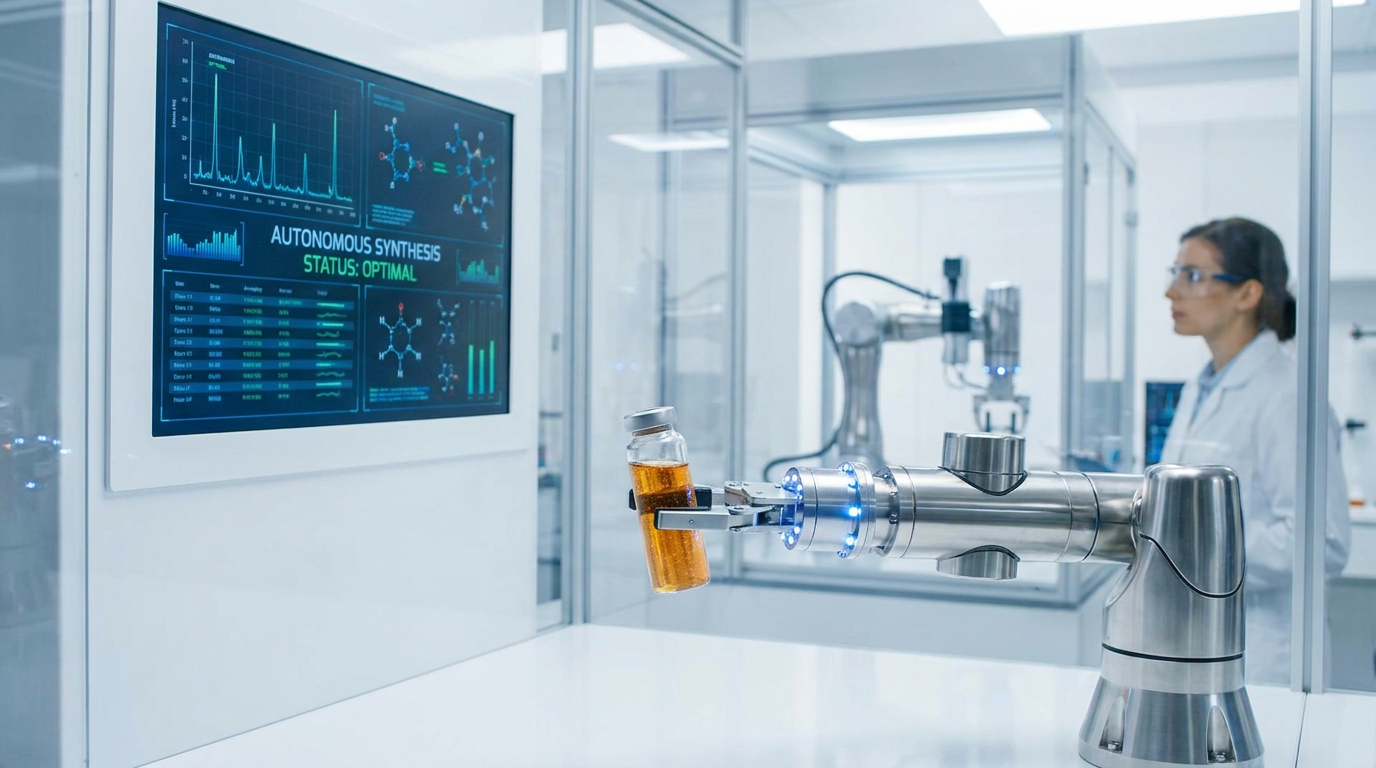
To bridge this gap, the scientific community is undergoing a profound transition from computer-assisted design to fully autonomous execution. [7] Enter the "Self-Driving Lab" (SDL)—a closed-loop experimental production system that combines artificial intelligence with advanced robotics to automate the entire scientific method. [5] These facilities are not merely automated assembly lines; they are cognitive ecosystems capable of planning, executing, and learning from experiments without human intervention. [3][3][5][7]
The architecture of a self-driving lab relies on a seamlessly integrated three-part stack. [3] First, an AI "brain" acts as the lead investigator, analyzing existing literature and high-dimensional datasets to formulate a hypothesis and design an experimental recipe. [3] Second, automated fluid-handlers, multi-axis robotic arms, and flow reactors execute the raw machine code, physically blending precursors and manipulating variables like temperature and pressure in real time. [3] [4][3][4]

The critical third step is what makes the system truly autonomous: in-situ characterization. [7] Integrated analytical suites—such as spectrometers and rheometers—measure the properties of the newly synthesized material the moment it is created. [3] This data is instantly fed back into the AI's machine learning models, which update their understanding of the chemical space and immediately trigger the next, optimized experimental run. [3] [4][3][4][7]
By removing human latency from this iterative design-build-test-learn cycle, self-driving labs can operate 24 hours a day, 7 days a week. [1] [4] This continuous operation compresses traditional research and development timelines by orders of magnitude, turning exploratory science into a relentless, machine-augmented engine. [7][1][4][7]
This revolution is being driven by a fundamental shift in how artificial intelligence is deployed in the laboratory. [8] For years, AI served as a single-step tool—predicting a protein's fold or summarizing a research paper—before handing control back to a human researcher. [8] Today, the field is dominated by "agentic workflows," where AI systems are endowed with memory, tool-use capabilities, and goal-directed behavior. [8][8]
This revolution is being driven by a fundamental shift in how artificial intelligence is deployed in the laboratory.
These agentic AI systems can orchestrate complex, multi-step pipelines. [8] They can independently query chemical databases, write the code to operate a robotic synthesizer, interpret the resulting mass spectrometry data, and decide whether to pivot the experimental strategy. [5] [8] This moves AI from the role of a passive computational tool to an active, autonomous research collaborator. [8][5][8]
The stakes for this technology are immense, particularly in fields requiring the exploration of vast chemical spaces. [1] In the energy sector, autonomous labs are accelerating the hunt for next-generation battery stabilizers, advanced catalysts for carbon capture, and resilient materials for fusion reactors. [1] [2] In the life sciences, they are systematically mapping the efficacy and manufacturability of new biologics and small-molecule drugs. [1][1][2]

Recognizing this potential, governments and institutions are treating autonomous science as critical national infrastructure. [1] [5] The U.S. Department of Energy recently launched the Genesis Mission, tasking national laboratories with building AI-driven discovery platforms that link supercomputers directly to autonomous experimentation. [1] At Oak Ridge National Laboratory, the INTERSECT initiative is already developing the physical and software infrastructure to support this ecosystem at scale. [4][1][4]
The momentum is equally strong globally and in the private sector. [5] The UK's Advanced Research and Invention Agency (ARIA) has heavily funded programs exploring systems that can reason and execute experiments autonomously. [5] Meanwhile, venture capital is pouring hundreds of millions of dollars into startups building "AI Science Factories" that bundle automated hardware with proprietary discovery pipelines. [5][5]
Despite the rapid progress, the rise of self-driving labs has faced legitimate skepticism from scientific traditionalists. [6] A primary concern has been the "black-box" nature of AI optimization. [6] Historically, machine learning models could identify a highly efficient material or catalyst, but they could not explain the underlying physical or chemical mechanisms that made it work. [6] For many scientists, a result without an explanation is a fragile foundation for future research. [6][6]
To address this, researchers are pioneering "gray-box" AI approaches. [6] In a landmark 2026 study published in ACS Catalysis, scientists demonstrated an AI-driven lab that explored chemical space not just to find the best catalyst for converting propane into propylene, but to simultaneously uncover the mechanisms behind its performance. [6] By bridging performance optimization with mechanistic insight, the AI acts as an interpretable partner rather than an opaque oracle. [6][6]

Beyond algorithmic transparency, the physical infrastructure of autonomous science presents massive engineering challenges. [5] Creating a reliable self-driving lab requires unprecedented interoperability between disparate pieces of hardware, standardized data formats, and robust error-handling protocols. [5] [7] When an AI agent decides to alter a chemical reaction dynamically, the robotic hardware must execute that command flawlessly to prevent catastrophic failures or contaminated samples. [5][5][7]
To democratize access to this complex infrastructure, the industry is increasingly moving toward a "cloud lab" model. [7] Rather than every university spending millions to build custom automated workcells, researchers can submit their experimental hypotheses via a web interface. [3] [7] A remote, centralized autonomous facility executes the physical experiments and streams the high-fidelity data back to the researcher, leveling the playing field for underfunded institutions. [7][3][7]
Ultimately, the transition to self-driving laboratories does not render human scientists obsolete; it elevates their role. [4] By liberating researchers from the manual drudgery of pipetting and data transcription, autonomous systems allow scientists to focus entirely on high-level strategy, creative hypothesis generation, and interpreting complex mechanistic insights. [3] [4] As the execution gap closes, the future of discovery will belong to those who can ask the best questions. [2] [8][2][4][8]
How we got here
Early 2020s
AI demonstrates mastery in predicting molecular structures, such as protein folding, but physical testing remains a manual bottleneck.
2024
The concept of 'agentic workflows' gains traction, allowing AI to orchestrate multi-step scientific processes rather than single tasks.
2025
Major government initiatives, including the US DOE's Genesis Mission and the UK's ARIA program, heavily fund autonomous lab infrastructure.
Mid-2026
Self-driving labs transition from academic prototypes to commercial infrastructure, demonstrating 'gray-box' capabilities that explain chemical mechanisms.
Viewpoints in depth
Automation Optimists
Viewing autonomous labs as the ultimate solution to the scientific bottleneck.
Proponents argue that the limiting factor in modern science is no longer a lack of ideas, but the slow, manual generation of high-quality experimental data. By deploying agentic AI that can operate robotic hardware 24/7, this camp believes we can compress decades of research into days. They point to the rapid discovery of novel battery stabilizers and catalysts as proof that removing human latency from the iterative loop is the key to solving urgent global challenges like climate change and pandemic preparedness.
Scientific Traditionalists
Warning against the loss of mechanistic understanding in the pursuit of speed.
While acknowledging the efficiency of self-driving labs, traditionalists caution against relying on 'black-box' AI that identifies optimal materials without explaining why they work. They argue that true scientific progress requires understanding the underlying physical and chemical mechanisms. This camp advocates for 'gray-box' approaches, where AI is specifically constrained to explore chemical space in a way that simultaneously uncovers the rules governing the reactions, ensuring that speed does not come at the expense of fundamental scientific reasoning.
Infrastructure Advocates
Focusing on the massive engineering and standardization hurdles required for scale.
This perspective emphasizes that a self-driving lab is not simply 'robots plus AI,' but a complex, highly integrated ecosystem. Advocates highlight the urgent need for standardized data practices, interoperable hardware, and robust cybersecurity protocols. They argue that without a shared software and data ecosystem—like the ones being developed at national laboratories—the promise of autonomous science will fragment into isolated, incompatible proprietary platforms. For them, the real breakthrough is building the connective tissue that makes autonomy reliable.
What we don't know
- How quickly proprietary, siloed automated labs can adopt standardized data formats to allow for global interoperability.
- Whether the high capital costs of building on-premise autonomous labs will centralize scientific power among a few elite institutions.
- The long-term impact on the scientific workforce as the demand for manual lab technicians decreases in favor of high-level experimental strategists.
Key terms
- Self-Driving Lab (SDL)
- A fully autonomous research platform that combines artificial intelligence with robotic hardware to design, execute, and analyze experiments in a continuous loop.
- Agentic AI
- Artificial intelligence systems capable of independent reasoning, planning, and executing multi-step workflows without continuous human prompting.
- Closed-Loop System
- An experimental setup where the results of one test are automatically analyzed and fed back into the AI to optimize the parameters for the next test.
- Gray-Box AI
- An AI model designed to be interpretable, revealing the underlying chemical mechanisms of its discoveries rather than just outputting a final result.
Frequently asked
Will AI replace human scientists?
No. Autonomous labs automate the manual execution of experiments, freeing scientists to focus on high-level strategy, hypothesis generation, and interpreting complex results.
What fields benefit most from self-driving labs?
Materials science and drug discovery are the primary beneficiaries, as they require synthesizing and testing vast numbers of chemical combinations to find optimal solutions.
How do researchers access these labs?
While large institutions build on-premise autonomous labs, a growing 'cloud lab' model allows researchers to submit experimental prompts remotely, democratizing access to advanced hardware.
Sources
Source coverage
8 outlets
3 viewpoints surfaced








[1]Ginkgo BioworksAutomation Optimists
Why autonomous labs matter for everyone
Read on Ginkgo Bioworks →[2]American Academy of Arts & SciencesScientific Traditionalists
The Execution Gap in AI for Chemistry
Read on American Academy of Arts & Sciences →[3]ChemCopilotAutomation Optimists
Self-Driving Labs: The Rise of Autonomous Chemical Discovery in 2026
Read on ChemCopilot →[4]Oak Ridge National LaboratoryInfrastructure Advocates
Autonomous Laboratories at Oak Ridge National Laboratory
Read on Oak Ridge National Laboratory →[5]IQ CapitalAutomation Optimists
Self-driving labs are having a moment
Read on IQ Capital →[6]WileyScientific Traditionalists
AI-powered self-driving labs move beyond discovery to explain catalyst performance
Read on Wiley →[7]Royal Society PublishingInfrastructure Advocates
A framework for evaluating the AI-driven automation of science
Read on Royal Society Publishing →[8]Factlen Editorial TeamInfrastructure Advocates
Synthesis by Factlen editorial team
Read on Factlen Editorial Team →

More in ai
See all 34 stories →Local AI
The Rise of Local AI: How to Run Powerful LLMs on Your Own Laptop
0 sources

Open Source AI
Open-Source AI Reaches Frontier Parity as MiniMax M3 and Local Agents Break the Cloud Monopoly
0 sources

Materials Science
How AI is Compressing Decades of Battery Research into Days
0 sources
AI in Medicine
UK Launches World's First AI Regulatory Sandbox to Transform Medicines Safety and Drug Development
0 sources
Every angle. Every day.
Get ai stories with full source coverage and perspective breakdowns delivered to your inbox.