
How Chile's Black Octagon Warning Labels Are Reshaping Global Nutrition
A decade after Chile mandated stark warning labels on unhealthy foods, new data shows the policy has significantly reduced sugar intake and plausibly lowered childhood obesity rates.
By Factlen Editorial Team
- Public Health Researchers
- Focus on the empirical health outcomes, measuring reductions in obesity risk and nutrient intake.
- Policy & Behavioral Experts
- Analyze how label design alters consumer psychology and advocate for standardized global regulations.
- Market Observers
- Track the commercial impact, focusing on how the food industry reformulates products to avoid labels.
What's not represented
- · Food Manufacturers
- · Low-Income Consumers
Why this matters
Traditional nutrition labels often fail to help rushed shoppers make healthy choices. Chile's success proves that clear, unavoidable warning labels can empower consumers, force companies to make healthier food, and actively reduce obesity rates at a population level.
Key points
- Chile's 2016 mandate requiring black octagon warning labels on unhealthy foods has significantly altered consumer behavior.
- Recent data shows households purchased 37% less sugar and 22% less sodium from labeled products.
- A 2026 Lancet study found the policy plausibly reduced the risk of childhood obesity by up to 2.9% within 18 months.
- The labels force 'cognitive friction,' proving more effective than colorful traffic-light systems that can confuse shoppers.
- To avoid the labels, many food manufacturers have reformulated their products, creating a 'stealth health' benefit for all consumers.
For decades, public health officials have fought a losing battle against the global rise of diet-related diseases, armed mostly with the traditional nutrition facts panel. Tucked away on the back of packaging, these grids of percentages and serving sizes are notoriously difficult for the average shopper to decode during a rushed grocery trip. But a radical regulatory experiment launched by Chile a decade ago is now yielding concrete, real-world evidence that a simpler approach works: putting stark, black warning labels right on the front of the box. This shift from passive information to active warning is fundamentally changing how people shop and how food is made.[1]
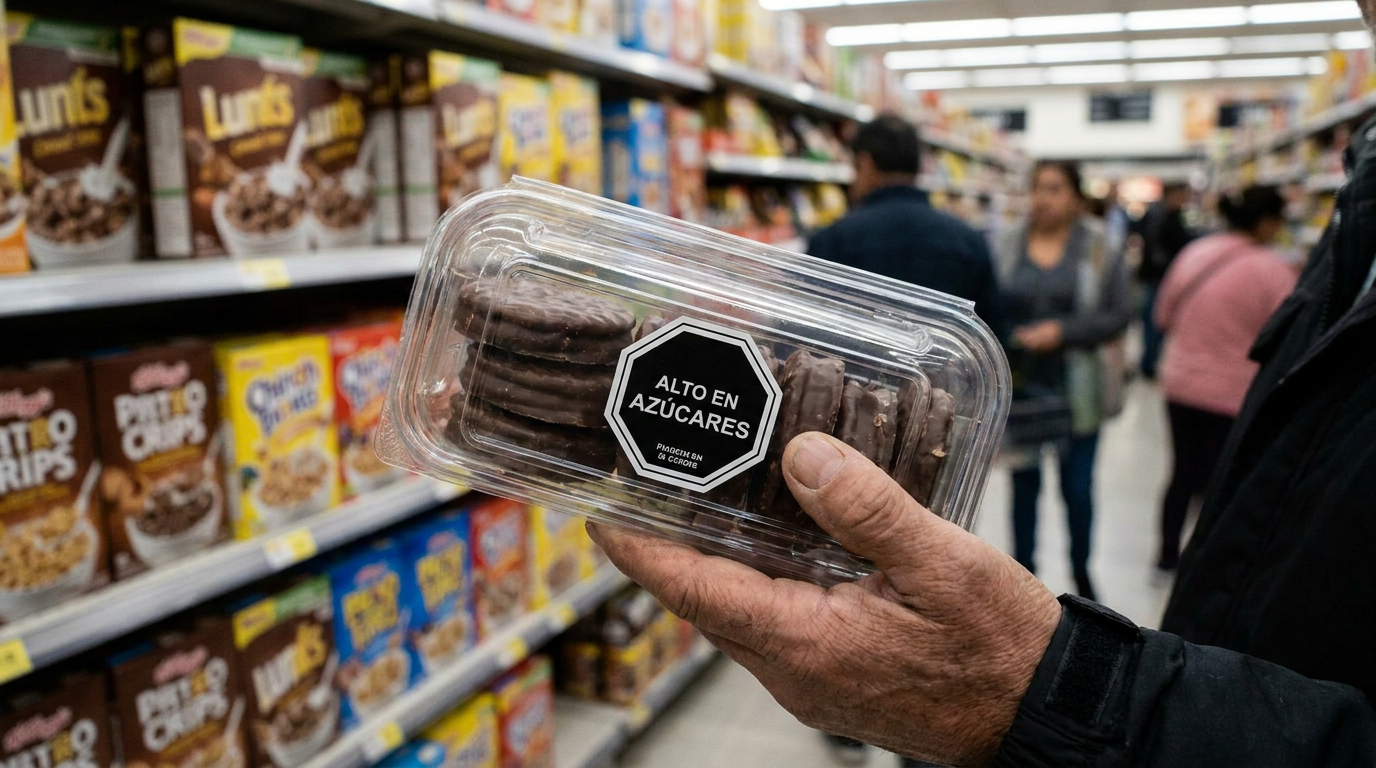
In 2016, Chile implemented the Food Labeling and Advertising Law (FLAL), a comprehensive policy designed to combat some of the highest childhood obesity rates in the world. The centerpiece of the legislation was a mandate requiring packaged foods and beverages that exceed set thresholds for added sugar, sodium, saturated fat, or calories to carry prominent black octagons on their front packaging. Resembling stop signs, the labels bluntly state 'High in Sugar' or 'High in Sodium.' The government recognized that traditional educational campaigns were failing to curb the consumption of ultra-processed foods, necessitating a more direct intervention at the point of purchase.[2][7]
The policy was a deliberate departure from the labeling systems favored in North America and Europe. Prior to implementing the black octagons, Chilean researchers studied the 'traffic-light' labels used in countries like Ecuador and the United Kingdom, which assign red, yellow, or green colors to various nutrients. They found that the colorful labels were often confusing for everyday shoppers, who struggled to weigh a product with a red mark for fat against a green mark for sugar. Furthermore, behavioral studies indicated that the bright colors sometimes inadvertently elicited food cravings, undermining the very purpose of a health warning.[5][6]
By contrast, the black octagons were designed to be unmistakable and visually unappealing. The goal was to create immediate cognitive friction, breaking through the carefully engineered, brightly colored marketing of ultra-processed foods. If a product triggers the regulatory thresholds, the manufacturer has no choice but to print the stark warning on the front of the package. This leverages 'negative dominance theory,' a psychological principle suggesting that negative warnings are far more effective at disrupting automatic, habitual behaviors than positive encouragements. Shoppers are forced to confront the health cost of their purchase before they even pick up the item.[1][5]

The labeling mandate was not introduced in a vacuum; it was paired with strict complementary policies to reshape the broader food environment. Any product carrying a black octagon is legally barred from being sold or promoted in Chilean schools, instantly removing junk food from cafeterias. Furthermore, these products cannot be marketed to children under the age of fourteen. This effectively banned the use of cartoon mascots, toys, and targeted television advertisements for unhealthy snacks, shielding children from the billions of dollars spent annually by the food and beverage industry to cultivate brand loyalty.[2][3]
Ten years after the law's passage, a wave of new data is confirming what public health advocates had hoped: the warnings are fundamentally altering consumer behavior. According to comprehensive research published by the University of North Carolina's Global Food Research Program and the journal PLOS Medicine, Chilean households have significantly shifted their purchasing habits away from labeled products. The data proves that when consumers are equipped with clear, accessible, and unavoidable information, they consistently choose to leave the most unhealthy items on the supermarket shelf.[4][7]
The specific numbers reveal a dramatic shift in dietary intake. The data shows that consumers purchased 37 percent less sugar, 22 percent less sodium, and 16 percent less saturated fat from products carrying the warning labels. Overall, households bought 23 percent fewer total calories from these flagged items. Crucially, researchers noted that these behavioral shifts were highly equitable. The reductions in junk food purchases occurred across all socioeconomic groups, rather than being isolated to highly educated or affluent shoppers who typically benefit most from traditional nutritional education campaigns.[7]

The specific numbers reveal a dramatic shift in dietary intake.
The most profound impacts, however, are now being measured in actual health outcomes rather than just grocery receipts. In June 2026, a landmark study published in the medical journal The Lancet provided what researchers describe as the first real-world evidence that a national package of food policies can plausibly reduce the risk of childhood obesity. This represents a holy grail for public health officials, who have long struggled to prove that regulatory interventions can move the needle on population-level weight metrics.[2][4]
The Lancet study analyzed longitudinal health data from more than 300,000 Chilean schoolchildren. It found that within 18 months of the policy's implementation, girls exposed to the new food environment were 2.9 percent less likely to be overweight or living with obesity, while boys were 2.4 percent less likely. Researchers even identified a plausible causal impact after just six months, suggesting that the combination of warning labels, school bans, and marketing restrictions acts rapidly to protect children's health during critical developmental windows.[2]
Beyond changing the minds of individual shoppers, the black octagons have triggered a massive, secondary mechanism of public health intervention: product reformulation. Because the warning labels are viewed as a severe commercial disadvantage, food and beverage manufacturers have been highly motivated to avoid them. The labels act as a direct financial penalty, threatening market share and brand reputation for products that fail to meet the government's nutritional standards. Rather than accept the stigma of a black stop sign on their packaging, many companies chose to overhaul their entire production process.[1][5]
To escape the black octagons, companies across Chile quietly changed their recipes. They reduced added sugars in breakfast cereals, lowered sodium in canned soups, and cut saturated fats in packaged snacks so that their products would fall just below the regulatory thresholds. This 'stealth health' effect means that even consumers who completely ignore the labels are inadvertently eating healthier, reformulated food. The burden of healthy eating is partially shifted from the individual's willpower to the manufacturer's supply chain.[6][7]

The undeniable success of the Chilean model has sparked a public health revolution across Latin America. Following Chile's lead, countries including Peru, Uruguay, Mexico, Argentina, and Colombia have all adopted mandatory front-of-package warning labels. In Mexico, early surveys showed that over 70 percent of consumers found the new warning labels easy to understand and highly useful for making purchasing decisions. The region has become a living laboratory for aggressive nutritional policy, proving that coordinated government action can successfully challenge the dominance of ultra-processed foods.[5][6]
The transition, however, has not been without intense friction. The global food and beverage industry has frequently lobbied against the black octagons, arguing that they demonize specific products and oversimplify complex nutritional science. In some markets, industry groups have pushed heavily for alternative, softer designs. For example, when Brazil implemented its labeling law, it opted for a black-and-white magnifying glass design rather than the stop-sign shape, a compromise that public health advocates argue is less punitive and therefore less effective at deterring unhealthy purchases.[6]
There are also ongoing debates within the nutrition community about the inherent limits of the labeling strategy. While the warnings successfully shift consumers toward healthier versions of ultra-processed foods, they do not necessarily drive people toward eating more whole, unprocessed foods like fresh fruits, vegetables, and legumes. Critics note that warning labels alone cannot fix systemic issues like food deserts, agricultural subsidies that favor corn and soy, or the high retail cost of fresh produce in low-income neighborhoods.[5]
Furthermore, as companies reformulate products to avoid sugar warnings, some have increasingly relied on artificial sweeteners to maintain flavor profiles. This substitution has raised new concerns about the long-term health effects of consuming high volumes of sugar substitutes, particularly regarding metabolic health and gut microbiomes. In response, several Latin American countries have already amended their labeling laws to include specific warnings about the presence of artificial sweeteners and caffeine, explicitly stating that such products are not recommended for children. The policy is constantly evolving to close loopholes exploited by manufacturers.[6]
Despite these nuances and ongoing challenges, the global consensus among public health experts is rapidly solidifying around the efficacy of interpretative, negative warning labels. The data from Chile demonstrates that when governments mandate clear, unavoidable nutritional transparency, consumers are empowered to make healthier choices. The combination of behavioral friction at the grocery store and forced industry reformulation creates a powerful dual mandate that actually moves the needle on population health metrics. It proves that the obesity epidemic is not solely a failure of individual willpower, but a systemic issue that can be regulated.[1][4]
As obesity rates and related healthcare costs continue to climb in the United States and Europe, policymakers in the Global North are increasingly looking south for proven solutions. The Chilean experiment proves that the modern food environment is not an immovable force, and that consumers do not have to be left to navigate deceptive marketing on their own. With political will and evidence-based regulations, governments can successfully prioritize human health over corporate marketing, providing a clear, actionable blueprint for the rest of the world to follow in the fight against diet-related disease.[1]
How we got here
2014
Chile implements a sugary-drinks tax modification as an early step to combat obesity.
2016
Phase 1 of Chile's Food Labeling and Advertising Law (FLAL) introduces mandatory black octagon warning labels.
2021
Argentina and several other Latin American nations adopt similar mandatory warning labels based on Chile's success.
June 2026
The Lancet publishes data showing the policy plausibly reduced childhood obesity risk among 300,000 schoolchildren.
Viewpoints in depth
Public Health Advocates
Argue that mandatory, negative warning labels are essential to counter billions of dollars in junk food marketing.
This camp points to the failure of voluntary, industry-led labeling schemes (like 'Guideline Daily Amounts') which often confuse consumers. They argue that clear, interpretative warnings—like black octagons—are necessary to correct the information asymmetry in the modern food environment, empowering consumers to make split-second healthy choices while simultaneously forcing the industry to reformulate products.
Food and Beverage Industry
Prefer voluntary or positive-focused labeling systems, arguing that stark warnings demonize specific products.
Industry groups have historically lobbied against mandatory black octagons, arguing they oversimplify nutrition and unfairly stigmatize packaged foods. They often advocate for 'traffic light' systems or 'Guideline Daily Amounts,' suggesting that consumers should be educated to balance their overall diets rather than being frightened away from individual products by stop-sign imagery.
Behavioral Economists
Focus on how label design alters the cognitive load and friction of grocery shopping.
Researchers in this camp emphasize that grocery shopping is a fast, automatic process. They note that black warning labels succeed because they leverage 'negative dominance theory'—breaking through the visual noise of colorful packaging to create immediate cognitive friction. They argue that while positive labels (like green checkmarks) encourage buying, only negative labels effectively disrupt the habitual purchase of ultra-processed foods.
What we don't know
- Whether the United States or European Union will adopt similar mandatory negative warnings despite heavy industry lobbying.
- The long-term health impacts of consumers replacing sugar with artificial sweeteners in reformulated products.
- How effectively warning labels can combat obesity in areas with severe food deserts and lack of access to fresh produce.
Key terms
- Front-of-Package Warning Labels (FOPWL)
- Mandatory visual indicators placed on the front of food packaging to alert consumers to high levels of unhealthy nutrients.
- Nutrients of Concern
- Specific components of food—typically added sugars, sodium, and saturated fats—that are linked to non-communicable diseases when consumed in excess.
- Product Reformulation
- The process by which food manufacturers alter their recipes (e.g., reducing sugar) to avoid triggering a mandatory warning label.
- Traffic-Light Labeling
- An alternative labeling system that uses red, yellow, and green colors to indicate nutrient levels, which studies show can sometimes confuse consumers.
- Negative Dominance Theory
- A psychological principle suggesting that negative warnings are more effective at disrupting automatic behaviors than positive encouragements.
Frequently asked
Do the warning labels actually change what people buy?
Yes. Data from Chile shows households purchased 37% less sugar and 22% less sodium from products carrying the black octagon labels.
Why use black octagons instead of traffic light colors?
Research found that colorful traffic-light labels can inadvertently elicit food cravings and confuse consumers, whereas black stop-sign shapes clearly communicate a health warning.
Did food companies change their products?
Yes. Many manufacturers reformulated their recipes to reduce sugar and salt specifically to avoid having to print the warning labels on their packaging.
Are other countries using these labels?
Yes. Following Chile's success, countries including Mexico, Peru, Uruguay, Argentina, and Colombia have adopted similar mandatory warning labels.
Sources
Source coverage
7 outlets
3 viewpoints surfaced







[1]Factlen Editorial TeamPolicy & Behavioral Experts
Synthesis by Factlen editorial team
Read on Factlen Editorial Team →[2]The LancetPublic Health Researchers
Changes in food purchases after the Chilean policies on food labelling, marketing, and sales in schools
Read on The Lancet →[3]PLOS MedicinePublic Health Researchers
An evaluation of Chile’s Law of Food Labeling and Advertising on sugar-sweetened beverage purchases
Read on PLOS Medicine →[4]STAT NewsMarket Observers
Chile offers new data on food warning label efficacy
Read on STAT News →[5]UNICEFPolicy & Behavioral Experts
Front-of-pack nutrition labelling: A policy tool for creating healthier food environments
Read on UNICEF →[6]The GuardianPolicy & Behavioral Experts
Latin America is leading the world in a movement to print nutritional warning labels
Read on The Guardian →[7]University of North Carolina Global Food Research ProgramPublic Health Researchers
Evaluating Chile’s Law of Food Labeling and Advertising
Read on University of North Carolina Global Food Research Program →

More in health
See all 23 stories →Type 1 Diabetes
FDA Approves First Therapy to Preserve Insulin Production in Newly Diagnosed Type 1 Diabetes
0 sources

Nutrition Science
The Food Matrix: Why Nutrition Science is Moving Beyond Calories and Macros
0 sources

Food Policy
How Chile’s Black Octagon Warning Labels Are Reshaping Global Nutrition
0 sources
Pediatric Diabetes
FDA Approves First Disease-Modifying Therapy for Children Newly Diagnosed With Stage 3 Type 1 Diabetes
0 sources

Every angle. Every day.
Get health stories with full source coverage and perspective breakdowns delivered to your inbox.