
How Chile’s Black Octagon Warning Labels Are Reshaping Global Nutrition
A decade after Chile pioneered mandatory "stop sign" warning labels for unhealthy foods, new data reveals sweeping reductions in sugar and sodium consumption, prompting a global shift in public health policy.
By Factlen Editorial Team
- Public Health Authorities
- Argue that mandatory, nutrient-specific warning labels are the most effective tool to combat diet-related diseases.
- Behavioral & Nutrition Scientists
- Focus on how clear visual nudges alter consumer purchasing habits and force industry reformulation.
- Food Industry & Retailers
- Faced with strict thresholds, they prioritize reformulating products to avoid warning labels and maintain market share.
What's not represented
- · Small-scale artisanal food producers
- · Low-income households facing fresh food barriers
Why this matters
By proving that mandatory, easy-to-understand warning labels can successfully force food companies to make healthier products and change consumer habits, Chile has provided a proven blueprint that is now reshaping global public health policy.
Key points
- Chile's 2016 law mandated black octagonal warning labels on foods high in sugar, sodium, saturated fat, or calories.
- The law also banned marketing these products to children and prohibited their sale in schools.
- Purchases of sugar from labeled products dropped by 37%, and high-calorie beverage purchases fell by 24%.
- Food manufacturers aggressively reformulated recipes, dropping the percentage of products needing labels from 71% to 53%.
- Early childhood obesity risk dropped by up to 2.9% among children exposed to the policy.
- The model has since been adopted by Mexico, Peru, Uruguay, and Argentina.
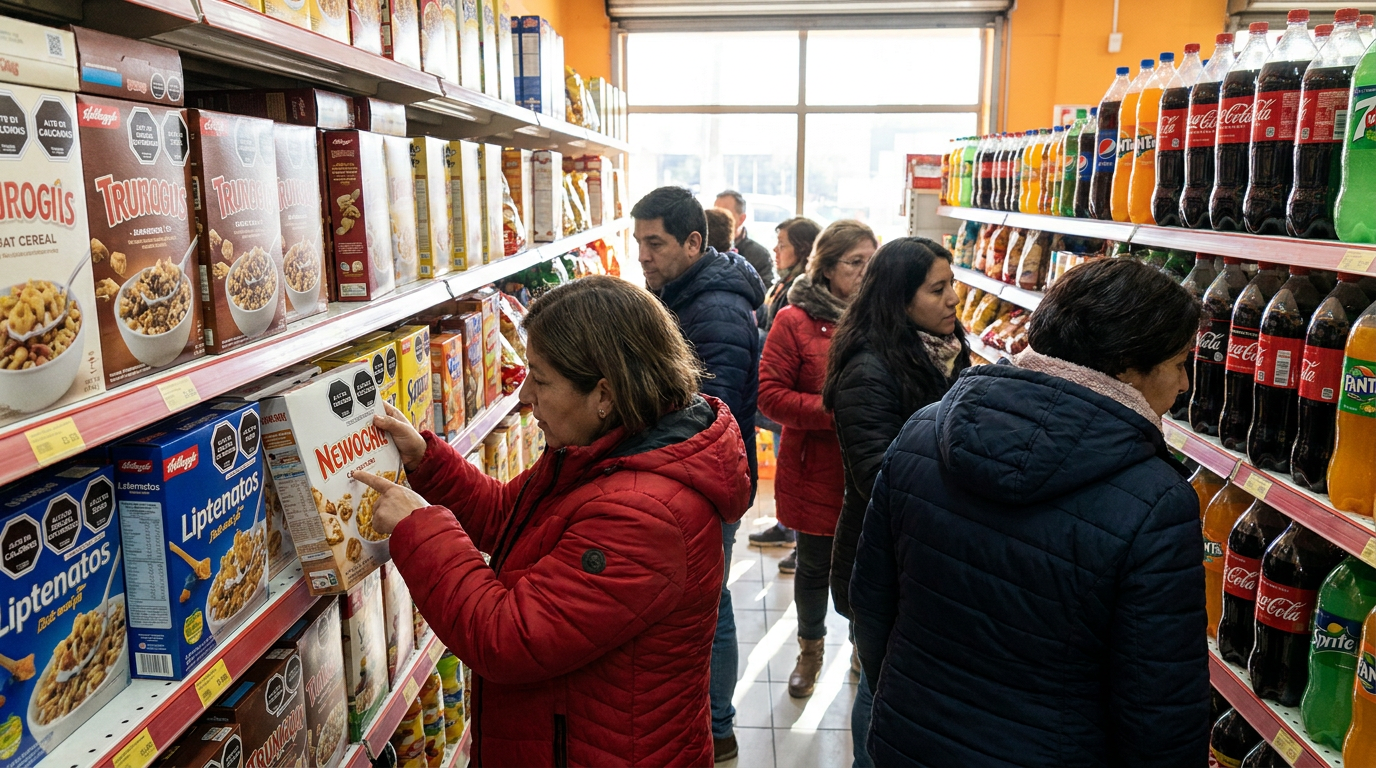
Walk down any supermarket aisle in Santiago, Chile, and the visual landscape is striking. Instead of packages covered exclusively in colorful mascots and health claims, thousands of products bear stark, black octagonal "stop signs." These labels bluntly declare when a food is "High in Sugar," "High in Sodium," "High in Saturated Fat," or "High in Calories." It is a deliberate visual disruption designed to break the autopilot of grocery shopping.[7]
A decade ago, Chile faced a crushing public health crisis. The country had some of the highest rates of sugar-sweetened beverage consumption in the world, and childhood obesity was climbing at an alarming rate. Recognizing that voluntary industry guidelines were failing to move the needle, the Chilean government passed the trailblazing Law of Food Labeling and Advertising, which went into full effect in 2016.[7]
Now, years of long-term data are confirming what public health officials had hoped: the black octagons work. Recent evaluations highlighted by global health monitors reveal that Chile's aggressive approach has triggered sweeping reductions in the consumption of concerning nutrients, providing a real-world blueprint for other nations struggling with diet-related diseases.[1][7]
The mechanism behind the law is uncompromising. Rather than relying on complex nutritional matrices or traffic-light systems that blend good and bad nutrients into a confusing average, the Chilean model uses absolute thresholds. If a product crosses the legal limit for added sugar, sodium, saturated fat, or calorie density, it gets a black octagon. If it crosses multiple limits, it gets multiple octagons.[2]

To give the food industry time to adapt, the government implemented the thresholds in three progressively stricter phases between 2016 and 2019. By the final phase, the limits were tightened significantly—for example, the threshold for a "High in Sugar" label dropped from 22.5 grams per 100 grams of solid food down to just 10 grams.[3]
Crucially, the labels serve as the anchor for a much broader regulatory ecosystem. Any product carrying at least one black octagon is legally barred from being marketed to children under 14. This means no cartoon mascots on the box, no toy tie-ins, and no television advertisements during daytime programming. Furthermore, these labeled products are entirely banned from being sold or promoted within Chilean schools.[4]
The impact on consumer behavior has been profound. According to comprehensive household purchasing data, Chileans bought 37 percent less sugar from labeled products after the law's second phase took effect. Purchases of sodium from labeled products dropped by 22 percent, saturated fat by 16 percent, and total calories from these items fell by 23 percent.[2]
According to comprehensive household purchasing data, Chileans bought 37 percent less sugar from labeled products after the law's second phase took effect.
The labels proved particularly effective at shattering the "health halo" surrounding certain products. Items like sweetened fruit juices, granola bars, and flavored yogurts—which were previously marketed as healthy choices—were suddenly stamped with "High in Sugar" warnings. Consequently, purchases of high-calorie beverages plummeted by 24 percent, a reduction significantly larger than those achieved by standalone soda taxes in other countries.[2][5]
But the most transformative effect of the law occurred before consumers even reached the checkout aisle. Faced with the prospect of their products being plastered with black warning signs and banned from schools, food manufacturers initiated a massive wave of recipe reformulation. The industry realized that the most effective marketing strategy was to alter their products to fall below the government's strict thresholds.[3][7]

Prior to the law's implementation in 2016, approximately 71 percent of packaged foods and beverages in Chilean supermarkets contained enough sugar, salt, or fat to require a warning label. By 2020, after the strictest phase of the law went into effect, that number had dropped to 53 percent. Categories like breakfast cereals, savory spreads, and dairy products saw the most aggressive reformulations.[3]
These environmental shifts are beginning to translate into measurable health outcomes for the next generation. A sweeping analysis of more than 300,000 schoolchildren found that exposure to Chile's policy package plausibly reduced the risk of early childhood obesity. Children aged four to six who were exposed to the law for 18 months were up to 2.9 percent less likely to be overweight or obese compared to historical cohorts.[4]
While a 2.9 percent reduction may sound modest, epidemiologists note that reversing population-level metabolic trends is a generational challenge. Even small reductions in excess weight during early childhood can significantly alter lifelong health trajectories, reducing the future burden of type 2 diabetes and cardiovascular disease.[4][6]

Despite these victories, researchers acknowledge ongoing uncertainties. Adult obesity rates in Chile remain stubbornly high, illustrating that labeling laws cannot instantly undo decades of dietary habits or address underlying socioeconomic disparities in fresh food access. Furthermore, as companies reformulate to avoid sugar labels, many have increased their use of artificial non-nutritive sweeteners, the long-term health impacts of which remain a subject of active scientific debate.[2][7]
Nevertheless, the Chilean experiment has fundamentally shifted the global consensus on food policy. For years, the food industry successfully lobbied for voluntary, self-regulated labeling systems. Chile proved that mandatory, government-defined warning labels are not only legally viable but highly effective at changing both supply and demand.[5][7]
The black octagon model is now rapidly spreading across Latin America. Mexico, Peru, Uruguay, and Argentina have all adopted similar mandatory front-of-package warning labels, adapting the Chilean framework to their own markets. The World Health Organization and UNICEF have both elevated the nutrient-specific warning label as a gold-standard policy recommendation.[5][6]

Ultimately, Chile's approach represents a paradigm shift in public health. By moving the burden of nutritional vigilance away from the individual consumer and placing it squarely on the food environment, the country has demonstrated that clear, unavoidable information is a powerful catalyst for systemic change.[6][7]
How we got here
2012
The Chilean government passes the foundational Law of Food Labeling and Advertising.
June 2016
Phase 1 takes effect, introducing the black octagonal warning labels and initial nutrient thresholds.
June 2018
Phase 2 lowers the allowed limits for sugar, sodium, saturated fat, and calories.
June 2019
Phase 3 implements the strictest final thresholds, forcing further industry reformulation.
2024–2026
Long-term academic studies confirm sustained reductions in unhealthy purchases and a drop in early childhood obesity risk.
Viewpoints in depth
Public Health Authorities
Global health organizations view mandatory labels as essential for combating diet-related diseases.
Organizations like the WHO and UNICEF argue that voluntary, industry-led labeling systems have consistently failed to improve public health. They point to Chile's mandatory, government-defined thresholds as the gold standard, noting that clear, unavoidable warnings are necessary to counteract billions of dollars in junk food marketing and effectively reduce the burden of non-communicable diseases.
Behavioral & Nutrition Scientists
Researchers focus on how the labels act as a behavioral nudge that breaks the 'health halo' of processed foods.
Behavioral economists emphasize that the black octagons work because they disrupt the autopilot nature of grocery shopping. By stripping away the 'health halo' from products like sweetened yogurts and fruit juices, the labels force consumers to confront the actual nutritional profile of their purchases. This shift in perception not only changes household buying habits but also alters social norms around what is considered acceptable food for children.
Food Industry & Retailers
Manufacturers highlight the massive logistical and financial effort required to reformulate products.
Faced with strict regulations that threatened their market share and access to school-aged consumers, food and beverage companies undertook unprecedented efforts to alter their recipes. While the industry largely complied, manufacturers note the immense technical challenge of reducing sugar and sodium without compromising taste or shelf life. Consequently, many companies have shifted toward using artificial non-nutritive sweeteners as a workaround to avoid the 'High in Sugar' labels.
What we don't know
- The long-term health impacts of the massive industry shift toward artificial non-nutritive sweeteners as a replacement for sugar.
- Whether the labeling law will eventually lead to significant reductions in adult obesity rates, which have remained stubbornly high.
- How effectively the marketing restrictions are working in the era of unregulated social media influencers and digital advertising.
Key terms
- Front-of-Package Warning Label (FOPWL)
- A clear, visual indicator placed on the front of a product to alert consumers to high levels of concerning nutrients.
- Reformulation
- The process by which food manufacturers alter a product's recipe—such as reducing sugar or salt—to meet new health standards.
- Health Halo
- A psychological effect where a product is perceived as healthy due to marketing claims, masking its actual poor nutritional content.
- Non-Communicable Diseases (NCDs)
- Chronic health conditions, such as heart disease and type 2 diabetes, that are not transmissible and are often linked to diet and lifestyle.
Frequently asked
Do the warning labels make food more expensive?
Studies have shown that the implementation of the labeling law did not lead to significant price increases for consumers, as companies largely absorbed the costs of reformulation.
Are all foods required to have these labels?
No. The law only applies to packaged and processed foods with added sugars, sodium, or saturated fats. Single-ingredient whole foods like fresh fruit, vegetables, and raw meats are exempt.
Can companies just use smaller serving sizes to avoid the label?
No. The Chilean law calculates nutrient thresholds based on 100 grams or 100 milliliters of the product, preventing companies from manipulating serving sizes to dodge the warnings.
Have other countries copied this law?
Yes. Mexico, Peru, Uruguay, and Argentina have all implemented similar mandatory front-of-package warning labels inspired by the Chilean model.
Sources
Source coverage
7 outlets
3 viewpoints surfaced







[1]STAT NewsFood Industry & Retailers
Chile offers new data on food warning label efficacy
Read on STAT News →[2]PLOS MedicineBehavioral & Nutrition Scientists
Changes in food purchases after the Chilean policies on food labelling
Read on PLOS Medicine →[3]BMC MedicineBehavioral & Nutrition Scientists
Chilean food supply sees substantial decreases in sugar, sodium, and saturated fat
Read on BMC Medicine →[4]The LancetPublic Health Authorities
Chile's combined food labelling, marketing and school food reforms plausibly reduced obesity risk
Read on The Lancet →[5]UNICEFPublic Health Authorities
Front-of-package nutrition labelling: Evidence of effectiveness
Read on UNICEF →[6]World Health OrganizationPublic Health Authorities
Front-of-package warning labels backed by WHO dietary intake goals
Read on World Health Organization →[7]Factlen Editorial TeamBehavioral & Nutrition Scientists
Synthesis by Factlen editorial team
Read on Factlen Editorial Team →

More in health
See all 6 stories →Dementia Research
Common Shingles Vaccine Linked to 24% Lower Dementia Risk in Major Study
6 sources

Gut Health
The Gut-Brain Axis: How the Microbiome Influences Mental Health and Cognitive Function
6 sources

Exercise Mimetics
The Science of the 'Exercise Pill': How New Mimetics Trick the Body into Fitness
7 sources

Vaccine Research
How the Shingles Vaccine Emerged as a Promising Shield Against Dementia
7 sources

Every angle. Every day.
Get health stories with full source coverage and perspective breakdowns delivered to your inbox.