
How Bidirectional Charging is Turning Electric Vehicles into Mobile Power Plants
As automakers make two-way charging standard in 2026, electric vehicles are evolving from simple transportation into massive home batteries that can slash utility bills and stabilize the power grid.
By Factlen Editorial Team
- Grid Operators & Utilities
- Viewing EVs as a massive, decentralized battery network to stabilize the grid and prevent blackouts.
- Homeowners & Consumers
- Prioritizing energy independence, blackout resilience, and lower daily utility bills.
- Hardware & Auto Manufacturers
- Racing to standardize bidirectional technology and reduce installation friction to sell new capabilities.
What's not represented
- · Traditional fossil-fuel generator manufacturers
- · Renters without access to home charging infrastructure
Why this matters
Bidirectional charging transforms the electric vehicle from a simple mode of transportation into a massive home battery. For consumers, this means total protection against grid blackouts and significantly lower daily utility bills, while providing society with a decentralized power network that can prevent large-scale power failures.
Key points
- Bidirectional charging allows electric vehicles to discharge stored energy back into homes, appliances, or the public power grid.
- An average EV battery holds enough energy to power a standard household for several days during a blackout.
- Vehicle-to-Home (V2H) technology can save owners hundreds of dollars annually by avoiding peak utility rates.
- Major automakers, including GM and Tesla, are making bidirectional capabilities standard across their 2026 vehicle lineups.
- California estimates its EV fleet holds 18.5 gigawatts of potential storage, surpassing all stationary utility batteries in the state.
For decades, the relationship between a car and its fuel source has been strictly one-way: you fill the tank, and the car burns the fuel. The first generation of electric vehicles followed the same logic, drawing power from the grid to fill their batteries. But in 2026, a fundamental shift in energy architecture is reaching the mainstream market. Electric vehicles are no longer just modes of transportation; they are being transformed into massive, mobile power plants capable of sending electricity back into homes and the public grid.[1][8]
This two-way flow of electricity, known as bidirectional charging, capitalizes on a simple reality: the average personal vehicle sits parked and idle for roughly 95 percent of its life. Instead of letting that immense energy storage sit dormant in a driveway or office parking lot, bidirectional technology allows the vehicle to act as a dynamic energy node. By unlocking the battery's ability to discharge power back out through the charging port, automakers and grid operators are turning a depreciating transportation asset into a revenue-generating piece of home infrastructure.[2][5]
To understand the scale of this shift, it helps to compare an EV to a standard home battery system. A popular residential battery, like the Tesla Powerwall, holds about 13.5 kilowatt-hours (kWh) of energy. In contrast, the average new electric vehicle in 2026 boasts a battery capacity exceeding 80 kWh, with larger trucks like the Ford F-150 Lightning carrying up to 131 kWh. That means a single parked EV can hold the equivalent of five to ten home batteries—enough to power an average household for several days during a blackout.[2][6]

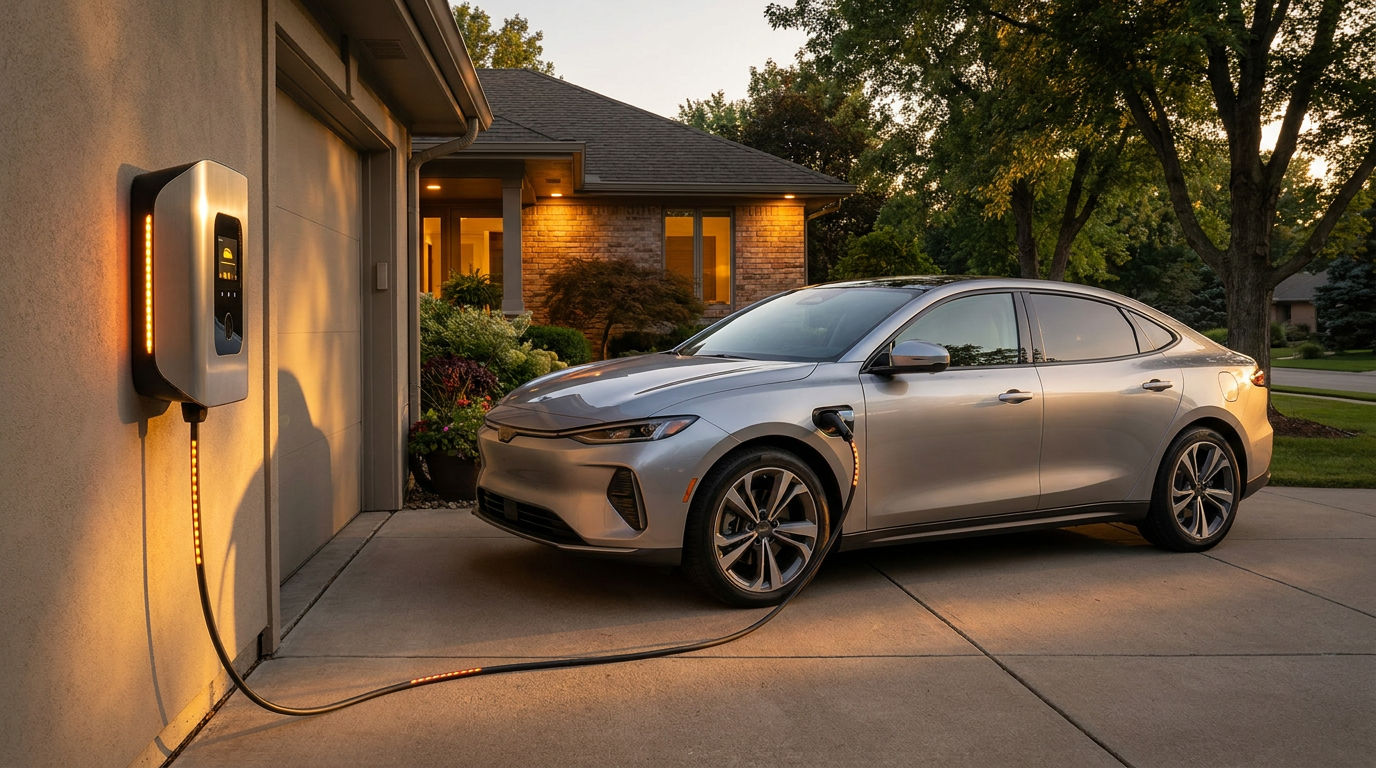
The technology is broadly categorized into three main applications, collectively referred to as Vehicle-to-Everything (V2X). The most accessible and rapidly adopted is Vehicle-to-Home (V2H). In a V2H setup, the EV is plugged into a specialized bidirectional wall charger. If the neighborhood loses power, the system automatically isolates the house from the dead grid and begins drawing direct current (DC) from the car, converting it to alternating current (AC) to keep the lights, refrigerator, and medical equipment running.[1][4][6]
But V2H isn't just for emergencies. Smart charging software allows homeowners to play the energy market every day. The system can be programmed to charge the car in the middle of the night when electricity rates are rock-bottom, or during the day using excess rooftop solar power. Then, during the late afternoon and evening when utility rates peak, the house stops pulling from the grid and instead runs entirely off the car's battery. The California Energy Commission projects this daily arbitrage can save households an average of $262 to $321 per summer season.[1][2][4][6]
The second, and more ambitious, application is Vehicle-to-Grid (V2G). While V2H keeps the energy behind the home's utility meter, V2G allows the car to export its stored power back into the broader electrical network. During extreme heatwaves or winter storms when the grid is strained, utility companies can call upon thousands of plugged-in EVs to simultaneously discharge a small portion of their batteries.[1][4][7]

The second, and more ambitious, application is Vehicle-to-Grid (V2G).
This decentralized network of vehicles acts as a "virtual power plant," providing instantaneous relief to the grid and preventing rolling blackouts. In exchange, EV owners are financially compensated by the utility for the energy they provide. The potential scale is staggering. A 2026 roadmap from the California Energy Commission revealed that the state's EV fleet already represents an estimated 18.5 gigawatts of potential energy storage—surpassing the total capacity of all stationary utility storage in the state.[1][2][7]
The third and simplest application is Vehicle-to-Load (V2L). Unlike V2H and V2G, which require expensive wall-mounted hardware and complex home integration, V2L is built directly into the car itself. It provides standard AC electrical outlets in the cabin, trunk, or truck bed, allowing drivers to plug in laptops, heavy power tools, or camping equipment. In emergency situations, V2L can even be used to charge another stranded electric vehicle directly from the host vehicle's battery, making it a highly versatile feature for off-grid utility and remote work sites.[4][7]
While the concept of bidirectional charging has existed in pilot programs for over a decade—pioneered early on by the Nissan Leaf—2026 marks the tipping point for mass commercialization. Automakers are aggressively rolling out the capability. General Motors has announced that bidirectional hardware will be standard across nearly its entire 2026 lineup, including the upcoming sub-$30,000 Chevrolet Bolt. Tesla, Kia, Hyundai, Volvo, and Polestar are similarly integrating the technology into their fleets.[2][3][5]
However, significant hurdles remain before every driveway becomes a self-sustaining microgrid. The primary bottleneck is the specialized hardware required for the home. Bidirectional chargers are essentially heavy-duty electrical inverters that must safely manage high-voltage direct current, and they remain significantly more expensive than standard one-way chargers. Furthermore, installing them is rarely a plug-and-play operation; it often requires costly electrical panel upgrades, the installation of automatic transfer switches to safely isolate the home during a blackout, and complex permitting processes that vary wildly by municipality.[1][6]

To mitigate these steep upfront costs, energy companies are introducing leasing models for bidirectional equipment, and several states are rolling out targeted infrastructure rebates to incentivize adoption. Industry leaders are also working feverishly to standardize the communication protocols between different car brands and charger manufacturers. The goal is interoperability—ensuring that a Ford bidirectional charger can seamlessly pull power from a Kia or Volkswagen vehicle without software conflicts, much like how USB-C standardized charging for consumer electronics.[1][2][3]
Regulatory friction is another major barrier. For V2G to work, utility companies and local governments must establish clear "interconnection" rules that legally allow residential homes to push power back onto the grid. While states like California, Maryland, and New York have pioneered these frameworks, much of the country still lacks the regulatory structure to support widespread V2G deployment.[3]
Finally, there is the persistent consumer anxiety regarding battery degradation. EV batteries degrade slightly with every charge and discharge cycle, leading some owners to worry that using their car to power their house will prematurely kill the battery. However, automakers and software providers design these systems to operate within strict parameters, limiting the depth of discharge and managing thermal loads to ensure the battery's lifespan is not meaningfully compromised.[4][8]

As these technical and regulatory barriers fall, the relationship between consumers and the energy grid is being fundamentally rewritten. The California Energy Commission likens the shift to the transition from mobile phones to smartphones. Just as a phone evolved from a device that only made calls into a pocket computer, the electric vehicle is evolving from a simple mode of transport into an intelligent, indispensable node in the global energy network.[2][3][8]
How we got here
2013
Nissan introduces the Leaf, the first widely available EV with basic bidirectional capabilities.
2022
Ford launches the F-150 Lightning with 'Intelligent Backup Power,' bringing V2H to the mainstream US market.
2024 - 2025
Pilot programs for V2G expand, and bidirectional chargers begin entering the residential market.
2026
Major automakers, including GM and Tesla, begin making bidirectional hardware standard across their vehicle lineups.
Viewpoints in depth
Grid Operators & Utilities
Viewing EVs as a massive, decentralized battery network to stabilize the grid.
For utility companies, the rapid adoption of electric vehicles initially posed a threat of overwhelming local transformers during peak charging hours. However, bidirectional charging flips this dynamic, turning millions of parked cars into a massive, decentralized energy reserve. By tapping into these batteries during extreme weather events or peak demand spikes, grid operators can avoid firing up expensive and polluting 'peaker' power plants. The focus for utilities is now on creating Virtual Power Plant (VPP) programs that seamlessly aggregate and dispatch this energy, transforming EVs from a grid liability into its ultimate safety net.
Homeowners & Consumers
Prioritizing energy independence, blackout resilience, and lower daily utility bills.
From the consumer perspective, the appeal of bidirectional charging lies in energy sovereignty and financial return. While the upfront cost of a bidirectional charger and home integration system is steep, the payoff is a home battery that is five to ten times larger than a standard wall-mounted unit. Consumers are drawn to the peace of mind that comes with surviving multi-day blackouts, as well as the daily financial arbitrage of charging at cheap overnight rates and powering their home during expensive evening hours, effectively slashing their utility bills.
Hardware & Auto Manufacturers
Racing to standardize bidirectional technology and reduce installation friction.
Automakers and charging hardware companies view bidirectional capabilities as the next major competitive frontier in the EV market. Their primary challenge is reducing the friction of adoption. Currently, installing a bidirectional system requires navigating a maze of local permitting, electrical panel upgrades, and proprietary software ecosystems. Manufacturers are pushing heavily for universal standards—ensuring any brand of car can communicate with any brand of charger—while simultaneously developing leasing models to lower the barrier to entry for consumers.
What we don't know
- How quickly local municipalities will streamline the complex permitting processes required to install bidirectional home chargers.
- Whether utility companies nationwide will offer standardized financial compensation for consumers who send power back to the grid.
- The long-term impact of daily bidirectional cycling on the resale value of electric vehicles.
Key terms
- Bidirectional Charging
- Technology that allows an electric vehicle to both receive electricity from the grid and discharge it back out.
- V2H (Vehicle-to-Home)
- Using an EV's battery to supply power directly to a house, often to provide backup power or avoid peak electricity rates.
- V2G (Vehicle-to-Grid)
- Exporting stored energy from an EV back to the public electricity network, often for utility compensation.
- V2L (Vehicle-to-Load)
- Using an EV to directly power external appliances, tools, or camping equipment via standard AC outlets.
- Virtual Power Plant (VPP)
- A decentralized network of home batteries and EVs coordinated by software to supply power to the grid during peak demand.
Frequently asked
Will bidirectional charging ruin my EV's battery?
While increased cycling does add wear, modern charging software limits the depth of discharge to protect battery health, and the impact is generally considered minimal compared to driving.
Do I need a special charger for V2H or V2G?
Yes. You need a bidirectional EV charger (EVSE) that contains an inverter to convert the car's DC power back into AC power for your home or the grid.
Can any electric vehicle do this?
Not yet, but the list is growing rapidly in 2026. Vehicles like the Ford F-150 Lightning, Kia EV9, and upcoming GM and Tesla models support bidirectional flow, but older EVs may lack the necessary hardware.
Sources
Source coverage
8 outlets
3 viewpoints surfaced








[1]Canary MediaHomeowners & Consumers
Bidirectional charging on display: How EVs are powering homes
Read on Canary Media →[2]California Energy CommissionGrid Operators & Utilities
State of California Bidirectional Charging Roadmap
Read on California Energy Commission →[3]V2G NewsGrid Operators & Utilities
2026 Predictions: The State of Bidirectional Charging
Read on V2G News →[4]RACVHomeowners & Consumers
What is bidirectional EV charging and how does it work?
Read on RACV →[5]DriivzHardware & Auto Manufacturers
Bidirectional Charging: V2G, V2H, and V2X Explained
Read on Driivz →[6]Clean Energy ReviewsHardware & Auto Manufacturers
Bidirectional EV Chargers Explained - V2G and V2H
Read on Clean Energy Reviews →[7]ElectroverseHardware & Auto Manufacturers
Everything you need to know about bidirectional charging
Read on Electroverse →[8]Factlen Editorial TeamHomeowners & Consumers
Synthesis by Factlen editorial team
Read on Factlen Editorial Team →
Every angle. Every day.
Get transportation stories with full source coverage and perspective breakdowns delivered to your inbox.