
The Return of the Sail: How Wind-Assisted Propulsion is Decarbonizing Global Shipping
Facing strict new emissions mandates, the global shipping industry is rapidly adopting high-tech wind propulsion systems like Flettner rotors and rigid sails to slash fuel consumption.
By Factlen Editorial Team
- Commercial Shipowners
- Focuses on the immediate return on investment, fuel savings, and hedging against volatile bunker prices and carbon taxes.
- Environmental Regulators
- Views wind propulsion as a critical, verifiable tool for meeting the IMO's 2050 net-zero targets and reducing the industry's 3% global emissions share.
- Maritime Engineers
- Prioritizes the technological optimization of aerodynamics, advanced materials, and lidar-based data integration to maximize thrust.
What's not represented
- · Port Authorities
- · Seafarers Unions
Why this matters
Maritime shipping accounts for roughly 3% of global greenhouse gas emissions. By harnessing wind power, the industry can drastically reduce its carbon footprint and compliance costs, ensuring the stable flow of global trade in a net-zero future.
Key points
- The maritime industry is rapidly adopting wind-assisted propulsion to meet strict new decarbonization mandates.
- Flettner rotors, which use spinning cylinders to generate thrust, are currently the most popular technology for large cargo ships.
- Wind-assist systems can reduce a commercial vessel's fuel consumption by 5% to 25%.
- Advanced lidar technology is increasingly used to measure undisturbed wind and optimize sail performance in real-time.
For millennia, the global economy relied entirely on the wind to move goods across the oceans, a practice that faded into obsolescence with the advent of steam and diesel engines. Today, in a striking historical reversal, the maritime shipping industry is returning to its roots. Wind-assisted ship propulsion (WASP) has transitioned from a niche environmental concept to a rapidly scaling commercial reality. As of early 2026, the technology is being deployed on massive bulk carriers, oil tankers, and roll-on/roll-off cargo ships worldwide, fundamentally altering the silhouette of modern merchant fleets and proving that ancient principles can solve modern crises.[6]
The scale of this maritime renaissance is accelerating at an unprecedented pace. According to industry data, over 60 large commercial vessels are currently operating with wind-assist technologies, with more than 100 additional installations scheduled for delivery by the end of 2026. Projections from the International Windship Association suggest that between 3,700 and 10,700 systems could be installed globally by 2030. This is not an incremental trend but a transformational shift in how ships are designed, built, and operated, driven by the urgent need to decarbonize a sector responsible for roughly 3% of global greenhouse gas emissions.[3][5][6]
The catalyst for this rapid adoption is a tightening web of international environmental regulations. The International Maritime Organization (IMO) has set ambitious targets to achieve net-zero greenhouse gas emissions by 2050, with intermediate milestones requiring a 40% reduction in carbon intensity by 2030. Simultaneously, the European Union's Emissions Trading System (EU ETS) has expanded to include maritime shipping, reaching 100% carbon cost coverage in 2026. With carbon prices adding significant operational costs, shipowners are highly incentivized to find immediate, verifiable ways to cut fuel consumption.[4]
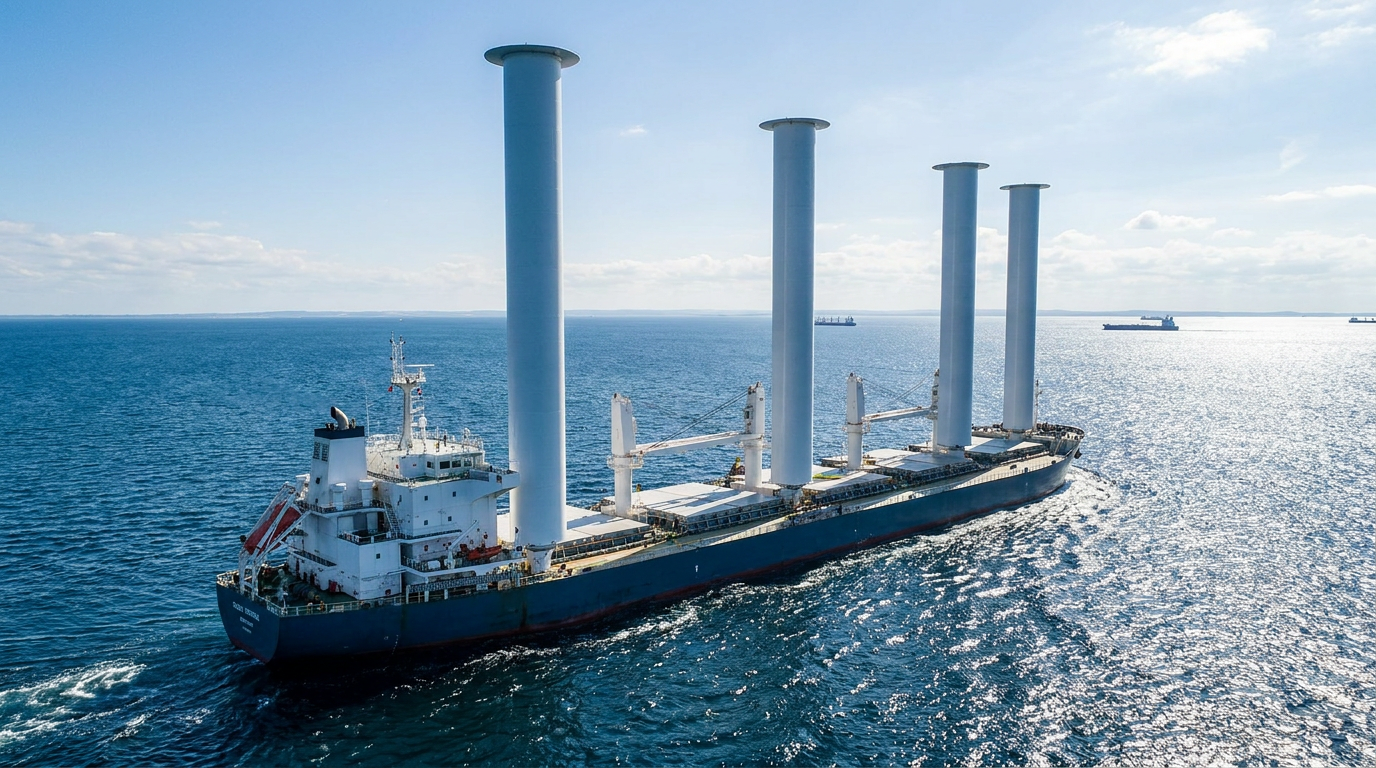
Among the various wind propulsion technologies, the Flettner rotor—or rotor sail—has emerged as the dominant solution, particularly for bulk carriers and tankers. Unlike traditional canvas sails, a rotor sail is a large, upright cylinder mounted on a ship's deck that is mechanically spun by a small motor. As wind flows around the spinning cylinder, it creates a pressure differential that generates aerodynamic lift perpendicular to the wind direction—a phenomenon known as the Magnus effect. This thrust is then transferred to the ship's hull, supplementing the main engine and reducing the load on the propellers.[1][4][5][6]

The engineering scale of these modern rotor sails is staggering. In April 2026, engineers at China State Shipbuilding Corp (CSSC), the world's largest shipbuilder, unveiled one of the largest rotor sail models ever developed. Measuring 35 meters in height and 5 meters in diameter, each of these massive cylinders can produce a top thrust of more than 355 kilonewtons while rotating at up to 180 revolutions per minute. Constructed from advanced green composite materials, these systems are designed to withstand the brutal conditions of the open ocean while requiring virtually no modifications to a ship's original operating procedures.[2]
The economic proposition of rotor sails and other WASP technologies is compelling. Depending on the vessel type, route, and prevailing weather conditions, wind-assisted propulsion can reduce a ship's fuel consumption by an average of 5% to 25%. On certain highly optimized trans-oceanic routes, emissions reductions of up to 30% have been reported. For a massive Capesize bulk carrier burning dozens of tons of heavy fuel oil per day, a double-digit percentage reduction translates to millions of dollars in annual fuel savings, effectively hedging against volatile bunker fuel prices and future carbon taxes.[2][4][5]
The economic proposition of rotor sails and other WASP technologies is compelling.
While rotor sails currently lead the market, they are not the only technology gaining traction. Rigid wing sails, which resemble vertical airplane wings, are also seeing increased deployment. These automated, highly aerodynamic structures use adjustable flaps to control camber and maximize lift, producing significantly more power per square meter than traditional soft sails. Suction sails, which use internal fans to draw boundary-layer air through vents to enhance lift, and large automated kite systems that fly high above the vessel to capture stronger, more consistent winds, are also being actively commercialized.[5][6]

As the hardware matures, the industry's focus is shifting toward data and optimization. The efficiency of any wind-assist system is entirely dependent on the vessel's ability to locate and harness optimal wind conditions. Historically, ships relied on conventional anemometers, which often suffer from interference caused by the ship's own superstructure and the sails themselves. To solve this, maritime engineers are increasingly turning to advanced lidar (Light Detection and Ranging) technology to measure undisturbed wind patterns hundreds of meters ahead of the vessel.[3]
Lidar systems provide highly accurate, real-time data on wind speed and direction, allowing the ship's automated control systems to continuously adjust the sails for maximum thrust. A recent industry survey revealed that nearly 70% of maritime operators now favor lidar-based remote wind measurements, recognizing that precise data is the key to verifying performance and maximizing return on investment. The new ISO 15016:2025 specifications, which apply to sea trials conducted in 2026, explicitly recognize lidar as a crucial tool for assessing the speed and power performance of wind-assisted ships.[3]
Despite the clear benefits, integrating massive wind structures onto commercial vessels presents distinct engineering and operational challenges. Deck space is at a premium, particularly on container ships where cargo is stacked high above the hull. Rotor sails and wing sails must be carefully positioned to avoid interfering with loading and unloading operations at port. To address this, many manufacturers now offer retractable or folding sail designs that can be lowered during cargo operations or when navigating under bridges and through narrow straits.[1][2][5]

The adoption curve is also being shaped by the dynamics of the global shipbuilding market. While retrofitting existing vessels is currently the most common approach, naval architects are increasingly designing "WASP-ready" newbuilds. By integrating wind propulsion concepts from the initial drafting stage, engineers can optimize the hull lines, weight distribution, and power management systems to maximize the synergistic effects of wind and mechanical propulsion. This holistic approach ensures that the vessel operates at peak efficiency across a wider range of conditions.[5]
Major global commodity players are throwing their weight behind the technology, providing the crucial market pull needed for rapid scaling. Brazilian mining giant Vale, global agricultural trader Cargill, and major ship operators like Berge Bulk have all committed to installing wind-assist systems on their massive dry bulk carriers. Anemoi Marine Technologies, a leading UK-based rotor sail manufacturer, recently announced plans to scale its production capacity to 250 sails per year by the end of 2025 to meet surging demand from these industry heavyweights, signaling a shift from custom pilot projects to serialized industrial production.[1]
Looking ahead, wind propulsion is not viewed as a replacement for the internal combustion engine, but rather as an essential baseline technology for the zero-carbon future. As the industry transitions to alternative green fuels like ammonia, methanol, and hydrogen, it faces a harsh economic reality: these future fuels are significantly more expensive and have lower energy densities than traditional fossil fuels. By cutting the total energy demand of the vessel at the source, wind-assist systems will make the transition to zero-carbon fuels economically viable.[5][6]

The return of the sail represents a rare convergence of environmental necessity, economic incentive, and technological innovation. By combining the ancient principles of wind power with cutting-edge aerodynamics, advanced materials, and real-time data analytics, the maritime industry is charting a course toward a more sustainable future. As thousands of wind-assisted ships prepare to take to the seas in the coming years, the global supply chain is proving that sometimes the most advanced solutions are rooted in the oldest traditions, ensuring that global trade can continue to thrive in a net-zero world.[6]
How we got here
2018
Early pilot projects begin testing modern rotor sails on commercial ferries and small cargo vessels.
2023
The International Maritime Organization revises its greenhouse gas strategy, targeting net-zero emissions by 2050.
2025
FuelEU Maritime regulations take effect, applying financial penalties for high carbon intensity in shipping.
2026
Wind-assisted propulsion reaches mainstream commercial adoption with hundreds of orders placed globally.
Viewpoints in depth
Commercial Shipowners
Focuses on the immediate return on investment, fuel savings, and hedging against volatile bunker prices and carbon taxes.
For the companies that actually own and operate the world's merchant fleets, the transition to wind power is fundamentally an economic calculation. Heavy fuel oil is a massive operational expense, and the introduction of carbon pricing mechanisms like the EU ETS has effectively created a tax on inefficiency. Shipowners view wind-assisted propulsion as a reliable hedge against these rising costs. Because the wind is free, a system that cuts fuel consumption by 15% offers a predictable return on investment, often paying for itself within three to five years. Furthermore, having a 'green' fleet allows these companies to secure more favorable charter rates from environmentally conscious cargo owners.
Environmental Regulators
Views wind propulsion as a critical, verifiable tool for meeting the IMO's 2050 net-zero targets and reducing the industry's 3% global emissions share.
Regulatory bodies like the International Maritime Organization and the European Commission see wind-assist technologies as an essential bridge to a zero-carbon future. While the ultimate goal is to transition the global fleet to alternative fuels like green ammonia or methanol, the infrastructure and supply chains for those fuels are still years away from maturity. Regulators argue that wind propulsion provides immediate, verifiable emissions reductions today. By mandating lower carbon intensity scores through frameworks like the Energy Efficiency Existing Ship Index (EEXI), regulators are intentionally forcing the market to adopt these energy-saving technologies rather than waiting for future fuel miracles.
Maritime Engineers
Prioritizes the technological optimization of aerodynamics, advanced materials, and lidar-based data integration to maximize thrust.
For naval architects and clean-tech innovators, the challenge lies in maximizing the aerodynamic efficiency of massive structures in the harsh marine environment. Engineers are focused on moving beyond simple retrofits to designing holistic 'WASP-ready' vessels where the hull, engine, and sails operate as a single optimized system. A major priority for this camp is the integration of advanced sensor networks, particularly lidar, to feed real-time, undisturbed wind data into automated control systems. They argue that the true potential of wind propulsion will only be unlocked when ships can autonomously adjust their sails and route paths to perfectly match the prevailing weather systems.
What we don't know
- The long-term durability and maintenance costs of advanced composite sails after decades in harsh, corrosive ocean environments.
- The exact return on investment for smaller coastal vessels compared to massive deep-sea bulk carriers.
- How the eventual widespread availability of zero-carbon fuels will alter the cost-benefit ratio of installing expensive wind hardware.
Key terms
- WASP
- Wind-Assisted Ship Propulsion; a broad category of technologies that use wind power to supplement a vessel's main engine.
- Magnus Effect
- An aerodynamic phenomenon where a spinning object in a fluid or air stream creates a whirlpool of fluid around itself, generating a perpendicular lifting force.
- Flettner Rotor
- A type of wind propulsion system consisting of a large, mechanically spinning vertical cylinder that generates thrust via the Magnus effect.
- Lidar
- Light Detection and Ranging; a remote sensing method that uses pulsed lasers to measure variable distances and, in shipping, to accurately map undisturbed wind patterns ahead of a vessel.
- EU ETS
- The European Union Emissions Trading System, a 'cap and trade' scheme that now requires maritime shipping companies to pay for their carbon emissions.
Frequently asked
What is a Flettner rotor?
A Flettner rotor is a large, upright cylinder mounted on a ship's deck that spins mechanically. As wind hits the spinning cylinder, it creates a pressure difference that generates forward thrust, known as the Magnus effect.
Can wind power completely replace ship engines?
No. Current wind-assist technologies are designed to supplement the main engine, not replace it. They reduce the load on the engine, saving fuel, but mechanical propulsion is still required for consistent speed and maneuvering.
How much fuel do these systems actually save?
Depending on the vessel type, route, and weather conditions, wind-assisted propulsion typically reduces a ship's fuel consumption by 5% to 25%, with some optimized routes seeing up to 30% savings.
Why is the shipping industry adopting sails now?
Strict new environmental regulations, such as the IMO's 2050 net-zero targets and the EU's carbon pricing system, have made high emissions financially penalizing. Wind power offers an immediate way to cut fuel use and compliance costs.
Sources
Source coverage
6 outlets
3 viewpoints surfaced






[1]Lloyd's RegisterMaritime Engineers
Wind Assisted Ship Propulsion comes of age
Read on Lloyd's Register →[2]China DailyCommercial Shipowners
China's shipbuilding giant develops advanced rotor sails for greener shipping
Read on China Daily →[3]VaisalaMaritime Engineers
The next frontier in wind-assisted ship propulsion
Read on Vaisala →[4]DataInteloCommercial Shipowners
Rotor Sail Market Outlook 2025-2034
Read on DataIntelo →[5]WindassistEnvironmental Regulators
Wind-assisted propulsion systems for commercial shipping
Read on Windassist →[6]Factlen Editorial TeamMaritime Engineers
Synthesis by Factlen editorial team
Read on Factlen Editorial Team →
Every angle. Every day.
Get transportation stories with full source coverage and perspective breakdowns delivered to your inbox.