
How Autonomous AI Agents Are Moving from Chatbots to Action-Takers
AI systems in 2026 have evolved beyond generating text, utilizing multi-agent networks and visual computer use to autonomously execute complex workflows.
By Factlen Editorial Team
- Enterprise Adopters
- Focuses on the massive efficiency gains, cost reductions, and scalability unlocked by deploying multi-agent workflows in business operations.
- Systems Architects
- Emphasizes the technical evolution of agent frameworks, the shift to decentralized networks, and the standardization of tool access via protocols like MCP.
- AI Safety & Governance
- Highlights the inherent risks of granting AI systems direct action capabilities, advocating for strict sandboxing and human-in-the-loop oversight.
What's not represented
- · Human workers whose routine tasks are being automated by agentic workflows
- · Legacy software vendors adapting to visual AI navigation
Why this matters
The transition from conversational AI to action-oriented agents means software can now autonomously execute multi-step tasks across different applications. This shift is fundamentally changing how digital work is delegated, allowing humans to offload tedious software operations and focus on high-level strategy.
Key points
- AI agents have moved beyond text generation to autonomously executing multi-step workflows using external tools.
- The ReAct cycle allows agents to reason, act, and adapt to errors dynamically without human intervention.
- Computer use capabilities enable AI to visually navigate legacy software and desktop applications that lack traditional APIs.
- Multi-agent systems distribute complex tasks across specialized AI personas, reducing hallucinations and context exhaustion.
- The Model Context Protocol (MCP) has standardized how agents securely connect to enterprise databases and applications.
- Production deployments require strict sandboxing and human-in-the-loop checkpoints to prevent unauthorized or destructive actions.
For the past few years, the public’s relationship with artificial intelligence has been largely conversational. Users typed prompts into a chat interface, and a large language model generated text in response. But in 2026, the era of the passive chatbot is giving way to a fundamentally different paradigm: the autonomous AI agent. Rather than simply answering questions, these systems are designed to take concrete actions across digital environments to achieve high-level goals. This transition marks the moment AI stopped being just a conversational partner and became an active participant in the digital workforce, capable of executing multi-step workflows with minimal human oversight.[8]
A production-grade AI agent is not merely a language model wrapped in a clever prompt. It is a comprehensive architecture comprising several distinct layers: a reasoning engine, short-term and long-term memory, planning capabilities, and access to external tools. While a traditional language model predicts the next word in a sequence, an agent operates within a continuous loop of perception, reasoning, and action. This architectural shift allows the system to evaluate its environment, decide on a course of action, execute that action, and then observe the results before determining its next move.[6]
This iterative process is commonly known as the ReAct cycle, standing for Reasoning and Acting. When given a complex objective, an agent does not attempt to generate a single, monolithic output. Instead, it breaks the goal down into smaller, manageable steps. It reasons about the current state of the task, selects an appropriate tool from its arsenal, executes a specific action, and then analyzes the feedback. If an API call fails or a search returns irrelevant results, the agent recognizes the error, adjusts its strategy, and tries an alternative approach. This adaptability is what grants agents their autonomy.[1][8]

The true power of an AI agent is defined by its "action space"—the specific set of tools it is permitted to use to interact with the outside world. Early agents were largely restricted to perception and analysis tools, such as reading files or querying databases. However, recent data from the UK AI Safety Institute reveals a massive shift toward execution. By early 2026, the share of AI tools designed to take direct action—such as executing code, sending emails, or making financial transactions—surged to 65 percent of all tool downloads, up from just 24 percent sixteen months prior.[3]

This explosion in tool usage was catalyzed by the widespread adoption of the Model Context Protocol (MCP). Introduced as an open standard, MCP acts as a universal plug that standardizes how agents communicate with external data sources and software applications. Instead of developers having to write custom, brittle integrations for every single API, MCP provides a uniform framework. Whether an agent needs to access a corporate database, a calendar application, or a cloud deployment platform, it can do so seamlessly, making production agents vastly more reliable and portable across different enterprise environments.[6]
Despite the efficiency of APIs, they have a critical limitation: millions of legacy applications and desktop software programs simply do not have them. To bridge this gap, developers introduced "computer use" capabilities, giving AI agents the digital equivalent of eyes and hands. Instead of relying on structured code to interact with a system, computer use agents observe the screen visually, interpret the graphical user interface, and execute actions exactly as a human would—by moving a cursor, clicking buttons, and typing on a keyboard.[4][5]
Computer use agents operate through a rapid, continuous perception-action loop powered by multimodal vision models. The agent captures a screenshot of the desktop, analyzes the visual layout to identify interactive elements like text fields and dropdown menus, and calculates the precise pixel coordinates required for a mouse click. Because they understand interfaces visually, these agents do not require backend access. They can navigate complex, unstructured environments, adapting on the fly if a button moves or a pop-up window obscures the screen.[5]

Computer use agents operate through a rapid, continuous perception-action loop powered by multimodal vision models.
The practical applications of computer use are transforming enterprise operations, particularly in environments burdened by technical debt. Where traditional rule-based automation fails entirely, visual agents thrive. They can log into decade-old accounting software, reconcile bank statements, extract data from scanned documents, and transfer information between incompatible legacy systems that have never been integrated. For organizations relying on outdated infrastructure, computer use agents offer a way to automate highly manual workflows without having to rewrite millions of lines of backend code.[4]
However, as developers began assigning increasingly complex tasks to these autonomous systems, they encountered a hard ceiling. A single AI agent, no matter how advanced, struggles when asked to act as an entire department. If a user asks a single model to research a market, write a comprehensive report, format the data, and publish it to a web portal, the agent often suffers from context exhaustion. It may lose its train of thought, hallucinate facts, or fail to verify its own work, much like a single human employee overwhelmed by wearing too many hats.[7]
The solution to this bottleneck is the Multi-Agent System (MAS). Rather than relying on one overloaded "god-mode" model, organizations now deploy coordinated teams of specialized AI agents. In a multi-agent architecture, the workload is distributed among distinct digital personas, each optimized for a specific function. These agents communicate with one another, share context, debate solutions, and review each other's outputs, effectively mimicking the structure of a human corporate department to tackle enterprise-grade complexity.[6][7]
In a typical multi-agent workflow, a "Supervisor" agent acts as the project manager, breaking down the user's high-level goal and delegating sub-tasks. A "Researcher" agent might be tasked with scouring the web and internal databases for information, passing its findings to a "Writer" or "Coder" agent for execution. Crucially, the system often includes a "Critic" or "QA" agent whose sole job is to audit the work of its peers, checking for errors, security flaws, or hallucinations before the final output is presented to the human user.[7]

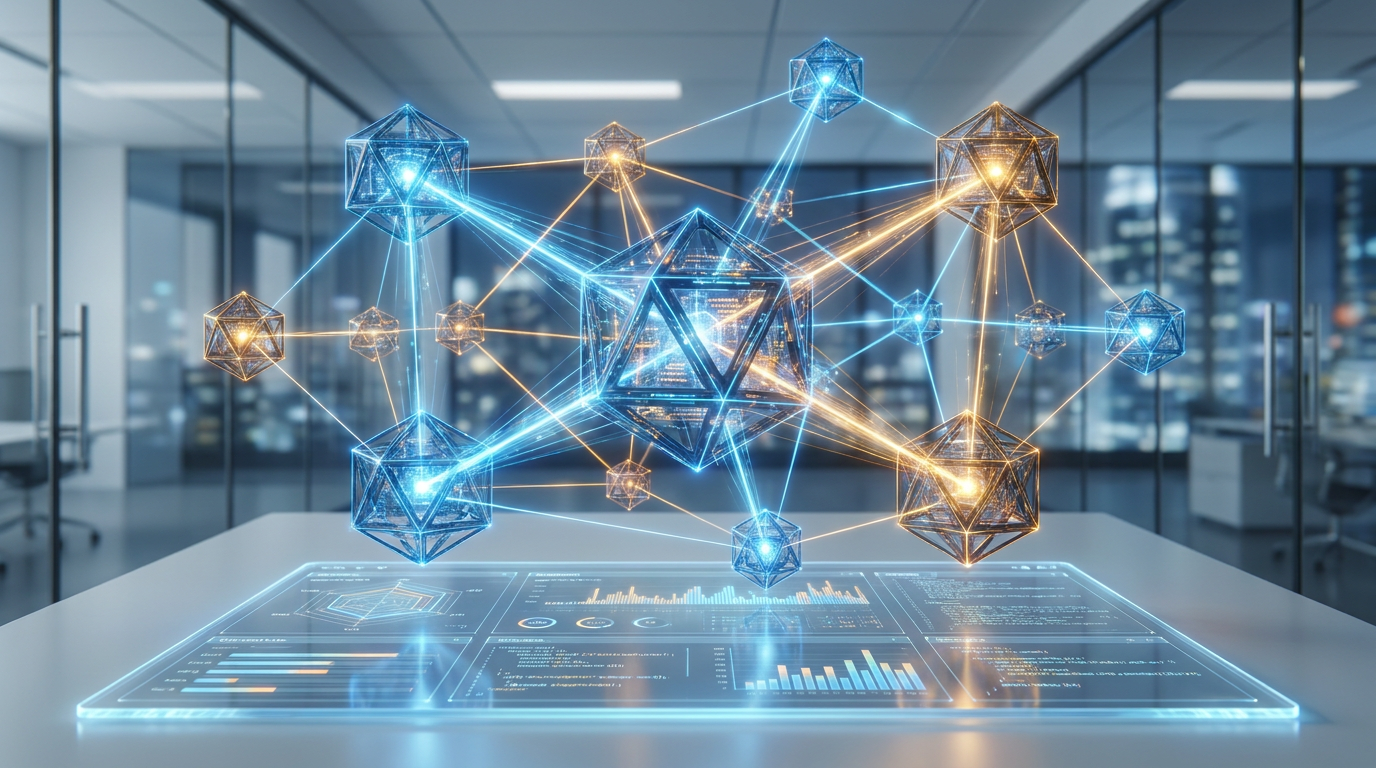
The infrastructure supporting these collaborative networks has matured rapidly, moving from experimental research projects to robust enterprise frameworks. While early systems relied heavily on centralized orchestration, newer architectures like AgentNet are pioneering decentralized models. In these advanced setups, agents autonomously route tasks and adjust their connections based on the specific demands of the workflow, eliminating single points of failure. This modularity allows organizations to mix and match different underlying language models, using a powerful, expensive model for the Supervisor while deploying faster, cheaper models for routine sub-tasks.[2][6]
The economic impact of deploying multi-agent systems is already becoming measurable across major industries. In customer support, organizations utilizing autonomous triage and resolution networks have seen dramatic efficiency gains. By allowing specialized agents to handle routine inquiries, process account changes, and navigate internal knowledge bases, some enterprises have reduced their cost per ticket resolution from seven dollars to roughly one dollar. Simultaneously, first-response times have plummeted from minutes to mere seconds, fundamentally altering the economics of digital service delivery.[6]
Software engineering has emerged as another primary domain for multi-agent adoption. Development teams are utilizing agentic workflows to accelerate the software lifecycle, deploying specialized bots to autonomously review pull requests, run comprehensive test suites, and draft deployment documentation. By offloading these repetitive, time-consuming tasks to AI teams, human engineers are freed to focus on high-level architecture, complex problem-solving, and creative feature development, significantly increasing overall engineering velocity.[1]
Despite their immense potential, the shift from observation to autonomous action introduces significant new risks. An agent equipped with computer use capabilities and access to production databases is inherently dangerous if left entirely unchecked. Unlike a chatbot that might generate a harmlessly incorrect paragraph, an action-oriented agent that misinterprets a visual interface or misunderstands a prompt could theoretically delete critical files, execute unauthorized financial transactions, or send erroneous communications to clients.[3][4]
To mitigate these risks, the deployment of production agents requires rigorous governance and strict boundary controls. Enterprise architectures mandate secure sandboxing, ensuring that agents operate in isolated environments where their actions cannot impact core systems without explicit authorization. Furthermore, critical workflows incorporate mandatory human-in-the-loop checkpoints. An agent may autonomously research, draft, and format a complex contract, but a human operator must review and approve the final document before the agent is permitted to click the send button.[3][8]
As 2026 progresses, the AI agent has firmly established itself as the third layer of the modern enterprise automation platform, sitting alongside traditional robotic process automation and business process management. By combining the reasoning capabilities of large language models with standardized tool access, visual computer use, and multi-agent collaboration, these systems are solving problems that were previously immune to automation. The focus has shifted entirely from what AI can say to what AI can do, unlocking a new era of digital productivity.[6]
How we got here
2023
Early research frameworks like Microsoft's AutoGen introduce the concept of conversational multi-agent collaboration.
Late 2024
Anthropic releases Claude Computer Use, proving that AI models can visually navigate desktop interfaces.
2025
The Model Context Protocol (MCP) is widely adopted, standardizing how AI agents connect to external tools.
Early 2026
Multi-agent systems become the standard for enterprise deployments, shifting the focus from AI chatbots to autonomous digital workforces.
Viewpoints in depth
Enterprise Adopters
Focuses on the massive efficiency gains, cost reductions, and scalability unlocked by deploying multi-agent workflows in business operations.
For enterprise leaders, the shift to agentic AI is fundamentally an economic equation. Early adopters point to dramatic reductions in operational overhead, such as customer support resolution costs dropping from seven dollars to a single dollar per ticket. By deploying multi-agent systems, organizations can automate complex, multi-step processes like procurement reporting or software testing without increasing headcount. This perspective views AI agents not as experimental tech, but as the critical third layer of corporate automation, freeing human employees from repetitive digital chores to focus on strategic, high-value work.
Systems Architects
Emphasizes the technical evolution of agent frameworks, the shift to decentralized networks, and the standardization of tool access via protocols like MCP.
Engineers and systems architects are focused on the underlying infrastructure that makes autonomous agents reliable at scale. They argue that the real breakthrough isn't just smarter language models, but the standardization of how those models interact with the world. The widespread adoption of the Model Context Protocol (MCP) and the shift toward decentralized frameworks like AgentNet allow developers to build modular, fault-tolerant systems. From this viewpoint, the ability to seamlessly swap out underlying models while maintaining robust tool connections is what finally pushed AI agents out of the laboratory and into production environments.
AI Safety & Governance
Highlights the inherent risks of granting AI systems direct action capabilities, advocating for strict sandboxing and human-in-the-loop oversight.
Safety researchers and governance experts view the rapid rise of action-oriented AI with cautious optimism heavily tempered by risk awareness. While a hallucinating chatbot is merely annoying, an autonomous agent with computer use capabilities that misinterprets a screen could execute destructive actions, such as deleting databases or sending unauthorized payments. This camp argues that as agents gain more autonomy, the focus must shift aggressively toward building secure sandboxes, implementing strict API boundary controls, and ensuring that high-stakes workflows always include a mandatory human confirmation checkpoint before final execution.
What we don't know
- How reliably computer use agents can adapt to sudden, unannounced UI changes in complex proprietary software over long periods.
- The long-term impact of multi-agent automation on entry-level knowledge worker employment.
- Whether decentralized agent networks will introduce new, unforeseen security vulnerabilities as they interact autonomously across different organizations.
Key terms
- AI Agent
- An artificial intelligence system capable of perceiving its environment, making decisions, and using tools to autonomously achieve a specific goal.
- ReAct Cycle
- A continuous loop of Reasoning and Acting where an AI agent evaluates a situation, takes a step, observes the outcome, and plans its next move.
- Model Context Protocol (MCP)
- An open standard that provides a universal way for AI agents to securely connect to and communicate with external data sources and software tools.
- Computer Use
- The capability of an AI vision model to navigate a graphical user interface by looking at the screen and simulating human mouse movements and typing.
- Multi-Agent System (MAS)
- An architecture where multiple specialized AI agents collaborate, share information, and review each other's work to complete complex enterprise tasks.
Frequently asked
What is the difference between an AI agent and a chatbot?
A chatbot is a reactive interface designed to generate text in response to a user's prompt. An AI agent is an autonomous system that can plan, use external tools, and take multi-step actions to achieve a specific goal without requiring human input at every step.
What does 'computer use' mean in AI?
Computer use refers to an AI agent's ability to interact with software visually, exactly like a human does. Instead of relying on backend code or APIs, the agent looks at the screen, identifies buttons and text fields, and simulates mouse clicks and keystrokes.
Why do developers use multi-agent systems instead of one smart AI?
Asking a single AI model to handle a massive, complex project often leads to context exhaustion and hallucinations. Multi-agent systems divide the work among specialized AI personas (like a researcher, a coder, and a reviewer) that collaborate and check each other's work.
Is it safe to let AI agents control computers?
It carries significant risks if deployed without safeguards. Production systems require strict sandboxing to limit what the agent can access, and high-stakes actions typically require a 'human-in-the-loop' to approve the final step before execution.
Sources
Source coverage
8 outlets
3 viewpoints surfaced







[1]arXivSystems Architects
From LLM Reasoning to Autonomous AI Agents: A Comprehensive Review
Read on arXiv →[2]NeurIPSSystems Architects
AgentNet: A Decentralized Framework for Multi-Agent Systems
Read on NeurIPS →[3]UK AI Safety InstituteAI Safety & Governance
Evidence from 177,000 AI agent tools: Shifting from observation to action
Read on UK AI Safety Institute →[4]TolokaAI Safety & Governance
Computer use agents: From browser use to desktop applications
Read on Toloka →[5]OrgoSystems Architects
What is Computer Use? The shift to visual interfaces
Read on Orgo →[6]EITT AcademyEnterprise Adopters
AI agents 2026 — a complete guide to production multi-agent systems
Read on EITT Academy →[7]SuperAnnotateEnterprise Adopters
What are multi-agent LLMs and how do they work?
Read on SuperAnnotate →[8]Factlen Editorial TeamSystems Architects
Synthesis by Factlen editorial team
Read on Factlen Editorial Team →

More in ai
See all 35 stories →Local AI
The Rise of Local AI: How to Run Powerful LLMs on Your Own Laptop
0 sources
Open Source AI
Open-Source AI Reaches Frontier Parity as MiniMax M3 and Local Agents Break the Cloud Monopoly
0 sources
Materials Science
How AI is Compressing Decades of Battery Research into Days
0 sources
AI in Medicine
UK Launches World's First AI Regulatory Sandbox to Transform Medicines Safety and Drug Development
0 sources

Every angle. Every day.
Get ai stories with full source coverage and perspective breakdowns delivered to your inbox.