
Grid-Scale Batteries Hit Record Capacity, Stabilizing US Power Grids Ahead of Summer
Massive deployments of utility-scale battery storage in California and Texas are successfully dampening wholesale price spikes and preventing blackouts. Driven by a 27% drop in battery costs, the technology is fundamentally reshaping how the electrical grid handles extreme weather and evening demand.
By Factlen Editorial Team
- Grid Reliability Operators
- Focused on maintaining system stability and preventing blackouts during extreme weather and daily demand peaks.
- Energy Market Analysts
- Focused on the financial mechanics of battery arbitrage and the suppression of wholesale electricity prices.
- Decarbonization Advocates
- Focused on the role of batteries in permanently displacing fossil-fuel peaker plants and ending renewable curtailment.
What's not represented
- · Fossil Fuel Peaker Plant Operators
- · Residential Ratepayers
Why this matters
By successfully stabilizing the electrical grid and dampening wholesale price spikes, massive new battery installations are protecting consumers from rolling blackouts and surging utility bills during extreme summer heat.
Key points
- California has surpassed 17,000 MW of grid-scale battery storage, while Texas has exceeded 7,500 MW.
- Battery costs plummeted by 27% in 2025, driving a massive surge in global deployment.
- Batteries are successfully flattening the 'duck curve' by absorbing midday solar surplus and discharging during evening peaks.
- The technology is actively suppressing wholesale electricity prices by preventing extreme scarcity spikes during weather events.
- Lithium Iron Phosphate (LFP) has emerged as the dominant, cost-effective chemistry for utility-scale projects.
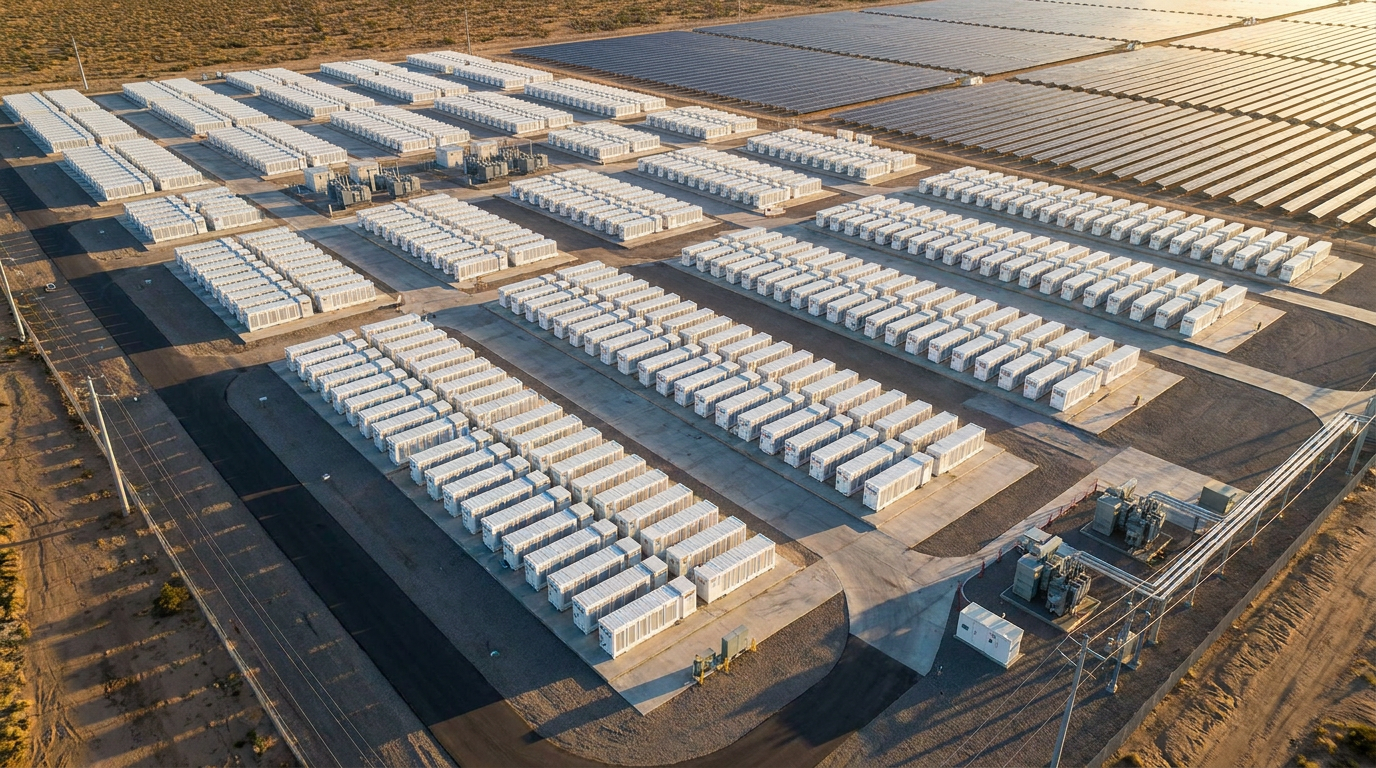
Summer 2026 is approaching, and grid operators in the United States' most energy-hungry states are facing the heat with a new level of confidence. A massive wave of utility-scale battery storage has come online over the past year, fundamentally altering the math of summer power reliability and grid economics.[1][2]
In May 2026, California energy leaders announced that the state had surpassed 17,000 megawatts (17 GW) of cumulative battery storage capacity. This represents a staggering increase from just 500 MW in 2020, transforming batteries from a niche pilot technology into a central pillar of the state's electrical grid infrastructure.[1][3]
Texas is experiencing a similar boom. The Electric Reliability Council of Texas (ERCOT) grid has surged past 7,500 MW of installed utility-scale storage. While California led the early adoption, Texas has rapidly accelerated its deployment, proving that large-scale batteries can thrive and scale rapidly in a deregulated, energy-heavy market.[2][3]

The core function of these massive battery parks is elegantly simple: they buy low and sell high, both in terms of energy and grid stability. During the midday hours, when solar panels flood the grid with cheap, abundant electricity, batteries absorb the surplus that would otherwise be wasted.[1][9]
This dynamic directly addresses the infamous "duck curve"—a phenomenon where midday solar generation causes net grid demand to plummet, followed by a steep, stressful ramp-up in demand as the sun sets and people return home from work.[6]
The impact is no longer theoretical. On March 29, 2026, data from the California Independent System Operator (CAISO) showed battery systems delivering over 12 GW of power during the evening peak. This massive discharge seamlessly replaced fading solar output, preventing the need to fire up expensive, polluting gas peaker plants.[6]

Beyond preventing blackouts, batteries are actively suppressing wholesale electricity prices. During a brief winter cold snap in February 2026, ERCOT's battery fleet proved its worth by discharging a record 4,100 MW simultaneously onto the Texas grid.[5]
Beyond preventing blackouts, batteries are actively suppressing wholesale electricity prices.
Market intelligence firm EnergyForge estimated that this single four-hour discharge event saved Texas commercial electricity buyers $150 million in avoided scarcity costs. By shaving the peak off the price curve, batteries prevented real-time prices from spiking to the grid's $5,000/MWh cap.[5]
This rapid deployment is being driven by a collapse in technology costs. According to BloombergNEF, the cost of grid battery storage fell by 27% in 2025 alone, significantly beating industry projections and accelerating the shift toward storage-led system balancing.[4]
The levelized cost of electricity for a standalone four-hour battery storage project dropped to $78/MWh. This cost reduction occurred even as other energy technologies, like wind and gas turbines, faced supply chain constraints and rising prices.[4]
The market has also settled on a dominant chemistry: Lithium Iron Phosphate (LFP). In recent years, LFP has captured nearly 95% of new utility-scale battery awards globally, favored for its lower cost, longer cycle life, and superior thermal stability compared to older nickel-based alternatives.[9]

The storage boom extends far beyond the United States. In Europe, countries like Italy and Germany are rapidly scaling their battery capacity to reduce reliance on imported natural gas and manage their own renewable generation peaks.[7][8]
Research from Ember indicates that deploying more battery capacity is crucial for displacing gas power generation, which frequently sets the marginal electricity price in European markets. By outcompeting gas during peak hours, batteries are lowering wholesale electricity bills across the continent.[7][8]
As the battery fleet grows, it is fundamentally changing market behavior. In California, batteries are now consuming so much midday solar surplus that they are lifting the price floor, reducing the frequency of negative wholesale prices and improving the underlying economics of solar farms.[2][6]

While short-duration lithium-ion batteries are solving the daily solar cycle, grid planners are already looking toward the next challenge. Long-duration energy storage (LDES) technologies, capable of discharging for 10 to 100 hours, will eventually be needed to manage multi-day weather events and seasonal lulls in renewable generation.[9]
For now, however, the 2026 summer outlook is brighter than it has been in years. The transition of grid-scale batteries from a promising concept to the heavy-lifting workhorse of the modern electrical grid is complete, offering a rare win-win for both grid reliability and consumer energy costs.[1][3]
How we got here
2013
California brings online its first utility-grade battery project, a modest 1.85 MW installation, laying the groundwork for the industry.
2020
California's battery fleet reaches roughly 500 MW, beginning a period of exponential growth driven by state mandates and falling costs.
2025
The cost of grid battery storage falls by a staggering 27% in a single year, significantly beating industry projections.
February 2026
Texas batteries discharge a record 4,100 MW during a winter cold snap, saving the market an estimated $150 million in scarcity costs.
May 2026
California energy leaders announce the state has surpassed 17,000 MW of installed battery capacity ahead of the summer season.
Viewpoints in depth
Grid Reliability Operators
Focused on maintaining system stability and preventing blackouts during extreme weather and daily demand peaks.
For grid operators like CAISO and ERCOT, batteries are the ultimate flexibility tool. Unlike traditional thermal power plants that take hours to spin up, battery systems can inject gigawatts of power into the grid in milliseconds. This rapid response is critical for managing the 'duck curve'—the steep evening ramp-up in demand that occurs just as solar generation drops off. Operators view the massive 2026 capacity milestones not just as an environmental win, but as a fundamental upgrade to grid security, providing a crucial buffer against the unpredictable nature of extreme summer heatwaves and winter cold snaps.
Energy Market Analysts
Focused on the financial mechanics of battery arbitrage and the suppression of wholesale electricity prices.
Market analysts track the profound deflationary impact batteries are having on wholesale power markets. By buying electricity when it is cheap (or even negatively priced) during midday solar peaks and selling it during expensive evening hours, batteries are executing massive-scale arbitrage. This behavior actively shaves the peak off price spikes, saving commercial and residential ratepayers hundreds of millions of dollars in scarcity costs. Analysts note that the 27% drop in battery capital costs in 2025 has supercharged this economic model, making standalone storage projects highly profitable even without paired solar generation.
Decarbonization Advocates
Focused on the role of batteries in permanently displacing fossil-fuel peaker plants and ending renewable curtailment.
For climate and clean energy advocates, the 2026 battery boom represents the beginning of the end for natural gas peaker plants. Historically, grids relied on heavily polluting, fast-ramping gas plants to meet evening demand spikes. Batteries are now directly outcompeting these plants on cost and response time. Furthermore, advocates highlight that batteries solve the problem of 'curtailment'—where excess wind and solar power is wasted because the grid cannot absorb it. By soaking up this surplus, batteries ensure that every megawatt of clean energy generated is actually utilized, accelerating the transition to a zero-carbon grid.
What we don't know
- How quickly long-duration energy storage (LDES) technologies can be commercialized to handle multi-day weather events.
- Whether interconnection queue delays and grid upgrade bottlenecks will slow the pace of battery deployments in the late 2020s.
- The long-term impact of dynamic grid fees and changing regulatory structures on the profitability of merchant battery projects.
Key terms
- Megawatt (MW)
- A unit of power equal to one million watts, used to measure the output capacity of power plants and large battery systems.
- Peaker Plant
- A power plant, typically running on natural gas, that only operates during times of peak electricity demand to prevent blackouts.
- Arbitrage
- The practice of buying electricity when prices are low (midday) and selling it back to the grid when prices are high (evening).
- Lithium Iron Phosphate (LFP)
- A highly stable, cost-effective battery chemistry that has become the dominant standard for utility-scale energy storage.
- Curtailment
- The deliberate reduction of renewable energy output below what could have been produced, usually because the grid cannot absorb the excess power.
Frequently asked
What is grid-scale battery storage?
It is a massive installation of batteries connected directly to the transmission network. These systems store excess electricity generated during low-demand periods and discharge it when demand and prices are highest.
How do batteries lower electricity prices?
By discharging stored energy during peak evening hours, batteries increase the power supply when the grid is most stressed. This prevents wholesale electricity prices from spiking to extreme scarcity levels.
What is the duck curve?
The duck curve is a graph showing the mismatch between solar energy production and electricity demand. It features a deep 'belly' of low net demand midday when the sun is shining, followed by a steep 'neck' of high demand in the evening.
Why are battery costs falling so fast?
The cost drop is driven by massive scaling in global manufacturing, particularly for Lithium Iron Phosphate (LFP) cells, as well as improvements in battery design and increased competition among suppliers.
Sources
Source coverage
9 outlets
3 viewpoints surfaced









[1]California Energy CommissionGrid Reliability Operators
California Energy Leaders Report Progress on Grid Reliability Ahead of Summer 2026
Read on California Energy Commission →[2]Modo EnergyEnergy Market Analysts
ERCOT Market Outlook Report - Q1 2026
Read on Modo Energy →[3]AmperonGrid Reliability Operators
Battery Energy Storage: ERCOT vs. CAISO
Read on Amperon →[4]BloombergNEFEnergy Market Analysts
Cost of Grid Battery Storage Fell 27% in 2025
Read on BloombergNEF →[5]EnergyForge IntelligenceEnergy Market Analysts
ERCOT Battery Storage Sets New Winter Discharge Record, Stabilizing Commercial Rates
Read on EnergyForge Intelligence →[6]EticaAGDecarbonization Advocates
How Battery Storage Is Addressing the Duck Curve: Insights from March 29
Read on EticaAG →[7]EmberDecarbonization Advocates
Early signs of the impact of batteries - European Electricity Review 2026
Read on Ember →[8]IEEFADecarbonization Advocates
Europe's reliance on gas power could increase electricity bills by up to €120 a year
Read on IEEFA →[9]PolinovelEnergy Market Analysts
Grid-Scale Battery Storage in 2026: Costs & Tech Guide
Read on Polinovel →

Every angle. Every day.
Get energy stories with full source coverage and perspective breakdowns delivered to your inbox.