
Chile's Strict Food Warning Labels Successfully Reduce Childhood Obesity Risk, New Data Shows
A decade after Chile mandated black octagonal warning labels on unhealthy foods, new research confirms the policy has significantly reduced obesity risk among schoolchildren and forced the food industry to reformulate its products.
By Factlen Editorial Team
- Public Health Researchers
- Argues that binary, visual warnings bypass the need for nutritional literacy and directly alter behavior at the point of purchase.
- International Policymakers
- Views the Chilean model as a proven blueprint for combating diet-related diseases globally, pushing for similar adoption in Europe and North America.
- Food Industry Observers
- Focuses on how mandatory thresholds force companies to reformulate products and adapt to new market realities to avoid negative visibility.
What's not represented
- · Food and Beverage Manufacturers
- · Local Chilean Consumers
Why this matters
The global obesity epidemic has largely resisted public health interventions, but Chile's data proves that strict, mandatory regulations on food packaging and marketing can successfully change consumer habits and force corporations to produce healthier food. This model is now being exported globally, potentially transforming the food environments of billions of people.
Key points
- A new study in The Lancet confirms Chile's food labeling law has reduced the risk of childhood obesity.
- The law mandates black octagonal warning labels on products high in sugar, sodium, saturated fat, or calories.
- Products carrying the labels are banned from being sold in schools or marketed to children.
- The food industry has heavily reformulated its recipes to avoid the labels, creating a healthier baseline food supply.
- Ten other nations have already adopted the Chilean model, with Canada and European countries considering similar laws.
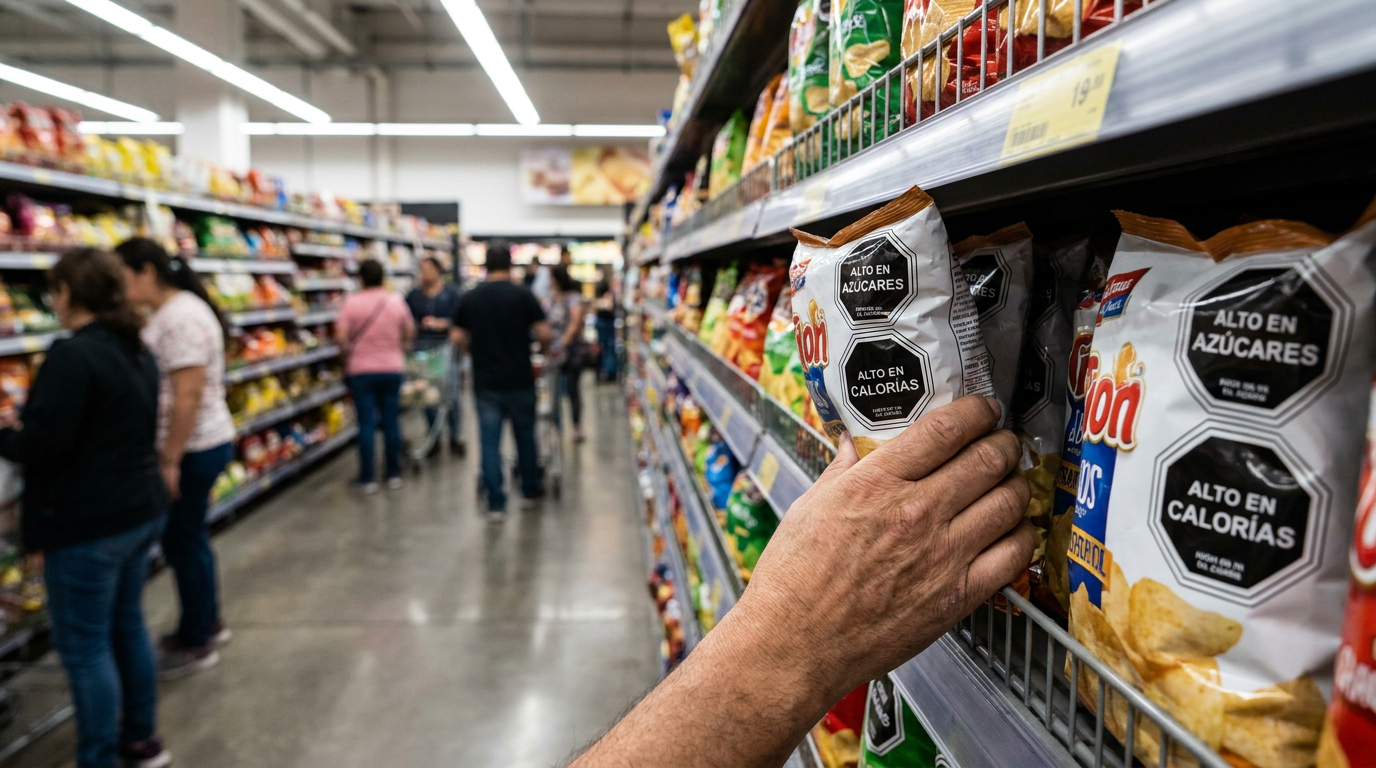
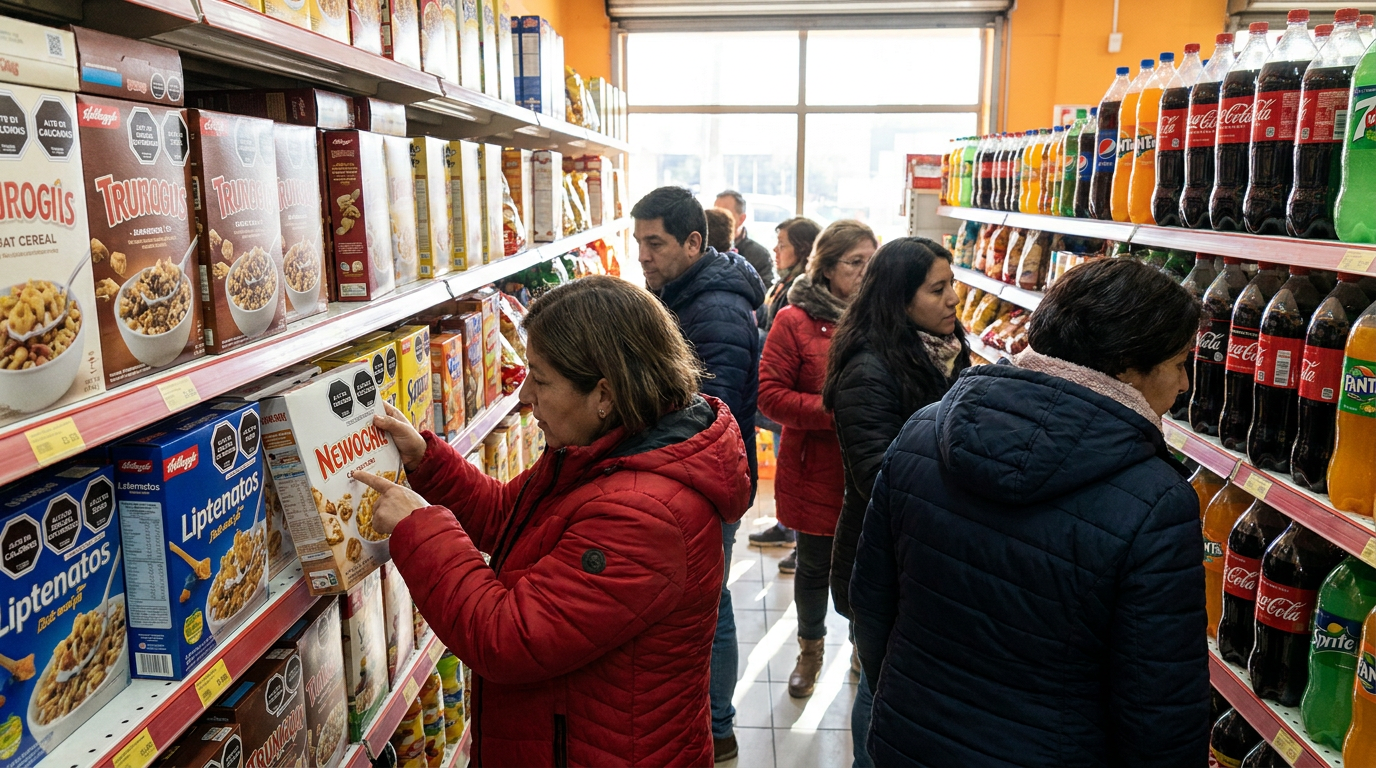
Walking down a grocery aisle in Santiago, Chile, shoppers are greeted by a stark, unavoidable visual: solid black octagonal stop signs plastered across the front of countless packaged foods. Whether it is a brightly colored box of breakfast cereal, a two-liter bottle of soda, or a family-sized bag of potato chips, these labels dominate the packaging, fundamentally altering the visual landscape of the modern supermarket and forcing consumers to confront the nutritional reality of their purchases before they even reach the checkout counter.[8]
These are not the subtle, complex nutritional tables traditionally hidden on the back of the box, which often require a calculator, a magnifying glass, and a degree in dietetics to fully decode. Instead, they are blunt, binary warnings that a product is "High in Sugar," "High in Sodium," "High in Saturated Fat," or "High in Calories." If a food item exceeds strict, government-mandated thresholds for these specific nutrients of concern, it is legally required to bear a black octagon for each violation, making it instantly clear when a product is heavily processed.[7][8]
Introduced in 2016 as part of a sweeping public health initiative, Chile's Law of Food Labeling and Advertising was initially considered a radical, untested experiment in state intervention. Industry lobbyists warned of economic ruin and widespread job losses, while skeptics questioned whether a simple black sticker could actually change deeply ingrained cultural eating habits in a country grappling with soaring obesity rates. Now, a decade later, a mountain of new empirical data proves that the experiment is working exactly as its architects intended.[1][7]
According to a landmark new study published this week in The Lancet, Chile's aggressive combination of mandatory warning labels and strict marketing bans has successfully reduced the risk of overweight and obesity among school-age children. The research provides some of the most compelling evidence to date that comprehensive, top-down regulatory frameworks can effectively combat the environmental factors that drive childhood weight gain. By shifting the burden of health from individual willpower to systemic regulation, the policy offers a beacon of hope for public health officials worldwide who have struggled to reverse the obesity trend.[5]

The comprehensive analysis, which tracked the health outcomes and body mass index trajectories of roughly 300,000 schoolchildren over several years, found a statistically significant decrease in the proportion of children aged four to six presenting with excess weight. By targeting the broader food environment rather than relying solely on educational campaigns or individual dietary restraint, the Chilean policy has managed to move the needle on a public health crisis that has stubbornly resisted intervention for decades across the developed world.[2][5]
The findings have triggered a wave of international media coverage and renewed policy debates, with outlets ranging from STAT News in the United States to Le Monde in France highlighting the Chilean policy as a proven blueprint for combating the global childhood obesity epidemic. Medical journals and mainstream news organizations alike are pointing to the data as proof that government intervention, when executed with clarity and strict enforcement, can yield measurable improvements in population health within a single generation.[1][2]
To understand why Chile's approach succeeded where countless other public health campaigns have failed, it is necessary to look at the holistic mechanism of the law itself. The policy recognizes a fundamental truth about modern consumption: human beings make split-second decisions in the grocery store, heavily influenced by colorful branding, convenience, and price. Traditional education campaigns often fail because they expect rushed, exhausted shoppers to carefully analyze complex nutritional data while navigating aisles specifically designed to maximize impulse purchases.[8]
By adopting a binary, highly visible warning system, the Chilean government effectively bypassed the need for high nutritional literacy. Consumers do not need to understand the metabolic difference between complex and simple carbohydrates, nor do they need to calculate daily sodium percentages based on a 2,000-calorie diet. They simply learn a universal visual language: fewer black octagons mean a healthier choice, and a product covered in stop signs is best left on the shelf or consumed strictly as an occasional treat.[7][8]
Crucially, the policy did not stop at the grocery store shelf. The architects of the law understood that children are particularly vulnerable to junk food marketing and that schools should be safe havens from predatory advertising. Therefore, any product carrying even a single black warning label is legally prohibited from being sold, served, or promoted in Chilean schools and nurseries, instantly transforming the nutritional quality of the food available to students during the school day and creating a protected environment.[5][7]

Crucially, the policy did not stop at the grocery store shelf.
Furthermore, these high-calorie products cannot be marketed to children anywhere in the country, closing the loopholes that food companies traditionally exploit to build brand loyalty early. This means an absolute ban on using cartoon mascots or licensed characters on sugary cereal boxes, a strict prohibition on including interactive toys with high-fat fast food meals, and a complete blackout on television and digital advertisements for these items during hours when children are likely to be watching.[2][7]
The impact of these combined measures on consumer habits has been profound, immediate, and highly measurable across demographic groups. Research published in PLOS Medicine revealed that after the labels were introduced, Chilean households fundamentally altered what they put in their shopping carts. The study found that consumers purchased 37% less sugar and 22% less sodium from packaged foods, indicating a massive shift away from the most highly processed items in favor of whole foods or reformulated alternatives.[7]
Overall caloric intake from products carrying the black warning labels dropped by 23% across the studied households. These striking figures demonstrate that when consumers are equipped with clear, accessible, and unavoidable information at the point of purchase, they actively and consistently alter their behavior to make healthier choices for their families. It thoroughly disproves the long-standing industry argument that warning labels only serve to confuse shoppers or that people will simply ignore the health warnings and buy their favorite junk foods regardless of the labeling.[7]
But the most significant and lasting shift driven by the law may not actually be in how consumers navigate the supermarket aisles, but in how the global food industry formulates its products behind closed doors. The true power of the Chilean model lies in its ability to force corporate behavioral change through the threat of negative visibility. Rather than accepting the black octagons as an inevitable cost of doing business, companies viewed them as a severe competitive disadvantage that had to be avoided at all costs.[6]
Facing the prospect of having their flagship products branded with multiple black stop signs—and subsequently banned from lucrative school contracts and children's television programming—food and beverage manufacturers initiated a massive, industry-wide wave of recipe reformulations. Research and development teams were urgently tasked with stripping out excess sugar, salt, and saturated fat to ensure their products could legally remain on shelves without the stigmatizing labels, sparking an unprecedented era of nutritional innovation within the packaged food sector.[6]

The results of this corporate scramble have been remarkably effective at cleaning up the national diet. A comprehensive 2025 study published in BMC Medicine found that the proportion of packaged foods in Chilean supermarkets requiring a "high in" label plummeted from 71% before the law was enacted to just 53% after its third and strictest phase took effect. This represents a massive, systemic reduction in the availability of ultra-processed junk food, proving that strict regulations can successfully force the invisible hand of the market toward healthier outcomes.[6]
By systematically reducing the amount of added sugar, salt, and saturated fats in their recipes to slip just below the regulatory thresholds, companies engaged in a silent, sweeping reformulation of the food supply. This dynamic effectively created a healthier baseline for the entire country, benefiting everyone across the socioeconomic spectrum. It is particularly protective of consumers who completely ignore the warning labels while shopping, as the products they habitually buy are now objectively less harmful and less calorically dense than they were a decade ago.[6][8]
The undeniable success of the Chilean model has not gone unnoticed by the rest of the world. Recognizing the unparalleled effectiveness of the black octagons in driving both consumer awareness and industry compliance, ten other nations, including regional neighbors like Mexico, Argentina, and Brazil, have already adopted similar mandatory front-of-package warning labels to combat their own domestic obesity crises. The policy is rapidly becoming the gold standard for public health interventions in Latin America, proving that developing nations can successfully stand up to multinational food conglomerates.[8]
The momentum continues to build globally, moving well beyond South America. Canada is slated to implement its own front-of-package warning system by the end of 2026, while lawmakers in France and Sweden are currently pushing for strict regulations modeled directly on the Chilean experience. Public health advocates in these countries argue that voluntary industry labels and confusing traffic-light systems are insufficient, and that only mandatory, highly visible warnings can adequately protect public health in an era of ultra-processed diets.[2][4][8]
Some questions do remain about the long-term generational impact of the policy. Researchers are eager to see whether the observed reduction in childhood obesity rates will ultimately translate into lower rates of adult metabolic diseases, such as type 2 diabetes and hypertension, in the coming decades. There are also ongoing debates about the food industry substituting sugar with artificial sweeteners to avoid the labels, a trend that public health officials are monitoring closely to ensure one health risk is not simply being traded for another.[5][6]
Nevertheless, the wealth of data emerging from Chile offers a rare, unequivocal victory in the realm of public health. It proves that decisive, evidence-based government policy can fundamentally reshape a nation's food environment, force industry compliance, and ultimately protect the health of its youngest citizens. As the global community searches for viable solutions to the obesity epidemic, the black octagons of Santiago stand as a powerful testament to the fact that progress is entirely possible when public health is prioritized over corporate convenience.[1][3]
How we got here
2016
Chile implements the first phase of its Law of Food Labeling and Advertising, introducing the black octagonal warning labels.
2018
The second phase of the law takes effect, tightening the nutritional thresholds that trigger a warning label.
2020
The third and strictest phase is enforced, requiring even lower levels of sugar, salt, and fat to avoid the labels.
Jan 2025
Research in BMC Medicine reveals that industry reformulation dropped the number of products needing labels from 71% to 53%.
Jun 2026
A landmark study in The Lancet confirms the policy has successfully reduced the risk of overweight and obesity among school-age children.
Viewpoints in depth
Public Health Consensus
The argument that binary, visual warnings bypass the need for nutritional literacy and directly alter behavior at the point of purchase.
Public health researchers argue that traditional nutritional labels fail because they require a level of mathematical and dietary literacy that most rushed shoppers do not possess. By contrast, the Chilean model succeeds because it relies on a universal visual language: the stop sign. This approach shifts the burden of health from individual willpower to environmental design, making the healthiest choice the easiest choice to identify.
The Industry Adaptation
How food manufacturers respond not by abandoning markets, but by reformulating recipes to avoid the stigma of the black octagon.
Industry analysts note that the true power of the labeling law lies in its ability to force corporate behavioral change. Rather than accepting the black octagons as an inevitable cost of doing business, companies viewed them as a severe competitive disadvantage. This sparked an unprecedented era of nutritional innovation, as research and development teams were urgently tasked with stripping out excess sugar, salt, and saturated fat to ensure their products could legally remain on shelves without the stigmatizing labels.
The Global Export
Why lawmakers in Europe and North America are increasingly abandoning voluntary, complex labels in favor of Chile's mandatory warning system.
International policymakers are increasingly viewing the Chilean model as the gold standard for combating diet-related diseases. Frustrated by the limited impact of voluntary industry labels and confusing traffic-light systems, lawmakers in countries like France, Sweden, and Canada are pushing for strict, mandatory regulations. They argue that the empirical data from Chile proves that only highly visible, unavoidable warnings can adequately protect public health in an era dominated by ultra-processed diets.
What we don't know
- Whether the reduction in childhood obesity rates will translate into lower rates of adult metabolic diseases in the coming decades.
- The long-term health impacts of the food industry substituting sugar with artificial sweeteners to avoid the warning labels.
Key terms
- Front-of-package warning label (FOPWL)
- A clear, visual indicator placed on the main display panel of a food product to alert consumers to high levels of unhealthy ingredients.
- Product reformulation
- The process by which food manufacturers alter a product's recipe—such as reducing sugar or sodium—to meet new health guidelines or avoid regulatory warnings.
- Nutrient of concern
- Specific components of a diet, such as saturated fat, added sugars, and sodium, that are linked to chronic health conditions when consumed in excess.
Frequently asked
What exactly do the Chilean warning labels look like?
They are solid black octagons, resembling stop signs, placed on the front of packaging. They feature white text warning if a product is "High in Sugar," "High in Sodium," "High in Saturated Fat," or "High in Calories."
Did the food industry fight the labeling law?
Initially, yes, but once implemented, companies adapted rapidly. Many manufacturers reformulated their recipes—reducing sugar and salt—specifically to avoid having to display the black warning labels on their products.
Are other countries using this system?
Yes. The success of the Chilean model has inspired over a dozen countries, including Mexico, Argentina, and Brazil, to adopt similar mandatory warning labels. Canada is scheduled to implement its version by 2026.
Does the law only apply to grocery stores?
No. A crucial component of the law bans any product carrying a warning label from being sold or promoted in schools, and prohibits marketing these unhealthy foods to children via television or toys.
Sources
Source coverage
8 outlets
3 viewpoints surfaced








[1]STAT NewsFood Industry Observers
Chile offers new data on food warning label efficacy
Read on STAT News →[2]Le MondeInternational Policymakers
Child obesity: Chile's successful experience with warning signs and banned marketing
Read on Le Monde →[3]Medical XpressPublic Health Researchers
Chile's food warning labels and ad bans cut child obesity risk, analysis suggests
Read on Medical Xpress →[4]Svenska DagbladetInternational Policymakers
Bans and Warnings Have Contributed to Obesity Among Children
Read on Svenska Dagbladet →[5]The LancetPublic Health Researchers
Impact of Chile's food labeling and marketing policies on school-age children's weight: a longitudinal study
Read on The Lancet →[6]BMC MedicineFood Industry Observers
Nutrient warning labels yield healthier food supply for Chile
Read on BMC Medicine →[7]PLOS MedicinePublic Health Researchers
Changes in food purchases after Chile's policies on food labeling, marketing, and sales in schools
Read on PLOS Medicine →[8]Obesity Evidence HubInternational Policymakers
Front-of-pack nutrition labelling
Read on Obesity Evidence Hub →

More in health
See all 24 stories →Type 1 Diabetes
FDA Approves First Therapy to Preserve Insulin Production in Newly Diagnosed Type 1 Diabetes
0 sources

Nutrition Science
The Food Matrix: Why Nutrition Science is Moving Beyond Calories and Macros
0 sources

Food Policy
How Chile’s Black Octagon Warning Labels Are Reshaping Global Nutrition
0 sources
Pediatric Diabetes
FDA Approves First Disease-Modifying Therapy for Children Newly Diagnosed With Stage 3 Type 1 Diabetes
0 sources

Every angle. Every day.
Get health stories with full source coverage and perspective breakdowns delivered to your inbox.