
Beyond Preservation: How Acoustic Enrichment and 'Super Corals' Are Engineering Reef Resilience
Marine biologists are deploying underwater speakers and breeding heat-resilient corals to actively rebuild degraded reefs, shifting conservation from passive protection to high-tech intervention.
By Factlen Editorial Team
- Active Interventionists
- Argue that passive conservation is no longer sufficient and that we must actively engineer reef resilience.
- Local Community Stewards
- Focus on mitigating local stressors like pollution and overfishing to give reefs a fighting chance.
- Ecological Skeptics
- Warn that selective breeding could create genetic bottlenecks and distract from the root causes of climate change.
What's not represented
- · Commercial fishing industry
- · Coastal tourism operators
Why this matters
Coral reefs support a quarter of all marine life and provide food, coastal protection, and economic stability for over a billion people. If these ecosystems collapse, the fallout will devastate coastal communities worldwide—making these breakthrough restoration techniques a crucial lifeline.
Key points
- Marine biologists are shifting from passive protection to active intervention to save coral reefs.
- Acoustic enrichment uses underwater speakers to attract coral larvae to degraded reefs.
- Scientists are breeding heat-resilient corals found in naturally warm 'hot pockets'.
- Microfragmentation allows corals to grow up to 50 times faster in underwater nurseries.
- Experts warn that these tools must be paired with global emissions reductions to succeed.
For decades, the dominant philosophy in marine conservation was passive protection: designate a marine sanctuary, restrict fishing, and let nature heal itself. But as ocean temperatures surge and mass bleaching events become an annual reality, passive conservation is no longer enough.[8]
In response, a new generation of marine biologists is shifting from preservation to active intervention. They are no longer just guarding reefs; they are engineering them, utilizing cutting-edge science to accelerate natural adaptation.[8]
At the forefront of this shift is a technique that sounds almost poetic: acoustic enrichment. Healthy coral reefs are incredibly noisy places, echoing with the crackling of snapping shrimp and the grunts of feeding fish.[1][6]
For years, scientists assumed coral larvae drifted aimlessly on ocean currents. But recent research from the Woods Hole Oceanographic Institution and the University of Bristol has proven that microscopic coral larvae actively navigate by sound, using the acoustic signatures of healthy reefs as homing beacons to decide where to settle.[1][5][6]

By placing underwater loudspeakers in degraded, silent reef patches and broadcasting the sounds of a thriving ecosystem, researchers have successfully tricked coral larvae into settling in barren areas.[1][6]
The results have been staggering. During field tests in the Maldives and Australia's Great Barrier Reef, broadcasting healthy reef sounds increased coral larval settlement rates by up to seven times within the first 36 hours of dispersal.[1][5]
Acoustic enrichment not only attracts corals but also draws in the juvenile fish necessary to clean the reef and create space for new growth, effectively kick-starting the ecosystem's natural recovery engine and doubling overall fish abundance.[6]
But attracting corals to a reef is only half the battle; they must also survive the warming waters that killed their predecessors. This is where "assisted evolution" and the cultivation of heat-resilient corals come into play.[8]
But attracting corals to a reef is only half the battle; they must also survive the warming waters that killed their predecessors.
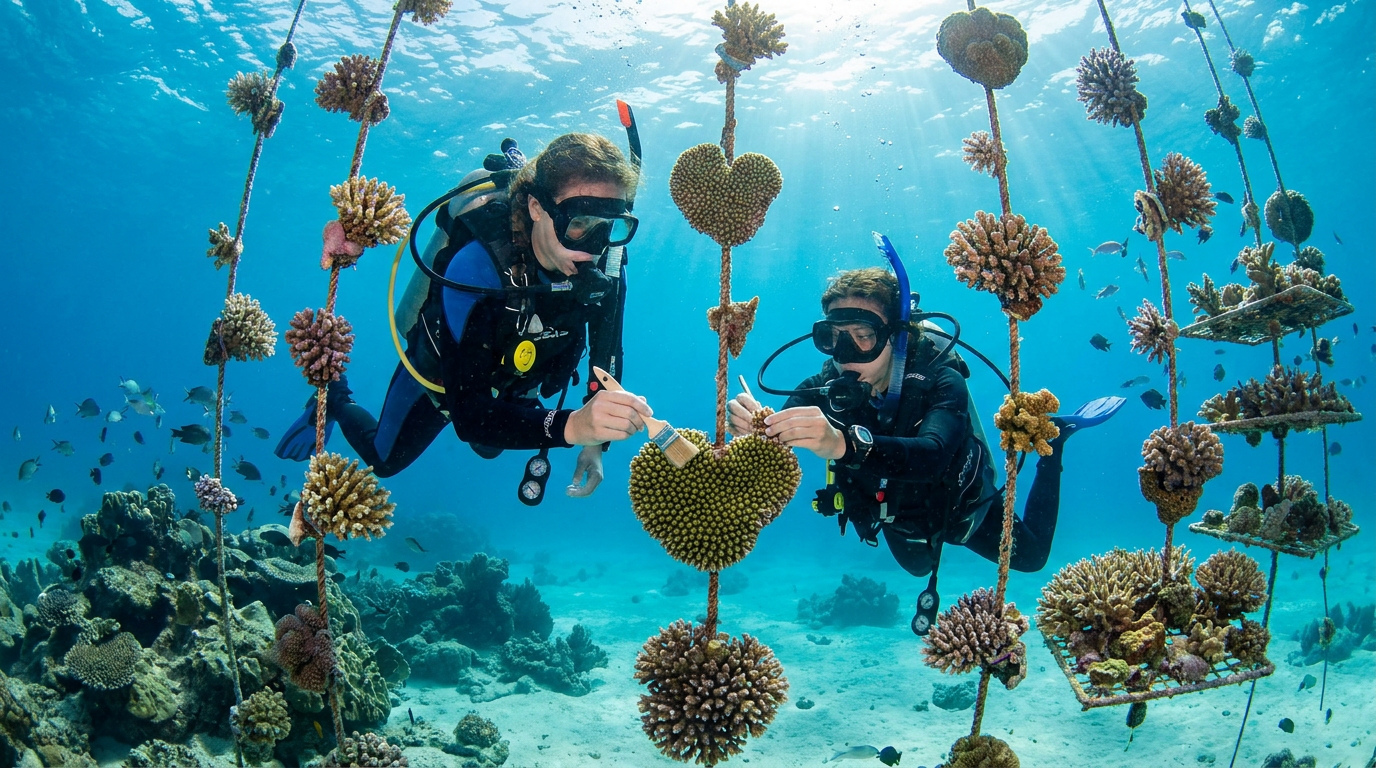
In places like Fiji, the United Nations Environment Programme is backing the "Reefs of Hope" initiative. Scientists scour shallow, nearshore lagoons—often referred to as "hot pockets"—where water temperatures already exceed normal limits.[2]
The corals surviving in these extreme environments possess natural genetic resistance to heat stress. Researchers harvest fragments of these resilient survivors and relocate them to underwater gene-bank nurseries.[2]
By clustering diverse strains of heat-adapted corals together, scientists ensure that when the corals spawn, they cross-breed. This natural sexual reproduction produces a new generation of larvae equipped with the genetic tools to withstand future marine heatwaves.[2]

To accelerate the process, conservationists utilize microfragmentation. By cutting corals into tiny pieces, they stimulate a rapid healing response that allows the corals to grow 25 to 50 times faster than their natural rate, drastically shrinking the timeline required to cultivate reef-building colonies.[7]
Despite these breakthroughs, the scientific community remains cautious about treating these technologies as a panacea. A major study from Rutgers University warned that focusing exclusively on selectively breeding heat-tolerant corals could inadvertently reduce the overall genetic diversity of a reef, making it vulnerable to other threats.[3]
A genetically homogenous reef might survive a heatwave only to be wiped out by a novel disease. Furthermore, the sheer scale of the ocean means that outplanting lab-grown corals will take decades to yield widespread ecological benefits, requiring massive sustained investment.[3]

Consequently, local conservation groups emphasize that high-tech restoration must be paired with foundational environmental work. Improving wastewater treatment, reducing agricultural runoff, and enforcing sustainable fishing quotas remain essential to giving restored corals a fighting chance.[4]
Ultimately, acoustic enrichment and assisted evolution cannot reverse the trajectory of global climate change. But they are not meant to. These interventions are designed to buy time, preserving the genetic legacy and structural foundation of coral reefs until humanity can stabilize the planet's climate.[8]
How we got here
2016–2017
Back-to-back mass bleaching events devastate 50% of the Great Barrier Reef, accelerating the search for active interventions.
2019
Researchers publish early findings demonstrating that acoustic enrichment can double fish recruitment on dead reefs.
2024
Studies confirm that multiple species of coral larvae actively navigate toward the sounds of healthy reefs.
2025–2026
The UN and global conservation groups scale up 'Reefs of Hope' and microfragmentation nurseries across vulnerable island nations.
Viewpoints in depth
Active Interventionists
Argue that passive conservation is no longer sufficient and that we must actively engineer reef resilience.
Marine biologists leading these efforts argue that climate change is outpacing natural evolution. By utilizing tools like acoustic enrichment and assisted evolution, they aim to accelerate the adaptation process. They view these interventions not as a replacement for emissions reductions, but as a necessary triage to prevent the total extinction of reef-building species while global climate policies take effect.
Ecological Skeptics
Warn that selective breeding could create genetic bottlenecks and distract from root causes.
Researchers focusing on population genetics caution against an over-reliance on 'super corals.' They argue that selectively breeding for heat tolerance often comes at the expense of other vital traits, such as disease resistance. Furthermore, they emphasize that outplanting lab-grown corals is incredibly resource-intensive and cannot scale fast enough to save global reef systems if ocean temperatures continue their current trajectory.
Local Community Stewards
Focus on mitigating local stressors like pollution and overfishing to give reefs a fighting chance.
Organizations working directly with coastal and Indigenous communities emphasize that high-tech solutions will fail if local water quality remains poor. They prioritize watershed management, wastewater treatment, and the establishment of marine protected areas. From their perspective, reducing daily environmental stress is the most effective way to allow corals to utilize their natural adaptive capacity.
What we don't know
- Whether lab-bred heat-resilient corals will maintain their genetic diversity over multiple generations in the wild.
- How quickly acoustic enrichment can be scaled across thousands of miles of degraded coastline.
- If restored reefs will be able to withstand novel diseases that may emerge as ocean temperatures continue to rise.
Key terms
- Acoustic enrichment
- The practice of broadcasting the sounds of a healthy ecosystem into a degraded area to attract marine life and encourage settlement.
- Assisted evolution
- Human interventions designed to accelerate the natural adaptation of a species to changing environmental conditions, such as breeding heat-tolerant corals.
- Microfragmentation
- A technique where corals are cut into tiny pieces to stimulate a rapid healing and growth response, significantly reducing the time needed to grow large colonies.
- Coral bleaching
- A stress response where corals expel the symbiotic algae living in their tissues, causing them to turn completely white and become vulnerable to starvation.
Frequently asked
What is acoustic enrichment?
It is a restoration technique that uses underwater speakers to play the sounds of a healthy reef—like snapping shrimp and fish grunts—to attract coral larvae and juvenile fish to degraded areas.
What are 'super corals'?
The term refers to coral strains that have naturally adapted to survive in unusually warm waters, which scientists are now breeding to help repopulate vulnerable reefs.
Can these technologies save the reefs on their own?
No. Scientists emphasize that while these tools buy critical time, they must be paired with local pollution reduction and global efforts to halt climate change.
Sources
Source coverage
8 outlets
3 viewpoints surfaced








[1]ScienceDailyActive Interventionists
Acoustic enrichment encourages coral to settle
Read on ScienceDaily →[2]UNEPActive Interventionists
Adapting Corals to a Warming Ocean: Reefs of Hope
Read on UNEP →[3]Rutgers UniversityEcological Skeptics
Popular Coral Restoration Technique Unlikely to Protect Reefs from Climate Change
Read on Rutgers University →[4]Coral Reef AllianceLocal Community Stewards
How Coral Reef Conservation Delivered Measurable Impact in 2025
Read on Coral Reef Alliance →[5]Make Water FamousActive Interventionists
Documentary sounds out baby coral breakthrough
Read on Make Water Famous →[6]ScienceAlertActive Interventionists
Scientists Are Broadcasting The Sounds of Healthy Reefs to Dying Ones
Read on ScienceAlert →[7]Coral VitaActive Interventionists
Coral Reef Restoration: A Critical Path to Ocean Recovery
Read on Coral Vita →[8]Factlen Editorial TeamLocal Community Stewards
Synthesis by Factlen editorial team
Read on Factlen Editorial Team →
Every angle. Every day.
Get environment stories with full source coverage and perspective breakdowns delivered to your inbox.