
The Science of Space: How Neuroaesthetics is Rewiring Interior Design
Researchers are using brain scans to prove that interior design isn't just about aesthetics—it's a measurable biological tool that can lower stress, boost focus, and improve mental health.
By Factlen Editorial Team
- Neuroarchitects & Researchers
- Focus on using biometric data to prove that architectural choices yield measurable physiological health outcomes.
- Evidence-Based Designers
- Focus on translating complex neurological data into practical, beautiful design applications for residential and commercial spaces.
- Neuro-Inclusive Advocates
- Emphasize that universal design rules must be adaptable to accommodate the unique sensory processing needs of neurodivergent individuals.
What's not represented
- · Traditional decorators who prioritize subjective artistic expression over scientific metrics.
- · Budget-conscious consumers navigating the cost barrier of advanced circadian lighting systems.
Why this matters
Understanding how your home affects your nervous system allows you to make simple, evidence-based changes to your lighting, layout, and decor that actively reduce daily stress and improve your sleep.
Key points
- Neuroaesthetics uses biometric tools like fMRI and EEG to measure how interior design affects the brain.
- Aesthetically pleasing spaces activate the brain's reward centers, lowering heart rates and cortisol levels.
- Circadian lighting systems that mimic the sun's natural progression can regulate energy and improve sleep.
- The human brain subconsciously prefers curvilinear forms and natural materials over sharp angles and synthetic textures.
- Reducing visual clutter and employing symmetrical layouts lowers the brain's cognitive load, promoting relaxation.
- Neuro-inclusive design adapts these scientific baselines to support neurodivergent individuals with different sensory needs.
For decades, interior designers have relied on intuition, training, and aesthetic judgment to create spaces that feel welcoming. Clients frequently walk into a well-designed room and instinctively express that it simply "feels good," though articulating exactly why has often been relegated to the realm of artistic magic. Today, however, that intuition is being validated by hard science. The emerging field of neuroaesthetics is proving that our reactions to a room are not merely matters of personal taste, but deeply ingrained biological responses. By measuring how the human brain and nervous system react to specific design choices, researchers are transforming interior design from a subjective art form into an evidence-based practice with documented health outcomes.[1]
The modern home is no longer just a physical shelter; it has become a biological necessity for recovery. In an era defined by constant connectivity and urbanization, the average person lives in a state of chronic sensory overload. The modern city and the digital landscape keep the nervous system in a state of low-level, permanent tension. When an environment is filled with unpredictable noise, harsh lighting, and visual clutter, the brain is forced to work overtime to filter out unnecessary stimuli. Consequently, the home must serve as a "sensory sanctuary"—a carefully engineered environment that allows the mind to power down, regulate its circadian rhythms, and enter a state of deep, natural regeneration.[6]
Neuroaesthetics sits at the exact intersection of neuroscience, psychology, and architecture. It is the scientific study of how beauty, spatial layout, and design elements directly affect our brains and bodies. Rather than simply asking people if they like a room, researchers are utilizing advanced biometric tools to measure the body's physiological reality. By employing functional magnetic resonance imaging (fMRI), electroencephalograms (EEG), and biomarker tracking, scientists can observe brain activity, track hormone releases, and measure cardiovascular changes in real-time as a person navigates different architectural environments.[1][2]
The mechanism behind these reactions is rooted in our evolutionary biology. According to researchers, human-building interactions are shaped by three primary neural networks: the sensory-motor system, the knowledge-meaning network, and the emotion-valuation network. The sensory-motor system processes the physical features of a room, such as its temperature, acoustics, and light. Simultaneously, the knowledge-meaning network interprets the space cognitively, while the emotion-valuation network assigns a feeling to the experience. When these networks are harmoniously engaged, the brain requires less energy to process its surroundings, resulting in a profound sense of ease.[3]

When we encounter an aesthetically pleasing space, specific neural pathways light up. Brain scans reveal heightened activity in the orbitofrontal cortex and the ventral striatum—regions intrinsically linked to the processing of reward and pleasure. This neural activity explains why stepping into a beautifully proportioned, well-lit room can feel genuinely rewarding, almost akin to the neurological response triggered by eating a delicious meal or listening to a favorite piece of music. The brain interprets the harmonious environment as a safe, nurturing habitat, prompting the nervous system to stand down from its defensive posture.[7]
The physiological benefits of this neurological shift are highly measurable. Studies consistently demonstrate that thoughtfully designed spaces can trigger a 15 to 20 percent reduction in stress hormones, particularly cortisol. As the brain registers the environment as safe and aesthetically pleasing, heart rates slow down, blood pressure drops, and the production of serotonin—a key neurotransmitter associated with mood stabilization and happiness—increases. In environments ranging from residential homes to healthcare facilities, these neuroaesthetic principles have been linked to accelerated patient recovery, improved cognitive performance, and a significant reduction in daily fatigue.[1]
One of the most potent tools in the neuroaesthetic arsenal is lighting. Light is the primary director of the human biological clock, and its impact on the brain is immediate and profound. Biodynamic, or circadian, lighting systems are designed to emulate the natural progression of the sun throughout the day. By carefully calibrating both the illuminance and the color temperature of a room's light, designers can actively support the body's natural hormonal cycles, boosting focus when it is needed and facilitating relaxation as the day winds down.[2][6]
One of the most potent tools in the neuroaesthetic arsenal is lighting.
In the morning and early afternoon, exposure to bright, cool-toned light—rich in blue wavelengths—suppresses the production of melatonin and stimulates cortisol, signaling to the brain that it is time to be alert and productive. Conversely, as evening approaches, transitioning to warmer, dimmer lighting mimics the setting sun. This shift cues the pineal gland to begin releasing melatonin, preparing the body for restorative sleep long before a person actually gets into bed. When a home's lighting works in tandem with human biology, it regulates energy levels without the occupant having to consciously think about it.[6]

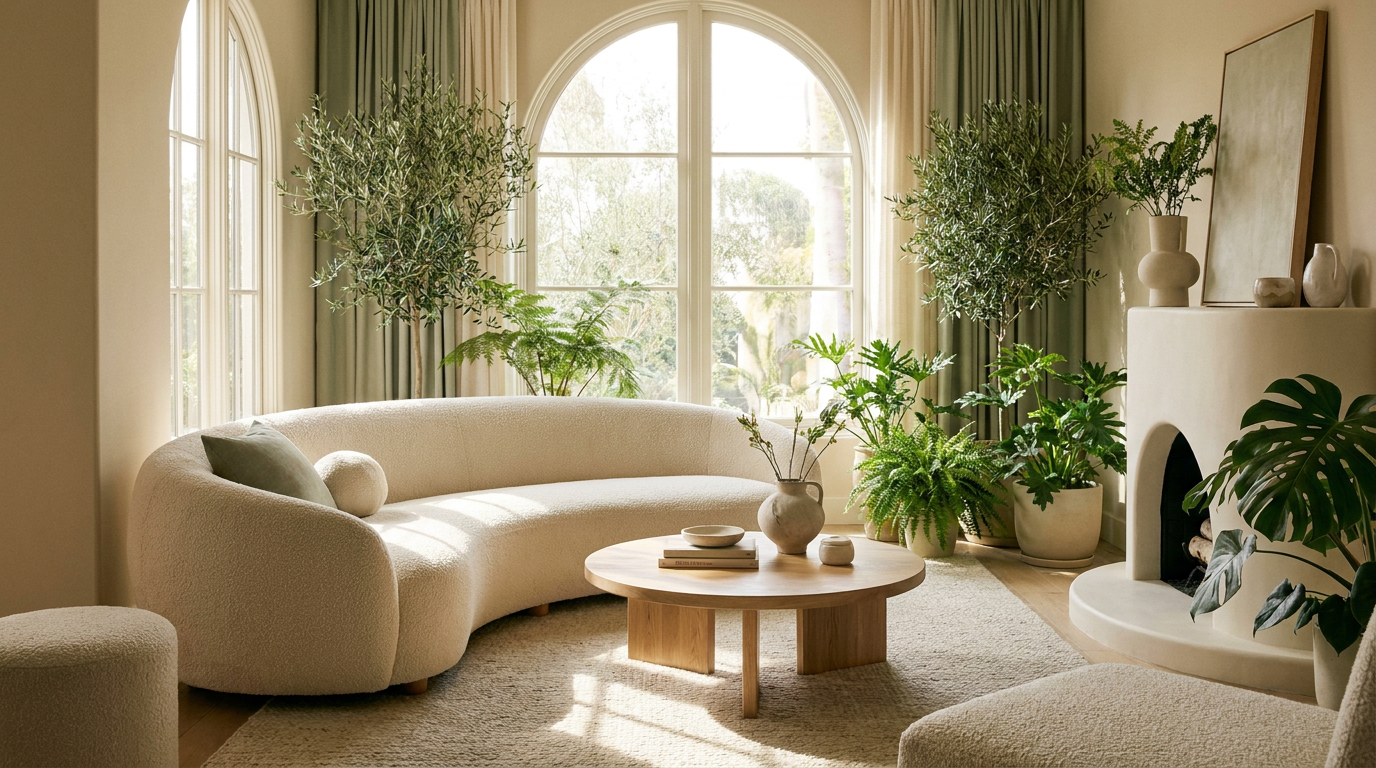
Beyond lighting, the brain is highly sensitive to the geometry and shape of its surroundings. Neuroaesthetic research reveals a profound, subconscious preference for curvilinear forms over sharp, angular lines. Curves, arches, and smooth, flowing transitions are deeply rooted in the natural world, echoing the shapes of rivers, leaves, and organic bodies. The human amygdala—the brain's emotional processing center—tends to interpret these soft shapes as safe and nurturing. In contrast, sharp, jagged edges and aggressive angles can subconsciously trigger a low-level threat response, elevating tension and alertness.[7]
Biophilic design, which involves integrating elements of the natural world into the built environment, is another core pillar backed by extensive neurological data. The human brain evolved outdoors, and it remains hardwired to seek out nature. Incorporating natural materials like wood, stone, and clay, alongside indoor vegetation and water features, has been shown to significantly lower stress markers. These elements provide a sense of grounding and permanence, offering a tactile and visual richness that synthetic materials often fail to replicate.[2][4]
Crucially, the brain does not necessarily require a live forest to reap these biological benefits. Exposure to the mere representation of nature can trigger similar neurological rewards. Fractal patterns—the complex, repeating geometric shapes found in snowflakes, tree branches, and coastlines—can be woven into rugs, wallpapers, and architectural details. The brain processes these natural patterns with remarkable ease, leading to a measurable drop in physiological stress. Even artificial greenery or nature-inspired motifs can deliver a calming effect, proving that the brain responds to the visual language of nature, regardless of its literal authenticity.[1][7]
Cognitive load is another critical factor in how a space feels. The brain is a prediction machine, constantly scanning its environment to make sense of its surroundings. When a room is plagued by visual clutter, disorganized layouts, or unpredictable acoustic noise, the nervous system is forced to expend significant energy filtering out the chaos. This high cognitive load leads to mental fatigue, irritability, and a diminished capacity for focus. By utilizing closed storage, logical spatial divisions, and acoustic dampening materials like soft rugs and acoustic panels, designers can drastically reduce the brain's processing burden.[6][7]

Symmetry and spatial balance play a vital role in minimizing this cognitive load. Symmetrical layouts are inherently easier for the human brain to process. When a room features balanced proportions—such as a pair of armchairs flanking a fireplace or a centered architectural feature—the brain quickly understands the spatial rules of the environment. This rapid comprehension reduces the need for continuous visual scanning, allowing the mind to relax and focus on higher-order tasks or simply enjoy a state of rest.[7]
However, neuroaesthetics does not advocate for sterile, featureless minimalism. While the brain craves order, it also requires moderate visual complexity to remain engaged. A completely blank, uniform room can lead to sensory deprivation, under-stimulation, and a feeling of institutional coldness. The goal is to strike a delicate balance between order and variety—providing enough visual anchors to maintain interest without tipping into chaos. Saturated colors and bold patterns can be highly effective when used as controlled accents, provided the background remains calm and harmonious.[6]
A vital area of ongoing exploration within the field is how neurodivergent individuals experience spatial stimuli. The baseline rules of neuroaesthetics—such as the calming effect of certain colors or the preference for specific lighting—are often based on neurotypical brain responses. For individuals with ADHD, autism, or sensory processing differences, the threshold for sensory overload or under-stimulation can vary dramatically. This reality underscores the need for highly adaptable, empathetic design solutions that allow occupants to customize their sensory environment, rather than relying on a rigid, one-size-fits-all approach to wellness.[5]

Ultimately, the integration of neuroaesthetics represents a paradigm shift in how we view the spaces we inhabit. It moves interior design away from being a purely decorative luxury and repositions it as a vital form of preventative mental healthcare. By understanding the profound biological impact of our surroundings, we can engineer homes, schools, and workplaces that actively support human flourishing. When design aligns with neuroscience, the environments we build become powerful allies in our daily pursuit of health, focus, and emotional resilience.[4][5]
Viewpoints in depth
Neuroarchitects & Researchers
Scientists measuring the physiological impact of the built environment.
For researchers in the fields of neuroarchitecture and cognitive neuroscience, the focus is entirely on empirical data. They argue that interior design should be treated as a public health issue rather than a purely aesthetic discipline. By utilizing fMRI machines, EEG headsets, and biomarker tracking, this camp has successfully quantified the impact of spatial design. They point to hard evidence showing that specific architectural choices—such as access to natural light and biophilic elements—can reduce cortisol levels by up to 20%, accelerate healing in hospitals, and improve cognitive retention in classrooms. Their ultimate goal is to establish standardized, evidence-based building codes that prioritize human biology.
Evidence-Based Designers
Practitioners translating biometric data into residential aesthetics.
Interior designers adopting neuroaesthetic principles view themselves as the bridge between clinical science and daily life. They argue that while the data is crucial, it must be translated into environments that are genuinely beautiful and livable. This camp focuses on the practical application of the science: sourcing circadian lighting systems, selecting curvilinear furniture, and balancing textures to reduce cognitive load. They emphasize that a home must still reflect the personal identity of its inhabitants. For these designers, neuroaesthetics is not about creating sterile, laboratory-like spaces, but rather using science as a foundational layer upon which personal style and comfort can be built.
Neuro-Inclusive Advocates
Voices pushing for adaptable environments that accommodate diverse sensory needs.
Advocates for neuro-inclusive design caution against treating neuroaesthetic findings as absolute, universal laws. They highlight that the baseline data often reflects neurotypical brain responses. For individuals with ADHD, autism, or sensory processing disorders, the threshold for what constitutes a 'calming' or 'stimulating' environment can vary wildly. This camp argues that true neuroarchitecture must prioritize adaptability and personal control. Rather than hardwiring a single 'optimal' lighting scheme or spatial layout, they advocate for environments where occupants can easily adjust sensory inputs—dimming lights, altering acoustics, or modifying visual complexity—to suit their specific, fluctuating neurological needs.
What we don't know
- How long-term exposure to highly optimized residential neuroarchitecture affects baseline mental health over decades.
- The exact degree to which personal, subjective memories of certain objects override universal neuroaesthetic principles.
- How to perfectly standardize neuroaesthetic guidelines for households with mixed neurodivergent and neurotypical sensory needs.
Key terms
- Neuroaesthetics
- The scientific study of how the brain perceives beauty and how design elements impact emotional and physiological states.
- Circadian Lighting
- Lighting systems designed to mimic the natural progression of sunlight, supporting the body's internal clock and hormonal cycles.
- Biophilic Design
- An architectural approach that integrates natural elements, materials, and patterns into the built environment to improve well-being.
- Orbitofrontal Cortex
- A region of the brain involved in the cognitive process of decision-making and the processing of rewards and pleasure.
- Cognitive Load
- The amount of mental effort and working memory required by the brain to process and understand its immediate environment.
- Fractal Patterns
- Complex, infinitely repeating geometric shapes found in nature, such as tree branches or snowflakes, which the brain processes with ease.
Frequently asked
Do I need to buy new furniture to apply neuroaesthetics?
Not necessarily. You can start by optimizing your lighting, reducing visual clutter, and rearranging existing furniture to create symmetrical, balanced layouts.
Is neuroaesthetic design always minimalist?
No. While the brain benefits from reduced clutter, it also requires moderate visual complexity to avoid under-stimulation. Bold colors and patterns work well as controlled accents.
How does room shape affect my mood?
The brain's emotional center tends to interpret curves and smooth transitions as safe and nurturing, while sharp, jagged angles can subconsciously trigger a low-level threat response.
Can artificial plants provide the same benefits as real ones?
Yes. Studies show that the brain responds positively to the visual representation of nature, meaning artificial greenery or nature-inspired motifs can still deliver a calming neurological effect.
Sources
Source coverage
7 outlets
3 viewpoints surfaced







[1]Science in DesignEvidence-Based Designers
Neuroaesthetics for Interior Designers
Read on Science in Design →[2]RISE Research Institutes of SwedenNeuroarchitects & Researchers
Neuroarchitecture & Neurodesign – Promoting Healthy Built Environments
Read on RISE Research Institutes of Sweden →[3]Journal of Cognitive NeuroscienceNeuroarchitects & Researchers
The Neuroaesthetics of Architectural Spaces
Read on Journal of Cognitive Neuroscience →[4]Building and EnvironmentNeuroarchitects & Researchers
Clever classrooms: Summary report of the HEAD project
Read on Building and Environment →[5]Factlen Editorial TeamNeuro-Inclusive Advocates
Synthesis by Factlen editorial team
Read on Factlen Editorial Team →[6]ViDesignEvidence-Based Designers
Neuroaesthetics at Home – Design That Helps You Live Better
Read on ViDesign →[7]KHAIAEvidence-Based Designers
Neuroaesthetics: The science behind Interior Design
Read on KHAIA →

Every angle. Every day.
Get home stories with full source coverage and perspective breakdowns delivered to your inbox.